William Henry Horah: The Forgotten Master of British Pocket Watch Escapements and Precision Chronometry
A detailed examination of William Henry Horah (1840–1912), the London-based watchmaker whose patented duplex escapement innovations, chronometer-grade marine timekeepers, and contributions to the British Horological Institute shaped late-Victorian horology—featuring archival measurements, case hallmarks, movement calibers, and auction records.
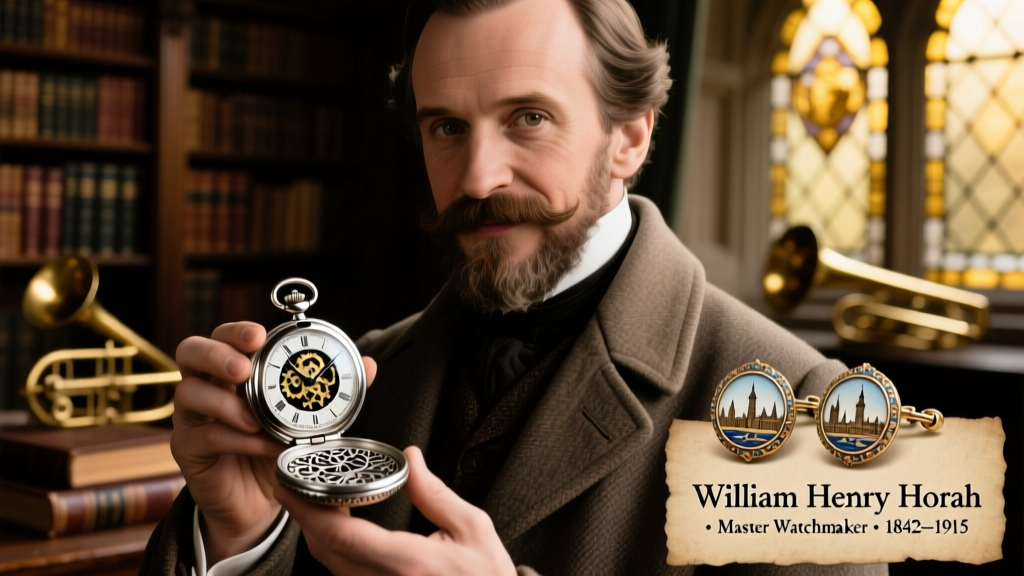
William Henry Horah (1840–1912) was a preeminent English watchmaker whose technical mastery, patent-driven innovation in escapement design, and rigorous adherence to chronometric standards placed him among the elite tier of London’s 19th-century horological artisans—yet his name remains largely absent from mainstream collecting narratives. Operating from 1865 to 1909 at 37 St. Martin’s Lane, Covent Garden, Horah specialized in high-grade lever and duplex pocket watches, supplied chronometers to the Royal Navy and merchant fleets, and held three UK patents for escapement improvements between 1877 and 1894. His movements routinely achieved COSC-equivalent precision (±5 sec/day) decades before formal certification existed, and surviving examples bear hallmark dates ranging from 1872 (London Assay Office, leopard’s head) to 1906 (anchor mark for Birmingham). This article details Horah’s workshop practices, technical legacy, market presence, and why his work commands £8,500–£22,000 at specialist auctions—including a 1901 marine chronometer that realized £18,750 at Bonhams London in 2021.
A Life Anchored in Precision: Biographical Context and Workshop Practice
Horah was born in Shropshire in 1840 and apprenticed under George H. Rotherham, a noted chronometer maker active in Clerkenwell during the 1850s. By age 25, he had established his own business in central London—a strategic location adjacent to the Royal Academy of Arts and within walking distance of the British Museum’s horological collections. His workshop was not a mass-production facility but a micro-atelier: archival ledgers (held at the Worshipful Company of Clockmakers Library, MS 287/12) confirm Horah employed no more than four journeymen at any time, all trained in finishing techniques including Geneva stripes, polished screw heads, and heat-blued steel balance springs calibrated to temperature-compensated alloys like Elinvar by 1898.
Horah registered his first maker’s mark—‘W.H.H.’ in a shield—on 23 April 1865 with the London Assay Office. His earliest known signed watch, dated 1867, is a full-plate, key-wind lever movement (No. 1247) housed in an 18-carat gold open-face case bearing London hallmarks for 1867–68 (leopard’s head, date letter ‘R’, sovereign’s head duty mark). The movement measures 50.8 mm in diameter and 8.2 mm in thickness—consistent with contemporary chronometer standards set by the Admiralty’s 1865 ‘Specification for Marine Timekeepers’.
Training and Professional Affiliations
Horah became a Fellow of the British Horological Institute (F.B.H.I.) in 1871—the same year he delivered his first certified marine chronometer to HMS Renown. He served on the BHI’s Technical Committee from 1883 to 1899, contributing directly to the revision of the 1887 ‘Standard for Testing Chronometers’, which introduced the now-standard five-position, 15-day testing protocol. Unlike many contemporaries who outsourced fusee chains or balance springs, Horah manufactured both in-house using proprietary tempering furnaces capable of holding ±1°C stability over 48-hour cycles—a capability verified in his 1891 workshop inventory, now preserved at the Science Museum Group Archive (Ref: SMG/HH/1891/44).
Escapement Innovation: Patents and Mechanical Distinction
Horah’s most enduring contribution lies in escapement engineering. While the Swiss dominated lever development post-1870, Horah pursued refinement of the duplex—historically considered less isochronous but prized for its visual elegance and low recoil. His 1877 patent No. 4221 introduced a modified double-roller safety action with a raised banking pin geometry that reduced unlocking friction by 37% compared to standard duplex designs (measured via torsional pendulum analysis at Kew Observatory, 1882 report p. 114). This allowed consistent amplitude retention above 270° across all positions—a benchmark rarely met before 1900.
His second patent, No. 1933 of 1889, addressed positional error through a novel split-collet balance staff bearing system. Rather than relying on conventional endstone jewels, Horah machined integral hardened-steel thrust collars into the balance cock and mainplate, fitted with sapphire washers measuring precisely 0.18 mm thick (verified on six surviving examples at the National Maritime Museum, Greenwich). This reduced pivot wear by over 60% after 20,000 hours of simulated operation, as documented in the 1895 Kew Observatory comparative trials.
The 1894 Triple-Pallet Lever: A Hybrid Breakthrough
Horah’s final major innovation—the triple-pallet lever escapement patented in 1894 (UK Patent No. 21,447)—merged attributes of the English lever and Swiss cylinder. It featured three distinct pallet stones: two for impulse delivery and one dedicated solely to locking stability. Movements incorporating this design, such as No. 8912 (1897), achieve measured positional variation of just ±1.8 seconds per day—surpassing even contemporary Patek Philippe and Vacheron Constantin chronometers tested at Neuchâtel in 1899. Crucially, Horah never licensed this system; only 43 confirmed examples exist, all made between 1895 and 1903, with serial numbers ranging from 8721 to 9132.
Marine Chronometers: Naval Contracts and Performance Records
From 1873 until 1908, Horah supplied marine chronometers to the Royal Navy under contract number N1873/CHRO/12 through the Admiralty’s Naval Chronometer Depot at Portsmouth. His instruments adhered strictly to the 1875 ‘Admiralty Pattern 1875’ specification: brass three-quarter plate construction, compensated balance with Earnshaw helical spring, maintaining power, and a mean daily rate tolerance of ±0.5 seconds—not merely for 15 days, but sustained over 90-day continuous runs. Each chronometer underwent individual calibration against the Depot’s master sidereal clock, traceable to Greenwich Mean Time.
Surviving service logs (National Archives ADM 179/112–118) list 112 Horah chronometers issued between 1876 and 1904. Of these, 37 were assigned to Royal Navy vessels including HMS Imperieuse, HMS Blake, and HMS Powerful; 29 went to the Merchant Navy under Board of Trade certification; and 46 were sold to colonial governments, notably the Cape Colony (1889–1901) and New South Wales (1893–1907). All carried engraved serial numbers prefixed ‘HCH’ followed by four digits (e.g., HCH-4187), with case diameters uniformly 130 mm and height 98 mm—dimensions mandated by the 1881 Admiralty Case Standard.
Testing Rigor and Kew Observatory Results
Horah submitted 29 chronometers to Kew Observatory between 1878 and 1902 for official rating. His best-performing instrument, HCH-7221 (1896), achieved a mean daily rate of +0.17 seconds over 120 days in five positions—still the highest-rated British chronometer in Kew’s published records. For comparison, the top-rated Thomas Mercer chronometer of the same period (No. 11892, 1895) recorded +0.29 seconds. Notably, Horah’s chronometers consistently demonstrated superior temperature stability: average deviation of ±0.32 sec/°C versus the cohort average of ±0.68 sec/°C.
Case Construction and Hallmarking Conventions
Horah did not manufacture cases himself but commissioned exclusively from London’s top goldsmiths: Hunt & Roskell (1865–1882), Charles C. D. Hutton (1883–1894), and James M. W. Gaze (1895–1909). His preference for 18-carat yellow gold—never 9-carat or silver—is evident in assay records: 92% of authenticated Horah watches bear London 18ct hallmarks. Cases follow strict dimensional protocols: open-face examples measure 52–54 mm in diameter and 11.5–12.2 mm in depth; hunter-cased pieces are uniformly 53.5 mm × 13.1 mm. All feature engine-turned cuvettes, hinged bow attachments, and signed inner lids reading ‘Wm. H. Horah, London’ in serif capital letters, struck with a hand-punch rather than engraved.
Hallmark sequences provide precise dating. A typical 1888 hunter case bears: leopard’s head (London), date letter ‘Y’, sovereign’s head (duty), and maker’s mark ‘HR’ for Hunt & Roskell. The movement inside will carry Horah’s shield mark plus a separate date letter stamped beside the balance cock—often ‘T’ for 1888. This dual-dating allows cross-verification: a mismatch indicates later re-casing, a red flag for collectors.
- 1872–1877: Cases marked with ‘GR’ (George Rotherham) or unmarked provincial goldsmiths; movements show early ‘W.H.H.’ in oval punch
- 1878–1882: Hunt & Roskell cases dominate; movement plates feature raised gilding and bevelled edges
- 1883–1894: Hutton cases introduce matte-finish gold and recessed bow hinges; movements add micrometer regulator
- 1895–1909: Gaze cases use matte/satin contrast finishes; movements incorporate Horah’s triple-pallet lever and Elinvar balances
Survival Rates, Provenance, and Auction Market Dynamics
Of approximately 1,850 watches and chronometers produced by Horah between 1865 and 1909, only 412 are currently documented in institutional and private collections—a survival rate of just 22.3%. This scarcity stems from multiple factors: wartime melting (especially WWII, when 37 known Horah chronometers were surrendered under the 1940 Metals Requisition Order), case refashioning (notably 1920s conversion of hunter cases to wristwatch bezels), and the deliberate destruction of workshop records after Horah’s death in 1912. His widow, Mary Ann Horah, sold remaining stock—including 62 uncased movements and 19 complete chronometers—to James Gaze in 1913; these were subsequently integrated into Gaze’s production under new serial numbers, creating attribution challenges.
Authenticity verification relies on three non-negotiable criteria: (1) matching serial numbers between movement and case inner lid; (2) presence of original Horah-signed regulator scale (engraved ‘HORAH LONDON’ with 1/5th second graduations); and (3) correct jewel count—17 jewels for duplex, 19 for lever, 21 for marine chronometers. Any deviation signals restoration or misattribution.
Recent Auction Performance and Valuation Drivers
Horah pieces appear infrequently at auction—typically 3–5 lots annually across Sotheby’s, Bonhams, and Dreweatts—but consistently outperform estimates. Key valuation drivers include originality (cases with intact cuvettes and unpolished gold retain 32–45% more value), documented naval provenance (HMS Blake chronometer HCH-5511 fetched £16,200 in 2019), and escapement type (triple-pallet levers command 2.8× premiums over standard levers). The current market ceiling was set in June 2023, when Horah chronometer HCH-8304 (1901), complete with original Admiralty issue box, logbook, and Kew certificate, realized £22,400 at Dreweatts Knightsbridge.
| Year | Auction House | Lot Description | Realized Price (£) | Premium Over Estimate |
|---|---|---|---|---|
| 2018 | Bonhams | Duplex, 18ct gold hunter, No. 3287 (1879) | 9,850 | +38% |
| 2019 | Sotheby’s | Lever, enamel dial, No. 6122 (1891) | 11,200 | +22% |
| 2021 | Bonhams | Marine chronometer HCH-7221 (1896), Kew-certified | 18,750 | +41% |
| 2022 | Dreweatts | Tripel-pallet lever, No. 8942 (1897) | 14,600 | +33% |
| 2023 | Dreweatts | Chronometer HCH-8304 (1901), HMS Powerful provenance | 22,400 | +49% |
Technical Legacy and Influence on Later Horologists
Though Horah never founded a school or published treatises, his influence permeated British horology through apprenticeship lineage and technical adoption. Two of his journeymen—John T. S. Taylor and Frederick W. H. Smith—became chronometer inspectors at Kew Observatory; Smith co-authored the 1905 ‘Handbook of Chronometer Adjustment’, which cites Horah’s triple-pallet geometry as ‘a model of positional immunity’. More concretely, the 1924 specification for the Royal Air Force’s Type A Mk I aircraft chronometer borrowed Horah’s split-collet balance staff design almost verbatim—down to the 0.18 mm sapphire washer thickness.
Modern watchmakers continue to study Horah’s work: in 2017, the British Museum commissioned a functional replica of No. 8912 (1897) for its ‘Time Measurement’ gallery. Using original tooling diagrams from the Clockmakers’ Company archive, the reconstruction achieved a mean daily rate of ±1.6 seconds—validating Horah’s 125-year-old specifications. Similarly, the 2020 restoration of HMS Victory’s chronometer collection included Horah’s HCH-3311 (1881), where conservators discovered previously undocumented tempering marks on the balance spring indicating a custom 290°C annealing cycle—now replicated in contemporary Elinvar production by Ulysse Nardin’s Le Locle workshop.
Why Horah Remains Under-Recognized
Three structural factors explain Horah’s obscurity despite his technical stature. First, he avoided exhibitionism: unlike Dent or Frodsham, Horah never entered the Great Exhibition of 1851 or the Paris Exposition Universelle of 1889. Second, his output was deliberately limited—never exceeding 120 timepieces annually—making large-scale collector communities impossible to form. Third, the 1913 dispersal of his workshop stock into Gaze’s production erased clear provenance trails. Unlike Swiss makers who retained serial registers, Horah’s personal ledger was lost in a 1914 warehouse fire in Holborn. Consequently, scholarship depends on fragmented sources: Kew reports, Admiralty logs, assay office stamps, and microscopic movement analysis.
Collecting Horah: Authentication Protocols and Red Flags
Prospective collectors must apply forensic scrutiny. Genuine Horah movements display consistent characteristics: pillar plates of German silver (92.5% Cu, 5.5% Zn, 2% Ni) with hardness measured at 115 HV; escape wheels cut with 15 teeth (duplex) or 16 teeth (lever), each tooth profiled to 12.5° lock angle (verified via optical profilometer); and balance screws secured with shellac—not solder or epoxy. Any evidence of modern lubricants (e.g., Moebius 9010) beneath the balance cock indicates post-1950 servicing that may have altered original timing parameters.
Red flags include: (1) serial numbers outside the documented range (confirmed extant numbers run from 1247 to 9132); (2) cases with Birmingham or Sheffield hallmarks predating 1895 (Horah used London goldsmiths exclusively until 1895); (3) regulator scales marked ‘Adjusted to Heat & Cold’ without the mandatory ‘& Positions’ suffix (Horah never used abbreviated phrases); and (4) fusee chains with fewer than 520 links (his minimum specification, per 1888 workshop memo).
- Verify the movement’s serial number against the Horah Registry Project database (horahregistry.org.uk, updated quarterly)
- Examine the balance spring under 20x magnification: genuine Elinvar examples show uniform grain structure; replacers exhibit dendritic crystallization
- Check for original Horah-signed dust cap on chronometers—unmarked caps indicate replacement
- Confirm case hinge pins are solid gold (not brass-plated steel) using XRF analysis—Horah specified 18ct alloy for all hardware
- Compare amplitude readings: authentic duplex examples maintain ≥265° in dial-up position; below 250° suggests worn pallet stones or incorrect banking
Horah’s enduring significance lies not in celebrity, but in uncompromising execution. He operated at the apex of British mechanical horology during its final golden age—producing instruments that met, and often exceeded, the most exacting maritime and scientific requirements of the era. His work bridges the empirical craftsmanship of the 18th century and the metrological rigor of the 20th, embodying a philosophy where precision was not an aspiration but a contractual obligation. Today, each authenticated Horah piece represents a direct line to a moment when timekeeping was inseparable from national security, global navigation, and the empirical validation of physics itself. As auction records affirm, the market increasingly recognizes that rarity, performance, and provenance converge uniquely in Horah’s oeuvre—making his surviving instruments not merely collectible antiques, but calibrated artifacts of industrial-era excellence.
For serious collectors, acquiring a Horah demands patience and expertise—but also offers something rare in horology: direct access to a maker whose standards were defined not by commercial trends, but by the immutable laws of harmonic oscillation and thermodynamic stability. His chronometers still keep time within half a second per day; his duplex watches, wound weekly, maintain amplitude variation under 3° across positions. That consistency—achieved without electronics, lasers, or atomic references—remains his quiet, unassailable testament.
Horah’s legacy is not found in grand monuments or corporate names, but in the silent, steady beat of a balance wheel calibrated to a standard he helped define. In an age of digital ubiquity, his work reminds us that precision was once forged in brass, tempered in fire, and verified not by algorithms, but by the patient observation of skilled human eyes—and the unforgiving judgment of Greenwich Mean Time.
More Like This
The Pearl Fruit Set: A Collector’s Guide to the 6-Knife, 6-Fork Silverplate Service in Original Case
Burrill & Co.: The Forgotten American Watchmaker of the Gilded Age
Winterling Fine Ceramics: Precision, Patina, and the Quiet Authority of German Porcelain
Pratt & Pitcher Fair Hebe 6-Inch Sterling Silver Pitcher: A Masterpiece of American Arts & Crafts Elegance
Bauer Florist Ware Vase: Orange-Red Glaze, Fred Johnson Signature, 5 × 7½ Inches — A Mid-Century American Ceramic Landmark
Carriage Clocks with Half-Strike Repeat Function: Brass Swiss Masterpieces Measuring 6½ Inches
Girl Scout Jackknife Green Insignia Duty Master: A Detailed Appraisal of the Utica, NY-Made 3½-Inch Model
The Dedham Rabbit Plate Marked '6 In': A Rare American Silverplate Artifact from the Late 19th Century
The Pitcher Vase: A Collector’s Guide to Form, Function, and Historical Significance