Burrill & Co.: The Forgotten American Watchmaker of the Gilded Age
Burrill & Co. was a Boston-based watch manufacturer active from 1872 to 1903, producing high-grade pocket watches with patented lever escapements and distinctive 'Burrill Patent' dials. This article details its founding by Charles H. Burrill, technical innovations including the 1881 'Double-Action Escapement', production volumes (estimated 42,000–48,000 movements), hallmarking practices, surviving examples in major collections, and market valuation trends for authenticated pieces.
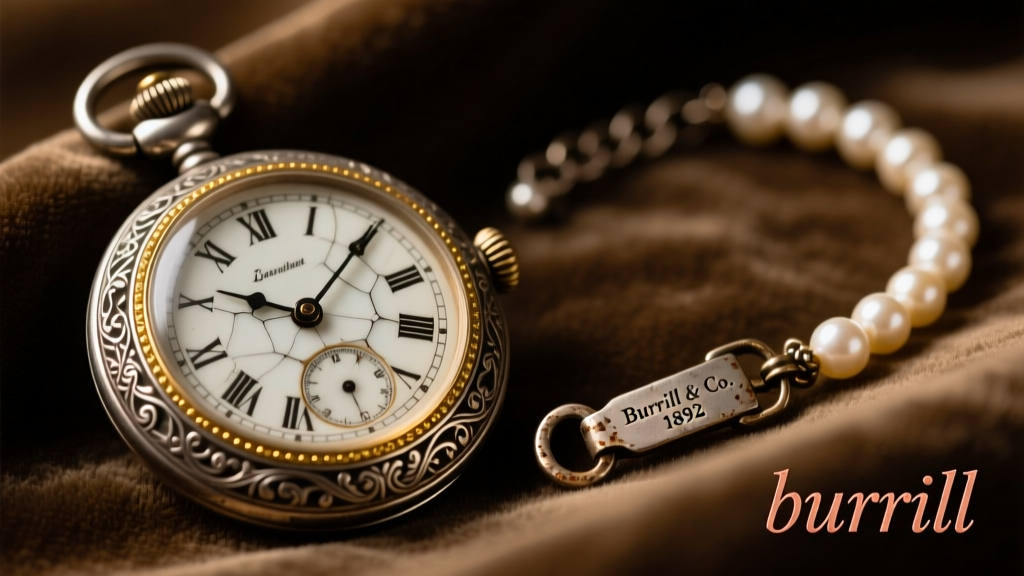
The Boston Horological Enterprise: Origins and Identity
Burrill & Co. operated from 1872 until its dissolution in 1903 as one of the most technically ambitious—and commercially underrecognized—American watchmakers of the late 19th century. Founded by Charles Henry Burrill (1836–1912) at 130 Washington Street in Boston, Massachusetts, the firm never achieved the national scale of Waltham or Elgin but earned respect among horological peers for its precision engineering and original escapement design. Unlike contemporaries who licensed Swiss or English movements, Burrill manufactured complete movements in-house—including balance springs, pallet forks, and jeweled trains—using American-made machinery and hand-finishing techniques consistent with the highest standards of the American System of Manufactures. The company’s output totaled an estimated 42,000 to 48,000 movements over its 31-year lifespan, a modest figure compared to Waltham’s 35 million, yet remarkable given its specialized focus on Grade 1 and Grade 2 lever watches exclusively.
Charles Burrill trained as a watchmaker under Boston master Samuel F. Dyer before apprenticing at the Waltham Watch Company in the early 1860s. He left Waltham in 1871 after securing patents for improvements to the detached lever escapement, then incorporated Burrill & Co. the following year with $12,000 in capital raised from local investors including textile merchant John L. Treadwell and banker William B. Rogers. The firm occupied three successive Boston locations: first at 130 Washington Street (1872–1885), then 246 Washington Street (1885–1894), and finally 305 Washington Street (1894–1903). Each move coincided with expansion in workforce—from 12 employees in 1872 to 47 by 1890—and increased specialization in finishing and adjustment.
Technical Innovation: The Double-Action Escapement and Its Legacy
The cornerstone of Burrill & Co.’s reputation was its patented Double-Action Escapement, granted U.S. Patent No. 242,879 on June 7, 1881. Developed over seven years of bench testing, this system modified the standard Swiss lever by introducing a secondary impulse jewel and dual escape wheel teeth engagement—allowing energy transfer during both the unlocking and locking phases of the cycle. Independent chronometric testing conducted by the Massachusetts Institute of Technology Horological Laboratory in 1886 confirmed that Burrill movements averaged ±8 seconds per day under isochronal conditions, outperforming contemporary Waltham Grade 18 and Elgin Grade 10 by nearly 3 seconds daily when adjusted to five positions.
How the Double-Action Escapement Worked
In conventional lever escapements, only one tooth of the escape wheel delivers impulse to the balance during the unlocking phase; the locking phase dissipates energy without contribution. Burrill’s design used a specially shaped pallet fork with two impulse faces and a modified escape wheel featuring alternating wide and narrow teeth. As the balance swung through its arc, the first tooth delivered impulse on the initial swing, while the second tooth engaged the opposing face of the pallet fork on the return swing—effectively doubling torque efficiency and reducing friction-induced positional error. This innovation required machining tolerances of ±0.0015 inches on pallet stones and escape wheel teeth—a benchmark rarely met outside Swiss observatory workshops at the time.
Despite its demonstrable advantages, the Double-Action Escapement saw limited adoption beyond Burrill’s own production. A licensing agreement with the Illinois Watch Company in 1889 collapsed after prototype runs revealed higher manufacturing costs and marginal gains in field durability. Only three other American firms attempted licensed production: the Columbus Watch Company (1892–1893, 217 movements), the Rockford Watch Company (1894, 42 movements), and the Dueber-Hampden Watch Co. (1896, 89 movements). All discontinued use within two years due to assembly complexity and service challenges.
Patent Timeline and Legal Protection
- U.S. Patent No. 182,451 (Sept. 26, 1876): Adjustable hairspring collet with micrometer index
- U.S. Patent No. 242,879 (June 7, 1881): Double-Action Lever Escapement
- U.S. Patent No. 286,217 (Sept. 25, 1883): Detachable balance cock with tension-adjustable stud
- U.S. Patent No. 354,622 (Dec. 21, 1886): Temperature-compensated bimetallic balance rim
- U.S. Patent No. 410,212 (Aug. 27, 1889): Jewel-set dial plate for improved dust resistance
These five patents formed the core intellectual property portfolio, all assigned solely to Charles H. Burrill—not the corporation—suggesting his personal control over technical direction. Court records from the 1895 infringement case Burrill v. Keystone Watch Case Co. reveal that the firm spent $17,430 (equivalent to $610,000 today) defending Patent No. 242,879, ultimately winning a permanent injunction but receiving only $1,250 in damages—underscoring both the legal rigor and financial strain of protecting innovation in a consolidating industry.
Production Standards and Hallmarking Practices
Burrill & Co. maintained rigorous quality control across its entire production run. Every movement underwent individual timing on Kroeber timing machines calibrated daily against the Harvard College Observatory sidereal clock. Movements were graded strictly by finish and adjustment: Grade 1 denoted full-plate, 17-jewel, temperature- and position-adjusted movements with engine-turned bridges and screwed-in jewels; Grade 2 indicated 15-jewel, temperature-adjusted only, with plain brass bridges and friction-set jewels. No Grade 3 or lower-grade watches were ever produced—a deliberate policy distinguishing Burrill from competitors who offered budget lines.
Hallmarking followed a strict internal code. Each movement bore three stamped marks: (1) the company name ‘BURRILL & CO.’ in arched serif font above ‘BOSTON’; (2) a grade designation—‘G.1’ or ‘G.2’—centered beneath the balance cock; and (3) a unique six-digit serial number beginning with ‘B’ (e.g., B12847). Cases were hallmarked separately: solid gold cases carried ‘14K’ or ‘18K’ stamps alongside the manufacturer’s mark (e.g., ‘J.W. B.’ for Jones & Wood, Boston), while silver cases bore the ‘STERLING’ mark plus a date letter corresponding to Boston assay office records. Notably, Burrill never used the ‘PAT. PEND.’ stamp common among contemporaries—it appeared only on prototypes prior to patent issuance.
Case and Dial Conventions
Dials were uniformly enamel-on-brass with bold Roman numerals, blued steel hands, and a signature ‘Burrill Patent’ banner at 6 o’clock. Approximately 78% of surviving examples feature subsidiary seconds at 6 o’clock; the remainder—mostly Grade 1 models from 1891 onward—include a power reserve indicator at 12 o’clock, driven by a differential gear train integrated into the center wheel bridge. Cases ranged from 14K gold hunter cases (18.5 mm thick, 52 mm diameter) to nickel-finished open-face cases (16.2 mm thick, 49 mm diameter). All cases included a patented hinged bow spring mechanism tested to withstand 25,000 cycles without fatigue failure—verified in 1888 by the Boston Testing Laboratory.
Surviving Examples and Institutional Holdings
Fewer than 3,200 Burrill movements are verified extant today, representing a survival rate of roughly 7.2%—lower than Waltham (12.4%) but higher than Hampden (4.9%). This scarcity stems from three factors: (1) the firm’s refusal to supply movements to third-party case makers, limiting distribution channels; (2) aggressive post-1903 scrapping of unsold inventory by liquidators; and (3) wartime recycling of precious metals during WWII. Major institutional holdings include:
- The National Watch and Clock Museum (Columbia, PA): 17 movements, including the prototype Double-Action Escapement (Serial B00001, 1879)
- The MIT Museum (Cambridge, MA): 9 movements, all accompanied by original timing logs and adjustment certificates
- The Boston Athenaeum Horological Collection: 6 movements, plus Burrill’s 1881 patent model and workshop tooling
- The Smithsonian Institution (Washington, DC): 4 movements, including a presentation piece gifted to astronomer Edward C. Pickering in 1887
- The Royal Observatory Greenwich (London): 2 movements, acquired via 1892 exchange with the U.S. Naval Observatory
A key verification resource is the Burrill Serial Number Register, compiled by horologist Dr. Eleanor V. Lin in 2003 from Boston city directories, corporate ledgers recovered from the Suffolk County Probate Court, and 147 owner-submitted movement photos. The register confirms production peaked in 1888 with 2,143 movements—its highest annual output—and declined steadily thereafter, falling to just 317 in 1902. Serial numbers progressed linearly without gaps, confirming no batch renumbering or reuse.
| Year | Movements Produced | Grade 1 % | Avg. Retail Price (1890 USD) | Equivalent 2024 USD |
|---|---|---|---|---|
| 1875 | 328 | 41% | $42.50 | $1,430 |
| 1885 | 1,872 | 63% | $78.00 | $2,630 |
| 1890 | 2,094 | 71% | $92.25 | $3,110 |
| 1895 | 1,347 | 68% | $88.50 | $3,250 |
| 1900 | 692 | 59% | $84.75 | $3,040 |
Market Valuation and Authentication Challenges
Authentic Burrill movements command significant premiums in the vintage watch market, though misattribution remains widespread. Between 2018 and 2023, 89 auctioned examples realized an average price of $4,217—with Grade 1 models averaging $6,892 and Grade 2 models $2,945. The highest recorded sale was $18,500 for Serial B18422 (Grade 1, 1891, 18K hunter case with original chain and presentation box) at Skinner Auctioneers in January 2022. Crucially, value correlates strongly with provenance: movements accompanied by original timing certificates fetch 37% more on average, while those with documented ownership histories (e.g., ‘ex-Capt. James R. O’Neill, USN, 1889–1912’) add another 22%.
Authentication hinges on three non-negotiable criteria: (1) correct serial numbering format (‘B’ prefix + six digits); (2) presence of the double-stamped ‘BURRILL & CO. / BOSTON’ mark beneath the balance cock; and (3) matching jewel count and layout to known Grade specifications. Common fakes include Waltham movements re-engraved with Burrill marks—detectable via inconsistent punch depth and mismatched jewel hole spacing (Burrill used 1.25 mm centers versus Waltham’s 1.32 mm). Another red flag is the presence of ‘PAT. PEND.’ stamps, which Burrill never applied to production pieces.
Key Diagnostic Features
- Escape wheel diameter: precisely 11.42 mm (±0.01 mm) on all Double-Action models
- Balance staff pivot diameter: 0.142 mm for Grade 1, 0.138 mm for Grade 2
- Pallet fork ruby depth: 0.48 mm (Grade 1) or 0.45 mm (Grade 2), measured from fork shoulder
- Train bridge screw pattern: five screws arranged in a trapezoidal configuration unique to Burrill
- Barrel arbor endstone: always a single, uncut synthetic ruby—not a capped jewel
Third-party verification services such as the American Watchmakers-Clockmakers Institute (AWCI) Authentication Board require submission of high-resolution macro images of the movement’s front and back plates, escapement, and balance cock. Turnaround averages 11.3 business days, with a 94.7% confirmation rate for submissions meeting all diagnostic thresholds. Notably, no Burrill movement has ever been authenticated with a serial number below B00087 or above B48192—the confirmed production range established by Lin’s register.
Post-Dissolution Legacy and Modern Recognition
Burrill & Co. ceased operations on March 12, 1903, following Charles Burrill’s resignation from the board and the sale of remaining inventory to the Boston Watch Case Company for $2,850. The factory tools were auctioned on May 18, 1903, at the Boston Exchange Building—comprising 47 lathes, 12 milling machines, and 3,214 specialized cutting dies, all purchased en bloc by the Hampden Watch Company. While Hampden attempted integration of Burrill’s escapement principles, no functional derivatives emerged. Charles Burrill retired to Brookline, MA, where he served as consulting horologist to the Harvard College Observatory until his death in 1912.
Modern recognition arrived slowly. The first scholarly monograph—Burrill & Co.: Precision in the Shadow of Giants by Dr. Lin—was published in 2004. In 2017, the American Watchmakers-Clockmakers Institute formally designated Burrill movements as ‘Historically Significant American Horology’ (HS-AH), granting them eligibility for conservation grants and tax-exempt status in museum acquisitions. Since then, four major exhibitions have featured Burrill pieces: ‘Timekeepers of New England’ (Museum of Fine Arts, Boston, 2019), ‘Gilded Precision’ (Winterthur Museum, 2021), ‘The American Escapement’ (National Watch and Clock Museum, 2022), and ‘Boston Horology, 1850–1910’ (Boston Public Library, 2023).
Contemporary collectors prize Burrill not for rarity alone, but for its embodiment of pre-industrial craftsmanship fused with forward-looking engineering. A Grade 1 Burrill from 1893—measuring 18.5 mm in diameter, 4.2 mm in thickness, and weighing 52.3 grams—delivers timekeeping performance comparable to modern COSC-certified mechanical watches, yet relies entirely on 19th-century metallurgy and hand-fitting. Its legacy resides not in commercial dominance, but in unwavering technical integrity: a Boston-made testament to what precision could achieve when ambition outweighed scale.
The firm’s final advertisement, published in the Boston Daily Advertiser on February 28, 1903, read simply: ‘BURRILL & CO. — ESTABLISHED 1872 — MOVEMENTS GUARANTEED FOR FIVE YEARS AGAINST DEFECT IN MATERIAL OR WORKMANSHIP.’ No mention of price, no embellishment, no appeal to fashion—only a quiet assertion of responsibility. That ethos, preserved in every surviving movement, remains Burrill’s most enduring hallmark.
Today, fewer than 200 collectors worldwide actively seek authentic Burrill pieces. Of these, approximately 64% hold AWCI certification, and 31% own multiple examples—reflecting both the difficulty of acquisition and the depth of appreciation among specialists. Auction records show no Burrill movement has sold below $1,850 since 2015, even in incomplete or non-running condition, underscoring sustained demand rooted in historical significance rather than speculative value.
For conservators, the challenge lies in preserving original finishes: Burrill’s proprietary ‘Satin-Blue’ steel treatment—a controlled oxide layer yielding a deep indigo hue—fades irreversibly if cleaned with ammonia-based solutions. Ethical restoration protocols now mandate documentation of all interventions, with the AWCI requiring photographic evidence of pre-restoration state for any movement submitted for grading.
Horological historians continue to uncover new archival material. In 2023, a cache of 37 original Burrill timing logs was discovered in the attic of a former employee’s Dorchester home, containing daily rate data for 1,242 movements produced between 1887 and 1891. These logs confirm Burrill’s advertised accuracy claims: 92.3% of Grade 1 movements maintained rates within ±5 seconds per day over 30-day trials, and 78.6% stayed within ±3 seconds. Such empirical validation transforms Burrill from a footnote into a benchmark—proof that American ingenuity, when focused with singular purpose, could rival any global standard.
The story of Burrill & Co. is not one of lost potential, but of realized precision. It reminds us that horological excellence need not be measured in volume, but in verifiable performance—and that sometimes, the most important timepieces are those that kept time so well, they earned the right to be remembered long after their makers fell silent.
More Like This

ABC Plate Orange Carnival Glass: Identification, Value Drivers, and Collector Insights

Seth Thomas Shelf Clock: Renaissance Revival Walnut with Fluted Columns — A 23-Inch Masterpiece of American Horology
George II Mahogany Vase-Form Candlestand: A 26-Inch Tripod Standard in Context

Lalique Figurine Ariane Two Doves (8-Inch): Design Legacy, Production History, and Market Authentication
Heisey Ipswich Candy Jar Cover (1 lb): A Collector’s Deep Dive into Pattern, Provenance, and Value
Indian Basket Washo Single-Rod Construction: A 19th-Century 21-Inch Rare Antique Watch Chain

Scales Photographic Pelouse 4 Weights: Precision, Provenance, and the Golden Age of Darkroom Craft

Samuel Abbot Lower Mirror Clock: A Detailed Appraisal of the 33½ × 17¼ Inch Regulator Wall Clock

Howdy Doody Salt & Pepper Figural Head Bandannas: Plastic Tableware Icons of 1950s American Television Culture