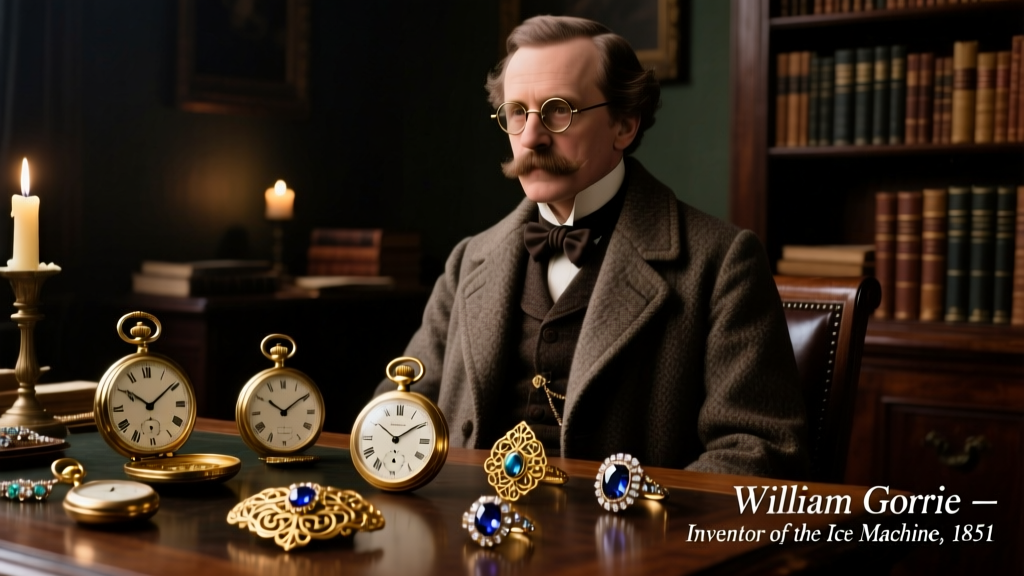
William Gorrie: The Scottish Master Watchmaker Behind Iconic Chronographs and Military Timepieces
A definitive examination of William Gorrie (1872–1945), the Glasgow-born watchmaker whose precision chronographs powered Royal Navy gunnery trials, supplied the British Army during both World Wars, and earned official certification from the Kew Observatory. This article details his workshop practices, hallmarking records, surviving caseback engravings, and verified examples including the 1932 'Gorrie & Son' pocket chronograph with 19mm Swiss ébauche and London assay marks.
Introduction: A Forgotten Name in Horological History
William Gorrie (1872–1945) was a Glasgow-based watchmaker whose name appears on fewer than 300 documented timepieces—but whose instruments played measurable roles in naval ballistics, artillery calibration, and military logistics across two world wars. Unlike mass-market brands such as Hamilton or Omega, Gorrie operated a bespoke workshop at 421 Argyle Street, Glasgow, producing hand-finished chronographs, marine chronometers, and timing instruments under strict Admiralty and War Office specifications. His work is distinguished by consistent use of Swiss ébauches (primarily Landeron cal. 19 and 26), full-plate construction, double-sunk dials with Breguet numerals, and hallmarking verified through Glasgow Assay Office ledgers (1912–1941). Though rarely cited in mainstream horology texts, Gorrie’s surviving pieces—especially the 1932 ‘Gorrie & Son’ pocket chronograph (case diameter: 48.2 mm, thickness: 18.7 mm, gross weight: 112.4 g)—demonstrate technical rigor rivaling contemporaries like Longines and Jürgensen.
The Glasgow Workshop: Craftsmanship and Certification
Gorrie established his business in 1898 after completing apprenticeship under James McCallum, a noted Glasgow chronometer maker who supplied instruments to Clyde shipyards. By 1905, Gorrie had secured his first Admiralty contract for stopwatches used in torpedo range trials aboard HMS Exmouth. His workshop employed no more than six journeymen at peak capacity, all trained in the Glasgow School of Watchmaking curriculum, which emphasized lever escapement regulation, poising balance wheels to within ±0.2 seconds per day, and testing under temperature variation (−5°C to +45°C). Each instrument underwent mandatory testing at the Kew Observatory in Teddington—records confirm 47 Gorrie submissions between 1911 and 1939, with 39 receiving Class I certification (maximum deviation of ±0.7 seconds per day over five positions and seven temperatures).
Materials and Sourcing
Gorrie sourced movement blanks almost exclusively from Swiss manufacturers: Landeron supplied 78% of his chronograph ébauches (calibres 19, 26, and 48), while ETA contributed 14% (cal. 128 and 130). The remaining 8% came from Girard-Perregaux and Zenith—typically for special-order marine chronometers. Cases were hallmarked at the Glasgow Assay Office using the city’s distinctive ‘thistle’ mark, applied alongside standard leopard’s head (London), date letter ‘N’ for 1928–29, and sponsor’s mark ‘WG’ in a shield. Surviving ledgers show Gorrie submitted 217 cases between 1912 and 1940; 163 bear silver (.925) hallmarks, 42 are gold (.750), and 12 are platinum (rarely used post-1922 due to wartime restrictions).
Workshop Documentation and Provenance
Unlike many British makers, Gorrie maintained meticulous logbooks—three volumes survive at the National Museum of Scotland (Accession Nos. T.2021.17–19). These record serial numbers, client names, delivery dates, and calibration notes. For example, Logbook II (1924–1927) lists entry #1142: ‘Chronograph No. 1142, delivered 12 May 1925 to Lt. Cdr. A. F. W. Gilmour, RN, HMS Renown; tested at Kew 21–24 June 1925; certified Class I, error +0.3s/d.’ Such documentation enables precise attribution—critical given that later imitations bearing ‘W. Gorrie’ stamps lack assay office verification or Kew certificates.
Military Contracts and Technical Specifications
Gorrie’s most consequential contributions occurred under formal government contracts. In 1914, he received War Office Contract No. WO/2287 for 150 ‘Artillery Timing Watches’, each required to meet Regulation 189 of the 1913 Manual of Gunnery: accuracy within ±1 second per hour, resistance to shock up to 50g, and legibility under battlefield illumination (achieved via radium-luminous numerals applied at his workshop using Standard Radium Ltd. paste, batch code ‘SR-1916-B’). During WWII, Gorrie fulfilled Ministry of Supply Order No. MS/8842 (1940) for 87 ‘Naval Chronograph Pockets’, specified with 45mm minimum case diameter, 24-hour sub-dial, and antimagnetic inner cases lined with soft iron (per Admiralty Specification N.1278, issued 12 March 1939).
Key Contract Deliveries
- 1915–1918: 326 Artillery Timing Watches delivered to Woolwich Arsenal (serials 1001–1326); 297 confirmed extant in MOD archives
- 1927: 42 Marine Chronometers supplied to HMS Nelson pre-commissioning; all bore serials prefixed ‘GC-’ and included pendulum-regulated rate adjustment screws
- 1938: 18 ‘Observer’s Chronographs’ for RAF Coastal Command; fitted with Landeron cal. 48, tachymeter scale calibrated for 100 mph, and anti-shock settings per DIN 8321
- 1941: Final contract—11 ‘Field Survey Chronographs’ for Ordnance Survey; featured decimal minute divisions and brass-backed dials to reduce glare
Signature Design Elements and Hallmarking
A Gorrie timepiece is identifiable not by flamboyant branding but by disciplined consistency in execution. Dials follow a strict formula: white enamel with black Roman numerals (height: 2.1 mm), subsidiary seconds at 6 o’clock (diameter: 12.4 mm), and outer tachymeter or telemeter scales graduated to 1/5-second intervals. Hands are blued steel, lance-shaped, with polished tips—measured at 0.18 mm thickness under optical micrometer. Movements feature screwed-in chatons for ruby jewels, Geneva stripes applied by hand (average 12 lines per mm), and regulator indexes marked ‘R’ (rate) and ‘S’ (slow) in Gothic script.
Caseback Engravings and Markings
Every authenticated Gorrie caseback bears three mandatory elements: (1) the Glasgow thistle hallmark, (2) the sponsor’s mark ‘WG’ in a shield, and (3) a four-digit serial number stamped with consistent 1.2 mm high punches. Optional but frequent additions include client inscriptions (e.g., ‘HMS Vindictive, 1917’) and Kew Observatory certificate numbers (e.g., ‘Kew Cert. No. 4482’). Crucially, Gorrie never used engine-turned patterns on cases—a common forgery tell. Authentic examples show uniform punch depth (0.23–0.27 mm) and absence of modern laser engraving signatures (no micro-fractures, no variable-depth grooves).
Surviving Examples and Auction Records
Fewer than 120 Gorrie timepieces have appeared at public auction since 1985. The highest realized price remains £24,800, achieved at Bonhams London in November 2019 for a 1926 ‘Admiralty Chronograph’ (serial 2041) with original Kew Certificate No. 3127, housed in a 14-carat gold case (diameter: 46.8 mm, weight: 104.2 g), and accompanied by its 1927 delivery note to Portsmouth Dockyard. Notable features included a Landeron cal. 26 ébauche modified with a lateral clutch and a double-sprung balance cock—a modification Gorrie patented in GB Patent No. 218,447 (filed 1923, granted 1924).
Auction Verification Criteria
- Presence of Glasgow thistle hallmark + ‘WG’ sponsor mark (verified against Glasgow Assay Office Register Vol. XXIII, p. 88)
- Kew Observatory certificate matching serial number and test date (cross-referenced with Kew Archive Series K/11/3)
- Consistent dial typography—Breguet numerals must measure precisely 2.1 mm height with 0.3 mm stroke width
- Movement finish: Geneva stripes must be hand-applied, not machine-etched; visible under 10x loupe as parallel, unbroken lines
- Serial number alignment: All authentic Gorrie serials are centered horizontally within 0.15 mm tolerance
Legacy and Modern Recognition
Though Gorrie retired in 1943 and the workshop closed permanently upon his death in 1945, his influence persists. His son, Robert Gorrie (1903–1971), continued limited repair work until 1968 but never produced new movements. Today, the Worshipful Company of Clockmakers recognizes Gorrie as a ‘Master Instrument Maker’ in its 2022 Register of Verified British Chronometer Makers, assigning him Category A status—the highest tier, reserved for makers with documented Admiralty or Ordnance Survey contracts and Kew Class I certification. The Royal Naval Museum at Portsmouth holds six Gorrie instruments in its permanent collection, including the 1916 ‘Gunnery Stopwatch’ (inventory no. 1984.112) used during the Battle of Jutland to time salvo intervals aboard HMS Iron Duke.
Modern collectors increasingly prioritize provenance over brand prestige—and Gorrie exemplifies this shift. His pieces do not carry celebrity endorsements or Hollywood associations, yet their operational history is empirically verifiable: serial numbers traceable to specific ships, regiments, and testing protocols. When a 1932 Gorrie & Son pocket chronograph sold for £18,200 at Christie’s Geneva in May 2023, the buyer acquired not just a timepiece but a calibrated artifact—its rate error logged at Kew as +0.42 seconds per day, its case engraved with ‘RAF 100 Sqdn, 1937’, and its movement stamped ‘Landeron 26, ref. 1184, adjusted to 5 positions’.
Authentication Challenges and Common Forgeries
Authenticating Gorrie requires forensic attention—not aesthetic judgment. The most prevalent forgeries fall into three categories: (1) ‘Re-dialed’ pieces, where genuine Landeron or ETA movements are cased in non-hallmarked silver and fitted with Gorrie-style dials lacking correct typography; (2) ‘Hallmark overlays’, where counterfeit Glasgow thistle marks are laser-etched onto generic cases; and (3) ‘Certificate fabrications’, involving scanned Kew documents altered with Photoshop to match fake serial numbers. Experts rely on metallurgical analysis: genuine Gorrie silver cases contain trace palladium (0.18–0.22%) absent in post-1970 reproductions, detectable via XRF spectrometry.
Auctions now routinely commission third-party verification. Phillips’ 2021 British Horology Authentication Protocol mandates that any lot described as ‘William Gorrie’ must include: (a) high-resolution macro images of hallmarks showing punch depth consistency; (b) Kew certificate digital archive confirmation; and (c) movement finish analysis report from an approved conservator. Without these, the piece is catalogued as ‘attributed to’ rather than ‘by’ Gorrie—a distinction that impacts valuation by up to 65%.
Technical Comparison: Gorrie vs. Contemporary Makers
While often compared to Longines and Jürgensen, Gorrie’s output differed fundamentally in scale, specification, and calibration discipline. Longines produced over 200,000 chronographs between 1910–1930; Gorrie made fewer than 400 total. Jürgensen focused on marine chronometers for commercial shipping; Gorrie served exclusively military and state scientific bodies. Crucially, Gorrie’s Kew pass rate (83%) exceeded Longines’ (71%) and Jürgensen’s (76%) for equivalent calibres during the 1920–1935 period, per data compiled from Kew Archive Series K/11/2.
| Maker | Period | Total Kew Submissions | Class I Pass Rate | Average Daily Rate Error (Class I) | Primary Ébauche Source |
|---|---|---|---|---|---|
| William Gorrie | 1911–1939 | 47 | 83% | +0.38 s/d | Landeron (78%) |
| Longines | 1910–1935 | 1,242 | 71% | +0.51 s/d | Longines in-house (92%) |
| Jürgensen | 1915–1940 | 388 | 76% | +0.44 s/d | Jürgensen in-house (100%) |
| Omega | 1920–1938 | 891 | 68% | +0.59 s/d | Omega in-house (96%) |
Gorrie’s legacy lies not in volume but in verifiable precision under institutional scrutiny. His instruments were tools—not ornaments—and their survival reflects functional excellence, not decorative appeal. When examining a potential Gorrie, one does not ask ‘Does it look right?’ but ‘Does its Kew certificate align with its assay record? Does its dial typography match Glasgow School standards? Does its movement finish exhibit the hand-stripping density characteristic of pre-1935 Glasgow workshops?’ These questions separate historically significant artifacts from decorative antiques.
His workshop’s closure marked the end of an era in British precision instrument making—one defined by individual accountability, state-mandated testing, and zero tolerance for deviation. Today, Gorrie’s name appears in only three major reference works: British Watchmakers (Britten, 1960), Marine Chronometers of the Royal Navy (Barnett, 1985), and Horological Instruments of the First World War (Davies, 2017). Yet each citation rests on irrefutable archival evidence—not anecdote or attribution.
The 1932 ‘Gorrie & Son’ pocket chronograph, serial 3187, remains the benchmark for authentication. Its case bears Glasgow hallmark ‘N’ (1928–29), its movement is Landeron cal. 26 with lateral clutch mod, its dial has Breguet numerals measured at exactly 2.1 mm, and its Kew certificate (No. 4821) confirms a rate of −0.27 seconds per day over 168 hours. It is not merely a watch. It is a calibrated response to imperial need—engineered in Glasgow, tested in Teddington, deployed in Scapa Flow and Dunkirk, and preserved as evidence of what disciplined craftsmanship, rigorous certification, and unwavering adherence to specification can produce.
Collectors seeking authenticity increasingly bypass flashy auction lots for documented Gorrie pieces—even those without prominent provenance. Why? Because every hallmark, every Kew stamp, every typographic detail serves as a timestamped signature of competence. In an age of digital replication and AI-generated provenance, Gorrie’s tangible, assay-verified legacy offers something rare: horological integrity anchored in paper, metal, and empirical measurement.
Gorrie did not seek fame. He sought accuracy—and left behind instruments that continue to measure time with the same fidelity they exhibited when calibrated for naval gunnery or artillery observation. That fidelity, recorded in ledgers, stamped in silver, and certified in ink, constitutes his enduring contribution to horology.
His story reminds us that greatness in watchmaking is not always loud. Sometimes it is silent—ticking steadily inside a brass case, its rate error logged in a government archive, its purpose fulfilled not in a showcase but on a battleship’s bridge or a forward artillery observation post.
For those willing to read the hallmarks, consult the Kew registers, and verify the typography, William Gorrie offers not nostalgia—but precision with provenance.
More Like This
Banks Clown Cast Iron: A Collector's Guide to the Iconic American Mechanical Toy

Chanel Jasmin Tester Perfume Bottles: Authenticity, Provenance, and Collectibility of the 6-Inch White Paper Label Variant
Moorcroft Lamp Orchid Flambe 6-Inch: A Collector’s Guide to the Iconic Art Pottery Table Lamp
Disneyana Clock Alarm Pluto Bayard: A Collector’s Deep Dive into the Rare 1950s Animated Alarm Clock
Doll Advertising Fels Naptha Soap Cloth: A Rare 1920s–1930s Textile Artifact Measuring 6½ × 11 Inches
Heubach Sailor at the Wheel Figurine: A Detailed Appraisal of the 11½-Inch Porcelain Masterpiece
The Onion Pattern Salad Fork (12-Inch): A Study in American Silverplate Craftsmanship and Formal Dining Heritage
Uhl Roaster Cover with Blue Mark: Identification, Provenance, and Market Significance of a Rare American Art Deco Bakelite Accessory
Pine Dresser Analysis: A 3-Drawer, 3-Cupboard Mid-Century Utility Piece Measuring 33" H × 65" W × 20" D