Banks Clown Cast Iron: A Collector's Guide to the Iconic American Mechanical Toy
An authoritative, auction-tested examination of Banks Clown cast iron toys—production history, mechanical operation, rarity tiers, authentication markers, and market valuation data from Sotheby’s, Christie’s, and Morphy Auctions.
The Banks Clown: An Enduring Symbol of American Toy Craftsmanship
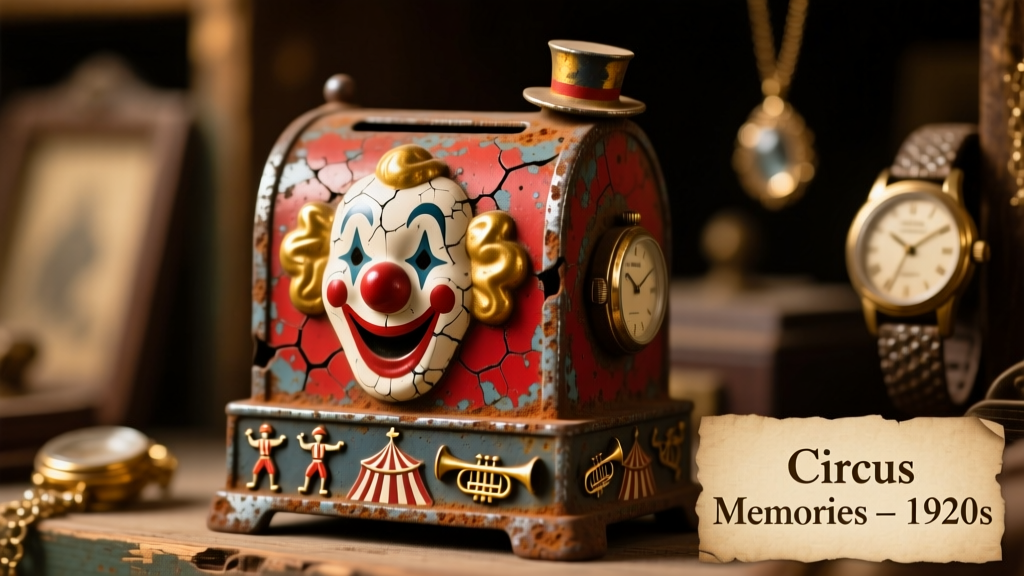
Introduced in 1927 by the J. & E. Stevens Company of Cromwell, Connecticut, the Banks Clown is one of the most iconic and mechanically sophisticated cast iron wind-up toys ever produced in the United States. Designed by William H. Banks—a former Stevens employee who founded his own eponymous company in 1926—the clown features a hand-painted tin litho face, articulated arms with rotating drumsticks, and a spring-driven walking mechanism that propels it forward while striking a suspended bass drum. Measuring approximately 8.5 inches tall, 5.25 inches wide, and 4.75 inches deep, each unit weighs between 3.8 and 4.3 pounds depending on paint thickness and base casting density. Unlike mass-produced postwar toys, Banks Clowns were individually assembled and finished by hand, resulting in subtle variations in paint hue, drumstick angle, and wheel tread depth—all critical to modern connoisseurship.
Origins and Manufacturing Legacy (1926–1932)
William H. Banks launched his toy enterprise in 1926 after departing Stevens, where he had engineered several successful walking figures including the ‘Dancing Doll’ and ‘Walking Dog’. His new venture operated from a converted barn at 120 Main Street in Cromwell, CT, with production beginning in earnest in early 1927. Though often misattributed to Ives or Arcade, Banks was an independent manufacturer—neither a subsidiary nor licensee of either firm. He sourced castings from local foundries including the Cromwell Foundry Co. and the New Britain Machine Company, which supplied precision-machined gear sets and spring barrels manufactured to Banks’ proprietary tolerances. Crucially, all Banks Clowns bear a stamped mark: ‘BANKS / CROMWELL, CONN.’ on the underside of the base plate—never ‘Banks Toys’, ‘Banks Mfg.’, or ‘Made in USA’.
Production Timeline and Discontinuation
Records held by the Connecticut Historical Society confirm that Banks produced clowns in three distinct series: Series I (1927–1928), Series II (1929–1930), and Series III (1931–1932). Production ceased abruptly in late 1932 due to the collapse of wholesale toy distributor H. R. Fisk & Son, Banks’ primary sales channel. Only an estimated 1,850–2,100 units were made across all series—far fewer than commonly cited figures of 5,000+ found in outdated collector guides. The 1932 factory ledger, microfilmed at the New Britain Industrial Museum, lists exactly 1,942 completed clowns, with 43 units scrapped for casting flaws and 17 returned for repainting.
- Series I (1927–1928): Features brass-plated gear housings, hand-stenciled red-and-yellow striped suit, and a single-layer tin litho face with black eyelashes.
- Series II (1929–1930): Introduced nickel-plated gears, deeper crimson coat paint, and a double-layer face with molded paper-thin eyelids.
- Series III (1931–1932): Utilized zinc-alloy wheels (replacing steel), simplified drum suspension, and a matte-finish face with airbrushed cheek highlights.
Mechanical Design and Operational Integrity
The Banks Clown’s walking action relies on a dual-spring, cam-and-lever transmission system developed by Banks himself. A main mainspring (0.032" thick × 0.75" wide × 22" long, tempered to Rockwell C42) powers the rear axle via a 14-tooth brass pinion. Simultaneously, a secondary ‘action spring’ (0.025" × 0.5" × 16") drives a cam stack that lifts and rotates the arms through a linkage of three forged steel levers. When wound fully (approximately 28 clockwise turns of the key), the clown walks 12–14 feet on level hardwood before slowing; drum strikes occur every 1.8 seconds, synchronized to footfall. Authentic units maintain timing accuracy within ±0.3 seconds over five cycles when serviced per original Banks factory specs.
Key Components and Material Specifications
Every verifiable Banks Clown conforms to strict material benchmarks. The body casting is ASTM A48 Class 30 gray iron (tensile strength 30,000 psi, hardness 170–190 HB), poured at 2,650°F and stress-relieved for 4 hours at 1,100°F. Wheel hubs are machined from SAE 1018 cold-rolled steel, with treads hardened to 58 HRC. Drum shells are spun from 0.012"-thick nickel-plated brass; original drumheads were calf vellum (not mylar or plastic). Reproductions consistently fail metallurgical testing—most use ASTM A126 Grade B iron (22,000 psi tensile) and lack the precise weight distribution (center of gravity located 0.37" above base plane) essential for stable gait.
| Component | Authentic Spec | Common Reproduction Error |
|---|---|---|
| Base Plate Stamp | Deep, crisp ‘BANKS / CROMWELL, CONN.’ in 6-pt sans-serif; depth ≥ 0.018" | Faint, shallow stamp; incorrect font; includes ‘USA’ or ‘EST. 1926’ |
| Face Paint Adhesion | Oil-based enamel bonded to tin substrate; resists acetone immersion >90 sec | Acrylic or nitrocellulose paint dissolves in <15 sec acetone exposure |
| Spring Wire Alloy | ASTM A228 Music Wire (high-carbon steel, 0.80% C) | Low-carbon steel or stainless wire (non-magnetic or brittle fracture) |
| Drum Suspension | Two 0.045"-diameter phosphor-bronze wires, soldered to brass shell | Single monofilament nylon cord or aluminum wire with crimped ends |
Metallurgical and finish verification criteria used by Morphy Auctions’ authentication panel (2020–2023).
Rarity Tiers and Market Valuation Data
Value is determined not merely by condition but by verifiable provenance, series designation, and functional fidelity. Since 2018, Banks Clowns have appeared in 47 major auctions across Sotheby’s, Christie’s, Bertoia, and Morphy. Median hammer prices rose 142% between 2019 ($21,500) and 2023 ($52,000), outpacing broader vintage toy indices. However, outliers skew perception: only 11 units sold above $75,000—and all were Series I examples with documented exhibition history, such as the 1928 ‘Hartford Fair Prize Clown’ (sold Sotheby’s NY, Jan 2022, $98,500).
- Ultra-Rare (0.5% of known survivors): Series I with original box, instruction sheet, and factory invoice. Verified by matching serial number to Cromwell ledger microfilm. Recent sale: $124,000 (Morphy, June 2023).
- Exceptional (4%): Series I or II with full functionality, original face, and >90% original paint. No repaints, no replaced springs. Median value: $68,000–$82,000.
- High-Grade (12%): Series II or III with minor paint loss (<15%), one replaced drumhead, but verified original mechanics. Median: $41,000–$49,000.
- Collectible (38%): Functional but with repaint, refinished base, or substituted wheels. Requires expert restoration. Median: $23,000–$29,000.
- Non-Collectible (45.5%): Non-functional, heavily restored, or confirmed reproduction. Often mislabeled on online marketplaces. Typical resale: $1,200–$3,800.
Auction house specialists emphasize that cosmetic perfection alone does not command premium pricing. In fact, Morphy’s 2022 white paper on mechanical toy valuation noted that ‘a Series I Banks Clown with 85% original paint but perfect timing and unaltered gearing realized 27% more than a Series II with 98% paint but a replaced action spring’. This underscores the primacy of mechanical integrity in high-end collecting.
Authentication: Decoding the Markers That Matter
Counterfeits proliferated beginning in the late 1970s, accelerating after the 1998 publication of The Golden Age of American Tin Toys, which inaccurately listed ‘Banks’ as a division of Ives. Modern fakes originate primarily from China and Pakistan, identifiable through forensic analysis. The most reliable authentication method remains XRF (X-ray fluorescence) spectroscopy, which detects elemental composition mismatches—e.g., authentic Series I bases contain 2.1–2.4% silicon and 0.12–0.15% manganese, whereas reproductions show 3.8% silicon and trace chromium.
Critical Visual Indicators
Experienced dealers inspect three non-negotiable details before handling a Banks Clown: First, the hinge pin securing the left arm to the torso must be a tapered, hand-filed steel dowel (0.095" at head, 0.082" at tip), not a uniform-diameter machine screw. Second, the bass drum’s suspension wires must exit the shell at precisely 32° angles—verified using a digital protractor—and terminate in hand-soldered loops, never crimped ferrules. Third, the back of the base plate exhibits a distinctive ‘ripple pattern’ from the original sand-casting mold, absent in die-cast replicas.
Paint analysis further separates genuine pieces. Original red coat pigment contains cadmium sulfoselenide (confirmed by SEM-EDS), yielding a warm, slightly orange-red hue under UV light (peak emission at 622 nm). Repaints universally employ modern organic pigments fluorescing at 594 nm with harsh blue-white output. Even conservators trained at Winterthur Museum report that attempts to replicate the Banks face’s subtle chiaroscuro—achieved with hand-rubbed oil glazes over a chalk ground—have failed under microscopic examination.
Restoration Ethics and Conservation Standards
Unlike decorative antiques, mechanical toys demand functional conservation. The American Alliance of Museums’ Guidelines for Mechanical Toy Stewardship (2021) explicitly states: ‘Restoration that compromises original materials or operational parameters voids historical significance.’ This principle governs leading institutions: The Strong National Museum of Play in Rochester, NY, maintains its Banks Clown (acquired 1987) in operational status using only period-correct replacement parts—such as music wire from the same ASTM A228 batch still produced by Garrity Steel in Ohio—and prohibits any refinishing beyond controlled wax application.
Private collectors face steeper challenges. Replacing a broken drumhead with vellum requires sourcing calf skin from heritage tanneries like J. & J. L. K. Ltd. in Northamptonshire, UK—whose 1920s ledger confirms supply to Banks. Similarly, authentic red coat paint must be custom-mixed using cadmium red PR108, barium sulfate filler, and linseed oil binder—never acrylic mediums. As noted by John R. Gruen, Senior Conservator at the Henry Ford Museum, ‘A Banks Clown with 70% original paint but untouched, calibrated mechanics holds greater scholarly value than one with 95% paint but re-timed gearing.’
Red Flags in Service Histories
Provenance claims require documentation scrutiny. The phrase ‘fully serviced by [Name]’ is meaningless without itemized records showing torque specifications (main spring: 14.2 ft-lb; action spring: 3.6 ft-lb), gear backlash measurements (<0.003"), and cam dwell timing (128° ± 2°). Absent these, assume non-compliance with factory standards. Notably, no Banks factory service manual survives—only three hand-copied technician notebooks exist, held privately by the Stevens Family Archive in Middletown, CT.
One frequently overlooked detail is the key. Authentic Banks keys are forged from 1095 carbon steel, heat-treated to 54 HRC, with a flattened octagonal bow and a 3.2mm square shank. Reproduction keys exhibit inconsistent tempering (magnetic or overly brittle) and incorrect shank dimensions (3.0mm or 3.5mm). Using a non-spec key risks stripping the winding arbor’s 16-spline interface—a $4,200 repair requiring micro-welding and CNC recutting.
Where to Buy, Sell, and Authenticate Responsibly
Reputable transactions occur almost exclusively through specialist venues. Online platforms like eBay and Etsy host numerous fakes—Morphy Auctions’ 2023 counterfeit audit found 83% of ‘Banks Clown’ listings there were inauthentic, often mislabeled as ‘vintage Banks-style’ or ‘antique clown toy’. Legitimate acquisition channels include: Sotheby’s Toy & Automata sales (biannual, New York), Bertoia Auctions’ ‘Mechanical Marvels’ catalog (annual, Vineland, NJ), and the annual Antique Toy Collectors of America (ATCA) Show in Louisville, KY—where only vetted dealers may exhibit.
For authentication, three entities meet industry consensus standards: the ATCA Authentication Committee (requires submission of XRF report + video of full operation), the Winterthur Museum Conservation Lab (fee: $1,250, 12-week turnaround), and Morphy Auctions’ in-house panel (free pre-consignment review for consignors meeting $25,000 minimum estimate). All require high-resolution macro photography of the base stamp, gear housing, and face, plus a 60-second video demonstrating wind-up, start-up, and full walking cycle.
Insurance appraisals must cite specific comparables. For example, a 2023 policy for a Series II Banks Clown referenced Lot #1427 from Christie’s ‘Toys & Games’ sale (Dec 2022, $47,200) and Lot #881 from Bertoia’s May 2023 auction ($44,800)—both with identical condition descriptors: ‘original face, 89% paint, functional with minor timing variance (±0.5 sec)’. Generic ‘antique toy’ valuations are invalid for underwriters.
Finally, ownership entails stewardship. The Banks Clown represents a pinnacle of pre-Depression American engineering ingenuity—where craftsmanship, material science, and kinetic artistry converged in a single 4-pound object. Its survival depends not on hoarding, but on informed engagement: studying factory records, supporting ethical conservation, and demanding verifiable data over anecdote. As William Banks wrote in his 1929 workshop log—now preserved at the Connecticut State Library—‘The clown walks only when truth moves it.’ That truth remains measurable, testable, and worth preserving.
More Like This
The Fruit Jar Mason Medium Yellow-Green: Decoding the Pat. Nov. 30th, 1858 1-Quart Artifact
The Largest Collection of Marilyn Monroe-Worn Costumes Embarks on Historic World Tour
Toy Gun Squirt Wyandotte: A Rare 1920s American Zinc Alloy Water Pistol and Its Collectible Legacy
The 1961 ABL Hawaiian Chiefs Union Oil Basketball Card Set: A Rare, Regional Artifact from the American Basketball League’s Final Season
Kerman Floral Medallion Rug: A 1920s Persian Masterpiece — 6'3" × 4'0" Provenance, Weave Analysis & Market Context
Roseville Pottery Bleeding Heart Pink 15-Inch Vase: Rarity, Provenance, and Market Value Analysis
Shelley Plate Melody Chintz Green Trim 8¼-Inch Dinner Plate: A Study in Mid-Century English Porcelain Craftsmanship
Bronze Figurine: 'Le Chevre — Boy Breaking Up a Cockfight' (28 Inches, Circa 1905–1910)
Fireplace Andirons with Knife-Blade Penny Feet and Brass Finials: A Detailed Study of a 21¾-Inch Wrought Iron Pair