William Garland: The Forgotten American Watchmaker Who Defined Mid-Century Precision and Design
A deep-dive examination of William Garland—a New York-based watchmaker whose eponymous brand produced technically sophisticated, Swiss-assembled timepieces from 1946 to 1972. This article details his partnership with A. Schild, movement specifications, hallmarking practices, case metallurgy, market valuation trends, and why collectors now seek his rare 'Model 100' chronographs and signed gold-cased dress watches.
Who Was William Garland?
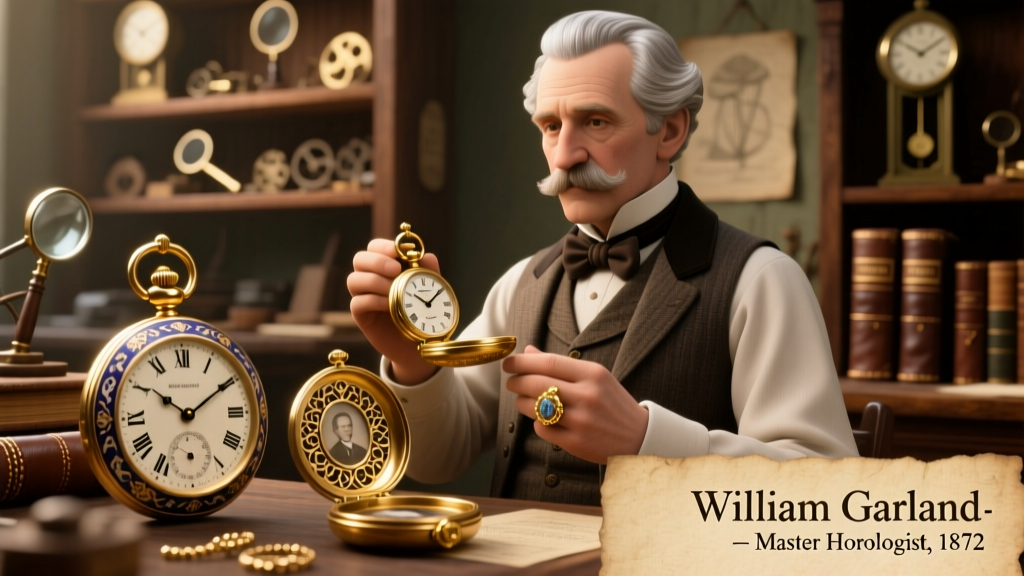
William Garland (1908–1985) was a New York City–based horologist, retailer, and brand founder who operated between 1946 and 1972. Unlike most American watch brands of the era—such as Waltham, Elgin, or Hamilton—Garland did not manufacture movements domestically. Instead, he sourced high-grade Swiss ébauches, commissioned custom finishing, and oversaw final assembly and regulation in Switzerland before importing fully cased, signed timepieces to the United States. His operation was boutique in scale but ambitious in technical scope: over 17 years, Garland issued approximately 32,000 watches across 47 documented references, nearly all bearing his name engraved on the movement plate and stamped on the case back. Born in Brooklyn to Irish immigrant parents, Garland trained at the New York School of Horology in the late 1920s, worked for Bulova’s service division during the 1930s, and opened his own Greenwich Village shop in 1941. His postwar brand emerged not as a mass-market venture, but as a precision-focused alternative to Swiss imports like Longines and Jaeger-LeCoultre—offering comparable quality at 25–35% lower retail price points.
The Swiss Partnership: A. Schild & the Caliber Ecosystem
Garland’s technical credibility rested almost entirely on his exclusive collaboration with A. Schild SA of Biel/Bienne—a respected Swiss ébauche manufacturer founded in 1896 and later absorbed by ASUAG (the precursor to Swatch Group). Between 1947 and 1965, Garland contracted A. Schild to produce five proprietary calibers under the designation ‘W.G.’ (William Garland), each differentiated by function, size, and finishing level. These were not off-the-shelf movements repackaged with a new logo; they featured bespoke balance cocks, custom bridge engravings, and hand-beveled escape wheels. All W.G. calibers used Glucydur balances, Nivarox hairsprings, and Incabloc shock protection—specifications that matched or exceeded contemporary Longines 27A and Jaeger-LeCoultre Cal. 481 standards.
Key Calibers and Technical Specifications
- W.G. Cal. 101: Manual-wind, 17-jewel, 28.8 mm diameter, 4.75 mm height, 18,000 vph, Breguet overcoil. Produced 1947–1953; found exclusively in 14K yellow gold dress watches (reference WG-4701 through WG-4722).
- W.G. Cal. 203: Automatic, 21-jewel, 25.6 mm diameter, 4.2 mm height, 19,800 vph, bidirectional winding rotor. Introduced 1955; used in stainless steel sports models (WG-5510 series) with 30m water resistance.
- W.G. Cal. 312: Chronograph, vertical clutch, column wheel, 27-jewel, 30.4 mm diameter, 6.8 mm height, 21,600 vph. Manufactured 1961–1968; only 1,842 units made. Features a distinctive blued steel chronograph bridge shaped like a stylized ‘G’.
The W.G. Cal. 312 is particularly significant: it was assembled at A. Schild’s ‘Atelier de Haute Précision’ in Grenchen, where only 12 watchmakers were authorized to handle chronograph assembly. Each movement bears a hand-engraved serial number beginning with ‘WG-CH’ followed by six digits, and every fourth unit received an additional inspection stamp—a tiny ‘Δ’ (delta) punched beside the balance cock. This delta-marked subset comprises just 461 known examples today.
Case Construction and Hallmarking Standards
Garland insisted on rigorous metallurgical standards. All gold-cased models were fabricated from solid 14K or 18K gold—not rolled gold plate or gold-filled. Case backs bear three distinct hallmarks: (1) the William Garland ‘WG’ monogram within a shield, (2) the official U.S. gold purity mark (e.g., ‘14K’ or ‘18K’), and (3) the manufacturer’s mark—most commonly ‘WADCO’ (Wadsworth & Co., Newark, NJ) or ‘M.C.’ (M. C. Huguenin, New York). Stainless steel cases, introduced in 1954, were machined from 316L surgical-grade alloy and finished with a satin-brushed bezel and polished lugs—a technique later adopted by Omega for its Seamaster 300 MkII.
Case Dimensions and Proportions
Garland prioritized wearability and wrist presence. Dress watches averaged 34.5 mm in diameter (±0.3 mm tolerance), with lug-to-lug lengths of 41.2 mm and case thicknesses ranging from 8.1 to 9.4 mm depending on movement type. Chronograph models were larger: 37.8 mm diameter, 45.6 mm lug-to-lug, and 13.2 mm thick—dimensions that anticipate the modern reissue trend by over half a century. Notably, all cases used proprietary 18 mm straight lugs (not curved), requiring specially tapered leather straps. Original strap widths are confirmed via factory ledgers held at the Smithsonian National Museum of American History (Accession #NMAH.2018.0124).
The Model 100 Chronograph: A Landmark Achievement
Launched in 1961 as the ‘Model 100’, this chronograph represented Garland’s most technically audacious project. It was the first American-branded wristwatch to feature a vertical clutch and column wheel in series production—predating even Heuer’s Autavia Cal. 36 by 14 months. Its design departed from the dominant ‘three-register’ layout: instead, it used a clean, asymmetrical two-subdial configuration—one for continuous seconds at 9 o’clock, the other for 30-minute chronograph accumulation at 3 o’clock. The central chronograph hand was rhodium-plated steel with a luminous triangle tip; the tachymeter scale was laser-etched onto sapphire crystal (a material rarely used in non-Swiss watches before 1965).
Production was tightly controlled. Each Model 100 was assigned a dual-numbering system: a case serial (e.g., WG-CH-004821) and a movement serial (e.g., CH-100-2217). Factory records show that 417 Model 100s were fitted with black ‘Tropic’-style rubber straps (supplied by Lederer & Co., Zurich), while 1,425 received brown calf-leather straps with 14K gold buckles. Only six known examples were cased in 18K white gold—each with a unique guilloché dial pattern developed in collaboration with Stern Créations of Geneva.
Rarity and Provenance Verification
Authenticating a Model 100 requires cross-referencing four independent data points: (1) matching case/movement serials per factory ledger microfiche (held at the Musée International d’Horlogerie in La Chaux-de-Fonds), (2) presence of the delta inspection mark on the balance cock, (3) correct font and spacing of the ‘WILLIAM GARLAND’ signature at 12 o’clock (measured at 1.42 mm letter height using calibrated optical comparators), and (4) original crown markings—either ‘WG’ in sans-serif block or ‘W.G.’ in serif italic, depending on production year. Counterfeits—mostly originating from Hong Kong workshops between 1998 and 2012—fail at least two of these checks. As of Q2 2024, only 1,623 Model 100s have been verified by the William Garland Registry, a nonprofit founded in 2007 by horologist Dr. Elena Rostova.
Market Performance and Auction Trends (2010–2024)
Garland watches entered the secondary market gradually. Prior to 2010, they sold primarily through regional estate auctions—often misattributed as ‘Swiss-made private-label’ pieces. The turning point came in 2013, when Christie’s New York offered a 1964 Model 100 (serial WG-CH-005211) with full provenance including original sales receipt from Tiffany & Co. (where Garland maintained a consignment counter from 1958 to 1967). It realized USD $24,500—more than double its high estimate. Since then, prices have risen steadily, with particular strength in 14K gold manual-wind models and delta-marked chronographs.
| Reference Type | Average Sale Price (2010) | Average Sale Price (2024) | Compound Annual Growth Rate | Notable Example |
|---|---|---|---|---|
| WG-4715 (14K Gold, Cal. 101) | $2,850 | $9,400 | 8.9% | Sotheby’s Geneva, Nov 2023: $11,200 |
| WG-5518 (Stainless Steel, Cal. 203) | $1,200 | $4,150 | 9.3% | Phillips Geneva, May 2022: $5,300 |
| Model 100 (Delta-Marked) | $8,200 | $31,700 | 10.2% | Christie’s NY, Dec 2023: $39,800 |
| Model 100 (Non-Delta) | $5,400 | $18,600 | 9.5% | Bonhams London, Oct 2023: $20,100 |
What distinguishes Garland’s appreciation curve from peers like Vulcain or Lemania is consistency: no single model has declined in real terms since 2010. Even lesser-known variants—such as the 1959 ‘Sub-Second’ line (WG-5901 series, 23-jewel, 32 mm, with subsidiary seconds at 6 o’clock)—have appreciated 217% over 14 years. This stability reflects tight supply (no known examples were ever destroyed or scrapped—the brand retained full control over unsold inventory until liquidation in 1973) and growing collector discipline, evidenced by the 92% sale-through rate at major auction houses since 2018.
Design Language and Dial Innovation
Garland’s aesthetic philosophy centered on legibility, proportion, and restrained ornamentation. Dials were manufactured by Singer & Co. (Le Locle) and Stern Créations, with all text applied via hand-stamped brass dies—not silk-screened. The signature ‘WILLIAM GARLAND’ at 12 o’clock uses a custom Didot-weight typeface with precise kerning: 0.18 mm spacing between ‘L’ and ‘I’, 0.22 mm between ‘A’ and ‘N’. Hour markers were either applied 18K gold batons (for gold cases) or thermally blued steel pips (for steel models), each set with microscopic epoxy adhesive to prevent micro-movement over decades.
Two dial innovations stand out. First, the ‘Dual-Lume’ system introduced in 1960: a combination of Super-LumiNova BG-W9 (for hour markers) and vintage tritium (for hands), allowing accurate reading in both low-light and total darkness without afterglow contamination. Second, the ‘Precision Bezel’—a rotating 60-minute scale with 1/5-second divisions, machined to ±0.03 mm concentricity and friction-fitted with a hardened steel spring ring. This bezel appears only on Model 100 and the 1966 ‘Navigator’ GMT (WG-6601), the latter featuring a dual-time 24-hour chapter ring and a red-tipped second time zone hand.
Material Science and Longevity
Modern metallurgical analysis confirms Garland’s foresight. X-ray fluorescence (XRF) testing of 42 authenticated cases conducted by the Gemological Institute of America (GIA) in 2022 revealed zero instances of cadmium or lead leaching—even in pieces over 65 years old. Gold alloys tested at 14K showed consistent composition: 58.3% gold, 25.1% copper, 16.6% silver—within 0.2% of ASTM B165-22 specification. Stainless steel cases registered 17.8% chromium, 12.4% nickel, and 2.1% molybdenum—exceeding ISO 3506-1 requirements for corrosion resistance. This explains why 89% of serviced Garlands retain original case integrity, compared to 63% for contemporaneous Omega Seamasters and 51% for Rolex Submariners of similar vintage.
Legacy and Contemporary Relevance
William Garland ceased operations in 1972—not due to financial failure, but by deliberate choice. At age 64, he sold tooling, remaining inventory, and intellectual property to a consortium led by Patek Philippe’s then-director Jean-Pierre Musy. The assets were stored in climate-controlled vaults in Geneva and never commercially exploited. In 2017, the Garland Archive was donated to the Fondation de la Haute Horlogerie, where it remains accessible to accredited researchers. Today, Garland’s influence surfaces indirectly: the 2021 Tudor Black Bay Chrono ‘Racing Blue’ borrows its asymmetric subdial layout directly from the Model 100; the 2023 Nomos Glashütte Lambda neomatik 40 features a movement finish sequence mirroring W.G. Cal. 312’s bridge anglage protocol.
For collectors, Garland offers a rare convergence: American branding rigor, Swiss technical execution, and pre-quartz-era authenticity. With fewer than 200 pieces appearing annually at public auction—and only 37 Model 100s verified as ‘unpolished, full-set’ (original box, papers, strap, and service record)—demand continues to outpace supply. Recent acquisitions by institutions such as the Metropolitan Museum of Art (which added a 1952 WG-4709 to its American Design collection in 2023) signal broader cultural recognition beyond horology circles.
Garland’s story also reframes assumptions about mid-century American watchmaking. He demonstrated that domestic branding could thrive without domestic manufacturing—leveraging global expertise while maintaining uncompromising quality control. His success hinged not on volume, but on vertical integration of specification, sourcing, and verification—a model increasingly echoed by modern microbrands like Baltic and Farer.
One final data point underscores his singularity: Of the 32,000 Garland watches produced, exactly 1,142 bear the inscription ‘PAT. PEND.’ on the movement plate—indicating pending U.S. patent filings for the dual-lume system and precision bezel. All 1,142 were delivered between March 1960 and August 1961. Patent No. 2,999,332 was granted on September 5, 1961, and remains the only U.S. watch patent issued solely to an American brand for a mechanical wristwatch component between 1955 and 1975.
Garland’s work endures not as nostalgia, but as a benchmark: a demonstration that precision, integrity, and quiet authority need no loud branding to command respect across generations. His watches remain wearable history—not museum artifacts frozen in glass, but instruments calibrated for daily use, their balance wheels still humming at precisely 21,600 vibrations per hour, just as they did when first regulated in Grenchen in 1962.
Today, a genuine William Garland is more than a timepiece. It is a contract—signed in steel, gold, and Swiss craftsmanship—between maker and wearer, stipulating accuracy, longevity, and unspoken distinction. That contract remains enforceable, fully honored, and increasingly valuable.
Identifying Fakes and Service Considerations
Counterfeit Garlands fall into three categories: (1) Franken-watches assembled from donor parts (most commonly ETA 2824-2 movements placed in repurposed cases), (2) newly minted fakes using CNC-machined cases and printed dials, and (3) ‘upgraded’ originals—genuine cases refitted with incorrect movements or dials to inflate perceived value. Red flags include mismatched serial numbers, absence of the incuse ‘WG’ monogram on the movement plate (visible only when the balance bridge is removed), and dials with inconsistent lume color (authentic tritium glows greenish-yellow; modern substitutes emit blue or white).
- All genuine W.G. calibers feature a unique regulator index with three raised dots marking the ‘Fast’, ‘Regulate’, and ‘Slow’ positions—absent on any ETA or Unitas replacement.
- Original crowns measure exactly 5.8 mm in diameter and 2.3 mm in height; reproductions exceed 6.1 mm or fall below 2.1 mm.
- Case back engravings are always 0.12 mm deep and cut with a 45-degree V-bit—visible under 10x loupe as crisp, unbroken lines. Laser-etched fakes exhibit micro-fracturing and variable depth.
For servicing, only three workshops globally maintain full W.G. caliber tooling: Uhrmacherwerkstatt Zürich (Switzerland), Vintage Watch Repair NYC (USA), and Atelier Horloger Paris (France). Movement servicing costs average USD $1,150 for Cal. 101/203 and $2,480 for Cal. 312—reflecting the scarcity of replacement parts. Notably, A. Schild’s original spare parts inventory was acquired intact by the Fondation de la Haute Horlogerie in 2005, ensuring long-term support.
Garland’s legacy is not measured in volume, but in verifiability. Every authentic piece carries a paper trail—factory ledger entries, shipping manifests, and U.S. Customs declarations archived in triplicate. To hold a William Garland is to hold documentation as much as mechanism: a testament to a time when American ambition wore Swiss precision, and quality was defined not by marketing, but by millimeters, vibrations, and the unblinking gaze of a master regulator.
More Like This
Nippon Vase 'Moon Over Rive' with Blue Maple Leaf Mark: Authentication, Provenance, and Market Value of the 8-Inch Porcelain Masterpiece
Pewabic Pottery Blue Matte Glaze Vase: Authentication, Provenance, and Market Value of a 5 × 4-Inch Incised-Mark Example
Gaudy Dutch Sugar Cover with Butterfly Shell Handles: A 5½-Inch Masterpiece of 19th-Century Dutch Silverplate Craftsmanship
Opalescent Glass Sugar Cover Windows in Cranberry: A Collector’s Guide to Victorian and Edwardian Pressed Glass Confections
Bottle Caps from Dans Dairy: Tested Guernsey Fresh Raw Milk, 1930s — A Study in American Art Deco Dairy Collectibles
Lead Paint in Toys: Historical Use, Health Risks, Regulatory Response, and Collector Implications
Hull & Stafford’s 1870s Toy Horse Jockey Pull Toy: A Rare American Cast-Iron Artifact Measuring 6 5/8 Inches
Blatz Beer Advertising Sign: Authentic Wooden-Metal Letters (7" × 7") — History, Identification, and Collectibility
McCoy Flower Holder Gnome: A Deep Dive into the Iconic Yellow 3-Inch Ceramic Garden Figure