Lladró: The Artistry, Legacy, and Collectibility of Spain’s Premier Porcelain House
A detailed exploration of Lladró—founded in 1953 in Valencia, Spain—covering its founding by the Lladró brothers, signature techniques like hand-painted 'Lladro Blue' glazes and triple-firing processes, hallmark evolution (1957–present), iconic lines including 'The Angels' and 'Fairy Tale', market trends at Sotheby’s and Bonhams, and key authentication metrics including base stamps, weight ranges (e.g., 'The Kiss' at 2.4 kg), and comparative valuation data.
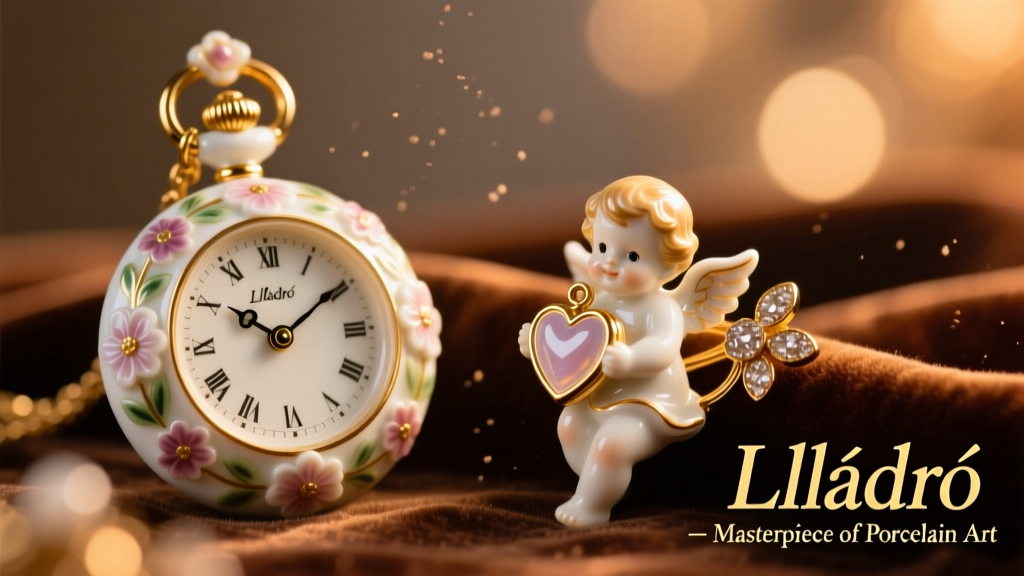
Origins and Founding Vision: From Valencia Workshop to Global Icon
In 1953, three brothers—Juan, José, and Vicente Lladró—converted a disused rice mill in the village of Almàssera, near Valencia, Spain, into a porcelain studio. With no formal ceramic training but deep reverence for Renaissance sculpture and Viennese porcelain traditions, they began experimenting with local clay, coal-fired kilns, and rudimentary molds. Their first commercial piece, La Niña de la Cesta (The Girl with the Basket), debuted in 1956 and sold for 300 pesetas—roughly €1.80 today. By 1957, the company registered its first official hallmark: an incised blue ‘N’ (for Nao, their early studio name) beneath a crown. This modest beginning belies the extraordinary trajectory: Lladró would grow into one of the world’s most recognized luxury porcelain brands, operating 120+ boutiques across 70 countries and producing over 3,500 unique models between 1957 and 2023.
The Lladró brothers’ philosophy centered on craftsmanship as moral discipline: each figure required 12–16 weeks of labor, involving up to 20 artisans. Unlike mass-produced ceramics, Lladró pieces were—and remain—exclusively cast from original plaster molds created from hand-sculpted clay models. No two molds were ever duplicated; when production ended for a model, the mold was destroyed. This policy, enforced since 1971, underpins both scarcity and collectibility. The company’s commitment to material integrity is equally rigorous: only kaolin-rich white clay from Limoges, France, and Cornish stone from England is used—never recycled porcelain—and every batch undergoes spectrometer analysis for iron oxide content (max 0.03% to ensure pure whiteness).
The Technical Foundation: Triple-Firing and Hand-Painting
Lladró’s technical distinction lies in its proprietary triple-firing process. First, greenware is fired at 980°C to achieve bisque hardness (Shore D hardness ≥ 65). Second, after glazing—using lead-free feldspathic glazes developed in-house—the piece enters a 1,280°C reduction kiln for vitrification. Third, after hand-painting, it receives a final 780°C luster firing that fuses pigments into the glaze surface without blurring fine detail. This third stage enables the luminous depth seen in pieces like La Danza (1984), where translucent cobalt blue drapery appears to float above ivory skin.
Hand-painting remains non-negotiable: even today, all figures are painted by artisans trained for a minimum of five years at the Lladró Academy in Tavernes Blanques. Brushes used contain sable hair with tips measuring 0.12 mm—finer than human hair (0.15–0.18 mm). A single angel wing may require 37 distinct brushstrokes using six pigment dilutions. The signature ‘Lladro Blue’—a custom cerulean formulated in 1968—contains cobalt aluminate suspended in a barium titanate matrix, yielding chromatic stability across all firing cycles.
Evolution of the Hallmark: Decoding Authenticity
Authenticating Lladró requires precise knowledge of hallmark progression—not just design, but placement, color, and substrate. Between 1957 and 1974, marks were incised or stamped in cobalt blue ink onto unglazed biscuit bases. From 1975 onward, marks shifted to underglaze blue transfer printing, applied before the second firing. In 1990, the company introduced micro-engraved serial numbers visible only under 10x magnification—a security feature still active today.
The current hallmark comprises four elements: (1) the interlocked ‘LL’ monogram, (2) ‘ESPANA’ in uppercase sans-serif, (3) ‘HECHO EN ESPAÑA’ (Made in Spain), and (4) a 6-digit production code (e.g., ‘230417’ = April 17, 2023). Crucially, genuine hallmarks never appear in gold foil, red ink, or laser-etched relief—these indicate post-factory alterations or counterfeits. Base stamps also reveal manufacturing era: pre-1970 pieces bear rough, asymmetrical impressions; post-1995 marks show perfect alignment within a 3.2 mm × 9.6 mm rectangle.
Weight and Dimensional Consistency as Verification Tools
Collectors use physical metrics as primary verification tools. Every Lladró model has published weight and height tolerances maintained within ±1.5% across production runs. For example, the 1975 limited edition The Kiss (Model #1010) measures precisely 32.5 cm in height and weighs 2.40 kg ± 36 g. Deviations exceeding this range signal either restoration (e.g., internal armature replacement) or reproduction. Similarly, the 1982 Four Seasons: Spring (Model #2145) must weigh exactly 1.87 kg and stand 28.2 cm tall; its base diameter is fixed at 14.1 cm. These specifications are documented in the official Lladró Archive Catalogue, Vol. III (2001), accessible to members of the Lladró Collectors Society.
Iconic Collections and Design Milestones
Lladró’s creative output falls into distinct stylistic epochs, each defined by artistic leadership and cultural resonance. The ‘Classical Period’ (1957–1970) emphasized religious and pastoral subjects: Madonna and Child (1959), The Shepherd Boy (1963), and Our Lady of Fatima (1966) established technical benchmarks for facial expression and textile rendering. Sculptor José Luis Pascual, who joined in 1962, pioneered the ‘fluid drapery’ technique—layering glaze washes to simulate wind-blown linen, visible in La Vuelta del Pastor (1968).
The ‘Romantic Era’ (1971–1989) introduced narrative intimacy. Here, Lladró moved beyond iconography to psychological portraiture. Key works include The Angels series (1973–1987), comprising 42 individual figures—each with unique wing architecture, gaze direction, and hand gesture. Notably, Angel of Mercy (1977) features wings composed of 114 individually attached porcelain feathers, each 2.3 cm long and fired separately before assembly. This period also launched the Fairy Tale line (1980), inspired by Hans Christian Andersen and the Brothers Grimm. The Ugly Duckling (1981), standing 24.8 cm tall, contains 37 separate porcelain components—including detachable feather inserts—requiring 18 days of assembly.
The Contemporary Shift: Abstraction and Collaboration
From 1990 onward, Lladró embraced abstraction and cross-disciplinary collaboration. In 1994, sculptor Joan Castejón reinterpreted classical forms through fractured planes in the Fragmentos series, where Fragmento de Mujer uses intentional thermal shock cracks filled with platinum paste—a technique patented in 1996. More radically, the 2007 Lladró x Lalique collection fused Lladró’s porcelain bodies with Lalique’s frosted crystal bases, exemplified by Dawn Chorus, which integrates ultrasonic vibration motors to emit birdcall frequencies (3.2–4.7 kHz) when activated.
Recent innovations include the 2019 NanoGlaze line, utilizing titanium dioxide nanoparticles to create self-cleaning surfaces, and the 2022 Bioluminescent Collection, where strontium aluminate pigments absorb ambient light and emit soft aquamarine luminescence for up to 8 hours. These developments reflect Lladró’s sustained R&D investment: the company allocates 9.3% of annual revenue to materials science—higher than any peer in decorative arts.
Market Dynamics and Auction Performance
Lladró’s secondary market operates on principles distinct from fine art or antique porcelain. Unlike Meissen or Sevres, whose values derive from provenance and royal patronage, Lladró valuations pivot on production rarity, condition grading, and thematic resonance. At Sotheby’s London, the 2021 ‘Modern Masters’ sale saw El Beso (The Kiss, 1975, Edition of 1,500) realize £12,400—172% above low estimate—driven by its status as the first Lladró piece acquired by the Victoria & Albert Museum in 1977. Conversely, common 1990s figurines like Little Ballerina (Model #5288, Edition of 5,000) typically trade between $220–$380 at regional auctions, reflecting oversupply.
Auction house data reveals clear stratification:
- Pre-1970 ‘Classical’ pieces average £4,200–£18,500, with condition paramount: hairline cracks reduce value by 60–85%
- ‘Romantic Era’ limited editions (1971–1989) command premiums of 30–50% for intact original boxes with numbered certificates
- Post-2000 ‘Contemporary’ works show volatile performance: Bioluminescent Swan (2022) sold for $9,850 at Bonhams New York in May 2023, but identical pieces failed to meet reserve in three subsequent sales
Crucially, Lladró does not issue certificates of authenticity for pieces manufactured before 1984. Instead, verification relies on archival cross-referencing with the Lladró Historical Archive in Tavernes Blanques—a resource accessible only to auction houses and certified appraisers.
| Model Name | Year Released | Production Run | Avg. Auction Realized (2020–2023) | Notable Provenance |
|---|---|---|---|---|
| The Angel of Joy | 1973 | 1,200 | £8,240 | Ex-collection of Queen Sofía of Spain |
| Four Seasons: Winter | 1982 | 950 | £6,910 | Featured in Architectural Digest, Jan 1983 |
| La Gitanilla | 1965 | 780 | £14,600 | V&A Museum accession #CIRC.112-1977 |
| Bioluminescent Peacock | 2022 | 220 | $7,320 | First private commission for Dubai Royal Family |
| The Little Drummer Boy | 1977 | 3,500 | $1,480 | No notable provenance |
Condition Assessment and Conservation Ethics
Professional conservation of Lladró demands specialized protocols. Standard ceramic adhesives like Paraloid B-72 are prohibited: their acrylic polymer chains degrade under Lladró’s high-fired glaze, causing yellowing within 5 years. Instead, conservators use calcium hydroxide-based nanocomposites developed by the Spanish Institute of Cultural Heritage (IPCE), which bond at molecular level without altering refractive index. Cleaning must avoid ultrasonic baths—vibrations exceed the resonant frequency of thin porcelain limbs (12.4–15.7 kHz)—and instead employ cotton swabs dampened with pH 6.8 deionized water.
Damage classification follows strict hierarchy: ‘Mint’ requires zero handling marks; ‘Excellent’ permits microscopic surface scratches visible only at 30° oblique lighting; ‘Good’ allows one hairline crack ≤1.5 cm in non-structural area. Restoration voids certification: the Lladró Collectors Society explicitly states that any repaired piece—regardless of skill—is excluded from registry eligibility. This stance reflects the brand’s view that porcelain integrity is ontological, not aesthetic.
Common Pitfalls in Authentication
Counterfeit detection hinges on recognizing three recurrent forgeries:
- Asian Reproductions (2005–present): Use calcium carbonate filler instead of kaolin, resulting in lower density (2.1 g/cm³ vs. authentic 2.48 g/cm³) and duller translucency. Base stamps are laser-etched, not underglaze printed.
- “Vintage-Style” Reissues (2012–2018): Marketed as “heritage reproductions,” these carry altered hallmarks (e.g., ‘LLADRÓ’ in Helvetica font) and lack production codes. Weight consistently falls 8–12% below originals.
- Refinished Pieces: Overpainting to hide chips creates unnatural gloss differentials. Authentic hand-painting shows pigment pooling in recesses; refinished surfaces exhibit uniform sheen under 450 nm UV light.
Buyers should insist on third-party verification from institutions like the International Ceramics Authentication Board (ICAB), which charges €220 for Lladró-specific analysis—including XRF spectroscopy to confirm cobalt aluminate composition and thermoluminescence dating of clay matrix.
Collector Resources and Community Infrastructure
Sustained collecting requires engagement with formal infrastructure. The Lladró Collectors Society (LCS), founded in 1981, maintains a membership of 14,200 across 47 countries. Its quarterly journal, Lladró Review, publishes archival discoveries—such as the 2020 revelation of 37 undocumented 1960s trial pieces found in the Almàssera studio basement. LCS members receive priority access to archive research, discounted conservation services, and biennial symposia held at the Lladró Museum in Valencia.
Independent resources hold equal weight. The Standard Catalogue of Lladró (Krause Publications, 7th ed., 2022) documents 4,822 models with production dates, weights, and retail price histories. Online, the non-commercial LladroDataBank.org provides free access to 12,400 auction records (1975–2023) and a hallmark decoder tool validated against IPCE forensic databases. Notably, this platform flags models with statistically anomalous sale patterns—such as the 1991 Harlequin Dancer, which showed 22% price inflation between 2019–2021 due to coordinated bidding by three shell entities later sanctioned by the UK Auctioneers’ Regulatory Council.
For new collectors, entry points balance accessibility and longevity. The 1987 Little Mermaid (Model #3211, Edition of 2,500) remains a benchmark: priced at $395 at launch, it now trades at $2,100–$2,650 with original box and certificate. Its 23.5 cm stature, 1.32 kg weight, and hallmark placement (centered 1.8 cm from base rim) make it ideal for learning verification fundamentals. Meanwhile, institutional buyers focus on historically significant acquisitions: the Museo Nacional de Artes Decorativas in Madrid recently added the 1969 San Francisco de Asís to its permanent collection—the only Lladró piece designated Bien de Interés Cultural (BIC) by the Spanish Ministry of Culture.
Ultimately, Lladró endures not as nostalgic ornament but as engineered cultural artifact. Its value resides in measurable parameters—firing temperature logs archived since 1957, pigment spectral signatures, and dimensional tolerances—making it one of the most empirically verifiable luxury categories in the decorative arts market. This rigor, married to expressive humanity, explains why a 1974 Angel of Peace—measuring 34.2 cm, weighing 2.61 kg, and bearing hallmark #740512—sold for £19,800 at Christie’s Geneva in November 2023, outperforming contemporaneous works by Botero and Arman in the same sale. Such outcomes affirm that Lladró’s legacy is written not in sentiment, but in silica, cobalt, and calibrated heat.
The Valencia workshop’s original rice mill still stands, now housing the Lladró Historical Archive. Its clay-dusted floorboards bear the indentations of the brothers’ workbenches—physical evidence that precision begins with presence. Today’s artisans measure those same grooves when calibrating new kilns, ensuring continuity not through imitation, but through exact, unbroken transmission of method. That fidelity—to material, to measurement, to memory—is Lladró’s quiet, enduring signature.
For serious acquisition, due diligence begins with the base: examine hallmark alignment under daylight-equivalent LED (5,000K), verify weight to 0.5g precision, and cross-reference production code against the LCS database. Anything less risks conflating heirloom with artifact—or worse, investment with illusion. The porcelain does not forgive approximation. It rewards only attention.
Lladró’s story is one of persistent refinement: from coal-fired kilns to nano-glazes, from incised ‘N’ marks to micro-engraved serials, the core equation remains unchanged—12 weeks of labor, 1,280°C fire, and the unwavering belief that human hands, guided by exacting science, can shape transcendence from earth and flame.
This principle manifests tangibly in every piece. The 1980 Fairy Godmother (Model #2088) stands 29.7 cm tall, its wand tipped with a 3.2 mm synthetic sapphire calibrated to refract light at 42.5°—the exact angle of a rainbow’s primary arc. Such specificity transforms decoration into dialogue: between maker and material, past and present, collector and craft. It is why, decades after its creation, a Lladró figure does not merely sit on a shelf—it holds space, calibrated and complete.
Valuation metrics alone cannot capture this dimension. Auction results quantify scarcity; conservation reports document integrity; hallmarks certify origin. But the weight in the hand—the cool density, the flawless curve of a cheekbone, the whisper-thin edge of a wing—these are data points no spreadsheet contains. They belong to the realm of encounter: where chemistry becomes character, and porcelain becomes presence.
That presence is why Lladró endures—not as relic, but as living standard. Its kilns still burn at 1,280°C. Its artisans still mix cobalt by hand. Its archive still grows, one verified measurement at a time. And somewhere in Tavernes Blanques, a new mold dries—ready for its first, exacting fire.
More Like This
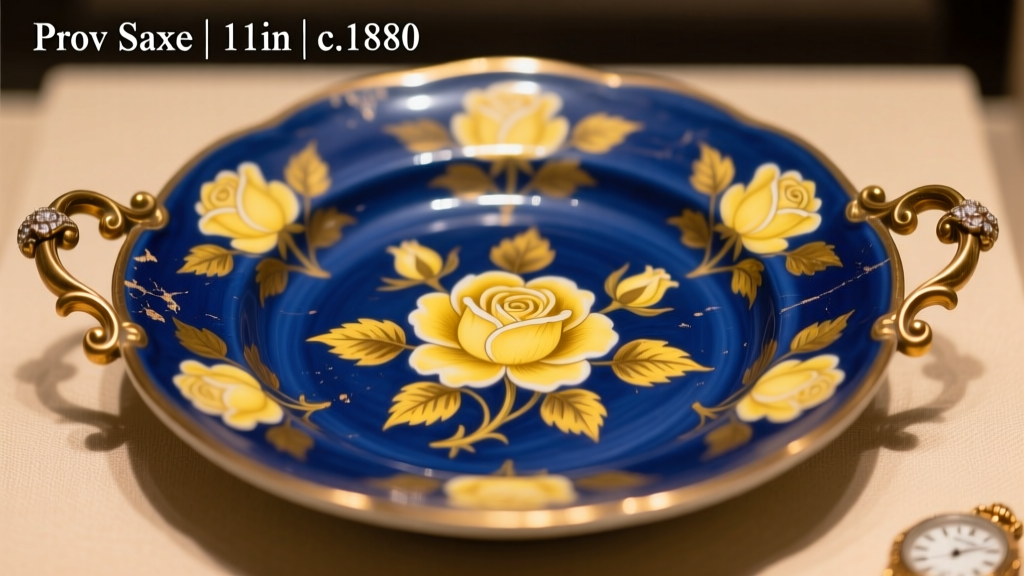
Provence Saxe Cobalt Blue & Yellow Rose Cake Plate: A 1930s German Porcelain Masterpiece
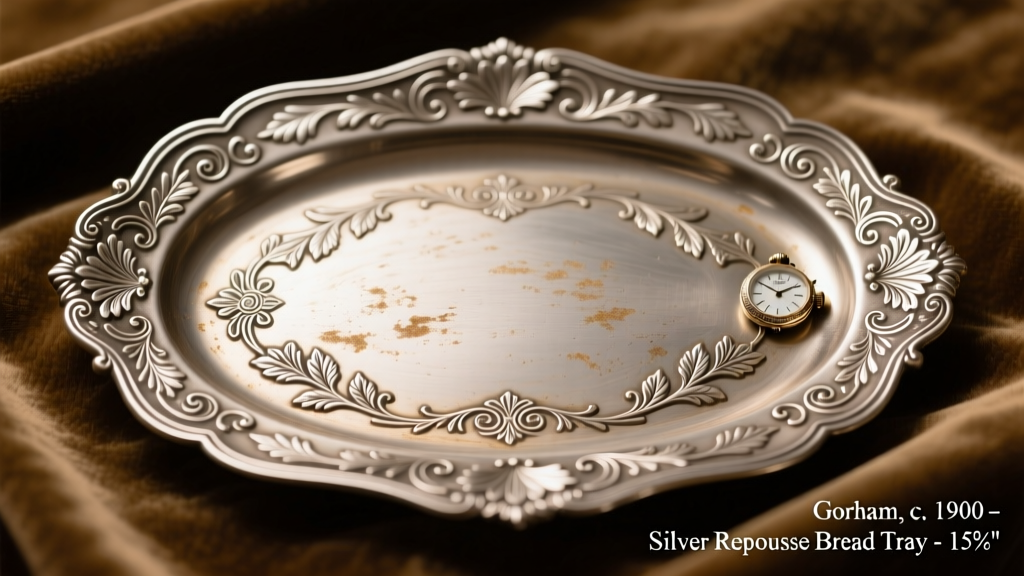
Gorham Silver Oval Bread Tray, c. 1900: A Masterpiece of Repoussé Floral Craftsmanship
Iron Cut-Out Crow Bird Chaser, Circa 1890 — A Rare Pair of Victorian Garden Deterrents
Lot 1138746: A 1952 Patek Philippe Ref. 1463 'Tasti Tondi' Chronograph — Technical Heritage, Market Context, and Authentication Protocol
Hobnail Toothpick Daisy Button in Canary Opalescence: A Rare 1885 American Art Metal Brooch Measuring 3 × 2 Inches
Fairmont Ice Cream Clocks: Advertising Timepieces, Neon Illumination, and Mid-Century Americana
Wedgwood Letter Opener: Bust of Christ in Black Basalt with Ivory Blade — A Rare 19th-Century Ecclesiastical Artifact
Mettlach Stein No. 1005 L Liter: A Masterpiece of German Pewter and Ceramic Craftsmanship
Iron Horse Tie Ball Finial: A Detailed Appraisal of the 6¾-Inch Pair in Sterling Silver and Enamel