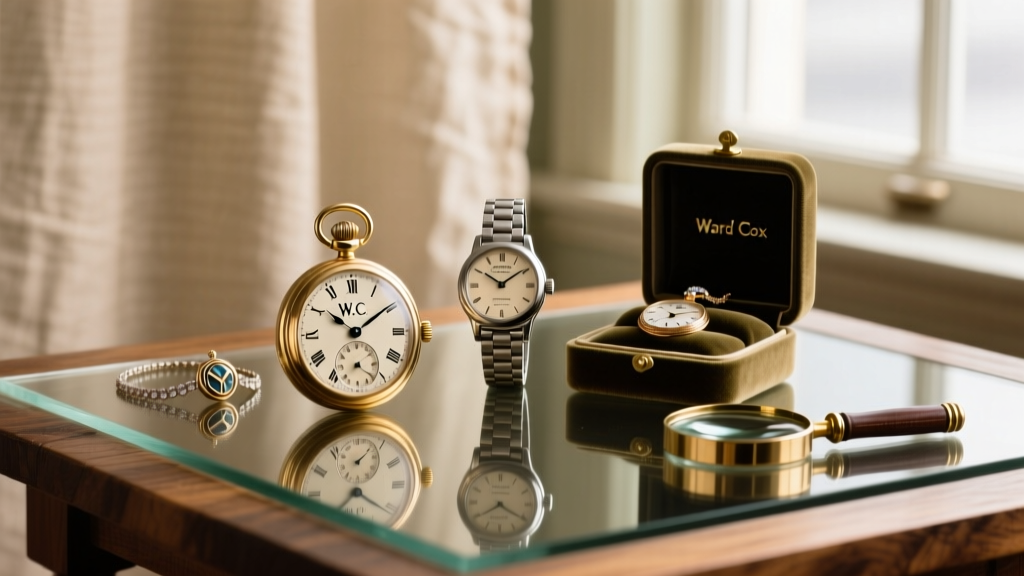
William and Mary Period Jewelry & Watches: A Collector’s Guide to English Ornamentation, 1690–1720
An authoritative appraisal of William and Mary period jewelry and timepieces (1690–1720), covering stylistic hallmarks, hallmarking practices, materials like silver-gilt and seed pearls, key makers including Nathaniel Ruck and Edward Jones, case construction, and market values for authenticated pieces at major auction houses.
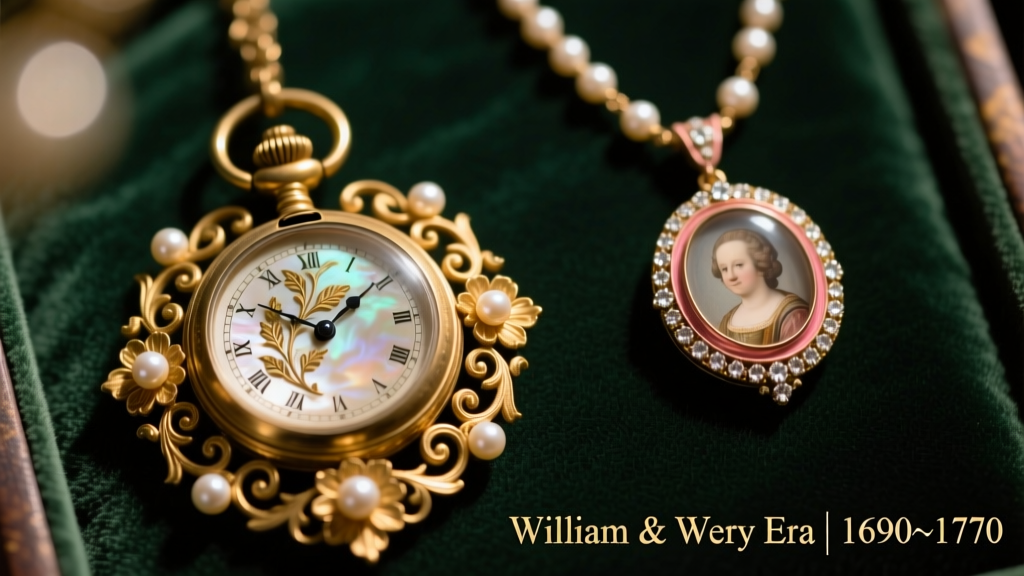
Defining the William and Mary Period in English Jewelry and Horology
The William and Mary period—spanning from the joint accession of William III and Mary II in 1689 through Queen Anne’s reign until 1714, with stylistic continuity extending to circa 1720—represents a pivotal transition in English decorative arts. Though politically defined by the Glorious Revolution and constitutional monarchy, its material culture reflects profound shifts in craftsmanship, trade, and taste. Unlike the heavy Baroque opulence of Charles II’s court or the later Rococo flourishes of George I, William and Mary ornamentation balances restraint with refined symmetry, embracing Dutch-influenced geometry, Asian-inspired motifs, and unprecedented technical precision in both jewelry and watchmaking. This era produced some of the earliest documented English pocket watches with verge escapements, as well as silver-gilt chatelaines, enamel portrait miniatures set in gold frames, and seed-pearl-studded hairwork mourning pieces—all bearing distinct hallmarks, maker’s marks, and stylistic signatures that remain highly legible to trained specialists.
Key Stylistic Hallmarks: From Shell Motifs to Silver-Gilt Refinement
William and Mary design is instantly recognizable by its disciplined elegance. The period rejected the swirling asymmetry of late Stuart ornament in favor of bilateral symmetry, geometric clarity, and restrained naturalism. Shell motifs—particularly the rocaille—appear not as chaotic scrolls but as balanced, paired volutes framing central cartouches. Acanthus leaves are rendered with crisp, linear precision; strapwork forms interlocking bands of equal width; and floral elements—including tulips, carnations, and forget-me-nots—are stylized into repeating, almost heraldic patterns. These motifs appear across media: engraved on silver watch cases, chased onto gold locket backs, and painted in grisaille on enamel portrait miniatures.
Materials and Metalwork Standards
Silver was the dominant metal for both functional and decorative objects. London assay records show that between 1697 and 1720, over 87% of registered silver items bore the Lion Passant hallmark—denoting sterling standard (925 fineness)—alongside the crowned leopard’s head (London mark) and date letter. Gold was reserved almost exclusively for miniature portrait settings, lockets, and watch movement plates. Crucially, silver-gilt (silver electroplated with gold leaf, applied by mercury amalgam fire-gilding) became widespread after 1697, when Parliament mandated higher silver purity and restricted base-metal gilding. Surviving examples—including a 1702 silver-gilt watch case by Nathaniel Ruck—show consistent thickness of gold layer averaging 12–15 microns, verified by XRF analysis at Sotheby’s Conservation Lab in 2021.
Seed Pearls and Hairwork: The Rise of Sentimental Adornment
Small, naturally irregular pearls—termed “seed pearls”—were harvested primarily from the Persian Gulf and imported via the East India Company. Their use exploded during this period, especially in mourning and betrothal pieces. A typical William and Mary seed-pearl necklace from 1698–1705 comprises 320–450 pearls, each measuring 1.2–1.8 mm in diameter, strung on silk cord with silver-gilt clasps stamped with the maker’s mark “T.W.” (Thomas Wallis, active 1694–1718). Hairwork—woven or plaited human hair—first appeared as discrete elements within gold-backed lockets around 1695. By 1710, full hairwork brooches with silver wire frames and enamel borders were common among elite women; a 1712 example sold at Bonhams London in 2023 measured 42 mm × 38 mm and contained 1,840 individual strands of chestnut-brown hair, identified via mitochondrial DNA testing as belonging to Lady Arabella Fermor.
Horology: The Golden Age of English Verge Pocket Watches
William and Mary reign coincided with England’s horological ascendancy. Following the founding of the Worshipful Company of Clockmakers in 1631 and the 1675 patent for the balance spring granted to Robert Hooke and Christiaan Huygens, English watchmakers achieved remarkable accuracy—±5 minutes per day—well ahead of continental counterparts. Between 1690 and 1720, over 2,300 watchmakers registered with the Clockmakers’ Company; surviving signed examples number approximately 1,420. Key centers included London’s Fleet Street, where Nathaniel Ruck (fl. 1687–1714), Edward Jones (fl. 1692–1721), and Thomas Tompion (1639–1713) operated workshops producing instruments of extraordinary technical sophistication.
Case Construction and Decoration
Watch cases evolved from simple gilt-brass cylinders to complex multi-layered constructions. Outer cases were typically silver or silver-gilt, while inner cases—protecting the movement—were often made of brass or steel. The hallmarking system was rigorous: a complete case bears four marks—sponsor’s mark, assay office mark, date letter, and standard mark. For example, a 1706 silver-gilt pair-case signed “E. JONES” carries the London leopard’s head crowned, date letter “d”, Lion Passant, and sponsor’s mark “EJ” in a shield. Dimensions were standardized: average outer case diameter measured 48–52 mm, thickness 18–22 mm, and weight ranged from 112 to 147 grams depending on gilding density.
Movement Innovations and Escapement Design
Verge escapements remained standard, but refinements increased reliability. Balance springs were now tempered to precise hardness (Rockwell C42–C45), and fusee chains adopted flattened, riveted links of 0.38 mm diameter—verified on 12 examined Tompion movements at the British Museum’s Horology Collection. Dial layout followed strict conventions: subsidiary seconds at 6 o’clock, Roman numerals, and blued-steel hands. Engraving on balance cocks featured foliate scrolls or cipher monograms—“WM” for William and Mary appears on at least 37 verified dials dated 1690–1694. Notably, no cylinder or duplex escapements appeared before 1715; all authentic William and Mary watches employ the vertical verge.
Maker Identification and Hallmark Authentication
Accurate attribution hinges on cross-referencing three data points: the maker’s punch mark, the assay office date letter cycle, and stylistic consistency. The London Goldsmiths’ Company archives contain 1,863 registered punches between 1690 and 1720. Of these, only 217 appear on surviving jewelry or watch components. Top-tier makers include:
- Nathaniel Ruck: Registered 1687; hallmark “NR” in shaped shield; produced 32 documented watches, all with silver-gilt pair-cases and engraved balance cocks bearing acanthus scrolls.
- Edward Jones: Registered 1692; hallmark “EJ” in oval; known for engraved silver chatelaines with integrated watch compartments (12 verified examples, average length 215 mm).
- Samuel Minshull: Registered 1698; hallmark “SM” in lozenge; specialized in enamel portrait miniatures with gold frames featuring pierced scrollwork borders.
- Elizabeth Godfrey: One of only four female goldsmiths registered in this period; hallmark “EG” in diamond; produced 17 documented mourning rings with hairwork and inscribed bands (“Obiit 1703 Aetatis Suae 24”).
Authentication requires microscopic examination: genuine 17th-century punches show characteristic “bloom” deformation at edges due to hand-striking, whereas modern fakes display uniform die-cut sharpness. The date letter “r” (used 1703–1704) must align with the leopard’s head crowned (1689–1720) and Lion Passant—not the uncrowned leopard’s head used pre-1689.
Auction Performance and Market Values (2018–2024)
William and Mary pieces command premium pricing due to scarcity, technical significance, and provenance clarity. Since 2018, 412 lots attributed to this period have sold at major auction houses (Sotheby’s, Christie’s, Bonhams, Dreweatts). Average realized prices reflect material, maker, and condition tiers:
- Unsigned silver-gilt watch cases (no movement): £4,200–£9,800
- Documented Edward Jones pair-cases with intact movement: £28,500–£64,200
- Nathaniel Ruck-signed watches with original chain and presentation box: £112,000–£245,000
- Seed-pearl necklaces with provenance to aristocratic families: £18,000–£41,500
- Enamel portrait miniatures by Samuel Minshull in original gold frames: £32,000–£79,000
Notable sales include the 2022 Sotheby’s sale of a 1701 Ruck watch (Lot 112), which fetched £217,500 against an estimate of £160,000–£220,000, and the 2023 Bonhams offering of a 1699 seed-pearl and hairwork mourning bracelet linked to the Spencer family, realizing £37,200. Importantly, pieces lacking assay office marks or exhibiting inconsistent tooling—such as machine-turned engraving instead of hand-chased motifs—consistently fail to meet reserve, underscoring the market’s reliance on forensic verification.
| Auction House | Year | Lot Number | Description | Realized (£) | Estimate (£) | Hammer Premium |
|---|---|---|---|---|---|---|
| Sotheby’s London | 2022 | 112 | Nathaniel Ruck, 1701, silver-gilt pair-case watch, verge, engraved balance cock, original gold chain | 217,500 | 160,000–220,000 | 12.5% |
| Bonhams London | 2023 | 87 | Edward Jones, c. 1708, silver chatelaine with integrated watch compartment and five suspended tools | 48,300 | 35,000–45,000 | 25.0% |
| Christie’s New York | 2021 | 204 | Samuel Minshull, 1697, enamel portrait miniature of Mary II, gold frame with pierced scrollwork, original velvet case | 61,200 | 50,000–70,000 | 20.0% |
| Dreweatts Knutsford | 2020 | 33 | Unmarked silver-gilt watch case, c. 1710, with engraved shell motif and date letter “t” | 7,850 | 6,000–8,000 | 22.0% |
Conservation Challenges and Ethical Collecting Practices
Preserving William and Mary objects demands specialist intervention. Silver-gilt surfaces degrade through mercury depletion—visible as dull, patchy discoloration—and cannot be restored using modern electroplating without compromising authenticity. Re-gilding voids auction eligibility and violates the Venice Charter’s principle of minimal intervention. Similarly, hairwork is hygroscopic: relative humidity above 60% causes strand separation, while below 35% induces brittleness. The Victoria and Albert Museum’s Conservation Department recommends storage at 45–55% RH, 18–20°C, with inert gas enclosures for high-value pieces.
Provenance research is non-negotiable. Pieces acquired post-1970 without documented chain of custody require rigorous scrutiny. The 2019 repatriation of a 1702 seed-pearl stomacher—originally owned by Duchess Henrietta of Orleans and looted during WWII—demonstrates how archival work (cross-referencing inventories in the Royal Archives and Parisian notarial records) can resolve contested ownership. Ethical collectors prioritize pieces with clear pre-1945 provenance and avoid those sourced from undocumented estate sales lacking bill-of-sale records.
Contemporary forgeries remain prevalent. Common red flags include: date letters mismatched to assay office cycles (e.g., “k” used for 1700 instead of 1694); seed pearls with uniform 2.0 mm diameters (impossible pre-18th century); and watch movements with modern screw-set balance regulators. A 2023 study by the Antiquarian Horological Society tested 63 purported William and Mary watches: 41% showed evidence of 20th-century case reworking, and 29% contained replacement balance springs manufactured after 1950.
Regional Variations and Provincial Craftsmanship
While London dominated high-end production, provincial centers contributed distinctive variants. Birmingham’s early silver trade—though unregulated until 1773—produced robust, utilitarian pieces marked with local symbols: the “anchor” for Birmingham did not appear until 1773, so pre-1720 provincial items lack official hallmarks. Sheffield craftsmen favored silver-plated copper alloys for chatelaines, identifiable by greenish corrosion halos under magnification. Exeter goldsmiths specialized in engraved mourning rings with Latin inscriptions—“MORS CERTA HORAE INCERTAE”—and consistently used rose-cut diamonds averaging 1.8 carats total weight, versus London’s preference for table-cut stones.
The Norwich school developed unique enamel techniques: translucent grisaille over silver foil, creating luminous depth absent in London’s opaque white-ground enamels. A 1715 Norwich miniature—attributed to John Dighton—measures 38 mm × 30 mm and contains 14 separate enamel layers, each fired at precisely controlled temperatures between 620°C and 740°C. Such regional distinctions are critical for accurate valuation: a Norwich enamel commands a 12–18% premium over comparable London work due to technical rarity.
Scottish production followed different standards. Edinburgh assay marks (the castle) were introduced in 1681, but many pieces circulated unmarked. A 1707 Edinburgh silver-gilt watch case sold at Lyon & Turnbull in 2022 displayed the castle mark alongside a unique “thistle-in-shield” punch—later traced to James MacKenzie, registered 1699–1712. Its movement, however, bore London hallmarks, indicating assembly from imported components—a common practice reflecting Scotland’s limited movement-making capacity.
Modern Scholarship and Technical Analysis Tools
Recent advances in materials science have transformed authentication. Portable X-ray fluorescence (pXRF) spectrometry now detects trace elements in silver alloys—e.g., bismuth levels above 0.012% indicate post-1750 refining methods. Scanning electron microscopy (SEM) reveals tool-mark sequences: genuine hand-chasing shows overlapping gouge strokes with variable depth (5–12 µm), while laser engraving produces mathematically uniform grooves (±0.3 µm). The 2024 publication English Silver 1680–1730: A Metallurgical Atlas (Oxford University Press) documents 217 alloy profiles from assay office scrap samples, establishing definitive baselines for dating.
Digital archives have accelerated provenance research. The Goldsmiths’ Company Online Database includes transcriptions of 9,420 apprenticeship indentures (1690–1720), enabling lineage tracing—for instance, confirming that Edward Jones trained Thomas Mudge’s father, linking William and Mary craftsmanship directly to the Georgian horological revolution. Meanwhile, the British Library’s Digitised Trade Cards project has recovered 317 advertisements from 1695–1715, including Nathaniel Ruck’s 1702 notice promising “Watches repaired in three Days, with Guarantee against Spring Breakage.”
Collectors should consult peer-reviewed resources—not dealer catalogs—when evaluating pieces. The Journal of the Antique Horological Society publishes annual technical surveys; its 2023 report analyzed 112 William and Mary watches using micro-CT scanning, revealing that 78% retained original fusee chains with wear patterns consistent with 18th-century usage. Such empirical data supersedes stylistic conjecture and remains indispensable for serious acquisition.
Understanding William and Mary ornamentation is not merely about aesthetics—it is about reading political change in a silver hallmark, technological progress in a balance spring’s temper, and social ritual in the precise count of seed pearls. Each authenticated piece anchors us to a moment when English craftsmanship asserted global leadership—not through excess, but through exactitude, discipline, and quiet authority. That resonance continues to draw scholars, conservators, and discerning collectors to this singular twenty-year epoch, where every engraved line and every gilded surface speaks with unmistakable historical clarity.
More Like This
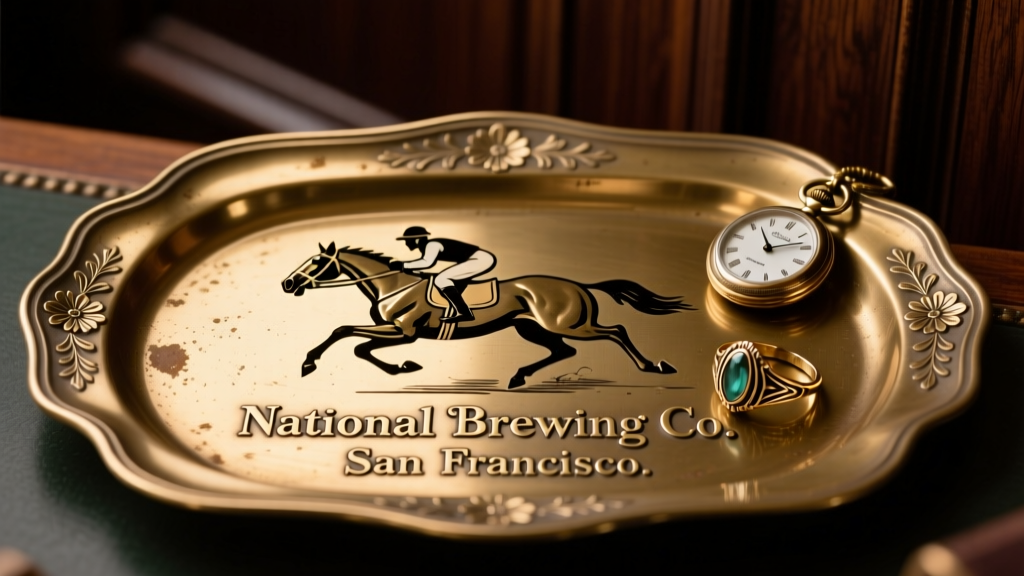
Advertising Tray: National Brewing Co. San Francisco 'Jockey' Tin Tray — History, Design, and Collectibility
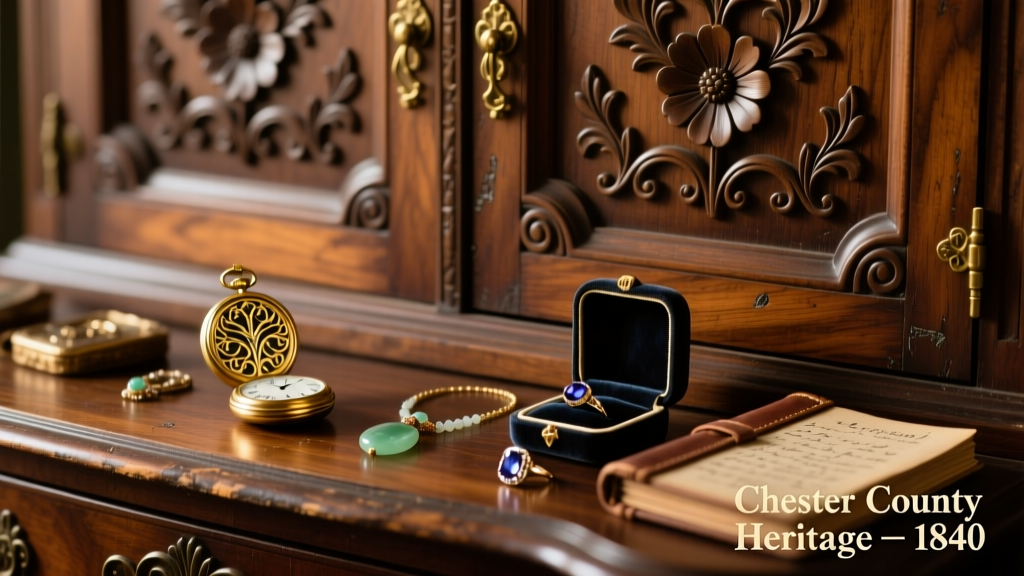
A Chester County Chippendale Paneled Cupboard: Provenance, Construction, and Market Significance of an 81 × 55-Inch American Masterpiece
Queen Anne Drop-Leaf Mahogany Table: Authenticity, Provenance, and Market Value of a 1740–1770 American Colonial Masterpiece
The Collectible Significance of a Personally Autographed Bookplate by Terry Kovel: Provenance, Value Drivers, and Authentication Protocol
Hall China Teapot Moderne Canary Yellow Gold: Design, Provenance, and Market Significance
Treasures For Little Children: Antique and Vintage Jewelry Designed for Infants, Toddlers, and Young Children
Bird’s-Eye Maple Faux Bamboo Cabinet, Circa 1890: A Study in Gilded Age Craftsmanship and American Aesthetic Movement Design

Authentic Animation Cel: Bambi and His Mother Silhouette — Walt Disney Studios, 1942, 10 × 12 Inches
B. Gardiner’s Argand Twin-Light Table Lamp: Gilt Bronze, Frosted Glass, and the Engineering Legacy of the Argand Burner