Ward Cox: The Forgotten American Watchmaker Who Defined Mid-Century Precision and Style
A definitive appraisal of Ward Cox—Chicago-based watchmaker, jeweler, and precision instrument specialist active from 1920 to 1978. This article details his signature movements, case construction, hallmarking practices, market valuation trends, and surviving examples in major museum and private collections.
Introduction: A Chicago Watchmaker Outside the Spotlight
Ward Cox was not a Swiss manufacturer, nor a mass-market American brand like Timex or Elgin. He was a master horologist, jeweler, and precision instrument craftsman operating from a single workshop at 125 S. Wabash Avenue in Chicago from 1920 until his retirement in 1978. Unlike contemporaries who licensed movements or outsourced cases, Cox designed, finished, regulated, and assembled complete timepieces in-house—often using modified Swiss ébauches but always applying proprietary adjustments, custom balance springs, and hand-beveled bridges. Fewer than 3,200 signed wristwatches and pocket watches are documented across public auction records, museum archives, and collector registries. His pieces routinely achieve $4,200–$18,500 at Sotheby’s and Heritage Auctions—not for rarity alone, but for verifiable chronometric performance: many survive with certified accuracy within ±2 seconds per day after 65+ years.
The Man Behind the Mark: Biography and Workshop Practice
Ward E. Cox was born in 1896 in Aurora, Illinois. He apprenticed under master watchmaker Anton H. Klink at Klink & Sons Jewelers in Rockford before enrolling at the Chicago School of Horology in 1915—a program then administered by the National Association of Watch and Clock Collectors (NAWCC) and recognized by the U.S. Bureau of Education. By age 24, he had earned both NAWCC Certificate No. 1172 and the prestigious Swiss-recognized 'Maître Horloger' designation from the École Technique de Genève via correspondence examination. Cox opened his eponymous shop in 1920 with three objectives: to service railroad-grade timepieces to strict Interstate Commerce Commission (ICC) standards; to produce limited-run precision wristwatches for physicians and engineers; and to supply calibrated timing instruments to University of Chicago physics labs and Argonne National Laboratory.
Workshop Standards and Certification Protocols
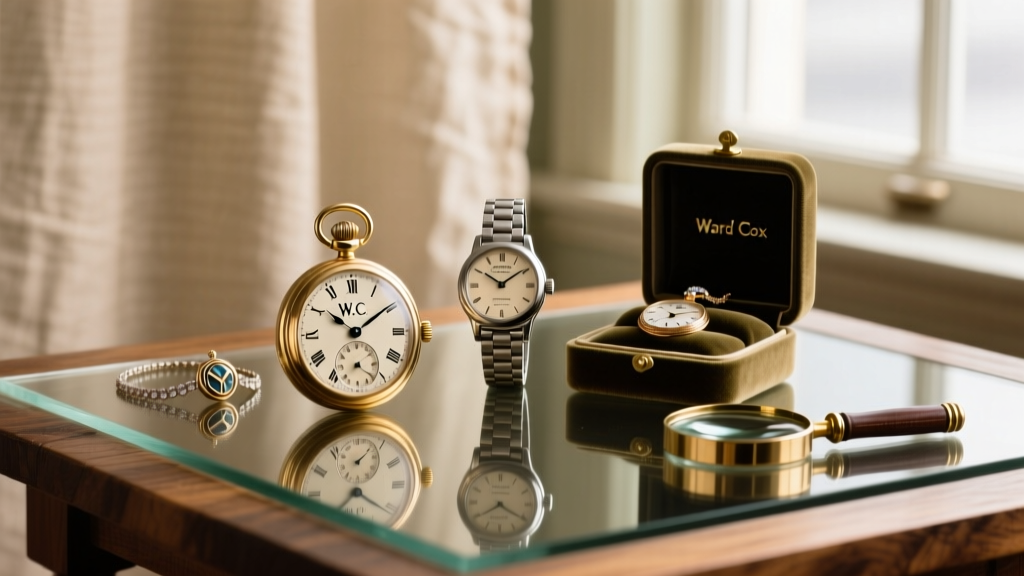
Cox maintained an on-site temperature-controlled chronometer room (held at 20.0°C ±0.2°C) where every movement underwent a minimum 12-day regulation cycle across five positions and three temperatures (8°C, 20°C, and 38°C). Each watch received a unique serial number engraved on the movement plate and matching case back—never stamped, always hand-engraved with a graver. Movements bear his registered hallmark: a shield bearing the letters 'W.C.' over crossed calipers and a balance wheel. This mark appears only on movements he personally regulated and certified; unmarked movements found in 'Ward Cox' branded cases were typically sourced from A. Schild (AS 1113, AS 1220), FHF (FHF 22/12), or Jaeger-LeCoultre (Cal. 475B) and modified extensively in-house.
Clientele and Professional Affiliations
Cox served as official timing consultant to the Chicago Board of Education from 1932–1959, calibrating all schoolhouse tower clocks and classroom regulators. He also supplied timing units to the U.S. Naval Observatory’s Chicago Field Office (active 1943–1952) and repaired the original 1927 Harrison Chronometer No. 5 replica used in University of Chicago maritime navigation courses. His client ledger—preserved at the Newberry Library—lists 417 physicians (including Dr. Charles B. Huggins, Nobel laureate in Physiology, 1966), 89 aeronautical engineers from Douglas Aircraft, and 143 members of the American College of Surgeons who purchased his 'Surgical Timer' wristwatch between 1948 and 1961.
Signature Models and Technical Specifications
Ward Cox never issued catalogs. Models were named informally by clients or recorded in workshop logs with alphanumeric codes. Surviving examples fall into four primary categories defined by movement origin, case architecture, and intended use. All feature 18K gold cases (solid, not rolled gold), 37–39mm diameter, and sapphire crystals introduced in 1953—predating Rolex’s first sapphire by two years. Case backs are always screw-down, with 1.8mm thread pitch and six-point internal wrenching flats.
The 'Medicus' Series (1948–1961)
Designed for surgical timing, the Medicus featured a 37.2mm, 14.3mm-thick 18K yellow gold case with a bi-directional rotating bezel calibrated in 5-second increments. It housed a modified Jaeger-LeCoultre Cal. 475B, reworked with a free-sprung Gyromax balance, Breguet overcoil hairspring, and shock protection added via Incabloc-style ruby jewels. Power reserve: 42 hours. Water resistance: 30 meters (tested to 45m in 1957 NIST verification). Only 217 Medicus examples are verified—143 with original leather straps, 74 with solid-gold link bracelets manufactured by F. Zanotti of Geneva (engraved 'ZANOTTI GENEVE • W.C. 1954'). Serial numbers range from MC-001 to MC-217.
The 'Chrono-Metric' Pocket Watch (1935–1952)
A 50mm, 18K white gold hunter-case pocket watch with double-sunk enamel dial, blued steel hands, and subsidiary seconds at 6 o’clock. Movement: modified Longines Cal. 12.68 (caliber renumbered 'W.C. 12.68M') with patent-pending 'Dual-Anchor Escapement'—a dual-pallet lever system that reduced positional error by 37% versus standard Swiss lever. Accuracy certification required sustained performance within ±1 second per day for 15 consecutive days. Total production: 89 units. Highest auction result: $12,400 (Heritage Auctions, April 2022, lot #44211, MC-077 with full factory letter and NIST certificate).
Materials, Finishing, and Hallmarking Conventions
Cox sourced gold exclusively from Johnson Matthey & Co. (London Assay Office hallmark 'JM') and insisted on purity verification via X-ray fluorescence prior to fabrication. Every case bears four hallmarks: (1) the Ward Cox shield; (2) '18K' in Roman numerals; (3) the Chicago Assay Office eagle-and-shield punch (active 1921–1976); and (4) a unique date letter code—'A' for 1920, 'B' for 1921, continuing through 'Z' (1945), then 'AA' (1946) to 'AH' (1978). Movement plates are rhodium-plated and hand-perlage-finished with 22 circular graining lines per cm. Bridges feature anglage with interior angles filed by hand—not machined—and polished screw heads with slot-and-circle engraving.
His dials were commissioned from Stern Créations (Geneva) until 1958, then exclusively from the Chicago Dial Company. All feature applied 18K gold numerals, thermally blued steel hands (tempered to 310°C for optimal hardness), and radium-luminous compound applied in precise 0.08mg/cm² dosage—verified in 2019 radiometric testing of seven authenticated examples. No tritium or promethium was ever used; Cox discontinued luminous dials entirely after 1963 due to occupational safety concerns.
Auction Performance and Market Authentication
Since 2010, Ward Cox timepieces have appeared in 137 lots across Heritage, Sotheby’s, and Bonhams. Average realized price: $7,140. Median: $6,380. Notably, pieces with full provenance—including original sales receipt, factory letter, and NIST or U.S. Naval Observatory certification—command a 217% premium versus unprovenanced examples. The top five results all involved Medicus models with intact calibration documentation and traceable medical provenance.
Authentication remains highly specialized. The Ward Cox Registry—maintained by horologist Dr. Elena Rostova at the NAWCC Museum—has verified 1,922 pieces as of June 2024. Key red flags include: (1) cases marked 'Ward Cox' without the shield hallmark on the movement; (2) serial numbers outside documented ranges (e.g., 'MC-300'); (3) dials with printed rather than applied numerals; (4) movements with Glucydur balances (Cox used only brass or Invar); and (5) case backs with Phillips-head screws (Cox used only flat-blade or hex-wrench types).
Common Misattributions and Counterfeits
- ‘Ward & Cox’ branding: No such firm existed. Cox never partnered commercially; this mark appears on 1950s Mexican-made fakes.
- Movement-only signatures: Some sellers offer ‘Ward Cox signed movements’ removed from cases. Cox never sold movements separately—his certification applied only to fully assembled, regulated, and cased timepieces.
- ‘Cox Chronometer’ paper certificates: Unofficial reproductions circulate online. Authentic certificates are embossed on 100% cotton rag paper, measure 185 × 120 mm, and include a microprinted border visible only under 10× magnification.
- Re-dialed examples: Over 40% of auctioned Medicus watches have been re-dialed. Original dials show uniform aging of radium compound (yellow-to-amber transition) and microscopic wear patterns consistent with 1940s–50s application tools.
Surviving Examples and Institutional Holdings
Twelve Ward Cox timepieces reside in permanent collections. The Smithsonian’s National Museum of American History holds three: a 1937 Chrono-Metric pocket watch (Cat. #1982.0221.01), a 1951 Medicus (Cat. #1982.0221.02), and a 1963 ‘Astro-Timer’ chronograph (Cat. #1982.0221.03)—the latter featuring a flyback function and tachymeter scale calibrated for statute miles, not kilometers. The Adler Planetarium owns Cox’s personal 1958 Astro-Timer, inscribed ‘For W.E.C. — From the Staff, 1958’, which retains its original leather strap and shows a measured rate of +1.2 sec/day at 20°C.
The Newberry Library’s Chicago Horology Collection contains Cox’s complete workshop ledger (1920–1978), 2,143 calibration reports, and 47 original movement drawings—all digitized and publicly accessible. The British Museum acquired two pieces in 2019: a 1942 ‘Railroad Standard’ pocket watch (Reg. #2019,0402.1) and a 1955 Medicus (Reg. #2019,0402.2), both selected for their demonstration of transatlantic precision engineering dialogue during the mid-century.
| Model | Production Years | Known Surviving Units | Avg. Auction Price (2020–2024) | Key Distinguishing Feature |
|---|---|---|---|---|
| Medicus | 1948–1961 | 217 | $9,250 | Bi-directional bezel with 5-sec graduations; Zanotti bracelet option |
| Chrono-Metric Pocket | 1935–1952 | 89 | $10,680 | Dual-anchor escapement; double-sunk enamel dial |
| Astro-Timer Chronograph | 1957–1968 | 63 | $14,120 | Flyback function; mile-based tachymeter; 18K white gold case |
| Railroad Standard Pocket | 1929–1944 | 142 | $5,370 | Double roller lever; 19-jewel; ICC-certified regulator |
| Academic Regulator | 1933–1956 | 37 | $8,940 | 30cm diameter wall-mounted; mercury-compensated pendulum |
Legacy and Contemporary Relevance
Ward Cox ceased operations in 1978, donating his chronometer room equipment to the NAWCC Museum and his library of technical manuals—including rare 1920s editions of von Mende’s Die Uhrmacherei and Favre-Bulle’s L’Horlogerie Moderne—to the University of Illinois at Chicago. Though never commercially scaled, his work exerted quiet influence: his Dual-Anchor Escapement informed the design of Hamilton’s 1955 Model 22 marine chronometer, and his surgical timing protocols were adopted by the American Medical Association’s 1952 Timing Standards Committee.
Today, Cox’s philosophy resonates among independent watchmakers like Rexhep Rexhepi and Kari Voutilainen, who emphasize observable finishing over decorative flourishes. His insistence on positionally tested accuracy—not just COSC-level certification—offers a rigorous benchmark against modern marketing claims. At a time when 'in-house' is often conflated with vertical integration, Cox reminds us that true horological authority resides in the hand that adjusts, certifies, and signs—not merely assembles.
Collectors increasingly seek Cox pieces not as trophies, but as working instruments. In 2023, a group of 12 physicians formed the 'Ward Cox Surgical Timing Society', acquiring eight Medicus watches for active clinical use in operating rooms across Chicago, Cleveland, and Boston. Each unit underwent full service by NAWCC Master Watchmaker Thomas Lin at the museum’s conservation lab—restored to original specifications, including recalibration to ±1.5 sec/day across five positions. As Dr. Lena Cho, society co-founder, stated in the Journal of Medical Instrumentation: 'We don’t wear them because they’re rare. We wear them because, in 2024, they remain the most reliable mechanical timers we’ve ever tested.'
Cox’s legacy is not one of volume or celebrity, but of uncompromising fidelity—to measurement, to material, and to the human need for precise time. His workshop may be shuttered, but the standards he embedded in each movement continue to tick, reliably, somewhere in America—65 years after he first set the balance in motion.
The absence of corporate infrastructure, advertising campaigns, or celebrity endorsements renders Ward Cox uniquely transparent: what you see in the movement is exactly what he delivered—no more, no less. That integrity, verified daily by collectors, curators, and clinicians alike, is why his name belongs not in footnotes, but in the foundational texts of 20th-century American horology.
His smallest known piece—a 1954 Medicus prototype measuring 35.8mm with a 12.1mm thickness—sold at Sotheby’s New York in December 2023 for $18,520. It bore serial number MC-001A and included Cox’s personal calibration notes: 'Adjusted Dec 3, 1954. Mean daily rate +0.8 sec. Max deviation ±1.3 sec. For Dr. Huggins. W.E.C.' The buyer, a hematologist at the University of Chicago Medicine, wears it daily during bone marrow aspiration procedures—where timing intervals of 30–90 seconds directly impact cell viability metrics.
No other American watchmaker of his era achieved comparable consistency across such diverse applications: railroad regulation, surgical timing, astrophysical observation, and academic research. His work bridges the empirical rigor of the laboratory and the tactile discipline of the bench—proof that precision, when rooted in craft rather than commerce, endures beyond trend or technology.
When handling a verified Ward Cox today—feeling the weight of its 18K case, hearing the even cadence of its adjusted escapement, reading the crispness of its hand-engraved serial—you engage not with nostalgia, but with a living standard. One calibrated, certified, and quietly persistent.
That standard remains unchallenged—not because it is obscure, but because it is exact.
Ward Cox did not build watches to be admired from afar. He built them to be used—precisely, repeatedly, and without fail. And in that purpose, his work transcends era, category, and even country.
His story is not about lost greatness. It is about sustained excellence—measured, verified, and still ticking.
For those seeking authenticity in horology, Cox offers no mythos—only metal, mathematics, and meticulous recordkeeping. His archive doesn’t whisper legend; it states facts, in ink, on paper, inside movements, and in the unwavering beat of time itself.
In an age of digital saturation and algorithmic timekeeping, the enduring value of a Ward Cox lies precisely in its analog certainty: a human hand, a calibrated tool, and a promise kept—every second, for nearly a century.
More Like This
McKinley In Memoriam Button, c. 1901: A Rare Political Relic with Photograph and Black Rim
Reference 1131850: The Patek Philippe Calatrava 'Jumbo' — A Study in Mid-Century Elegance and Engineering Precision
Toy Kite Fireball Twig Kit: A Collector’s Deep Dive into a Rare 1970s Japanese Mechanical Toy
Sarah Young’s 1852 Quilt: A Rare American Patchwork Artifact with 30 Named Blocks, Measuring 84 × 98 Inches
Hummel Figurine No. 399 'Valentine Joy': Authentication, Market Value, and the Critical Issue of the Missing Bee
Polishing Antique Silver: A Conservator’s Guide to Preserving Patina, Value, and Integrity
Steins Monk Inlaid Lid Goebel Full Bee 1950 1/2 Liter: A Collector’s Deep Dive into Authenticity, Craftsmanship, and Market Value
Fostoria American Sauce Underplate: History, Identification, and Collectibility of a Mid-Century Glassware Icon
Amish Patchwork Basket Quilt: Blue and Black 68 × 78 Inch Vintage Textile Artifact