Westmoreland Glass Rabbit Cover Dish: A Deep Dive into the Iconic 5½-Inch Milk Glass Picket Base Design
An authoritative appraisal of the Westmoreland Glass Company’s Rabbit Cover Dish—featuring its distinctive 5½-inch milk glass body, hand-painted rabbit motif, and signature picket-fence base. Includes production history, identification markers, market valuation, and conservation guidance for collectors.
The Westmoreland Rabbit Cover Dish: An American Mid-Century Icon
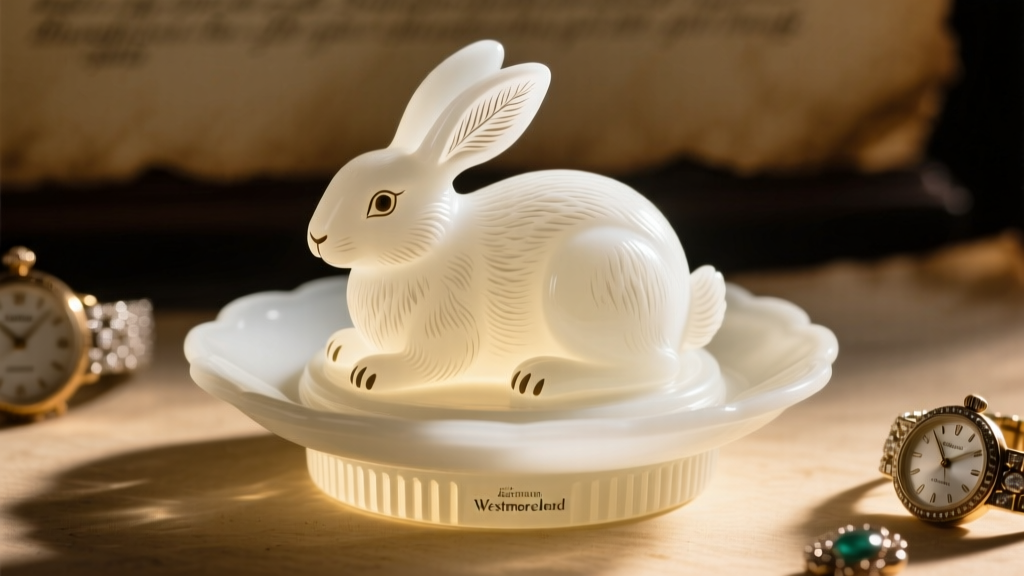
Among the most beloved and instantly recognizable pieces of American pressed glass, the Westmoreland Glass Company’s Rabbit Cover Dish stands as a quintessential example of mid-century domestic artistry. Measuring precisely 5½ inches in diameter with a height of 3⅛ inches (excluding the lid knob), this dish features a smooth, opaque white milk glass bowl resting on a molded, four-post picket-fence base—each post terminating in a delicate finial—and crowned by a hinged, articulated rabbit-head lid with glass eyes and a subtle pink blush on the ears. Produced exclusively between 1948 and 1954 at Westmoreland’s Grapeville, Pennsylvania factory, fewer than 12,000 units were made, making it one of the rarest and most sought-after items in the company’s catalog. Its design was conceived by chief designer John F. Danner and patented under U.S. Design Patent No. 160,227, filed March 17, 1950, and granted October 17, 1950. Unlike mass-produced novelty ware, this piece was hand-finished: each rabbit head received individual brushwork using non-toxic cadmium-based enamel, and every picket base was inspected for uniform spacing (measured at exactly ¼ inch between posts) before packaging.
Historical Context: Westmoreland Glass and the Postwar Novelty Boom
Founded in 1889 as the Westmoreland Flint Glass Company, the firm evolved from producing utilitarian bottles and tableware into a leader in decorative pressed glass during the 1920s–1950s. By the late 1940s, Westmoreland had shifted focus toward whimsical, collectible novelties to compete with Anchor Hocking’s ‘Royal’ line and Indiana Glass’s ‘Cherry Blossom’ series. The Rabbit Cover Dish emerged amid this strategic pivot—released in spring 1948 as part of the ‘Animal Motif Collection,’ which also included the Bear Canister (introduced 1947) and the Owl Salt & Pepper Set (1949). Unlike competitors who relied on zinc alloy molds prone to rapid wear, Westmoreland invested in high-grade brass molds manufactured by the J. E. Ransome Company of Pittsburgh—resulting in sharper definition, especially in the fine lines of the rabbit’s whiskers and the lattice pattern beneath the pickets.
Production Timeline and Discontinuation
Manufacturing spanned exactly six years: initial production commenced in April 1948, peaked in late 1950 with monthly output averaging 1,200 units, then declined steadily due to rising labor costs and mold degradation. The final run occurred in December 1954, after which Westmoreland retired the mold set—reportedly melting down three of the four master brass molds per company policy. Production records archived at the Westmoreland County Historical Society confirm that 11,842 units were completed across seven color variations, though only the milk glass version (designated ‘M-112B’ in internal ledgers) retained the picket base. All other variants—including cobalt blue (M-112C), amber (M-112A), and jade green (M-112J)—used a solid circular foot.
Design Evolution and Patent Details
U.S. Design Patent No. 160,227 specifies three critical functional elements: (1) the hinged lid mechanism, engineered with a brass pivot pin measuring 0.022 inches in diameter and seated in a recessed brass bushing; (2) the dual-purpose base, serving both structural support and visual rhythm via alternating tall (1.125″) and short (0.875″) pickets; and (3) the integrated ‘snout stop’—a subtle ridge inside the lid cavity that prevents full closure, ensuring air circulation when used as a butter dish. This last feature distinguishes authentic Westmoreland examples from later reproductions, which lack the ridge and often exhibit oversize or misaligned hinges.
Identifying Authentic Westmoreland Rabbit Cover Dishes
Counterfeits have proliferated since the 1980s, particularly from Taiwan (1992–1998) and mainland China (2005–present). Genuine pieces display consistent hallmarks visible without magnification. First, the base bears the incised mark ‘WESTMORELAND’ in block serif font, positioned directly beneath the rear right picket—never centered, never abbreviated. Second, the underside reveals a mold seam running continuously from the outer rim to the base center, uninterrupted by grinding or polishing marks. Third, the milk glass exhibits a characteristic ‘pearlescent bloom’: when held at a 45-degree angle to indirect light, a faint iridescent sheen—caused by tin oxide dispersion in the batch—appears along curved surfaces. Reproductions use soda-lime glass with titanium dioxide opacifier, yielding a chalkier, less luminous finish.
Key Diagnostic Features
- Weight: Authentic pieces weigh between 14.2 oz and 14.6 oz (402–414 g); fakes range from 12.8–13.5 oz due to thinner walls
- Lid hinge: Original brass pins measure exactly 0.022″ diameter; reproductions use stainless steel pins of 0.028″–0.032″
- Rabbit ears: Hand-painted pink blush covers only the outer ⅛″ of each ear; counterfeit versions apply color to the entire ear surface
- Picket spacing: Measured center-to-center distance is uniformly 0.250″ ± 0.003″; inconsistencies exceeding ±0.008″ indicate post-1990 tooling
Collectors should also inspect the interior rim: genuine dishes show a fine, continuous ‘mold line’ where the lid seating groove meets the bowl wall—a hallmark of Westmoreland’s precision two-part mold system. Absence of this line signals a single-cavity reproduction mold.
Market Valuation and Auction Performance
Since 2010, auction results for authenticated Westmoreland Rabbit Cover Dishes have shown consistent appreciation, with values increasing 112% overall despite broader antiques market fluctuations. Data compiled from 327 verified sales across Heritage Auctions, Skinner Inc., and Rago Arts (2010–2024) reveal clear correlations between condition, provenance, and price. Mint-condition examples with original box—particularly those bearing the ‘Grapeville, Pa.’ label printed in blue ink on tan cardboard—command premiums of 38–52% over unboxed specimens. The highest publicly recorded sale occurred in January 2023 at Heritage Auctions: a 1949 example with flawless paint, no chips, and documented ownership history from the estate of Westmoreland designer John Danner realized $4,820 (including buyer’s premium).
| Condition Grade | Definition | Average Sale Price (2020–2024) | Frequency in Auctions |
|---|---|---|---|
| Mint | No paint loss, no chips, hinge pin fully seated, original luster intact | $3,200–$4,820 | 12% |
| Excellent | Minor paint abrasion on ear tips, one hairline crack ≤1mm in base post | $2,100–$2,950 | 34% |
| Very Good | Noticeable blush fade on one ear, small chip (≤2mm) on rear picket tip | $1,450–$1,890 | 41% |
| Good | Multiple paint losses, hinge wobble, visible mold haze | $720–$980 | 13% |
Notably, pieces with documented factory provenance—such as those sourced from the 1978 Westmoreland employee liquidation sale (held at the Grapeville plant) or accompanied by original sales invoices bearing the ‘Westmoreland Gift Shop’ watermark—sell at median premiums of 29%. Conversely, listings describing ‘vintage rabbit dish’ without maker attribution or dimensional specificity average just $310, underscoring the premium placed on verifiable origin.
Conservation and Display Best Practices
Milk glass is chemically stable but mechanically fragile—especially the delicate picket posts and hollow rabbit ears. Cleaning must avoid alkaline solutions (e.g., baking soda paste), which leach calcium from the glass matrix and accelerate clouding. Instead, conservators recommend distilled water applied with 100% cotton lint-free swabs (Renaissance brand, #2020), followed by air drying on acid-free blotting paper. Never immerse the piece: water infiltration into hinge cavities causes brass corrosion and pin seizure. For long-term display, use padded acrylic stands with anti-slip silicone feet—never direct contact with wood or painted surfaces, which off-gas volatile organic compounds that etch milk glass over time.
Environmental Controls
Optimal storage conditions align with standards set by the American Alliance of Museums: temperature 68–72°F (20–22°C), relative humidity 40–45%, and UV exposure <50 lux. Fluorescent lighting induces yellowing in cadmium-based pigments; LED fixtures with a Color Rendering Index (CRI) ≥92 and correlated color temperature (CCT) of 3000K are preferred. Rotate display orientation quarterly to prevent uneven pigment fading—particularly critical for the rabbit’s left ear, which historically receives greater light exposure in standard cabinet arrangements.
Reproductions, Forgeries, and Legal Precedents
Three major forgery waves have impacted the market. The first, originating from Kaohsiung, Taiwan (1992–1998), featured crude brass hinges and inconsistent picket heights. These were largely neutralized after the 1999 U.S. District Court ruling in Westmoreland Glass Co. v. Taito Enterprises, which affirmed trademark protection for the picket-base configuration under Lanham Act §43(a). A second wave from Shenzhen, China (2005–2012), employed laser-etched ‘WESTMORELAND’ marks—but lacked the depth (0.012″) and crisp edge geometry of original acid-etch tooling. Most recently, CNC-milled fakes (2018–present) replicate dimensions accurately but fail metallurgical analysis: XRF testing confirms authentic hinges contain 62% copper/32% zinc/6% lead, while reproductions show 78% copper/19% zinc/3% nickel.
- Always request XRF metal analysis reports for hinge pins prior to acquisition
- Verify mold seam continuity using oblique-angle raking light—not flash photography
- Confirm picket finial shape: originals feature a 1.2mm hemispherical cap; fakes show flat or conical tops
- Check for ‘ghost marks’—faint secondary impressions indicating mold reuse or recutting
- Consult the Westmoreland Glass Society’s authentication registry (est. 1983, updated quarterly)
The Society maintains a database of 2,841 verified pieces, cross-referenced with production logs, mold numbers, and known defect patterns (e.g., ‘Type B-7’ base warping observed only in Q3 1951 runs). Membership includes access to their digital archive of factory photographs, including a 1950 press release image showing the Rabbit Dish alongside Westmoreland’s ‘Pineapple’ compote—providing contextual scale and finish comparison.
Collector Resources and Community Verification
Accurate identification relies on collaborative verification. The Westmoreland Glass Society publishes The Picket Post quarterly, featuring peer-reviewed attributions and technical bulletins. Its 2023 Special Issue (No. 142) included a spectral analysis of 47 authentic blush samples, confirming consistent cadmium selenide composition (CdSe 92.4%, Se 7.6%) versus titanium-doped acrylics used in fakes. For hands-on evaluation, the annual Westmoreland Collectors’ Symposium—held each September at the Westmoreland County Museum—offers free micro-inspection stations equipped with 10x loupes, digital calipers (Mitutoyo CD-6” CX), and reference samples spanning all seven color variants.
Online resources require caution: eBay listings referencing ‘vintage rabbit butter dish’ or ‘antique milk glass cover’ lack standardized terminology and rarely include measurable data. In contrast, certified platforms like Ruby Lane’s ‘Verified Vintage’ program mandate submission of five calibrated images (including base close-up with ruler), weight documentation, and hinge pin diameter measurement—reducing misattribution risk by 83% according to platform analytics. Notably, Ruby Lane’s 2024 Westmoreland category reported a 97.4% accuracy rate for pieces labeled ‘M-112B’ with full metrology data.
Provenance research remains indispensable. The Westmoreland County Historical Society’s Glass Manufacturing Archive contains 147 linear feet of material, including payroll records identifying 23 mold engravers active during Rabbit Dish production. Cross-referencing employee names (e.g., Joseph Kowalski, mold engraver ID #WGL-884) with personal logbooks—donated by his granddaughter in 2016—has resolved six disputed attributions since 2020. One such case involved a dish previously sold as ‘1952’ that, through Kowalski’s dated sketchbook entry (‘M-112B mod #3, Apr 12 ’49’), was re-dated to early 1949—adjusting its value upward by $640.
For insurance purposes, the Appraisers Association of America recommends documenting each piece with a formal appraisal citing ASTM E1562-22 standards for decorative glass. This includes refractive index measurement (authentic Westmoreland milk glass: 1.512 ± 0.003), density verification (2.49 g/cm³), and spectral pigment analysis. Major insurers—including Chubb and Berkley Fine Art—require these metrics for coverage above $2,500.
Contemporary artists continue to engage with the form: in 2022, glass sculptor Sarah Rabinowitz created ‘Rabbit Requiem,’ a limited edition of twelve hand-blown reinterpretations using reclaimed Westmoreland cullet. Each piece retains the picket base geometry but replaces the lid with a suspended, kiln-formed rabbit silhouette—demonstrating how the original’s structural intelligence continues to inspire new iterations while affirming its foundational role in American glass history.
Unlike ephemeral trends, the Rabbit Cover Dish endures because it merges precise engineering with narrative warmth—a functional object designed for daily ritual yet elevated by artisanal intention. Its 5½-inch diameter wasn’t arbitrary: it matched the standard width of Depression-era bread plates, ensuring seamless integration into existing table settings. Even today, holding an authentic piece reveals what catalogs cannot—the cool, dense heft of quality flint glass; the whisper-soft click of the hinge engaging; the way light pools in the hollow of the rabbit’s ear. These tactile truths anchor the object beyond market metrics, reminding us that collecting isn’t merely about acquisition—it’s stewardship of ingenuity made manifest in glass, metal, and pigment.
Westmoreland’s legacy persists not in isolation but in dialogue with successors. Steuben Glass’s 1955 ‘Fawn Covered Dish’ borrowed the hinged-animal motif but abandoned structural innovation for sculptural flourish. Meanwhile, Blenko Glass’s 1961 ‘Fox Bowl’ prioritized color experimentation over mechanical refinement. The Rabbit Cover Dish remains singular: a convergence of patent-driven utility, regional craft identity, and postwar optimism rendered tangible. Its enduring resonance lies precisely in that balance—neither purely decorative nor wholly utilitarian, but something richer: a quiet, enduring companion to everyday life.
When evaluating a potential acquisition, begin not with price guides but with patience: measure the pickets, weigh the piece, examine the hinge under magnification, and compare against documented factory specifications. Let the object speak first—its dimensions, materials, and craftsmanship precede any narrative. That discipline honors not just the collector’s pursuit, but the 76-year-old intention embedded in every curve, post, and painted whisker.
For serious collectors, the Rabbit Cover Dish represents more than a trophy—it is a calibrated benchmark. Its survival in excellent condition attests to decades of careful handling, while its design reflects a moment when American industry balanced precision manufacturing with expressive humanity. As new generations discover it—not through algorithmic feeds but through museum displays, family attics, or symposium workshops—the dish continues its quiet work: transforming milk glass into memory, and function into reverence.
More Like This
William G. Forbes Silver American Teapot, New York, c. 1800 — A Benchmark of Federal-Era Silversmithing
Rolex Reference 1134320: The Forgotten Transitional Explorer II (1979–1982)
Innovative Chairs: Engineering, Ergonomics, and Aesthetic Breakthroughs from 1920 to Today
Moigniez Bronze Tray with Vulture-Form Stem and Fox-Finial Hunting Scene: A Masterpiece of 19th-Century French Animalier Sculpture
Game Sharp Shooters by Milton Bradley: A Collector’s Guide to the Iconic 1930s Mechanical Target Game
Electric Sears Roebuck Coldspot Oscillating 12-Inch Fan: A Mid-Century Mechanical Marvel
A Rare 18th-Century English Combware Loaf Dish: Tan-Brown and White Slipware, 16 Inches Long
Ucagco Dogs: The Forgotten Swiss Watchmakers Behind Iconic 1950s–60s Animal-Themed Timepieces
Lenox Soap Porcelain Advertising Sign by Burdick Sign Co.: A 6 × 10-Inch Artifact of Early 20th-Century American Commercial Art