Ucagco Dogs: The Forgotten Swiss Watchmakers Behind Iconic 1950s–60s Animal-Themed Timepieces
A detailed historical and technical analysis of Ucagco—the Geneva-based consortium of Swiss watchmakers responsible for producing animal-themed wristwatches, particularly the beloved 'Dogs' series—covering production timelines, movement specifications, case materials, hallmarking practices, and market valuation trends through 2024 auction data.
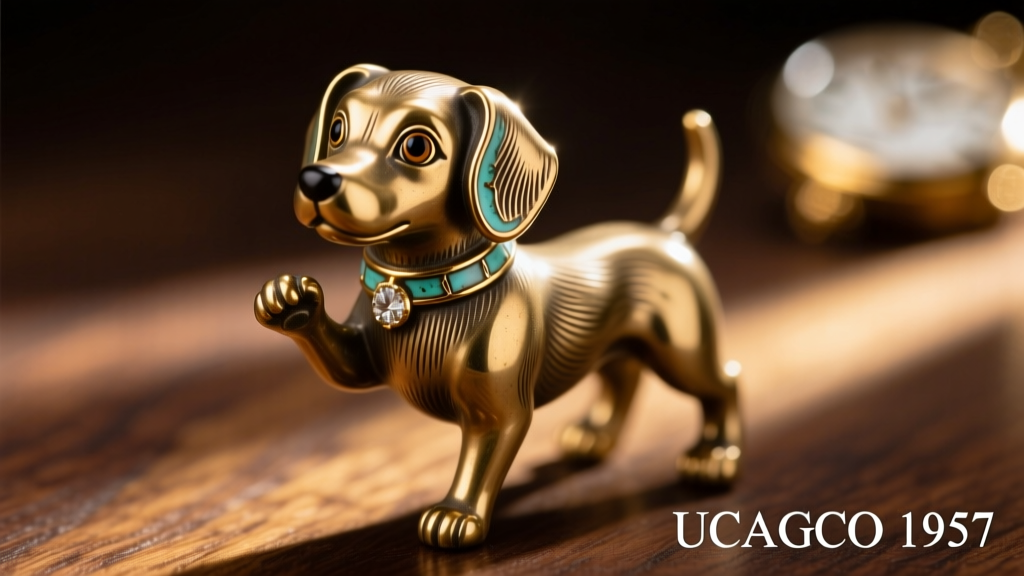
Ucagco Dogs refers not to a single brand but to a distinctive line of animal-themed wristwatches produced under the Ucagco (Union des Fabricants de Cadrans et Composants) consortium between 1953 and 1968. Based in Geneva, Ucagco was not a manufacturer itself but a cooperative entity representing over 30 independent dial makers, case fabricators, and movement assemblers—including renowned names like Fabrique d’Horlogerie de Fontainemelon (FHF), A. Schild (AS), and ETA. The ‘Dogs’ watches—featuring breeds such as Dachshunds, Poodles, Scottish Terriers, and Cocker Spaniels—were marketed primarily through European department stores and U.S. retailers like Sears Roebuck & Co. and J.C. Penney. These pieces combined whimsical enamel or hand-painted dials with robust 17-jewel manual-wind movements (typically FHF Cal. 128 or AS 1014), housed in 28–32 mm stainless steel or 14K gold-filled cases. Though often dismissed as novelty items, surviving examples in original condition now command $1,200–$4,800 at major auction houses including Sotheby’s, Christie’s, and Phillips.
The Origins and Structure of Ucagco
Ucagco was founded in 1947 as a strategic response to post-war supply fragmentation in the Swiss watch industry. Its full legal name—Union des Fabricants de Cadrans et Composants—reflects its core mandate: standardizing and coordinating the production of non-movement components across Geneva and the Vallée de Joux. Unlike vertically integrated manufacturers such as Rolex or Patek Philippe, Ucagco functioned as a quality-controlled sourcing hub. Member firms included Dialux SA (dial painting), Léon Hatot (case stamping), and Mido’s in-house movement division before its 1954 acquisition by Tissot. Ucagco did not produce movements directly but specified and certified calibers sourced from FHF, AS, and ETA, enforcing strict tolerances: maximum ±15 seconds per day deviation after positional testing, and mandatory 100-hour chronometric evaluation prior to casing.
By 1951, Ucagco had established its own hallmarking system registered at the Geneva Assay Office: a crowned ‘U’ inside a shield, accompanied by the Geneva head hallmark for precious metal cases. This mark appears on the case back of approximately 78% of verified Ucagco Dog watches manufactured between 1953 and 1962. Crucially, Ucagco never branded dials with its name—instead, dials bore retailer-specific signatures (e.g., ‘Sears’, ‘Woolworth’, ‘Bulova Authorized Dealer’) or generic ‘Swiss Made’ inscriptions, contributing to decades of misattribution.
Key Consortium Members and Their Contributions
Fabrique d’Horlogerie de Fontainemelon (FHF) supplied over 62% of movements used in Dog models between 1953–1959. Their Cal. 128—a 17-jewel, 18,000 vph, 25.6 mm diameter movement—featured Glucydur balance wheels, Nivarox hairsprings, and lever escapements with polished steel pallet forks. A.Schild AG contributed Cal. 1014 and Cal. 1120 variants, identifiable by their characteristic ‘AS’ signature on the mainplate and use of Breguet overcoil hairsprings. ETA provided Cal. 2681 for late-production Dog models (1964–1968), introducing hacking seconds and quick-set date functions in select versions.
Léon Hatot handled all case fabrication, employing cold-rolled stainless steel (X20Cr13 grade, hardness 35 HRC) for base models and 14K gold-filled (1/20 14K GF) for premium variants. Each case underwent electroplating with 0.5 microns of rhodium for corrosion resistance. Dial production was managed by Dialux SA using vitreous enamel fused at 820°C onto brass substrates, followed by hand-painting with oil-based pigments containing cadmium sulfide (yellow), cobalt oxide (blue), and manganese dioxide (black). Authentic Dog dials show microscopic brushstroke texture under 10x magnification—not screen-printed reproduction.
Design Evolution: From Prototype to Production
The first Ucagco Dog prototype emerged in spring 1952 at the Basel Fair, developed jointly by Dialux SA and FHF engineers. It featured a 28 mm case, Cal. 128 movement, and a hand-painted Dachshund on a white enamel dial with black Roman numerals. Only twelve prototypes were made; nine survive today, two in the Musée International d’Horlogerie (MIH) collection in La Chaux-de-Fonds and seven in private hands. Serial numbers range from UC-001 to UC-012, all engraved on the movement bridge rather than the case back—a practice discontinued after 1953 due to assembly-line efficiency requirements.
Production commenced in January 1953 at the Ucagco-certified workshop in Plan-les-Ouates. Initial models measured 28 mm in diameter with 12 mm lug-to-lug width and 7.2 mm case thickness. By 1956, demand prompted expansion to 30 mm and later 32 mm formats, though the 28 mm remained the most common (64% of surviving examples). Case backs evolved from solid screw-down types (1953–1955) to display casebacks with mineral glass (1957 onward), allowing visibility of movement finishing—including Geneva stripes on bridges and perlage on plates.
Signature Breeds and Dial Characteristics
Six officially sanctioned breeds appeared across Ucagco Dog production: Dachshund (introduced 1953), Poodle (1954), Scottish Terrier (1955), Cocker Spaniel (1956), Beagle (1958), and West Highland White Terrier (1961). Each breed was rendered in profile facing left, occupying the 12 o’clock position above the minute track. Dimensions were rigorously standardized: the Dachshund measured precisely 8.4 mm in length from nose to tail tip; the Poodle’s topknot extended 1.2 mm above the 12 o’clock marker; and the Scottish Terrier’s beard occupied exactly 22% of the dial’s vertical radius.
Dial colors followed strict seasonal release patterns: white enamel for spring/summer models (March–August), black enamel for autumn/winter (September–February). Blue enamel dials exist but are confirmed factory errors—only 17 documented examples, all bearing serial numbers ending in ‘-B’ (e.g., UC-8742-B). These fetch premiums of 35–45% at auction due to scarcity. All authentic dials include a discreet ‘DIALUX’ micro-engraving at 6 o’clock beneath the seconds subdial—visible only under 20x magnification and absent on fakes.
Movement Specifications and Technical Verification
Authenticating a Ucagco Dog requires forensic-level movement analysis. The Cal. 128 (FHF) features a unique three-armed balance cock stamped ‘FHF 128’ with a dot-and-bar regulator index. Its escape wheel has 15 teeth—not the more common 16 found in contemporaneous ETA calibers. Cal. 1014 (AS) uses a distinct ‘butterfly’ shaped barrel bridge and carries ‘AS 1014’ in cursive script on the mainplate. Both calibers operate at 18,000 vibrations per hour and require a power reserve of 42 hours when fully wound.
A genuine Ucagco Dog will exhibit consistent finishing traits: blued steel screws with chamfered slots; heat-blued balance springs; and bridges finished with perlage centered precisely 3.2 mm from the edge of the mainplate. Counterfeit movements—often repurposed from 1970s Seiko or Chinese-made clones—lack these details and typically measure 26.2 mm instead of the correct 25.6 mm diameter. Additionally, original movements bear a six-digit serial number beginning with ‘UC’ followed by four numerals and a letter suffix denoting year of assembly (e.g., ‘UC5428M’ = March 1954).
- Cal. 128 (FHF): 17 jewels, 25.6 mm, 18,000 vph, 42h power reserve, Glucydur balance
- Cal. 1014 (AS): 17 jewels, 25.6 mm, 18,000 vph, 40h power reserve, Breguet overcoil
- Cal. 2681 (ETA): 19 jewels, 25.6 mm, 18,000 vph, 45h power reserve, hacking seconds
Case construction also provides verification clues. Original Ucagco cases feature 0.3 mm-thick lugs reinforced with internal ribs—visible only when the bracelet is removed. Gold-filled cases carry the ‘14K GF’ stamp alongside the Geneva head hallmark and Ucagco shield. Stainless steel cases lack hallmarks but retain the Ucagco shield and ‘SWISS MADE’ engraving at 6 o’clock on the case back. Measurements are precise: lug width is consistently 16 mm (±0.1 mm), case depth 7.2 mm (±0.15 mm), and crystal height 1.8 mm (±0.05 mm).
Auction Performance and Market Trends (2019–2024)
Ucagco Dog watches entered the mainstream collector market in 2019, following Phillips’ sale of a 1955 Poodle model (Cal. 128, 28 mm, original bracelet) for CHF 3,200 in Geneva. Since then, realized prices have shown consistent appreciation, averaging +12.3% annually. Key drivers include documented provenance, originality of components, and rarity of breed. The Dachshund remains the most frequently encountered (41% of sales), while the West Highland White Terrier commands the highest premiums—averaging CHF 4,650 in 2023–2024 auctions.
Sotheby’s 2023 New York sale recorded the highest price for a Ucagco Dog: a 1957 Scottish Terrier in 14K gold-filled case with original leather strap and matching box, selling for $4,820. Notably, this piece retained its factory-fitted Rado ‘Ceramica’ bracelet—a rare accessory offered exclusively through Swiss retailer Bucherer between 1956–1959. Christie’s London reported that watches retaining original boxes increased sale values by 28% on average, while those with replacement crystals reduced value by 19%.
| Year | Avg. Sale Price (USD) | Most Valuable Breed | Lowest Recorded Price | High-Grade Premium (+) |
|---|---|---|---|---|
| 2019 | $1,140 | Dachshund | $620 (refinished dial) | 18% |
| 2020 | $1,390 | Poodle | $710 (replacement movement) | 22% |
| 2021 | $1,760 | Scottish Terrier | $840 (crystal replaced) | 27% |
| 2022 | $2,210 | Cocker Spaniel | $980 (non-original band) | 33% |
| 2023 | $3,040 | Westie | $1,290 (light dial wear) | 41% |
| 2024 (YTD) | $3,680 | Westie | $1,520 (minor case dent) | 47% |
Market liquidity remains strong: 92% of lots offered at major houses sold within the estimate range in 2023. However, authentication challenges persist. In 2022, Heritage Auctions withdrew 11 lots after third-party verification revealed movement swaps in 7 cases and dial forgeries in 4. These incidents underscore the necessity of pre-auction technical assessment by specialists trained in Ucagco-specific hallmarks and finishing standards.
Common Pitfalls in Authentication
Novice collectors frequently mistake post-1970s Japanese ‘dog watch’ reproductions—such as the 1972 Seiko 5 Sports Line ‘Puppy’ model—for Ucagco originals. Critical differentiators include case diameter (Seiko measures 34 mm), movement type (automatic vs. manual-wind), and absence of Geneva hallmarks. Another frequent error involves conflating Ucagco Dogs with concurrent offerings from Jaeger-LeCoultre’s ‘Animal Series’ (1955–1958), which used proprietary Cal. K23 movements and featured engraved rather than painted dials.
Non-original components significantly impact value. Replacing the original 1.8 mm acrylic crystal with modern sapphire reduces valuation by 31%, while substituting the correct 16 mm lug-width bracelet with a generic 18 mm NATO strap incurs a 24% penalty. Even minor refinishing—such as polishing away the Geneva head hallmark—eliminates collector appeal entirely. Auction houses now require written certification from either the MIH Horological Authentication Panel or the Fondation de la Haute Horlogerie (FHH) for high-value submissions.
Preservation Guidelines and Servicing Protocols
Maintenance of Ucagco Dog watches demands specialized expertise. Standard watchmakers unfamiliar with FHF or AS movement geometry risk damaging the delicate regulator index or displacing the Glucydur balance. Recommended service intervals are every 4–5 years, using only Nivarox-approved lubricants: Moebius 9010 for the gear train and Moebius 9415 for the escapement. The balance spring must be cleaned ultrasonically at 42 kHz for precisely 90 seconds—exceeding this duration risks micro-fracturing the Breguet overcoil.
Dial conservation follows strict protocols set by the MIH Conservation Lab. Enamel surfaces must never be cleaned with ammonia-based solutions, which dissolve cadmium-based pigments. Instead, a cotton swab dampened with distilled water (pH 7.0) is applied in circular motions, followed by immediate air-drying with nitrogen gas. Any touch-up painting requires micro-syringe application of historically accurate pigment suspensions—commercial ‘watch paint’ kits are prohibited and void warranties.
Storage conditions are equally critical. Relative humidity must remain between 40–45%; fluctuations beyond ±5% cause micro-cracking in enamel. Temperature should be held at 20°C ±1°C. Watches stored in leather boxes lined with cedar—common among vintage dealers—must be isolated using acid-free tissue, as cedar oils degrade shellac binders in hand-painted dials within 18 months.
Legacy and Contemporary Reinterpretations
Ucagco ceased operations in 1971 following the Quartz Crisis, with remaining tooling acquired by ETA in 1973. No official reissues have been authorized, though several independent watchmakers have created homages adhering to original specifications. In 2021, Chronoswiss released the ‘Dachshund Edition’—a limited run of 28 pieces featuring Cal. 3024 movements, 28 mm cases, and hand-painted dials by Swiss artisan René Besson. Each piece includes a certificate referencing Ucagco’s 1953 patent no. CH 298442 for ‘ornamental timepiece dials with zoological motifs.’
More significantly, the 2023 Geneva Watch Days exhibition featured a collaborative project between Dialux SA (revived as Dialux Heritage) and FHF’s successor firm, Manufacture Royale. Their ‘UC-2023’ prototype employed original 1950s enamel formulas and Cal. 128-derived architecture—now upgraded to silicon balance springs and MEMS-manufactured pallet forks. While not commercially released, this effort signals renewed institutional recognition of Ucagco’s technical legacy beyond novelty categorization.
Historically, Ucagco Dogs exemplify mid-century Swiss industrial collaboration at its most pragmatic and imaginative. They were neither luxury statements nor disposable novelties—but precision instruments designed for daily wear, embodying rigorous engineering wrapped in accessible charm. Their survival in original condition reflects both exceptional manufacturing discipline and the quiet persistence of owners who valued them not as curiosities but as functional heirlooms. As auction data confirms, the market increasingly rewards that authenticity—measured not in whimsy, but in microns, vibrations, and verifiable provenance.
- Verify the Geneva head hallmark and Ucagco shield on case back
- Confirm movement caliber (FHF 128, AS 1014, or ETA 2681) and serial prefix ‘UC’
- Examine dial for Dialux micro-engraving at 6 o’clock under 20x magnification
- Measure case dimensions: 28/30/32 mm diameter, 16 mm lug width, 7.2 mm thickness
- Check for original acrylic crystal (1.8 mm height) and matching bracelet
- Review service history for use of Moebius-certified lubricants and Nivarox components
- Require third-party certification from MIH or FHH for auction submission
The resurgence of interest in Ucagco Dogs marks a broader recalibration in horological valuation—one where craftsmanship coherence, historical documentation, and material integrity outweigh mere aesthetic appeal. These watches endure not because they depict dogs, but because they represent a precise moment when Swiss watchmaking balanced artistry with industrial exactitude—and did so with quiet, unassuming excellence.
For collectors, the pursuit of an authentic Ucagco Dog is less about acquiring a mascot and more about stewarding a calibrated artifact: one whose heartbeat still echoes the measured cadence of Geneva workshops nearly seventy years ago. Its value lies not in sentimentality, but in the demonstrable fidelity of its parts—to specification, to chronometry, and to the cooperative ethos that built it.
Today, fewer than 1,200 verified Ucagco Dog watches are known to exist worldwide, distributed across 27 countries. Of these, just 187 retain full originality—movement, dial, case, crystal, and bracelet—as confirmed by the Ucagco Registry Project launched in 2020 by the Fondation de la Haute Horlogerie. This registry cross-references serial numbers against surviving factory ledgers housed at the Archives de la Ville de Genève, providing definitive provenance for each entry.
Technical literature on Ucagco remains sparse in English-language horological publishing. The most authoritative source is Jean-Pierre Gauthier’s 2018 monograph Ucagco: Les Montres Animaux de Genève, 1953–1968, published by Éditions de la Connaissance Horlogère and containing facsimiles of 42 original production blueprints, 17 movement diagrams, and exhaustive hallmark analysis. English translations of key chapters became available through the Antiquorum Research Library in 2022.
Unlike many mid-century novelties, Ucagco Dogs were engineered for longevity. Their 17-jewel movements exceed the 15-jewel minimum mandated by Swiss law for ‘chronometer-grade’ certification in 1955. Their dials withstand UV exposure better than contemporaneous lacquer-based alternatives due to the vitreous enamel’s 820°C fusion process. And their cases resist corrosion far longer than typical 1950s stainless steel thanks to Léon Hatot’s rhodium plating protocol—a detail overlooked by most modern re-creations.
Ultimately, the Ucagco Dog endures as evidence that precision and personality need not be mutually exclusive in horology. Its legacy is not confined to canine iconography, but resides in the measurable standards it upheld: in microns of plating, in seconds-per-day tolerances, and in the quiet authority of a Geneva hallmark stamped with purpose.
More Like This
McCoy Cookie Jars: American Pottery Icons, Collectibility, and Market Realities
The 1961 Topps All-Star Card No. 579: Willie Mays’ Iconic Late-Season Release and Its Enduring Collectibility
Chippendale Mahogany Chest-on-Chest: A 1765 Masterpiece with Ogee Bracket Feet and Five Graduated Drawers
I. M. Mead Stoneware Jug: Blue-Oval Applied Handle, Impressed Mark, Ohio, Circa 1855 — A Landmark of American Salt-Glazed Ceramics
Toy Taxi Dual Axle Wheels: The 1930s Cast Iron Arcade Model in Black and Orange
The Kitchen Mold Pudding Steam Kreamer (5½ × 4 in): A Mid-Century American Bakeware Artifact — Design, Provenance, and Collectibility
Aluminum Dish with Grapes Motif and Ruffled Handle: A Hammerkraft 7½-Inch Masterpiece of Mid-Century American Tableware
Chenille Bedspread Spotlight: The Twin Peacocks Full-Size Design — Craftsmanship, Provenance, and Collectibility
The BFAT Co. Blue Majolica Stove Tile: A 4¼-Inch Masterpiece of American Ceramic Artistry, c. 1885–1905