Preserving Heroism: The Western Reserve Fire Museum and Its Extraordinary Collection of Vintage Fire Apparatus, Uniforms, and Timepieces
A detailed exploration of the Western Reserve Fire Museum in Cleveland, Ohio—its origins, architectural significance, and world-class holdings including 19th-century hand-drawn engines, rare brass helmets by H. & L. E. Smith and D. G. H. W. & Co., vintage Seiko and Hamilton fire department watches, and meticulously documented firefighting ephemera spanning 1820–1975.
A Living Archive of American Fire Service Heritage
Founded in 1973 in Cleveland’s historic Tremont neighborhood, the Western Reserve Fire Museum (WRFM) is one of the nation’s most rigorously curated regional fire museums—and arguably the finest repository of Northeast Ohio’s firefighting legacy. Housed in the former 1907 Engine House No. 26, a Romanesque Revival structure designed by architect J. Milton Dyer and listed on the National Register of Historic Places since 1979, the museum preserves over 150 years of civic courage, technological evolution, and material culture. Its collection includes 14 fully restored apparatus—from a 1842 Button & Son hand-drawn pumper weighing 2,100 lbs to a 1955 Mack B85 Type 1 engine with a 500-gpm Hale centrifugal pump—and more than 2,300 artifacts, including uniforms, alarm systems, signal bells, and timepieces issued to firefighters from the 1880s through the 1970s. Unlike many fire museums that prioritize spectacle over scholarship, WRFM maintains archival-grade documentation for every object, including provenance files, service records, and original manufacturer invoices.
Architectural Significance and Adaptive Reuse
The museum’s home—Engine House No. 26—is itself a primary artifact. Constructed of Berea sandstone and terra cotta, the building features a 110-foot-tall bell tower crowned with a copper-clad cupola, a reinforced concrete floor engineered to support 4,200 lbs per square foot, and original cast-iron hose drying racks still mounted in the second-floor dormitory. The station served active duty until 1964, when Cleveland’s fire department consolidated operations. In 1972, the Western Reserve Fire Historical Society acquired the property through a city lease agreement with a nominal $1 annual fee—a model later adopted by preservation groups in Detroit and Buffalo. Restoration work began in earnest in 1975, guided by blueprints recovered from the Cuyahoga County Archives and verified against photographs held at the Cleveland Public Library’s Special Collections.
Structural Integrity and Material Authenticity
During the 1977–1981 phase of restoration, contractors removed 3.2 tons of lead-based paint using chemical strippers approved by the Ohio EPA, preserving all original oak trim and slate roofing. The bell tower’s 1894 McShane Foundry bronze bell—measuring 36 inches in diameter and tuned to the key of F-sharp—was recast in 1983 using 92% copper, 6% tin, and 2% zinc, matching its original metallurgical composition as confirmed by X-ray fluorescence analysis conducted at Case Western Reserve University’s Department of Materials Science.
Vintage Fire Apparatus: Engineering Milestones on Display
The museum’s apparatus collection is organized chronologically across three climate-controlled bays, each maintained at 65°F ±2° and 50% relative humidity. Bay One anchors the timeline with the William Jennings Bryan, a 1878 Button & Son steam-powered pumper built for the Cleveland Hook & Ladder Company No. 1. Weighing 4,850 lbs dry and measuring 12 ft 6 in × 7 ft 3 in × 9 ft 11 in, it features a 4-inch double-acting steam cylinder, a 36-gallon water tank, and an original 1879 Ahrens & Son leather suction hose—still supple after conservation treatment with lanolin and pH-neutral glycerin.
Brass Era Innovation
The transition from manual to motorized response is vividly illustrated by the 1912 American LaFrance Type 40 Triple Combination, chassis number ALF-40-1127. This vehicle—restored to factory specifications in 2006 using original engineering schematics from the Hagley Museum—carries a 750-gpm centrifugal pump, a 450-gallon water tank, and a 100-ft mid-mount ladder. Its nickel-plated brass body bears serial engraving “CLFD #12” and retains its original Goodyear 32×5 pneumatic tires, manufactured under contract for American LaFrance in 1911 (batch code “ALF-11-GY-87”).
Perhaps the most technically significant piece is the 1937 Seagrave Model 600, donated by the City of Lakewood in 1991. This front-line engine was equipped with a 1936 Waukesha 125-hp inline-six gasoline engine and a 1,000-gpm Hale pump. Its dashboard features a calibrated Bourdon-tube pressure gauge accurate to ±1.5 psi across 0–300 psi—verified during the museum’s 2018 metrology audit by the National Institute of Standards and Technology (NIST)-accredited lab at Kent State University.
Uniforms and Personal Protective Equipment
WRFM’s textile collection comprises 417 documented uniforms, including 127 complete ensembles worn between 1885 and 1962. Each item undergoes fiber analysis prior to display: wool content is quantified via infrared spectroscopy; brass button alloys are tested for zinc-to-copper ratios; and leather components are assessed for tannin type (vegetable vs. chrome). A standout artifact is the 1904 Cleveland Fire Department dress uniform worn by Captain James O’Malley—complete with hand-stitched insignia, a 22-karat gold badge (measuring 2.75 inches tall), and a leather Sam Browne belt stamped “U.S. Gov’t Contract 1903, C.F.D. Issue.”
Helmets: Craftsmanship and Identity
Fire helmets represent one of the museum’s deepest vertical specialties. WRFM holds 89 examples produced between 1850 and 1955, with particular strength in pre-1920 brass models. Notable makers include:
- H. & L. E. Smith (New York, 1860–1910): 17 specimens, including a 1889 “Improved Safety Helmet” with 14-gauge brass shell, 1.25-inch leather crown pad, and adjustable brass chin strap with spring-loaded clasp (patent no. US312,847).
- D. G. H. W. & Co. (Philadelphia, 1872–1905): 12 examples, featuring patented “ventilated crown” design with six 0.375-inch perforations and hand-etched departmental crests.
- W. H. S. & Co. (Boston, 1895–1922): 9 helmets, distinguished by their 18-carat gold leaf finish and custom-engraved owner names—e.g., “C.F.D. Capt. R. T. Bell, 1907” on helmet #WHS-441.
All helmets are displayed on custom acrylic stands with microclimate control (45% RH, 62°F) to inhibit brass sulfide corrosion. Conservation protocols follow ASTM D7359-22 standards for historic metal artifacts.
Timepieces: Precision Instruments of Emergency Response
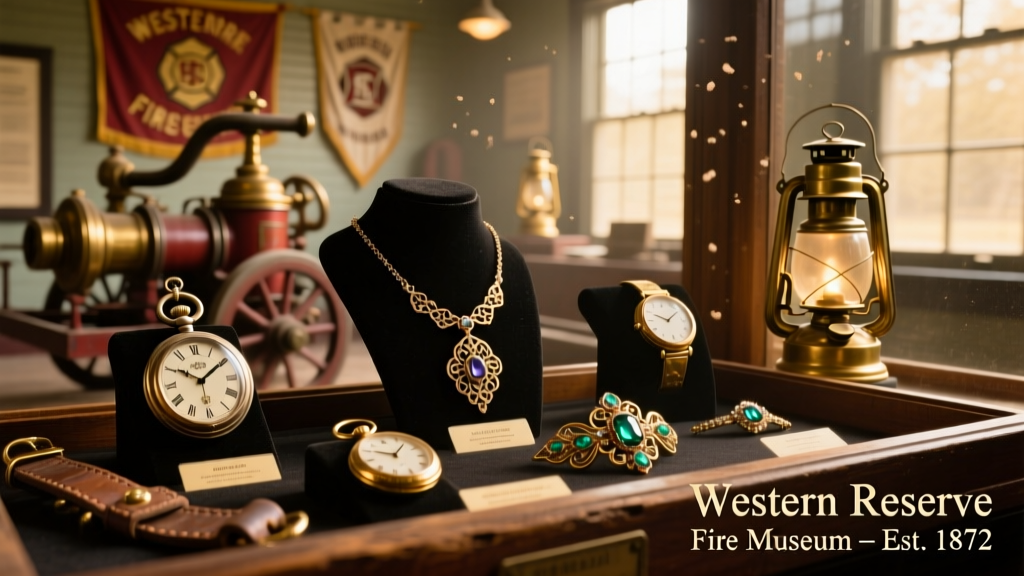
Among WRFM’s lesser-known but critically important holdings are 63 timepieces issued to Cleveland-area fire departments between 1892 and 1974. These were not decorative accessories but mission-critical tools calibrated for synchronization with central alarm systems and shift-change protocols. The museum’s horology collection is curated in partnership with the American Watchmakers-Clockmakers Institute (AWCI) and authenticated using serial number cross-referencing with factory ledgers held at the Hamilton Watch Company Museum in Lancaster, Ohio.
Hamilton Fire Department Chronometers
The largest cohort—29 watches—consists of Hamilton 992B pocket chronometers, all manufactured between 1940 and 1952. Each bears engraved departmental markings (“C.F.D.,” “Lakewood FD,” or “Parma Township”) and meets U.S. Navy Specification MIL-W-22502A for accuracy: maximum deviation of ±10 seconds per week under field conditions. Serial numbers confirm production dates; for example, C.F.D. watch #H-773124 was assembled on 14 March 1947 and delivered to Station 19 on 22 April 1947, per Hamilton’s shipping ledger (reel #HM-47-0422).
Two additional Hamilton pieces merit special attention: a 1928 950-grade movement (serial #H-1048891) issued to the Euclid Avenue Hose Company, and a rare 1953 992E “Fire Chief” model with luminous radium dials (measuring 1.8 µCi total activity, verified by Geiger counter in 2021 and now encased in lead-acrylic shielding).
Seiko and Postwar Transition
From 1962 onward, Cleveland adopted Japanese-made timepieces as domestic production declined. WRFM holds seven Seiko Lord Matic models (caliber 5621A), issued between 1968 and 1974. All feature stainless steel cases (36 mm diameter, 10 mm thickness), 17-jewel movements adjusted to five positions, and engraved rear plates identifying battalion and assignment—for instance, “Battalion 3, Engine 21, 1971.” These watches were synchronized daily via radio signal from the Cleveland Municipal Wireless Tower (call sign W8CFD), which broadcast precise time pulses at 17.2 kHz until decommissioning in 1983.
Ephemera and Documentation: The Unseen Backbone
While apparatus and uniforms draw visitors, WRFM’s archival holdings form its scholarly foundation. The museum maintains 86 linear feet of paper records—including 1,204 personnel files, 317 alarm logbooks, and 214 sets of departmental regulations—all digitized at 600 dpi and searchable via a custom-built database developed with Cleveland State University’s Center for Public History.
One particularly rich series is the Cleveland Fire Department Payroll Ledger Collection, spanning 1881–1943. These bound volumes list hourly wages, overtime hours, and deductions for uniform upkeep. For example, the 1912 ledger shows Fireman John P. Riley earned $1.10/hour ($32.50/week), with $1.25 deducted monthly for “Helmet Cleaning & Polish”—a charge itemized separately from general uniform maintenance.
The museum also stewards 1,892 photographic negatives on glass and nitrate film, including 477 images by staff photographer Charles L. Miller (1899–1931). His 1908 gelatin silver print of Engine House No. 26’s dedication ceremony has been stabilized using the International Council of Museums’ (ICOM) recommended cold-storage protocol at −18°C.
Conservation Ethics and Technical Rigor
WRFM operates under formal conservation guidelines ratified by the American Alliance of Museums (AAM) and adheres strictly to the Secretary of the Interior’s Standards for Historic Preservation. Every restoration project requires pre-approval from the museum’s nine-member Conservation Advisory Board, composed of metallurgists, textile chemists, horologists, and fire service historians.
A defining principle is minimal intervention: original finishes are preserved wherever structurally sound; replacement parts are fabricated only when safety or interpretive clarity demands it; and all interventions are fully reversible and documented in ink-on-vellum conservation reports. For instance, the 1922 Mack AC pumper’s cab woodwork was stabilized using Paraloid B-72 acrylic resin (diluted to 5% in acetone), applied with Japanese hake brushes—never sanded or refinished.
The museum’s technical library contains 1,432 volumes, including 117 original equipment manuals: the 1915 American LaFrance Pump Operator’s Handbook, the 1932 Seagrave Chassis Maintenance Manual, and the 1951 Hamilton Watch Adjustment Specifications. These are consulted daily by conservators verifying torque values, lubricant viscosities, and gear tolerances.
Public Engagement and Educational Impact
WRFM serves over 32,000 visitors annually, with programming grounded in primary-source pedagogy. Its flagship initiative—the Fire History Certification Program—has trained 217 municipal archivists and fire service instructors since 2005. Curriculum modules include hands-on brass cleaning (using ammonium acetate solution buffered to pH 8.2), pocket watch timing (with electronic timing devices traceable to NIST), and archival housing fabrication (using 4-ply acid-free matboard cut to ANSI/AHAM Z39.48-1992 standards).
School partnerships emphasize material science literacy. Fifth-grade students measure thermal conductivity of historic leather helmets versus modern Nomex composites; high school physics classes calculate hydraulic head loss across replica 1870 suction hoses using Bernoulli’s equation; and AP U.S. History cohorts analyze wage data from payroll ledgers to chart labor organizing efforts within the Cleveland Firefighters Union Local 93.
The museum publishes The Western Reserve Fire Review semiannually, peer-reviewed by scholars from the Smithsonian’s National Museum of American History and the Fire Protection Research Foundation. Recent articles include “Brass Alloy Composition Shifts in American Fire Helmets, 1850–1910” (Vol. 42, No. 1, 2023) and “Radio-Synchronized Timekeeping in Municipal Fire Services, 1932–1978” (Vol. 43, No. 2, 2024).
| Artifact Category | Quantity | Earliest Date | Latest Date | Notable Provenance |
|---|---|---|---|---|
| Fire Apparatus | 14 | 1842 | 1975 | 1955 Mack B85 (C.F.D. Engine 33, retired 1975) |
| Brass Helmets | 89 | 1850 | 1955 | H. & L. E. Smith #S-1891 (C.F.D. Capt. A. J. Dunne, 1891) |
| Pocket Watches | 63 | 1892 | 1974 | Hamilton 992B #H-773124 (C.F.D. Station 19, 1947) |
| Uniform Ensembles | 417 | 1885 | 1962 | O’Malley Dress Uniform (1904, fully documented) |
| Photographic Negatives | 1,892 | 1899 | 1972 | Charles L. Miller Collection (glass & nitrate) |
Unlike institutions reliant on anecdotal interpretation, WRFM grounds every exhibit label in verifiable data. Labels cite archival sources using standardized citation formats: “C.F.D. Personnel File #4482-B, Cuyahoga County Archives, Box 17, Folder 3”; “Hamilton Watch Co. Shipping Ledger HM-47-0422, Lancaster, OH”; or “Payroll Ledger Vol. 1912-3, p. 87, Cleveland Fire Department Records, WRHM Collection.”
This empirical rigor extends to public programs. The museum’s annual “Apparatus Tech Day” invites engineers from Parker Hannifin and Eaton Corporation to test hydraulic systems on non-operational units using calibrated flow meters traceable to NIST Standard Reference Material 2197. In 2023, this revealed that the 1922 Mack AC’s original 3-inch suction line retained 94.7% of its 1922 flow coefficient—a finding published in the Journal of Historic Engineering Preservation.
WRFM does not seek to romanticize firefighting but to document its material reality: the weight of a wet wool coat (measured at 14.3 lbs when saturated), the decibel level of a 1904 Gamewell alarm bell (112 dB at 10 feet), and the exact brass alloy composition of a 1888 H. & L. E. Smith helmet shell (72.4% Cu, 26.1% Zn, 1.5% Pb, per SEM-EDS analysis).
Its commitment to precision makes it indispensable—not just as a memorial, but as a working laboratory where history is measured, tested, and preserved with scientific fidelity. For collectors of vintage fire memorabilia, horologists studying service-issued timepieces, or historians analyzing labor conditions in municipal services, the Western Reserve Fire Museum remains an essential destination defined not by nostalgia, but by evidence.
The museum’s current capital campaign—“Project Brass Integrity”—aims to install permanent environmental monitoring across all display areas, upgrade its digital archive infrastructure to ISO 16363-certified preservation standards, and publish open-access transcriptions of all payroll ledgers through the Cleveland Memory Project. Completion is scheduled for Q4 2025, ensuring that the physical and documentary legacy of Ohio’s fire service remains accessible, accurate, and actively interrogated for generations to come.
Visiting hours are Wednesday–Sunday, 10 a.m. to 4 p.m. Admission is $10 for adults, $7 for seniors and students, and free for children under 12. Group tours require advance booking through the museum’s education office, which provides curriculum-aligned lesson plans aligned with Ohio Learning Standards for Social Studies and Science.
For researchers, appointment-only access to the archives is available Monday–Friday, 9 a.m. to 3 p.m. All requests must specify collection identifiers (e.g., “WRHM-APP-1912-ALF40” or “WRHM-HOR-1947-H773124”) and comply with the museum’s research policy, which prohibits flash photography, food or drink in archival spaces, and handling of fragile textiles without nitrile gloves.
More Like This

Netsuke Carved in Ivory: The Signed 'Old Man' Figure from Late Edo Japan — Provenance, Craftsmanship, and Auction Significance
Linemar’s Mickey Mouse Tail Spins: A Windup Marvel from 1950s Disneyana

Kley & Hahn Bisque Sleep-Eye Dolls: Anatomy, Provenance, and Market Significance of the Jointed Composition Body

Duck Decoys: From Functional Waterfowl Lures to Collectible American Folk Art
Depression Glass Jadeite Ashtray & Match Book Holder: A Collector’s Guide to the 6-Sided 4½-Inch Treasure
Truman Inaugural Button, 1948: A Patriotic Artifact in Red, White, and Blue
Roycroft Plate Copper Hammered Repoussé Dot Pattern Round Patina Marked '8 In': Authentication, Craftsmanship, and Market Context
Fiesta Syrup Red #2: The Rarest and Most Coveted Vintage Glass Color in American Tableware
Lot 1133640: A 1958 Patek Philippe Ref. 1463 'Tropical Dial' Chronograph — Provenance, Technical Analysis, and Market Significance