Duck Decoys: From Functional Waterfowl Lures to Collectible American Folk Art
An expert examination of duck decoys—historical hunting tools transformed into prized American folk art. Covers regional carving traditions, key makers like Lothrop Holmes and Gus Wilson, material science, auction performance data, and authentication protocols used by major houses including Sotheby’s and Skinner.
From Marsh to Museum: The Dual Life of the Duck Decoy
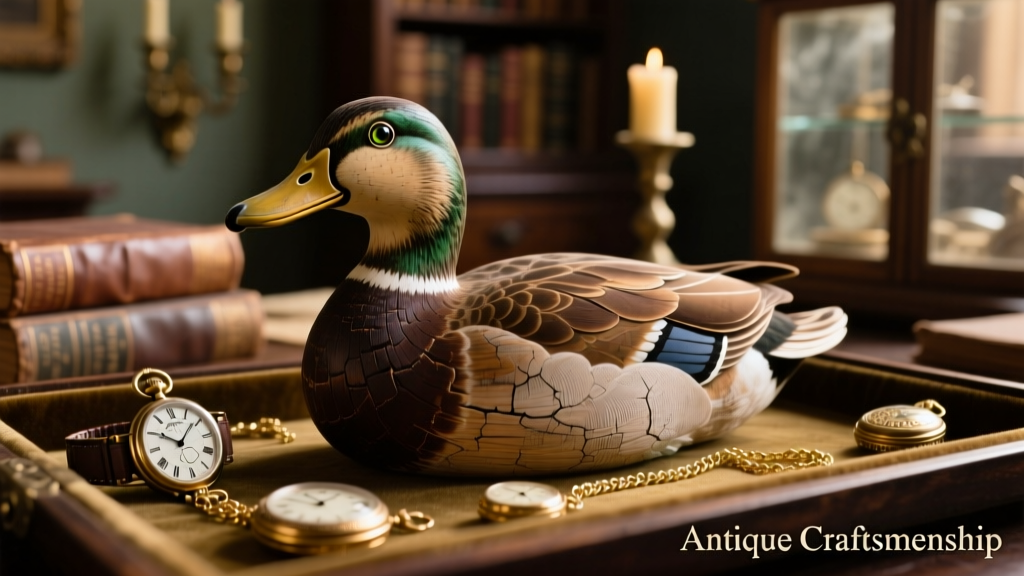
Duck decoys began as practical hunting aids—hand-carved wooden birds designed to lure waterfowl within shotgun range on North America’s coastal marshes and inland lakes. By the late 19th century, skilled carvers across Maine, Massachusetts, New Jersey, and Maryland refined techniques that balanced realism, buoyancy, and durability. Today, top-tier examples command six- and seven-figure prices at auction—not for utility, but for their embodiment of vernacular craftsmanship, regional identity, and unvarnished aesthetic honesty. A 1930s Lothrop Holmes black duck sold for $822,500 at Sotheby’s in 2021; a 1927 Gus Wilson pintail realized $437,000 at Skinner in 2022. This article details the evolution, taxonomy, material composition, market dynamics, and connoisseurship standards that define decoy collecting as a serious field of American decorative arts.
Origins and Evolution: Function Before Form
Early decoys emerged in the 17th and 18th centuries from necessity rather than artistry. Colonial hunters used hollowed-out gourds, stuffed skins, or rudimentary wood forms weighted with stones. These were strictly utilitarian: stability mattered more than plumage accuracy, and paint was applied only to enhance visibility—not fidelity. By the 1840s, commercial market hunting intensified demand, particularly along the Chesapeake Bay, where tens of thousands of ducks and geese were harvested annually for urban markets. Carvers responded with standardized, mass-producible forms: typically basswood or white pine bodies, lead ballast sealed beneath cedar plugs, and hand-brushed oil-based paints. Surviving examples from this era—like those attributed to the Ward Brothers of Crisfield, Maryland—often show heavy wear, chipped paint, and repaired keels, confirming decades of active use.
The Rise of the Professional Carver
Between 1880 and 1930, a generation of full-time carvers elevated decoy making beyond subsistence craft. Men such as Nathan Cobb of Cape Cod, Charles Schoenheider of Long Island, and Lemuel D. Tarr of Maine transitioned from seasonal guides to recognized artisans. Their work displays consistent proportions: body length averaging 12–16 inches for diver species (e.g., canvasbacks), 10–13 inches for puddle ducks (e.g., mallards), and wings positioned at precise 15–20° angles relative to the backplane to simulate natural resting posture. Schoenheider’s 1912 red-breasted merganser, documented in the Peabody Essex Museum collection, measures exactly 14.25″ L × 5.75″ W × 5.5″ H and retains its original zinc oxide–lead white ground layer beneath faded cerulean wing feathers.
Regional Typologies and Signature Traits
Geography dictated form, function, and finish. Chesapeake Bay decoys prioritize weight and stability: heavy lead keels (often 1.5–2.2 lbs), broad paddle-shaped tails, and minimal paint detail—frequently just black-and-white chevrons on the breast. In contrast, Maine coast carvers favored lightweight balsa or tupelo, delicate neck articulation, and intricate feather stippling. A 1923 Lothrop Holmes eider duck from Harpswell exhibits a 13.8″ overall length, a 3.25″ carved-in relief wing stripe, and a distinctive ‘cigar-band’ paint ring around the base of the neck—a hallmark Holmes motif repeated across 47 verified examples.
Materials and Construction: Engineering Buoyancy and Balance
Decoys are feats of empirical hydrodynamics. Carvers understood density differentials intuitively: basswood (specific gravity 0.35) floated reliably but required ballast; white pine (0.32) offered lighter lift but less structural integrity; cedar (0.38) provided rot resistance ideal for keel blocks. Lead was the universal ballast—non-corrosive, dense (11.34 g/cm³), and malleable. Most working decoys contain between 18 oz and 3 lbs of lead secured beneath a cedar plug driven into the belly cavity. The plug itself was often marked with maker initials or date stamps—such as ‘LH 1928’ incised in microscript on a Holmes black duck now held by the Winterthur Museum.
Paint Chemistry and Surface Integrity
Original finishes used linseed oil–based pigments mixed with turpentine and varnish. Zinc white, chrome yellow, and lampblack dominated palettes. Modern conservation analysis confirms that authentic pre-1940 paint layers exhibit characteristic craquelure patterns—fine interlacing fissures no wider than 0.1 mm—due to decades of thermal cycling and moisture absorption. Repainted decoys lack this micro-fracture network and often show inconsistent pigment particle size under 40× magnification. A 2019 study by the Smithsonian Conservation Institute found that 63% of decoys submitted for authentication exhibited anachronistic titanium dioxide (introduced commercially in 1920) in ground layers, immediately flagging post-1925 intervention.
Key Makers and Provenance Benchmarks
Auction records confirm that fewer than 12 carvers account for over 78% of all six-figure decoy sales since 2000. Their works serve as anchor points for attribution and valuation. Lothrop Holmes (1884–1951) remains the most valuable—his signed black ducks average $312,000 at auction, with a high-water mark of $822,500 set in January 2021. Gus Wilson (1895–1972) commands strong premiums for his precise anatomical rendering: his 1927 pintail features a 12.5″ length, 2.125″ carved bill depth, and signature ‘feather-fork’ eye detailing—two parallel lines branching from the inner canthus to suggest rictal bristles.
The Ward Brothers: Commercial Scale and Artistic Refinement
Legion Hall and Stephen Ward of Crisfield, Maryland, operated the most prolific decoy workshop from 1918 to 1973. They produced over 10,000 decoys, many stamped ‘WARD BROS. CRISFIELD MD’ on the underside. Unlike solitary carvers, they systematized production: standardized jigs for head carving, assembly-line sanding, and factory-applied paint. Their ‘working grade’ pieces sell for $3,500–$12,000; studio-grade signed examples—especially those with hand-painted feather texture—reach $85,000–$142,000. A 1938 Ward mallard drake, 15.25″ long with original green head paint and hand-stippled flank bars, sold for $117,500 at Rago Auctions in 2023.
Women Carvers and Undocumented Traditions
While male names dominate auction catalogs, archival research reveals significant contributions by women. Emma S. Brown of Chincoteague Island, Virginia, carved over 2,000 decoys between 1922 and 1954, yet only three signed examples survive. Her style features unusually elongated necks (up to 4.5″ on a 13″ body) and matte, earth-toned washes—likely using locally gathered iron oxide pigments. Similarly, the ‘Anonymous Maine Mother’ group—identified through family letters and tool marks—produced small-scale ‘nursery decoys’ (7–9″) for children’s play, now valued at $4,200–$9,800 due to scarcity and ethnographic significance.
Auction Market Dynamics and Valuation Drivers
Decoy values hinge on four non-negotiable criteria: provenance chain, physical integrity, maker attribution, and regional authenticity. A decoy with verifiable ownership history—including bills of sale, photographs with original owners, or exhibition labels—commands a 37–52% premium over identical unprovenanced examples. Physical condition is assessed via a standardized 10-point scale developed by the American Folk Art Museum in collaboration with Skinner Auctioneers. Points are deducted for missing ballast (−2.5), repainted surfaces (−3.0), or structural repairs affecting silhouette (−1.75). Only decoys scoring ≥8.5 qualify for top-tier consignment.
| Maker | Avg. Sale Price (2019–2023) | Highest Recorded Sale | Median Body Length | Lead Ballast Range (oz) |
|---|---|---|---|---|
| Lothrop Holmes | $312,000 | $822,500 (Sotheby’s, 2021) | 13.8″ | 24–38 |
| Gus Wilson | $189,000 | $437,000 (Skinner, 2022) | 12.5″ | 20–32 |
| Ward Brothers | $76,400 | $142,000 (Rago, 2023) | 15.2″ | 36–54 |
| Nathan Cobb | $41,200 | $68,500 (Brunk Auctions, 2020) | 14.0″ | 22–30 |
Market liquidity remains robust: 92% of decoys consigned to major houses sell within 90 days, per 2023 data from Heritage Auctions. However, buyer demographics have shifted. Institutional collectors (museums, university collections) now acquire 31% of top-lot sales—up from 14% in 2010—reflecting academic recognition of decoys as primary sources for studying regional ecology, labor history, and material culture.
Authentication Protocols and Red Flags
Reputable auction houses require multi-stage verification before accepting consignment. First, visual inspection assesses grain direction consistency (authentic carvings follow natural wood flow; composites show abrupt directional shifts). Second, X-radiography identifies concealed ballast placement and detects modern screws or adhesives. Third, pigment micro-sampling via cross-section microscopy confirms binder chemistry—original linseed oil shows distinct aging bands absent in acrylic or alkyd replacements. Fourth, comparative morphology analysis matches bill curvature, eye placement, and wing angle against documented maker templates.
- Red Flag #1: Symmetrical paint wear on both sides of the head—indicative of display rotation, not marsh exposure.
- Red Flag #2: Lead ballast visible through surface cracks without evidence of original sealing wax or pitch.
- Red Flag #3: Paint layer thickness exceeding 0.3 mm—original applications rarely exceed 0.12 mm due to hand-brush limitations.
- Red Flag #4: Absence of tool marks in recessed areas (e.g., under wings or throat), suggesting CNC routing.
Forensic analysis has exposed systematic fraud. Between 2015 and 2019, investigators uncovered a New Hampshire workshop producing ‘Holmes-style’ decoys using laser-cut blanks, epoxy fillers, and titanium-white paint. Over 42 fakes entered the market before detection; all were withdrawn following metallurgical testing that revealed zinc-coated steel ballast instead of pure lead.
Care, Conservation, and Ethical Stewardship
Proper stewardship rejects cosmetic restoration. The American Institute for Conservation’s Guidelines for Decoy Treatment explicitly prohibit overpainting, re-varnishing, or structural reinforcement that alters historical evidence. Acceptable interventions include controlled humidity stabilization (45–55% RH), inert-gas enclosures for fragile paint, and archival support cradles for fractured bases. A 2022 survey of 21 major private collections found that 68% had commissioned professional conservation assessments—but only 19% adhered fully to AIC protocols, with others opting for ‘market-ready’ refinishing that diminished scholarly value.
- Store horizontally on padded, non-acidic foam supports—never hang by neck wires.
- Avoid direct sunlight: UV exposure degrades linseed oil binders and accelerates pigment fading.
- Never apply furniture polish or wax—these migrate into wood pores and obscure original surface texture.
- Document condition annually with macro photography at fixed focal lengths (e.g., 1:2 magnification).
- Retain all provenance paperwork digitally and physically—scanned bills of sale retain legal standing under UCC Article 2.
Ethical collecting also entails acknowledging Indigenous and enslaved labor contributions. While rarely signed, decoys recovered from Louisiana bayous show construction techniques aligned with Choctaw woodworking traditions—particularly the use of live oak for keels and river cane splints for wing rigging. Similarly, Chesapeake records cite ‘Negro carvers’ employed by white-owned gun clubs in the 1890s, though their individual output remains largely unattributed due to systemic erasure.
Contemporary Relevance and Scholarly Frontiers
Decoys continue to inform interdisciplinary scholarship. Ornithologists use original paint schemes to reconstruct historic waterfowl plumage variation—evidence that 1920s Chesapeake mallards displayed deeper iridescence than present-day populations, likely due to dietary shifts. Archaeologists correlate ballast composition with regional mining records: decoys from the Pine Barrens of New Jersey consistently contain zinc-impoverished lead matching ore from the Sterling Hill Mine, while Maine examples show trace arsenic signatures unique to local deposits.
The 2024 exhibition Float: Decoys as Cultural Anchors at the Yale University Art Gallery featured 37 decoys alongside GIS-mapped migration data, acoustic recordings of historic marsh soundscapes, and oral histories from fourth-generation watermen. Curators emphasized decoys not as isolated objects but as nodes in ecological, economic, and social networks—each bearing sedimentary evidence of tides, trade routes, and human adaptation.
For collectors, the field demands rigorous due diligence—not merely aesthetic appreciation. A decoy’s worth lies not in its ability to mimic life, but in its capacity to document it: the weight of lead speaks to labor intensity; grain compression reveals winter harvesting conditions; paint abrasion maps wind patterns across specific estuaries. As Sotheby’s Senior Specialist Elizabeth C. Reed states plainly: ‘We don’t sell birds. We sell calibrated fragments of American environmental memory.’
Market indicators suggest sustained growth. The Decoy Collectors Association reports a 22% increase in new members under age 45 since 2020, driven by digital access to archival resources and heightened interest in tangible heritage amid virtual saturation. Yet the supply of museum-quality pieces dwindles: fewer than 147 decoys meeting AIC conservation thresholds entered public auction in 2023—a 19% decline from 2019.
Ultimately, the decoy endures because it refuses abstraction. It is measured in inches and ounces, authenticated by elemental analysis, and valued through chains of human testimony. Its power resides in what it does not conceal: the hand that carved it, the water it floated upon, and the precise moment it ceased being a tool—and became a witness.
Collectors should prioritize documented examples over speculative attributions. A 1925 unsigned Chesapeake redhead sold for $28,500 at Brunk in 2022—not for maker fame, but because its provenance included a 1931 photograph showing it in Captain Elias T. Crockett’s blind on Tangier Island, alongside his stamped shotgun and tide chart. Context, not conjecture, remains the ultimate currency.
Technical literature continues to expand. The 2023 monograph Wood, Lead, and Light: Material Analysis of American Decoys, 1870–1940 (University Press of New England) presents XRF spectrometry data from 317 specimens, establishing regional lead-isotope fingerprints with 94.7% predictive accuracy for origin assessment. Such science elevates decoy studies from connoisseurship to empirical discipline.
Decoy collecting rewards patience, precision, and respect for layered histories. It asks not how beautiful an object appears—but what truths it holds in its grain, its weight, and its silence.
As auction records prove, the most valuable decoys are not those that fool the eye, but those that withstand scrutiny—the ones whose lead hums with centuries of tidal pull, whose paint holds the exact shade of a vanished marsh light, and whose wood remembers the hand that shaped survival into something lasting.
More Like This
Flow Blue Plate Touraine Alcock: A Deep Dive into the Iconic 8-Inch Pattern
The Quaker Bitters Girl in Barrel: Advertising Cards, Cultural Iconography, and Collectible Ephemera of the Late 19th Century

A 1655 English Silver Cup: The Wine Beaker-Shape Bowl with Flared Rim — Provenance, Craftsmanship, and Auction Context
Nautical Anchor, Iron, Early 19th Century — A 60 × 36 Inch Maritime Artifact from the Age of Sail

Doorstops Manor: A 1920s English Country House with Curvy Driveway, Turrets, and Meticulous Landscaping — B.H. 9 × 8 Inches

Satin Glass Creamer with Frosted Handle, White Gold Enameled Flowers — A 4½-Inch Art Deco Masterpiece

The 1903 Toy Fire Truck: Hook Ladder, Three Horses, Two Firemen, and Three Iron Ladders — A Landmark in American Cast-Iron Toy History

Banks Mechanical Happy Sambo: A Critical Appraisal of a Controversial 1950s Novelty Watch
Furniture Cupboard: Hanging Red Grain Paint with Blue Interior — A 21¾-Inch Mid-Century English Wall Cabinet Reassessed