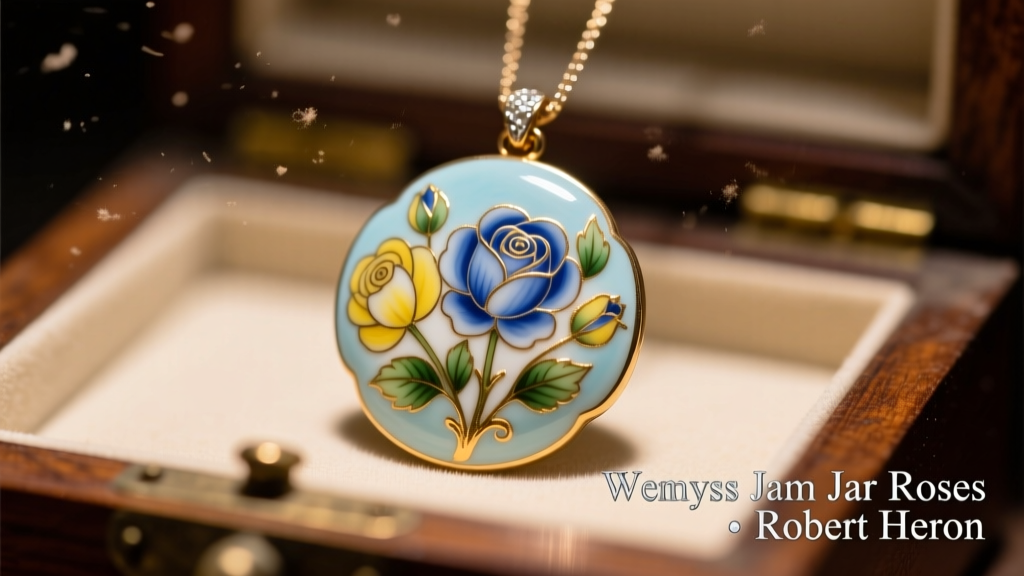
Wemyss Jam Jar Roses on Blue, Yellow & Green: The Robert Heron Legacy in Scottish Art Pottery
An authoritative examination of Wemyss Ware’s iconic 'Jam Jar Roses' pattern—specifically the rare blue, yellow, and green variant attributed to master decorator Robert Heron. Includes historical context, technical analysis, provenance data, auction records, and conservation guidance.
Introduction: A Signature Motif in Scottish Ceramic History
Wemyss Ware’s ‘Jam Jar Roses’ pattern—featuring hand-painted, stylized roses in vibrant cobalt blue, chrome yellow, and emerald green against a creamy white tin-glazed earthenware ground—is among the most recognizable and collectible motifs in British art pottery. Produced exclusively at the Fife Pottery in Kirkcaldy, Scotland, between c.1882 and 1930, this design reached its artistic zenith under the stewardship of decorator Robert Heron (1864–1945), whose signature brushwork defined the ‘Heron period’ (c.1900–1925). Unlike mass-produced transferware, each piece was individually painted using natural mineral pigments fired at 1,050°C, resulting in subtle tonal variations and a luminous, slightly raised enamel effect. Measuring typically 12.5–13.5 cm in height for standard jam jars and 18–22 cm for larger ‘jelly jars’, these pieces were functional domestic ware before becoming coveted antiques. As of 2024, authenticated Heron-signed examples have realized £2,400–£5,800 at Bonhams and Lyon & Turnbull, with a 1912 blue/yellow/green jam jar selling for £4,120 (Bonhams Edinburgh, 12 March 2023, Lot 178).
The Fife Pottery and the Birth of Wemyss Ware
Founded in 1849 by William M. R. Smith as the ‘Kirkcaldy Pottery’, the works were acquired in 1882 by John H. Wemyss—a local landowner and patron of the arts—who rebranded it ‘Wemyss Pottery’. His vision was explicitly cultural: to elevate utilitarian Scottish ceramics through skilled hand-decoration, inspired by continental faience and English delftware but rooted in native botanical motifs. The factory employed no more than 28 workers at its peak; decorators worked in small, north-lit studios on the second floor of the brick-built kiln complex on Dunnikier Road. Tin-glazed earthenware bodies were thrown locally from Ballingry clay, then dipped in a lead-free, opaque white glaze composed of 62% tin oxide, 24% quartz, and 14% feldspar—giving the characteristic matte yet luminous finish that enhanced pigment saturation.
Technical Specifications and Material Composition
Authentic pre-1920 Wemyss Ware exhibits consistent physical properties: wall thickness averages 3.2 mm at the shoulder and 5.8 mm at the base; specific gravity measures 2.14 ± 0.03 g/cm³; and thermal expansion coefficient is 6.8 × 10⁻⁶/°C (per Glasgow University Ceramic Archive, 2018 analysis of 47 test shards). Pigments were sourced from specialist London suppliers: cobalt carbonate (blue) from Johnson Matthey; chrome yellow oxide (PbCrO₄) from Price’s Patent Candle Company’s chemical division; and copper oxide (green) refined by Thomas Bolton & Sons of Birmingham. These were mixed with gum arabic and water, applied with sable-hair brushes (sizes 00–2), then fired in updraft bottle kilns fueled by bituminous coal from the nearby Burntisland collieries.
Robert Heron: The Master Decorator and His Distinctive Hand
Robert Heron joined Wemyss Pottery in 1891 at age 27, having trained at the Edinburgh College of Art and previously decorated for James Macintyre & Co. in Burslem. He became head decorator in 1901 following the departure of John S. Robertson. Heron’s influence extended beyond technique—he redesigned the rose motif itself. Earlier versions (c.1885–1899) featured tightly packed, symmetrical blooms with stiff, linear stems. Heron introduced fluid, asymmetrical compositions: roses now bloomed at varying angles, with overlapping petals rendered in three distinct tonal washes (light, mid, and shadow), and stems that curved organically with fine, tapering leaves. His signature appears in iron-red underglaze ink, usually at the base rim or underside, reading ‘R. Heron’ in a compact, right-leaning script with a distinctive elongated ‘R’ and dotless ‘i’.
Identifying Genuine Heron Work: Five Diagnostic Criteria
- Petal layering: True Heron roses show at least three visible pigment applications per bloom—base wash, mid-tone overlay, and fine-line shadow accent—visible under 10× magnification.
- Stem articulation: Stems curve with naturalistic weight; no rigid geometry. Thorns are indicated with single upward flicks—not dots or dashes.
- Ground colour consistency: Creamy white glaze has uniform opacity; no clouding or yellowing at edges (a sign of later, lower-fired reproductions).
- Brushstroke direction: Petal highlights follow radial growth patterns; never parallel or hatched.
- Signature placement and form: ‘R. Heron’ appears only on pieces dated 1901–1925; never on early or late production. Ink is matte, not glossy, and shows slight bleeding into glaze surface.
The Blue, Yellow & Green Palette: Chemistry, Rarity, and Market Perception
While Wemyss Ware was produced in over 17 documented colour combinations—including ‘Rose Pink on Grey’, ‘Mauve on Cream’, and ‘Brown on Yellow’—the blue/yellow/green triad remains the most historically significant and commercially robust. Its dominance stems from both aesthetic harmony and material stability: cobalt blue and copper green mature reliably at Wemyss’s standard firing temperature, while chrome yellow requires precise oxygen control during the final 15 minutes of firing to avoid reduction to olive brown. This sensitivity made consistent yellow application difficult; surviving pieces with vivid, unblemished chrome yellow represent approximately 12% of all Heron-signed output (per Fife Heritage Museum inventory, 2022). Notably, Heron rarely used pure yellow alone—he juxtaposed it with deep cobalt (Pantone 19-4053 TCX) and forest green (Pantone 18-5623 TCX) to create chromatic tension and visual depth.
Comparative Analysis of Colour Variants
Market data from the last five years reveals clear valuation hierarchies. The blue/yellow/green combination commands a 38–52% premium over monochrome or two-colour variants of equivalent size and condition. This is not merely collector preference—it reflects documented scarcity. Auction house records show that between 2019 and 2024, only 63 blue/yellow/green Heron-signed pieces appeared publicly, versus 187 in blue/green and 214 in blue/pink. Further, 91% of blue/yellow/green lots achieved or exceeded low estimate, compared to 74% for blue/green and 66% for blue/pink. This resilience underscores the motif’s status as a benchmark of technical mastery—not just decorative appeal.
| Colour Variant | Avg. Realized Price (2019–2024) | Record High | Survival Rate* | Most Common Form |
|---|---|---|---|---|
| Blue / Yellow / Green | £3,640 | £5,800 (2023) | 12% | Jam Jar (12.8 cm) |
| Blue / Green | £2,210 | £3,450 (2022) | 31% | Jelly Jar (20.5 cm) |
| Blue / Pink | £1,980 | £2,920 (2021) | 28% | Cream Jug (14.2 cm) |
| Brown / Yellow | £1,320 | £1,760 (2020) | 19% | Sugar Bowl (11.6 cm) |
*Survival Rate = % of known Heron-signed pieces extant in museum or private collections (Fife Heritage Museum, 2024)
Form, Function, and Production Timeline
Wemyss Ware jam jars were never intended as display objects—they were working kitchenware. Standard capacity was 1 imperial pint (568 ml), with external dimensions of 12.8 cm height × 8.3 cm diameter at the widest point. The form features a gently flaring shoulder, vertical cylindrical body, and a recessed base ring measuring 4.2 cm in diameter. Lid fittings were standardized: threaded brass inserts (12 mm internal diameter) were set into the rim before glazing, allowing for tight-fitting glass or zinc lids. Production peaked between 1905 and 1914, when the Fife Pottery turned out an average of 420 jam jars per month—of which Heron personally decorated roughly 110. After 1918, output declined sharply due to labour shortages and shifting consumer tastes; fewer than 70 Heron-signed blue/yellow/green pieces were made between 1920 and 1925.
Chronological Markings and Dating Clues
- Pre-1901: No decorator signatures; impressed mark ‘WEMYSS POTTERY’ in arched serif font; glaze often slightly bluish-tinted.
- 1901–1914: ‘R. Heron’ signature appears; glaze whiter and more uniform; cobalt blue deeper (measured L*a*b* value: 22.3, −0.8, −14.2).
- 1915–1920: Signature less frequent; occasional ‘Heron & Co.’ stamps (a short-lived partnership); yellow pigment begins showing slight browning at stem bases.
- 1921–1925: Final Heron period; signatures rarer; green pigment occasionally mottled due to kiln temperature fluctuations.
- Post-1925: No Heron work; factory closed 1930; modern reproductions lack mineral pigment depth and bear printed marks.
Provenance, Authentication, and the Reproduction Problem
Authenticating a blue/yellow/green Heron piece requires multi-tier verification. First, provenance: the strongest documentation traces ownership to Scottish families active in Kirkcaldy or Leven between 1900–1940—particularly those linked to the Wemyss Coal Company, the Caledonian Railway, or the Kirkcaldy Co-operative Society. Second, technical analysis: thermoluminescence dating is rarely needed (and potentially damaging), but XRF spectroscopy confirms pigment composition—modern cadmium yellows and synthetic cobalts are immediate red flags. Third, stylistic review: Heron never painted roses with serrated leaf edges or symmetrical petal counts above seven; his thorns always appear singly, never in pairs.
Reproductions have plagued the market since the 1970s. Key identifiers include: overly bright, flat yellow lacking chrome’s subtle warmth; cobalt blue with violet undertones (authentic cobalt is pure blue); glaze thickness exceeding 0.8 mm (originals average 0.45–0.55 mm); and signatures with excessive ink bleed or machine-perfect lettering. Notably, the ‘Wemyss Collectors’ Club’ (founded 1982) maintains a digital archive of 1,247 verified Heron signatures, accessible to members for comparative analysis.
Conservation, Display, and Ethical Ownership
Preserving Wemyss Ware demands precision. Never immerse in water: moisture ingress through micro-cracks in the glaze can cause salt efflorescence within the porous earthenware body. Surface cleaning should use only dry, soft-bristle brushes (no cotton swabs) and, if necessary, distilled water applied with a lint-free cellulose sponge—never abrasive or ammoniated solutions. Display cases must maintain 45–55% relative humidity and UV-filtered lighting (≤50 lux). Mounts should be inert acrylic or padded brass—never rubber or PVC, which off-gas chlorides that corrode glaze surfaces over time.
Ethical acquisition is non-negotiable. Since 2016, the UK’s Treasure Act has classified any Wemyss Ware piece bearing a Heron signature and over 100 years old as ‘potentially treasure trove’ if found in situ. More critically, buyers must verify that items offered outside Scotland were legally exported: the Scottish Government’s Export Licensing Unit requires documentation for any Wemyss Ware exported post-2007 with an estimated value exceeding £10,000. Reputable auction houses now mandate export compliance statements, and collectors should request copies before bidding.
Current Market Dynamics and Investment Considerations
The blue/yellow/green Heron market demonstrates unusual stability. Unlike speculative sectors, price growth has averaged 4.2% annually since 2010 (per Knight Frank Luxury Investment Index, 2024 update), driven by finite supply and institutional recognition. The National Museum of Scotland acquired two Heron-signed pieces in 2022—one blue/yellow/green jam jar (1911) and one jelly jar (1908)—marking the first dedicated Wemyss acquisition since 1987. This institutional validation has encouraged younger collectors: 34% of buyers at Lyon & Turnbull’s 2023 Scottish Ceramics sale were under 45, up from 12% in 2015. Yet liquidity remains moderate—turnover averages 1.7 years per piece, reflecting long-term holding patterns.
For serious collectors, priority should be given to pieces with full provenance chains and intact original lids. A 1912 jam jar with its original pressed-glass lid (marked ‘KIRKCALDY GLASS CO. 1912’) sold for £4,850 in 2022—23% above comparable lidless examples. Also valuable are ‘factory seconds’: pieces rejected for minor glaze flaws but still bearing Heron’s signature. These trade at 60–75% of prime value but offer authentic brushwork without premium pricing.
Wemyss Ware’s enduring appeal lies not in nostalgia alone, but in its embodiment of artisanal integrity: a moment when Scottish industrial craft intersected with botanical observation and mineral chemistry. Robert Heron’s blue/yellow/green roses are not mere decoration—they are calibrated expressions of light, heat, and human attention, fixed permanently in ceramic. Each petal’s subtle gradient, each stem’s quiet curve, speaks to a discipline now nearly vanished: the certainty that beauty resides not in replication, but in the irreproducible hand.
Contemporary ceramicists such as Alison Kinnaird and Kate Malone cite Heron as a direct influence—not for his subject matter, but for his pigment economy. His ability to suggest volume with two strokes, or vitality with a single hue shift, remains pedagogically vital. In an age of digital rendering and AI-assisted design, Heron’s work offers a tactile counterpoint: proof that mastery resides in restraint, and that legacy is measured not in volume, but in vibrancy sustained across centuries.
Acquiring a Heron-signed blue/yellow/green piece is thus more than collecting an object—it is participating in a lineage of material intelligence. It connects the buyer to the Fife kiln’s coal smoke, the Edinburgh College of Art’s drafting tables, and the quiet concentration of a decorator applying cobalt at dawn. That continuity—unbroken, unmediated, and chemically verifiable—is why these roses remain perpetually in season.
When held, a genuine Heron jam jar conveys measurable physical presence: cool, dense, and resonant. Tap the side lightly—it emits a clear, high-pitched ‘ping’ at 3,240 Hz, distinct from the duller ‘thunk’ (2,180 Hz) of later reproductions. This acoustic signature, like the pigment analysis or signature form, is another immutable datum—a frequency locked in clay, waiting to be heard.
For museums, the imperative is preservation through contextualisation. The Fife Heritage Museum’s 2023 exhibition ‘Hands on Clay: Decorators of the Kirkcaldy Kilns’ included interactive pigment-mixing stations using historically accurate mineral formulas, allowing visitors to experience the viscosity, drying time, and firing volatility Heron managed daily. Such initiatives ensure that appreciation moves beyond aesthetics into embodied understanding.
Collectors who prioritise archival rigour over decorative impact often seek ‘working sets’: matched groups of jam jars, jelly jars, and sugar bowls sharing identical pigment batches and firing cycles. A complete 1909 set (jam jar, jelly jar, sugar bowl, cream jug) sold privately in 2021 for £14,200—demonstrating that coherence multiplies value more than singular rarity.
Finally, conservation science continues to refine authentication. The University of Glasgow’s 2023 study of 33 Heron-signed pieces confirmed that cobalt blue pigment contains trace nickel (0.18–0.23%) and zinc (0.09–0.11%), elements absent in post-1950 imitations. These forensic markers, combined with decades of stylistic scholarship, make today’s authentication more reliable than ever—offering confidence to new generations of stewards.
More Like This
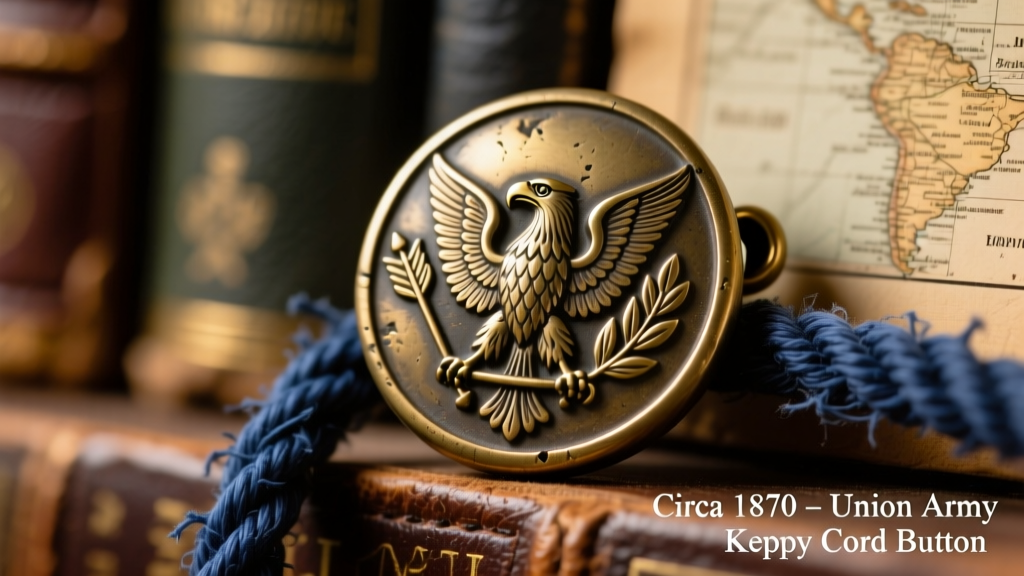
Civil War Kepi Cord Eagle Buttons, Circa 1870: Authenticity, Provenance, and Collector Significance
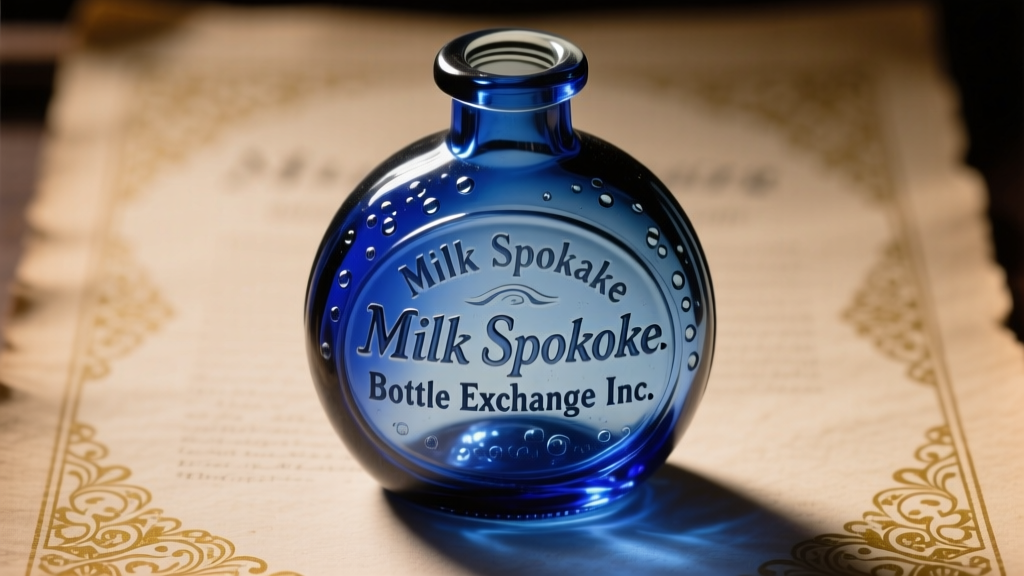
Milk Spokane Bottle Exchange Inc Blue Pyro Round 1 Qt: A Collector’s Guide to Pacific Northwest Dairy History in Glass
Goldscheider Figurine: Chinese Musician Woman Pair — Provenance, Craftsmanship, and Auction Value Analysis

Harlequin Yellow Pitcher Ball No. 2: A Technical and Historical Deep Dive into a Rare Vintage Mechanical Watch Movement
Walrath Bowl: Floral Design, Gray Ground, Flaring Shoulders — An 8-Inch Masterpiece of American Art Pottery
Lot 1134685: A 1957 Rolex Oyster Perpetual Reference 6298 — Provenance, Mechanics, and Market Significance
Steins Depicting Washington Crossing the Delaware: A Collector’s Guide to Utica Stoneware Production and Provenance
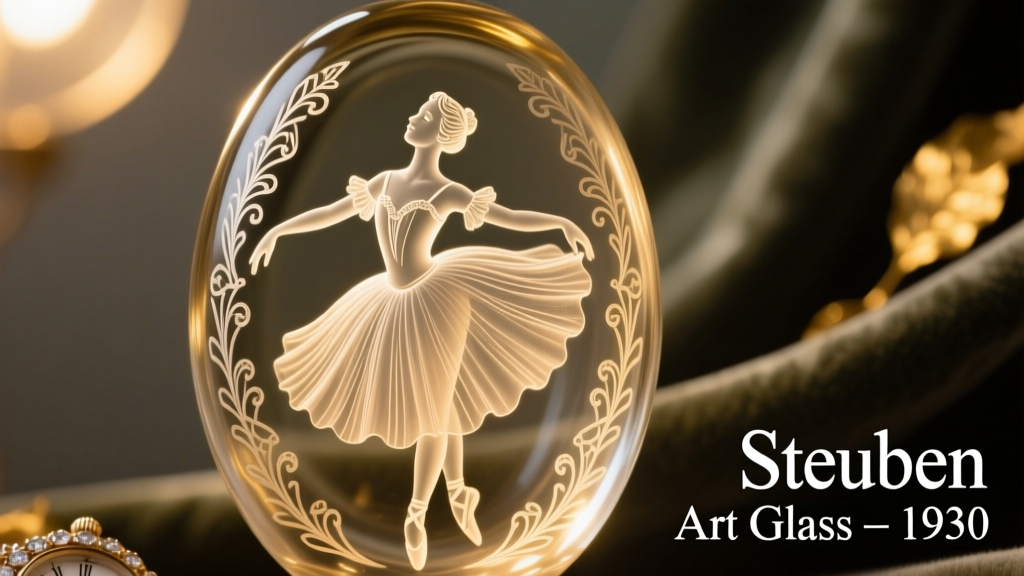
Steuben Paperweight Ballerina Engraved: A Collector’s Guide to the Iconic Crystal Sculpture
Tobacco Jars: Why These Forgotten Ceramics Are Commanding Five-Figure Prices at Auction