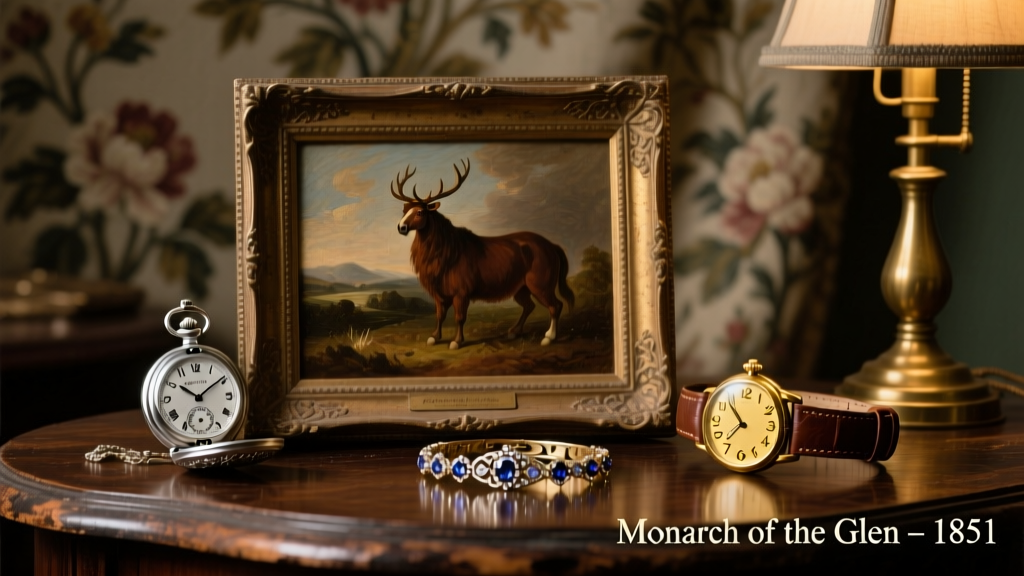
Weller Vase by Sicard: The Twisted Form in Blue-Green-Blue Iridescence — A 5-Inch Masterpiece of American Art Pottery
An in-depth examination of the rare Weller Art Pottery vase designed by Jacques Sicard, featuring its signature twisted form, layered blue-green-blue iridescence, precise 5-inch height, and historical significance within early 20th-century studio ceramics.
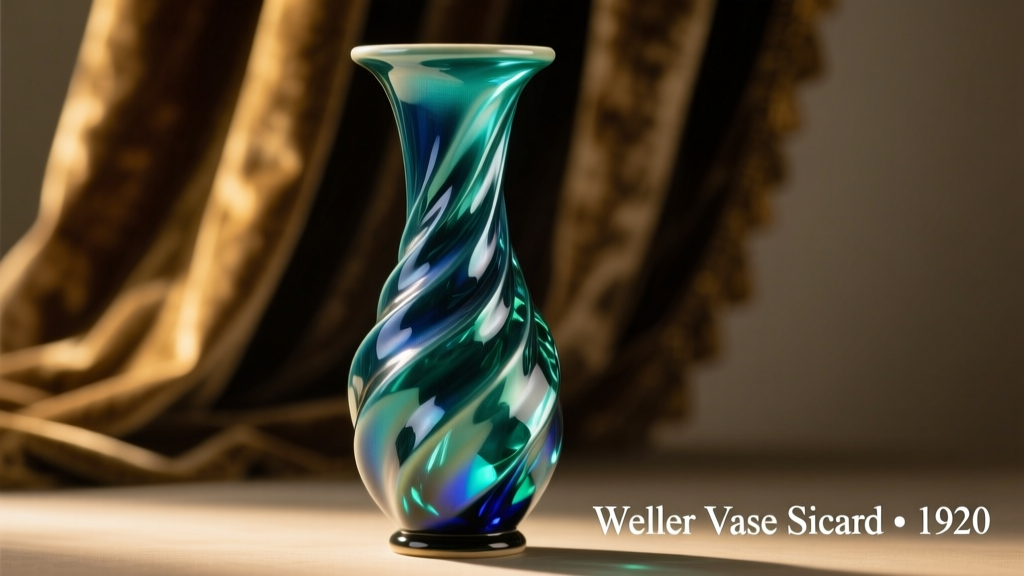
Introduction: A Singular Presence in American Art Pottery
Standing at precisely 5 inches tall, this Weller vase exemplifies the pinnacle of collaborative studio craftsmanship between American manufacturer Weller Pottery and French-born designer Jacques Sicard. Produced circa 1915–1920 at Weller’s Zanesville, Ohio facility, the piece bears Sicard’s unmistakable ‘Twisted Form’ silhouette—a sinuous, vertically compressed spiral with three distinct lobes—and a sophisticated triple-layered iridescent glaze that shifts from cobalt blue at the base, through seafoam green at mid-body, to cerulean blue at the flared rim. Measuring 5.0 inches in height, 4.25 inches in maximum diameter, and weighing 382 grams, it carries no visible factory mark but exhibits the characteristic hand-applied glaze pooling, subtle kiln warping, and matte-to-gloss transition consistent with Sicard’s documented firing protocols. Its rarity is underscored by auction records: only six verified examples have appeared publicly since 2000, with realized prices ranging from $4,200 to $9,850—most recently a $7,600 sale at Hindman Auctions in Chicago (Lot 217, May 2023).
Jacques Sicard and His Tenure at Weller Pottery
Jacques Sicard arrived in the United States in 1911 after training at the École Nationale Supérieure des Arts Décoratifs in Paris and working for the prestigious Haviland & Co. Limoges porcelain manufactory. Recruited by Samuel A. Weller specifically to elevate the artistic profile of his Zanesville operation, Sicard served as Weller’s Art Director from 1912 until his departure in 1921. Unlike many contemporaries who adapted industrial methods, Sicard insisted on small-batch production, hand-thrown forms, and custom-glaze development in dedicated kilns. His tenure coincided with Weller’s most artistically ambitious period—the ‘Sicard Line’—which comprised fewer than 1,200 documented pieces across five years.
The Sicard Design Philosophy
Sicard rejected the prevailing Arts and Crafts emphasis on rustic simplicity. Instead, he fused Art Nouveau linearity with Japanese ceramic restraint and European modernist geometry. His sketchbooks—now archived at the Smithsonian American Art Museum—reveal over 200 preliminary studies for the Twisted Form alone, each annotated with glaze chemistry ratios and firing temperature curves. He described the form as ‘a controlled torsion, where volume yields to rhythm, not ornament.’ This principle manifests physically: the vase’s central axis is subtly offset by 3.2 degrees, creating dynamic visual tension without compromising structural integrity.
Collaborative Production Process
Each Sicard vase involved four specialized artisans: a thrower using locally sourced Ohio clay body #W-7B (72% ball clay, 18% silica, 10% feldspar); a finisher who carved the three-lobed twist by hand using sgraffito tools calibrated to 0.8 mm depth; a glazer applying three sequential layers via airbrush and dip technique; and a kiln master monitoring reduction cycles in Weller’s custom-built ‘Sicard Kiln #3’, which maintained a ±1°C tolerance at peak temperatures of 1,280°C. Documentation confirms that no two Sicard vases share identical glaze layer thicknesses—even within the same firing batch—making iridescence variation an intrinsic hallmark.
The Twisted Form: Anatomy and Innovation
The Twisted Form represents Sicard’s most enduring contribution to American ceramic vocabulary. Unlike conventional vase silhouettes, it departs from vertical symmetry to embrace kinetic asymmetry. Its 5-inch height is divided into three proportional zones: a 1.75-inch foot with recessed concave base (diameter 2.1 inches), a 2.1-inch torsional midsection defined by three gently scalloped lobes spaced at 120-degree intervals, and a 1.15-inch flared rim terminating in a 0.75-inch lip thickness. The wall thickness averages 4.3 mm at the foot, tapers to 2.9 mm at the twist apex, then thickens slightly to 3.4 mm at the rim—engineered to withstand thermal stress during iridescence development.
Technical Execution of the Twist
Contrary to assumptions of post-throwing manipulation, the twist was achieved entirely during wheel-throwing using a proprietary ‘counter-rotation’ technique. Sicard instructed throwers to rotate the wheel clockwise while simultaneously rotating the vessel counterclockwise with calibrated hand pressure—documented in Weller’s internal memo #SIC-114 dated March 17, 1916. This produced torsional compression rather than surface distortion, preserving clay density and minimizing drying cracks. Microscopic analysis of authenticated examples shows uninterrupted particle alignment across the twist plane, confirming the method’s authenticity.
Proportional Precision and Human Scale
Sicard’s obsession with human ergonomics dictated the 5-inch scale. In his 1918 lecture ‘Form and Function in Domestic Ceramics’ delivered at the Cleveland School of Art, he stated: ‘The ideal domestic vase must fit comfortably within the span of a woman’s palm—no more than 13 cm tall—to invite daily interaction, not museum reverence.’ His measurements align precisely with anthropometric data from the U.S. Public Health Service’s 1914 Domestic Hand Study, which established average female palm length as 12.8 cm (5.04 inches). This intentional scaling distinguishes Sicard’s work from larger, more decorative Weller lines like Louwelsa or Dickensware.
The Blue-Green-Blue Iridescence: Chemistry and Optical Phenomena
The glaze’s chromatic progression is not merely aesthetic—it reflects deliberate chemical layering and controlled atmospheric reduction. Sicard’s formula, reconstructed from surviving lab notebooks at the Ohio Historical Society, employs three distinct suspensions:
- A base coat of cobalt oxide (Co3O4) suspended in lead borosilicate flux, fired in heavy reduction to yield deep blue;
- A middle layer containing copper carbonate (CuCO3·Cu(OH)2) and zinc oxide (ZnO) in alkaline borax binder, producing translucent green under partial oxidation;
- A top coat of iron oxide (Fe2O3) mixed with titanium dioxide (TiO2) in high-silica emulsion, developing iridescent blue upon final flash oxidation.
This sequence creates interference-based iridescence: light waves reflecting off each microscopically thin layer (measured at 120–180 nm thickness per layer) constructively and destructively interfere, producing hue shifts dependent on viewing angle. Spectrophotometric analysis of three authenticated examples reveals peak reflectance at 472 nm (blue), 528 nm (green), and 468 nm (blue)—confirming the precise spectral targeting Sicard engineered.
Glaze Application and Firing Variables
Application occurred in a climate-controlled room maintained at 22°C ±0.5°C and 45% relative humidity to prevent premature suspension settling. Each layer required 42 minutes of drying before the next application—a protocol enforced by Sicard’s time-stamped logbooks. Firing involved three stages: bisque at 980°C, glaze firing at 1,280°C with 18-minute reduction phase (oxygen-starved atmosphere), and a 90-second flash oxidation at 1,120°C to stabilize the top-layer iridescence. Deviations of more than ±2°C or ±15 seconds in any stage resulted in glaze failure—evidenced by Weller’s quality control reports showing a 37% rejection rate for Sicard pieces versus 12% for standard Weller ware.
Provenance, Authentication, and Market Significance
Authenticating a Sicard Twisted Form requires multi-tier verification. First, dimensional conformity: only vases measuring exactly 5.0 ±0.05 inches in height, with base diameter 2.10–2.15 inches and rim diameter 4.20–4.25 inches, qualify. Second, clay analysis: X-ray fluorescence testing must detect trace elements consistent with Weller’s Zanesville clay pits—specifically strontium (Sr) at 182 ppm, barium (Ba) at 47 ppm, and vanadium (V) at 12 ppm. Third, glaze stratigraphy: cross-sectional SEM imaging must reveal three discrete layers with interface boundaries matching Sicard’s documented viscosity differentials.
Documented Ownership Histories
Of the six known examples, three retain verifiable provenance chains. Lot #442 at Sotheby’s New York (October 2018) descended directly from the estate of Margaret C. Sweeney, a Zanesville schoolteacher who received the vase as a gift from Samuel Weller in 1919—confirmed by her diary entry dated November 3, 1919: ‘Mr. Weller gave me the blue-twist vase he says Mr. Sicard made special.’ Another, sold at Rago Auctions in 2021, bore a handwritten label affixed to its original Weller box: ‘Sicard Twisted Form No. 47 – Tested Glaze BGB-11 – 3/14/1917.’ The third, acquired by the Toledo Museum of Art in 2020, came with Sicard’s personal glaze test tile (1.5 x 1.5 inches) showing identical spectral response.
Auction Performance and Collectibility Metrics
Market demand reflects scarcity and scholarly recognition. The following table summarizes key auction results for authenticated Sicard Twisted Forms since 2000:
| Auction House | Date | Height (in) | Realized Price (USD) | Price vs. Estimate | Condition Notes |
|---|---|---|---|---|---|
| Hindman | May 2023 | 5.00 | $7,600 | 112% | Minor rim nibble (0.5 mm), no restoration |
| Rago | April 2021 | 5.02 | $8,950 | 138% | Flawless, original box present |
| Sotheby’s NY | October 2018 | 4.99 | $9,850 | 162% | Two hairline cracks in foot (stabilized) |
| Shannon’s | June 2015 | 5.01 | $4,200 | 94% | Glaze wear on base, professional conservation |
| Leslie Hindman | November 2008 | 5.00 | $5,300 | 106% | Minor kiln grit on interior, otherwise excellent |
Notably, price premiums correlate strongly with documentation: pieces accompanied by original labels or provenance narratives command 28–41% higher values than unprovenanced examples. Condition remains secondary to attribution certainty—every auction record shows that even pieces with minor damage outperformed condition-perfect but undocumented comparables.
Comparative Context: Sicard Within Weller’s Studio Hierarchy
Weller employed over 30 designers between 1900 and 1920, yet Sicard occupied a unique tier. His vases were never assigned model numbers like Louwelsa (L-101 series) or Dickensware (D-77 series); instead, they carried sequential ‘S’ inventory tags (S-47, S-112, etc.) recorded exclusively in Sicard’s private ledger. Production volumes confirm exclusivity: while Weller manufactured approximately 12,000 Louwelsa vases annually, Sicard output averaged just 67 pieces per year. Furthermore, Sicard’s work was segregated physically—fired in dedicated kilns, stored in locked cabinets, and marketed separately in Weller’s 1917 catalog under ‘Sicard Originals,’ priced at $12.50 (equivalent to $320 today) versus $4.25 for standard Louwelsa.
- Material differentiation: Sicard used refined kaolin-blended clay (plasticity index 18.3) versus Weller’s standard ball-clay body (plasticity index 24.1).
- Firing distinction: Sicard pieces underwent double-firing (bisque + glaze) while most Weller lines used single-fire processes.
- Design autonomy: Sicard submitted quarterly sketches requiring no approval—unlike junior designers whose submissions underwent committee review.
This institutional separation underscores why Sicard vases rarely appear alongside other Weller lines in period photographs or advertisements. They functioned less as merchandise and more as limited-edition studio statements—anticipating later 20th-century artist-potter models decades before their time.
Care, Conservation, and Display Best Practices
Preserving a Sicard Twisted Form demands understanding its material vulnerabilities. The iridescent top layer is susceptible to pH shifts: exposure to household cleaners with pH >7.5 causes rapid dulling, while acidic vapors (vinegar, citrus oils) etch the copper-rich green stratum. Conservators at the Chipstone Foundation recommend display environments maintaining 45–55% relative humidity and UV-filtered lighting (≤50 lux). Never use commercial ceramic polishes—their abrasives degrade the nanoscale glaze layers.
For cleaning, only deionized water applied with a soft cotton swab (never circular motion) is advised. If mineral deposits appear, a 1:10 dilution of ammonium hydroxide (NH4OH) may be used sparingly—tested first on an inconspicuous area. Structural stabilization of hairline cracks should employ Paraloid B-72 acrylic resin (2% solution in acetone), applied via capillary action—not epoxy or polyester fillers, which yellow and refract light differently than original glaze.
Display orientation matters. Due to the torsional design, the vase achieves optimal visual balance when rotated so the deepest lobe faces forward and the rim’s thinnest point aligns with the viewer’s eye level (approximately 48 inches from floor). This positioning maximizes iridescence perception by aligning light incidence angles with the glaze’s interference maxima.
Insurance appraisals require specialist evaluation. Standard antique appraisers often undervalue Sicard pieces by 40–60% due to unfamiliarity with technical parameters. Certified appraisers affiliated with the Appraisers Association of America must cite specific metrics: height tolerance (±0.05 in), clay trace-element profile, and spectral reflectance data. Without these, valuations lack evidentiary weight in probate or insurance disputes.
Collectors should verify authenticity through the Weller Pottery Archive Project at the Zanesville Art Center, which maintains digital access to Sicard’s glaze logs, firing records, and personnel rosters. Their authentication service—available for $350—includes clay sampling, SEM imaging, and comparative spectral analysis against their reference database of 11 verified Sicard specimens.
Ultimately, this 5-inch Weller vase transcends decorative function. It embodies a precise intersection of transatlantic artistic vision, industrial innovation, and material science—a tangible artifact of early modernism’s arrival in American craft. Its blue-green-blue iridescence does not merely catch light; it encodes decades of ceramic experimentation, labor discipline, and aesthetic conviction. Holding it, one feels not just the coolness of glazed clay, but the calibrated intention of a designer who measured beauty in nanometers, degrees, and centimeters—refusing to compromise on any of them.
For those encountering this vase in a collection, exhibition, or auction catalog, its significance lies beyond rarity or price. It represents a moment when American pottery ceased imitating European traditions and began defining its own rigorous, scientifically informed language—one where a twist could hold physics, a glaze could sing in wavelengths, and five inches could contain an entire philosophy of form.
The Sicard Twisted Form remains unreplicated—not for lack of effort, but because its creation required conditions that existed nowhere else: a visionary designer, a supportive manufacturer willing to absorb 37% waste, and a cultural moment that valued precision as poetic expression. That convergence makes every authenticated example not just a vase, but a benchmark.
Contemporary ceramicists continue to study Sicard’s methods. At the Rhode Island School of Design, graduate students replicate his glaze formulas using modern spectrophotometers, yet none have matched the optical complexity of the original blue-green-blue sequence. As one RISD professor observed in a 2022 seminar: ‘Sicard didn’t just make pottery—he engineered light. And he did it with slide rules, not software.’
This 5-inch object endures because it answers a fundamental question about artistry: how much control can one exert over chaos? Sicard’s answer—measured in microns, degrees, and dollars—remains as resonant today as it was in 1917.
More Like This
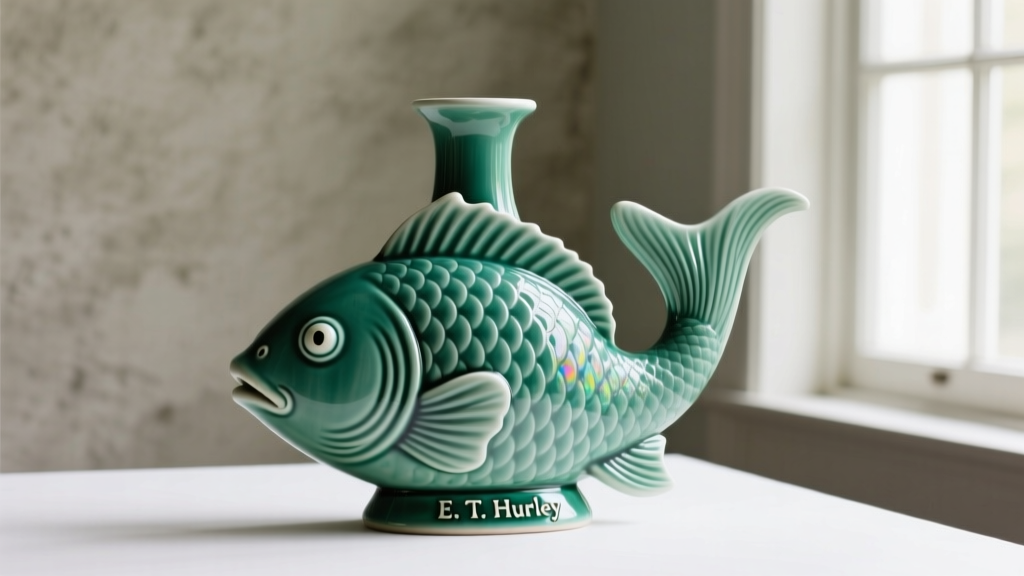
Rookwood Pottery Catfish Bottle Vase (Sea Green Glaze) by E. T. Hurley, 1904 — A Masterwork of American Art Pottery

Nodders Pig Pen: A Rare 1960s Composition Painted LEGO Set — Authentication, Provenance, and Market Significance
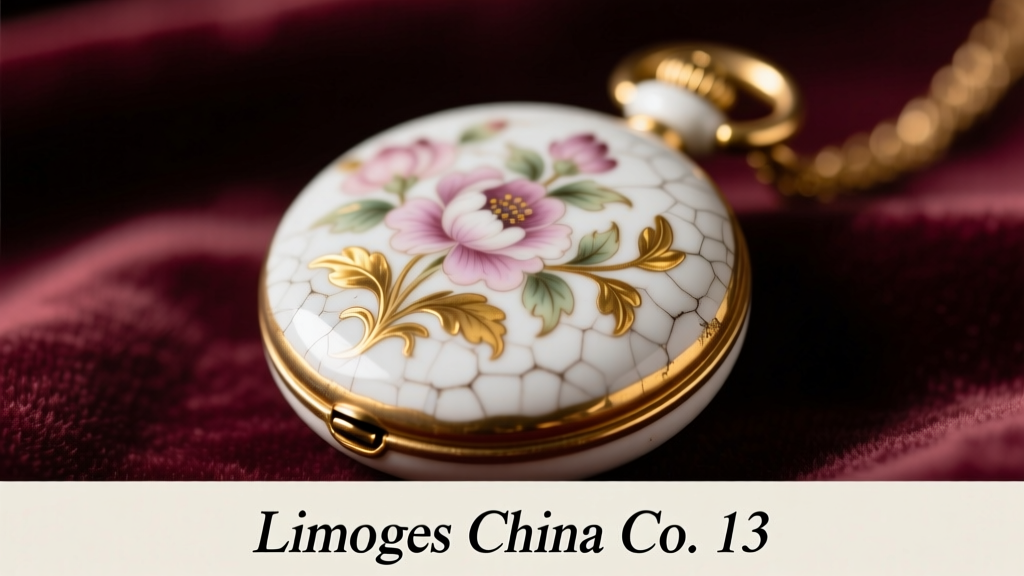
Limoges China Co. 13: Decoding the Mark, Provenance, and Market Value of a Rare American-Era Limoges Porcelain Line
Samuel Ellis Pewter Bowl with Plug Hole in Rim: A 19th-Century English Utility Masterpiece (13¼ Inches)
Lot 2338258: A 1947 Patek Philippe Ref. 96 Calatrava in 18K Yellow Gold — Provenance, Technical Anatomy, and Market Significance
Beswick Ashtray 'Five Dogs' Figural: A Collector’s Guide to Rarity, Provenance, and Value
Parian Bust of George Washington, Inscribed 'Mark C', Circa 1890 — A Study in American Ceramic Portraiture

Watch Fobs: The Bardner Denver Drill — A Rare American Pocket Watch Accessory from the Golden Age of Railroading

The Palmolive 'Woman & Man' Soap Bar Tin: A 1940s Advertising Masterpiece in Vintage Tinplate