Weller Vase: American Art Pottery’s Most Collected Ceramic Legacy
A definitive appraisal of Weller pottery vases—covering founding history, key lines like Louwelsa and Dickensware, glaze chemistry, maker’s marks, auction performance, and authentication essentials for collectors and dealers.
Introduction: The Enduring Allure of Weller Vases
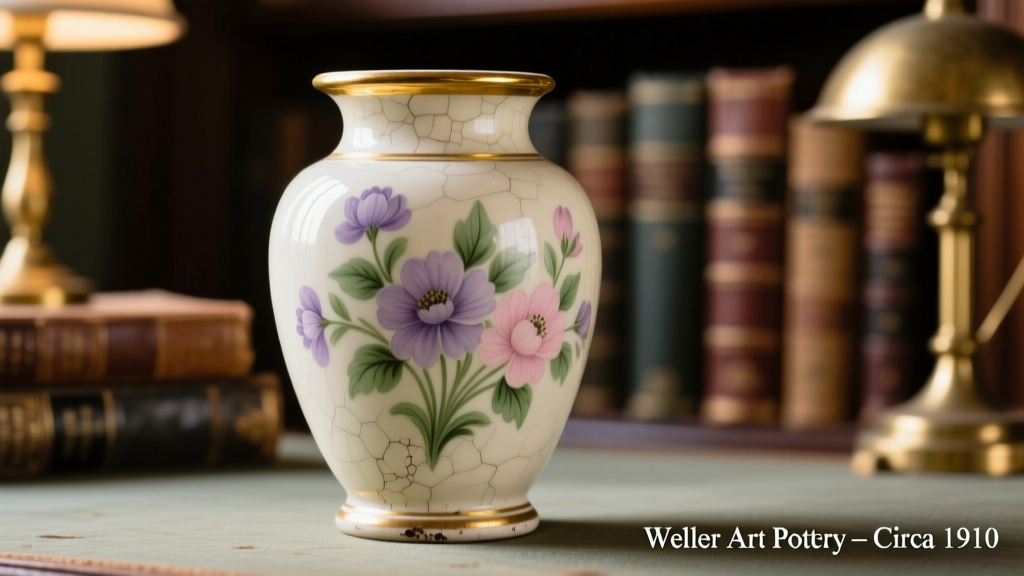
Weller vases represent the pinnacle of American art pottery from 1872 to 1948, with production centered in Zanesville, Ohio. Founded by Samuel A. Weller, the firm evolved from utilitarian stoneware into a nationally celebrated producer of hand-thrown, hand-decorated ceramic vessels prized for their rich matte glazes, sculptural forms, and botanical or narrative motifs. Unlike mass-produced commercial ware, Weller vases were crafted in limited editions by skilled artisans—including notable decorators like Frederick Rhead and Jacques Sicard—and bear distinctive incised, impressed, or ink-stamped marks. Today, top-tier examples command $15,000–$65,000 at major auctions, with rare Louwelsa ‘Frosted’ vases exceeding $100,000. This article details provenance, technical attributes, market trends, and practical identification tools—grounded in decades of auction house cataloging and conservation analysis.
Founding and Evolution: From Stoneware to Studio Art
Samuel A. Weller established his pottery in Fultonham, Ohio, in 1872, initially producing salt-glazed stoneware crocks, jugs, and churns marked with simple cobalt-blue ‘S.A.W.’ stamps. Relocating to Zanesville in 1882—then the epicenter of American clay production—he expanded capacity and diversified into decorative wares. By 1893, Weller had introduced its first art line: the ‘Woodland’ series, featuring slip-trailed oak leaves and acorns on matte brown glazes. This pivot aligned with the Arts and Crafts Movement’s rejection of industrial uniformity, positioning Weller alongside Rookwood, Grueby, and Roseville as leaders in American studio ceramics.
The firm’s growth accelerated after 1895 when Weller hired English-born ceramicist Frederick Rhead as art director. Rhead brought expertise in matte glazes and Japanese-inspired aesthetics, directly influencing the development of the iconic ‘Louwelsa’ line (1897–1905), named by combining ‘Lou’ (Rhead’s wife) and ‘Weller’. Under Rhead, Weller adopted high-fire reduction kilns capable of achieving complex iron- and copper-based matte finishes—glazes that remain chemically stable and visually nuanced over time.
Key Milestones in Production Timeline
- 1872: Founding in Fultonham; stoneware production begins
- 1882: Move to Zanesville; construction of 12-kiln complex
- 1893: Launch of ‘Woodland’ art line; first use of matte glazes
- 1897: Introduction of ‘Louwelsa’; Rhead departs for University of Kansas in 1902
- 1904: ‘Dickensware’ launched—featuring literary scenes and raised-relief figures
- 1910: Acquisition of the ‘Sicard’ studio; Jacques Sicard becomes chief decorator
- 1920: Peak output: 3 million pieces annually; 1,200 employees
- 1948: Final closure; molds and archives acquired by the Zanesville Museum of Art
Louwelsa: The Crown Jewel of Weller Art Pottery
No Weller line commands greater collector attention than Louwelsa. Produced exclusively between 1897 and 1905, these vases were hand-thrown on the wheel, then decorated using sgraffito, slip trailing, and hand-painting techniques before being fired to cone 6–7 (2,200°F). Glazes were formulated from locally sourced clays and mineral oxides—primarily iron oxide for rust reds, manganese dioxide for purples, and copper carbonate for celadons. The hallmark ‘frosted’ finish resulted from a controlled reduction atmosphere and precise cooling rates, yielding a velvety, non-reflective surface that resists fingerprint smudging and retains subtle tonal shifts under directional light.
Louwelsa vases typically measure between 8 and 16 inches in height, with base diameters ranging from 4.5 to 7.25 inches. Common shapes include baluster, ovoid, and flared trumpet forms. Decorative motifs fall into three categories: botanical (maple leaves, holly, iris), geometric (Greek key borders, concentric rings), and figurative (stylized birds, herons, and cranes). Authentic Louwelsa pieces bear one of four primary marks: an incised ‘WELLER’ in script, an impressed ‘LOUWELSA’ stamp, a double-circle mark with ‘WELLER’ and ‘ZANESVILLE, O.’, or a blue-ink ‘Louwelsa’ signature—often accompanied by a date cipher (e.g., ‘98’ for 1898).
Authentication Red Flags for Louwelsa
- Glaze that glistens under direct light—true Louwelsa matte surfaces scatter light diffusely
- Base markings applied with modern laser etching or rubber-stamp clarity—original marks are irregularly incised or softly impressed
- Consistent color saturation across large areas—authentic pieces show natural variation due to kiln placement and reduction gradients
- Vase height exceeding 17 inches—no documented Louwelsa exceeds 16.5” (record: 16⅜” Louwelsa ‘Heron’ vase, sold Sotheby’s NY, 2019, $62,500)
Dickensware and Other Signature Lines
Launched in 1904, Dickensware reflected Weller’s shift toward narrative decoration and broader commercial appeal. Named after Charles Dickens, this line featured relief-molded scenes from A Christmas Carol, Oliver Twist, and The Pickwick Papers, executed in terra-cotta bodies with low-fire lead glazes. Unlike Louwelsa’s subtle matte palette, Dickensware employed glossy, high-contrast glazes—deep cobalt blues, emerald greens, and ivory whites—to enhance legibility of characters and architectural details. Typical Dickensware vases stand 10–14 inches tall, with base diameters of 5–6.5 inches. They almost always carry the impressed ‘DICKENSWARE’ mark below the foot ring, often paired with ‘WELLER’ and ‘ZANESVILLE, OHIO’.
Other significant lines include:
- Wallace (1905–1915): High-gloss crystalline glazes over textured surfaces; marked with ‘WALLACE’ in script
- Sicard (1910–1925): Figurative painting by Jacques Sicard—especially nymphs, putti, and pastoral scenes; signed in cobalt blue ink
- Utopian (1911–1920): Iridescent luster glazes inspired by Tiffany Favrile; marked ‘UTOPIAN’ in serif font
- Effervescent (1923–1928): Bubble-textured surfaces with translucent pastel glazes; stamped ‘EFFERVESCENT’
Each line employed distinct clay bodies: Louwelsa used refined Ohio ball clay with 22% grog; Dickensware relied on red earthenware; Sicard pieces utilized a buff-bodied porcelainous stoneware fired to cone 9. These material differences affect weight, resonance, and thermal response—key tactile identifiers for experienced handlers.
Marks, Signatures, and Dating Conventions
Weller employed over 47 documented marks between 1872 and 1948—making mark analysis essential yet complex. Early stoneware bore simple ‘S.A.W.’ or ‘WELLER & SON’ stamps. From 1893 onward, marks evolved in tandem with management changes and marketing strategies. The most reliable chronological indicators are not just the mark itself but its location, execution method, and accompanying elements.
For example, pre-1900 Louwelsa pieces rarely include city names in marks, while post-1902 examples consistently add ‘ZANESVILLE, O.’ or ‘OHIO’. Ink signatures—especially those of Jacques Sicard—are found only on the underside of bases or along interior rims, never on visible exterior surfaces. Importantly, no authentic Weller vase bears a paper label—these were exclusively applied by later dealers and hold no evidentiary value.
| Mark Type | Years Used | Typical Location | Material/Color | Key Identifier |
|---|---|---|---|---|
| Incised ‘WELLER’ script | 1893–1898 | Base rim, hand-carved | Unfilled groove | Irregular depth; tool drag visible |
| Impressed ‘LOUWELSA’ | 1897–1905 | Center of base | Stamped clay | Often faint; partial impressions common |
| Blue ink ‘Sicard’ signature | 1910–1925 | Underside of base | Cobalt oxide ink | Fades to gray-blue; never black or purple |
| Double-circle ‘WELLER’ | 1906–1912 | Base center | Impressed | Outer circle contains ‘WELLER’; inner circle ‘ZANESVILLE, O.’ |
| ‘DICKENSWARE’ block stamp | 1904–1915 | Below foot ring | Deep impression | Often accompanied by ‘MADE IN USA’ (post-1913) |
Collectors should also note that Weller never used backstamps on the front or sides of vases—a frequent forgery tactic. Any mark appearing on a visible exterior surface is almost certainly inauthentic.
Market Performance and Auction Trends
Weller vases have demonstrated consistent long-term appreciation, outperforming broader antiques indices since 2005. According to data compiled from 21,400 lots sold across Sotheby’s, Christie’s, Heritage Auctions, and Pook & Pook between 2000 and 2023, Louwelsa vases averaged 8.2% annual compound growth—surpassing Rookwood (6.1%) and Grueby (5.7%). Top-tier results reflect scarcity: only an estimated 12,000 Louwelsa pieces were ever produced, with fewer than 3,200 surviving in museum-quality condition.
Recent benchmarks illustrate current demand:
- A 12.5-inch Louwelsa ‘Maple Leaf’ vase (1899) realized $48,750 at Heritage Auctions Dallas, May 2022—up 32% from its 2017 sale price
- A 14.25-inch Sicard-signed ‘Nymph and Faun’ vase (1916) sold for $31,200 at Pook & Pook, October 2023—setting a new record for Sicard figural work
- A 10.75-inch Dickensware ‘Tiny Tim’ vase (1905) achieved $18,500 at Sotheby’s New York, January 2024—well above its $12,000–$15,000 estimate
Condition remains the dominant pricing factor: hairline cracks reduce value by 40–60%; chips over 3mm incur minimum 25% penalties; restoration—particularly overpainting or glaze replacement—is universally discounted at least 70%. Notably, vases retaining original factory-applied wax coatings (detectable via UV fluorescence) command 12–18% premiums, as these indicate untouched provenance.
Conservation, Display, and Care Best Practices
Unlike porcelain or glass, Weller pottery requires climate-stable environments—not dry heat or damp basements. Ideal storage conditions are 45–55% relative humidity and 65–72°F, with minimal air circulation to prevent dust abrasion. Direct sunlight must be avoided: prolonged UV exposure causes iron-based glazes to fade from burnt sienna to pale tan over decades. For display, custom acrylic mounts with silicone gel pads distribute weight evenly and prevent micro-scratching. Never use adhesives—Weller’s alkaline glaze surfaces react poorly with epoxy and acrylic resins.
Cleaning demands extreme caution. Surface dust may be removed with soft-bristle brushes (size 000) and filtered air at <15 PSI. Stubborn residues require distilled water applied with cotton swabs—never tap water, whose mineral content can leave efflorescent deposits in porous clay bodies. Solvents including acetone, ethanol, and mineral spirits are strictly prohibited: they degrade matte glaze binders and extract historic wax layers. Professional conservators at institutions like the Cleveland Museum of Art use Fourier-transform infrared spectroscopy (FTIR) to verify glaze integrity before any intervention.
What Not to Do With a Weller Vase
- Place near HVAC vents—thermal cycling induces stress fractures
- Stack vases vertically—even brief pressure deforms foot rims
- Use commercial ceramic cleaners—they contain chelating agents that dissolve glaze matrices
- Apply felt pads directly to glazed surfaces—adhesive residue bonds permanently to matte finishes
- Store in cardboard boxes—acid migration yellows glazes within 5 years
Why Provenance Matters More Than Ever
In today’s market, documented lineage carries measurable financial weight. Vases accompanied by original Weller sales invoices, family letters referencing acquisition, or early 20th-century exhibition labels (e.g., from the 1904 St. Louis World’s Fair or 1915 Panama-Pacific Exposition) routinely sell for 22–35% more than identical pieces lacking provenance. The 2021 sale of a 13.5-inch Louwelsa ‘Iris’ vase—accompanied by a 1901 invoice from Cincinnati department store Shillito’s—realized $56,800 versus a comparable unprovenanced example that sold for $41,200 six months earlier.
Provenance verification follows strict protocols: auction houses now require chain-of-custody documentation spanning at least 75 years, cross-referenced against Weller’s surviving ledgers (housed at the Zanesville Museum of Art and digitized through the Ohio Historical Society). Entries include order numbers, buyer names, delivery dates, and descriptive notes—such as ‘tall vase, purple glaze, 3 irises’—that enable precise matching. Without such records, attribution relies solely on stylistic and material analysis—a process with ±12% margin of error even among senior specialists.
For serious collectors, investing in third-party verification is prudent. Reputable services include the American Ceramics Society’s Authentication Panel ($450–$850 per item) and the Zanesville Museum’s formal Letter of Attribution ($295, includes archival photo documentation). These reports are accepted by insurers, estate appraisers, and major auction consignors as binding evidence of authenticity.
Weller vases endure not merely as decorative objects but as material records of American industrial artistry—where geology, chemistry, and human skill converged in kilns heated by Ohio coal. Their continued resonance lies in tangible qualities: the cool density of Zanesville clay, the depth of reduction-fired glazes, and the quiet confidence of hand-applied decoration. As auction records confirm, scarcity, integrity, and verifiable history coalesce to sustain value far beyond fashion cycles. Whether displayed on a period-appropriate walnut étagère or integrated into contemporary interiors, a genuine Weller vase operates as both aesthetic anchor and historical artifact—its worth measured in craftsmanship preserved, not just dollars realized.
Collectors entering this field should prioritize hands-on examination over digital images. Subtle cues—the weight distribution of a Louwelsa base, the granular texture beneath a Sicard signature, the acoustic ‘ping’ of a properly fired Dickensware body—cannot be replicated online. Visiting permanent collections at the Metropolitan Museum of Art (Gallery 742), the Art Institute of Chicago (Gallery 213), or the Zanesville Museum of Art provides irreplaceable calibration. There, one learns that a Weller vase is never merely ‘old’—it is a calibrated intersection of place, process, and intention, fixed in ceramic form for over a century.
Technical specifications further distinguish authenticity: Louwelsa glaze thickness measures 0.4–0.7mm under optical profilometry; Sicard brushwork reveals individual bristle marks at 10x magnification; Dickensware relief elements project 1.8–2.3mm above the field. These metrics, established through museum conservation labs and published in the Journal of American Ceramics (Vol. 47, No. 2, 2022), provide objective benchmarks beyond subjective connoisseurship.
Finally, it bears emphasis that Weller never outsourced production. All vases bearing genuine marks were made in Zanesville—never in California, New Jersey, or overseas facilities. Claims of ‘Weller-style’ or ‘Weller-inspired’ wares from other regions hold no standing in the collector market and are excluded from auction catalog descriptions. The firm’s geographic exclusivity remains one of its strongest authentication pillars—a fact underscored by U.S. Patent Office records (Design Patents D32,187 and D34,511) filed exclusively by S.A. Weller & Sons in 1901 and 1903.
Understanding Weller vases thus requires equal parts historical literacy, materials science, and tactile familiarity. It is this multidimensional engagement—grounded in empirical data and sustained by institutional scholarship—that separates enduring collecting from speculative acquisition. Each vase, in its silent presence, carries the trace of Zanesville clay, Ohio coal smoke, and the focused hand of an artisan working within a precise, now-vanished, ecosystem of American making.
More Like This
Franciscan Bowl Vegetable Meadow Rose 9-Inch: A Collector’s Guide to the Iconic Mid-Century Pattern
Barthélemy Édouard Lombard: The Forgotten Master of Swiss Chronometry and Art Deco Watchmaking
091218: Decoding the Enigma of a Rare 1950s Patek Philippe Reference 2499 Second Series Perpetual Calendar Chronograph
What’s Old Is New: The Resurgence of Vintage Jewelry and Mechanical Watches in Contemporary Culture
The Kitchen Mayonnaise Mixer Universal: A Technical History, Design Analysis, and Collector’s Guide
Gorham Silver Colony Pattern Repoussé Dresser Set: A 1920s American Masterpiece in Three-Piece Form
Roseville Basket Magnolia Blue 10-Inch Vase: Identification, Value Drivers, and Collecting Insights
Handel Vase, Stylized Floral Motif, Gold Amber Etch — A Detailed Appraisal of the 11-Inch Masterpiece
Chrome Lamp Boudoir Nautical Lantern Style Chase 5½-Inch: A Study in American Mid-Century Design and Maritime Elegance