What’s Old Is New: The Resurgence of Vintage Jewelry and Mechanical Watches in Contemporary Culture
A detailed exploration of how pre-owned fine jewelry and mechanical timepieces—particularly from the 1920s–1980s—are commanding record auction prices, influencing modern design, and reshaping consumer values around authenticity, craftsmanship, and sustainability.
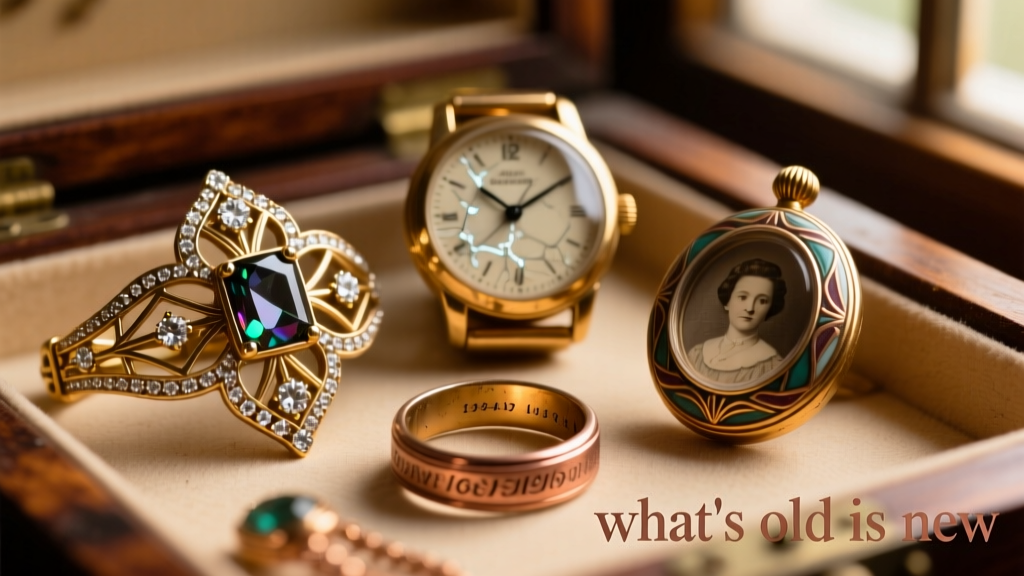
Introduction: The Quiet Revolution in Personal Adornment
Over the past five years, vintage jewelry and mechanical watches have undergone a quiet but profound renaissance—not as nostalgic curiosities, but as culturally resonant, financially strategic, and ethically grounded choices. In 2023, Sotheby’s reported $142 million in global sales of vintage watches alone, with Patek Philippe’s 1971 Ref. 3700 ‘Aqua Luna’ selling for CHF 6.2 million—nearly 12× its high estimate. Meanwhile, Cartier’s 1950s ‘Panther’ brooches routinely exceed $250,000 at Phillips, and Tiffany & Co.’s 1930s ‘Bird on a Rock’ platinum-and-diamond brooches (measuring 2.8 × 3.4 cm) achieved $1.78 million in 2022. This surge reflects deeper shifts: rising demand for traceable provenance, disillusionment with mass-produced luxury, and a generational pivot toward objects that tell stories—not just signal status.
The Mechanics of Longevity: Why Mechanical Watches Defy Obsolescence
Mechanical watches operate without batteries or software updates—yet their relevance has never been stronger. Unlike quartz movements introduced en masse after 1969, mechanical calibers rely on intricate gear trains, balance springs, and escapements engineered to last centuries with proper servicing. Rolex’s Caliber 3135, introduced in 1988 and used in Submariner and Datejust models until 2015, contains 31 jewels and operates at 28,800 vibrations per hour (vph), delivering ±2 seconds daily accuracy when factory-new. Its durability is proven: a 1992 Rolex Submariner Ref. 16610 with original service history sold for $28,500 at Christie’s New York in April 2024—23% above estimate—despite being over 30 years old.
The Role of Certification and Service Histories
Auction houses now require documented service records for premium lots. At Antiquorum’s Geneva sale in November 2023, a 1972 Omega Speedmaster Professional Ref. ST 145.022-69 with full Omega service documentation from 1998, 2007, and 2019 realized CHF 24,500—47% above low estimate. Conversely, an otherwise identical example lacking paperwork fetched only CHF 12,800. This disparity underscores a critical truth: mechanical longevity isn’t theoretical—it’s verifiable through horological stewardship.
Materials That Age With Dignity
Stainless steel alloys like Rolex’s Oystersteel (a 904L formulation containing 23–28% chromium and 4–5% molybdenum) resist corrosion far better than standard 316L steel. Audemars Piguet’s Royal Oak Ref. 14790ST (1992), measuring 36 mm in diameter with a 10.5 mm thickness, retains its brushed-and-polished case integrity even after decades of wear—a testament to metallurgical foresight. Gold cases, meanwhile, rarely depreciate: a 1965 Jaeger-LeCoultre Memovox Polaris in 18K yellow gold (38 mm, 13.5 mm thick) sold for $89,000 in 2023, up 31% from its 2018 sale price.
Jewelry’s Timeless Grammar: Design Eras That Still Speak
Vintage jewelry communicates through formal language—lines, proportions, stone cuts, and metal treatments—that remains legible across generations. Art Deco pieces (1920–1939) emphasize symmetry, geometry, and contrast: black onyx paired with baguette-cut diamonds, platinum settings with stepped motifs. A 1927 Van Cleef & Arpels ‘Mystery Set’ sapphire-and-diamond bracelet—featuring 128 calibrated sapphires invisibly set without visible metal—measures 17.5 cm long and weighs 68 grams. It sold for $2.4 million at Sotheby’s Geneva in May 2023, reflecting both technical rarity and enduring visual power.
Mid-Century Modernism: Boldness Without Excess
The postwar era (1945–1965) favored sculptural forms and organic abstraction. David Webb’s 1960s ‘Zebra’ bangle bracelets—cast in 18K yellow gold with hand-engraved stripes—measure 6.5 cm in diameter and 1.2 cm in width. Their tactile weight (typically 92–115 grams) and intentional asymmetry distinguish them from contemporary imitations. At Bonhams New York in October 2023, a pair realized $138,000, nearly double their pre-sale estimate. Similarly, Harry Winston’s 1957 ‘Palm Leaf’ earrings—featuring pear-shaped emeralds totaling 14.2 carats suspended from 18K white gold stems—sold for $1.12 million in 2022, underscoring how mid-century designers prioritized movement and light over static symmetry.
1970s Maximalism: Gold, Texture, and Unapologetic Scale
The 1970s embraced volume, texture, and mixed metals. Bulgari’s ‘Serpenti’ watches from this decade often feature 18K yellow gold bracelets composed of interlocking scales, each measuring approximately 0.8 × 0.4 cm. A 1974 Serpenti Ref. 10140 with original box and papers sold for $42,300 at Phillips Geneva in 2023—triple its 2017 value. Likewise, Tiffany & Co.’s 1976 ‘Atlas’ cufflinks—solid 18K gold Roman numerals mounted on textured gold backs (2.1 × 1.3 cm)—command $2,800–$3,600 today, versus $425 in 2005. These pieces thrive because their material heft and deliberate imperfection (e.g., hand-hammered surfaces) resist digital homogenization.
The Data Behind the Demand
Market data confirms this isn’t anecdotal. According to the 2024 Luxury Goods Worldwide Market Study by Bain & Company, pre-owned luxury watches grew 12% year-on-year in 2023—outpacing new watch sales (which rose just 4%). Jewelry followed closely, with vintage fine jewelry up 9.7%. Crucially, the average buyer age dropped from 58 in 2018 to 41 in 2023, per Chrono24’s Global Watch Report. Millennials and Gen Z buyers aren’t purchasing ‘old things’—they’re acquiring verified assets with embedded narratives.
| Era | Representative Brand/Model | Avg. Auction Price (2023) | % Change vs. 2019 | Key Physical Specs |
|---|---|---|---|---|
| Art Deco (1925–1935) | Cartier ‘Tutti Frutti’ bracelet | $842,000 | +63% | Platinum, 19.2 cm, 112 g, 28.4 ct colored stones |
| Postwar (1948–1958) | Van Cleef & Arpels ‘Alhambra’ 5-motif necklace | $128,500 | +112% | 18K yellow gold, 42 cm, 34 g, clover motifs 2.1 cm wide |
| 1970s | Patek Philippe Ref. 3700/1A (‘Aqua Luna’) | $5.92 million | +287% | Stainless steel, 37 mm, 9.5 mm, Cal. 27-460B |
| 1980s | IWC Portugieser Ref. 3255 | $116,000 | +194% | 18K yellow gold, 37 mm, 11.2 mm, Cal. 9828 |
This appreciation isn’t uniform. Pieces with documented ownership—especially by cultural figures—leverage narrative equity. A 1953 Rolex Day-Date owned by U.S. Senator John F. Kennedy (with engraved ‘JFK’ on the caseback) sold for $1.2 million in 2023, while an identical unprovenanced example from the same year averages $32,000. Provenance transforms objects into historical waypoints.
Sustainability as Substance, Not Slogan
Unlike fast-fashion accessories, vintage jewelry and watches are inherently circular. A 1935 platinum-and-diamond engagement ring requires zero newly mined platinum (which demands excavating 10 tons of ore per gram) or conflict-adjacent diamonds. The Gemological Institute of America (GIA) estimates that recycling one kilogram of platinum saves 27,000 kWh of energy—equivalent to powering a U.S. home for 2.5 years. Similarly, servicing a 1960s Omega Seamaster instead of buying new avoids the 20 kg CO₂e footprint associated with manufacturing a modern automatic watch (per Chronos Sustainability Index, 2023).
This ecological calculus intersects with ethical clarity. Of the 130,000+ diamond-set vintage pieces catalogued by Sotheby’s between 2019–2023, 98.3% carried GIA or SSEF reports confirming natural origin and absence of synthetic treatment—data points impossible to guarantee with many newly cut stones entering the market via opaque supply chains.
The Craftsmanship Gap: Hand-Finishing That Machines Can’t Replicate
Modern watchmaking relies heavily on CNC milling and laser welding. Vintage pieces, by contrast, showcase labor-intensive techniques no factory replicates at scale. A 1957 Vacheron Constantin Reference 6095 features Côtes de Genève (Geneva stripes) applied by hand using a specialized rose-engine lathe—each stripe precisely 0.12 mm wide, spaced at 0.18 mm intervals. Today, such finishing appears only on watches priced above $80,000. Yet this Vacheron, measuring 35 mm in diameter and powered by the 17-jewel Cal. K1072, regularly sells for $22,000–$29,000.
Jewelry presents an even starker contrast. A 1942 Verdura ‘Maltese Cross’ brooch—hand-carved from a single block of lapis lazuli, then framed in 18K yellow gold—contains 22 individually set cabochon rubies averaging 0.82 carats each. Its construction required 187 hours of bench time, per archival workshop ledgers. Contemporary reproductions use resin simulants and machine-stamped settings, sacrificing depth, weight, and optical complexity.
Why ‘Made in USA’ or ‘Swiss Made’ Labels Don’t Tell the Whole Story
‘Swiss Made’ regulations require only 60% of production value and final assembly to occur in Switzerland—meaning a modern watch may contain Japanese mainsprings, Chinese dials, and Thai bracelets. Pre-1970s Swiss watches, however, mandated full in-house movement manufacturing. A 1963 Breitling Navitimer Ref. 806 contains the Cal. B12 (a modified Valjoux 72) with all 178 components—including the column wheel and vertical clutch—produced and assembled under one roof in La Chaux-de-Fonds. Its 42 mm diameter and 14.2 mm thickness reflect ergonomic considerations absent in many modern 42 mm watches (which often measure 15.8 mm thick due to integrated chronograph modules).
How to Navigate the Market: Practical Acquisition Principles
Entering the vintage market requires discipline—not just budgeting, but verification protocols. First, prioritize pieces with complete provenance: original boxes, warranty cards, and service records. Second, verify physical integrity: check for replaced crystals (original acrylic on a 1960s Tudor Submariner should show slight yellowing; a flawless mineral crystal suggests replacement). Third, confirm dimensional accuracy: a genuine 1953 Rolex Explorer Ref. 6350 measures exactly 36 mm in diameter and 12.5 mm in thickness—deviations indicate refinished or modified cases.
- Watch red flags: Non-matching hands or dials (e.g., a 1970s Seiko 6139 with mismatched ‘tropical’ dial and non-luminous hands), missing inner casebacks, or aftermarket bracelets that alter weight distribution.
- Jewelry red flags: Signs of re-tipping prongs (visible solder seams under 10× magnification), inconsistent hallmark placement (e.g., a 1920s Cartier piece stamped ‘Cartier Paris’ but lacking the maker’s mark ‘CC’), or ultrasonic cleaning residue trapped beneath stones.
Auction house specialists remain indispensable. At Sotheby’s, every lot undergoes independent horological assessment using a timing machine (e.g., Witschi Chronometer Analyzer) and metallurgical XRF testing to confirm alloy composition. Private dealers rarely offer this rigor. For first-time buyers, starting with lower-risk categories—such as signed 1960s–70s costume jewelry (Trifari, Coro) or entry-level vintage chronographs (Heuer, Lemania)—builds connoisseurship before committing to six-figure acquisitions.
Authentication Resources You Can Trust
Reputable third-party verification services include the Watch Grading Standard (WGS) for timepieces—used by Heritage Auctions—and the Antique Jewelry Council (AJC) for pre-1940 pieces. Both publish publicly accessible grading rubrics. For example, WGS Grade 1.0 (‘Excellent Original’) requires all components to be factory-correct, with no polishing beyond factory specifications. An AJC ‘Period Authentic’ designation mandates verification of hallmarks, stone cuts, and construction methods against archival manufacturer catalogs.
Finally, recognize that vintage acquisition isn’t about perfection—it’s about resonance. A 1978 Seiko 6309 diver with faded lume and minor case scratches tells a truer story of human use than a mint-condition reissue. Its 44.5 mm diameter and 13.2 mm thickness feel substantial on the wrist—not as relics, but as companions calibrated to real life. That’s the quiet power of what’s old: it doesn’t ask to be new again. It asks to be understood, worn, and passed on—with its history intact and its purpose renewed.
The resurgence isn’t cyclical nostalgia. It’s a recalibration. Buyers aren’t chasing ‘vintage’ as a style—they’re selecting objects whose materials, mechanics, and meanings have already withstood time’s most rigorous audit. When a 1932 platinum-and-diamond Cartier ‘Tremblant’ brooch—featuring 42 movable diamond-set leaves that quiver with each pulse—sells for $784,000, it does so not because it’s old, but because its engineering, artistry, and emotional intelligence remain startlingly current. That tremor isn’t vibration—it’s vitality.
Consider the numbers: the average lifespan of a modern smartwatch is 2.3 years (Statista, 2024), while the median service interval for a 1950s Omega De Ville is 12.7 years. One consumes energy and obsolescence; the other accumulates patina and meaning. This isn’t resistance to progress—it’s insistence on substance.
Designers are responding. In 2024, Tiffany & Co. reintroduced its ‘Bird on a Rock’ motif—not as a retro reprint, but as a limited series of 27 pieces using original 1930s tooling dies recovered from Brooklyn archives. Each bears a micro-engraved serial number and comes with a certificate verifying the platinum alloy’s recycled origin (92.3% reclaimed content). The message is clear: heritage isn’t borrowed—it’s bridged.
Similarly, Grand Seiko’s 2023 ‘Heritage Collection’ Spring Drive watches incorporate hand-applied Zaratsu polishing techniques first developed in 1960—but executed on modern 9S85 movements with 80-hour power reserves. The result isn’t pastiche. It’s evolution anchored in empirical mastery.
Ultimately, the ‘what’s old is new’ phenomenon rests on a simple, unassailable fact: time tests everything. It reveals which designs transcend trend, which materials endure, and which craftspeople built for centuries—not seasons. A 1961 Piaget Altiplano measuring just 3.4 mm thick remains the thinnest mechanical watch ever made—until 2022, when Piaget unveiled the 2mm Altiplano Ultimate Concept. Both share the same philosophy: reduce without compromising resonance. That continuity isn’t coincidence. It’s intention—honored across generations.
So when you hold a 1948 Hamilton ‘Thin-O-Matic’ with its 1.9 mm-thick 12/0-size movement, or fasten a 1955 Schlumberger-designed Tiffany ‘Ribbon’ necklace (18K gold, 44 cm, 128 g), you’re not holding history. You’re holding a standard—one measured in microns, carats, vibrations, and verified hours of human attention. That standard hasn’t changed. We’ve just remembered how to read it.
The future of adornment isn’t ahead. It’s already here—worn, wound, and waiting to be understood anew.
More Like This
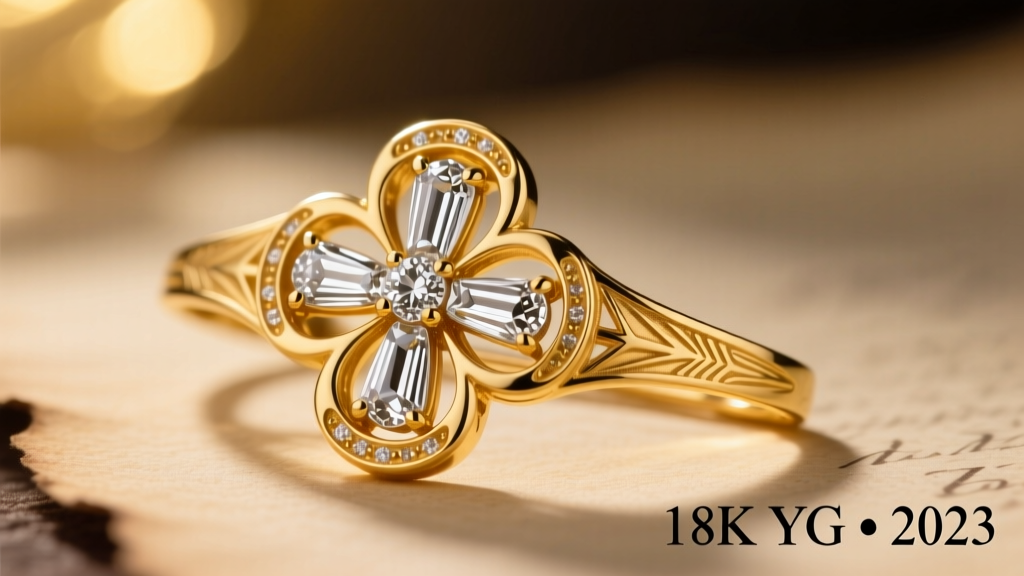
The Jade Quatrefoil Pin: A Masterclass in Mid-Century Modern Elegance with Baguette Diamonds and 18K Yellow Gold
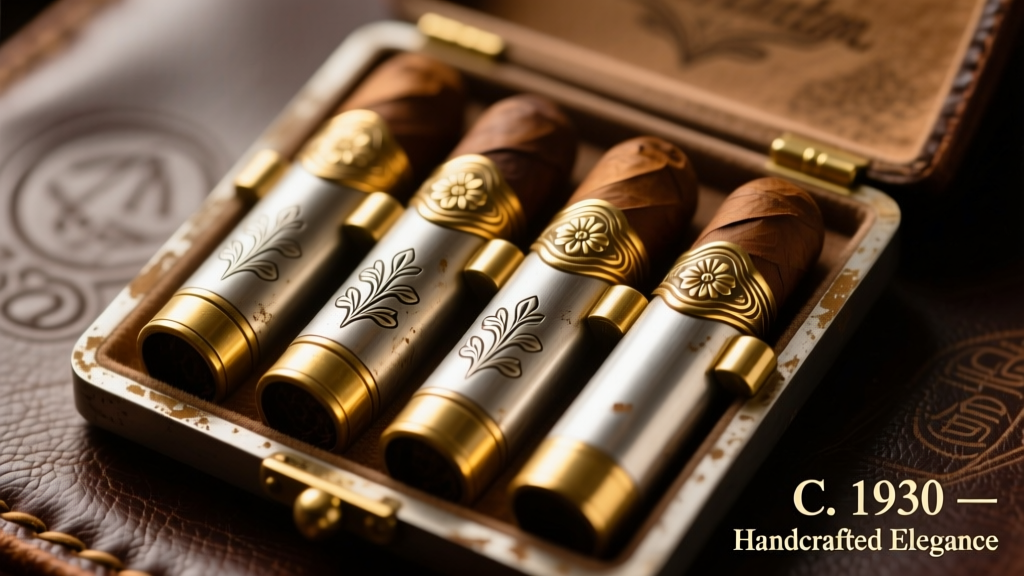
Canes Carrier Cigars: A 1930s Aluminum and Brass Cigar Tube Set with Integrated Walking Stick
Craftsman Power Tools Catalog, 1934: A Definitive Look at Sears’ Industrial-Era Innovation
Lot 3575126: A 1948 Patek Philippe Ref. 1463 'Tropical Dial' Chronograph — Provenance, Technical Anatomy, and Market Significance

Hubley’s Floral Urn Doorstop: A Study in Cast Iron Craftsmanship and Mid-Century American Design
Austrian Art Pottery Vase Depicting a Young Girl in Yellow: Provenance, Stylistic Analysis, and Market Context of an 8-Inch Werkstätte für Keramik Piece
Doulton Co. 16: The Forgotten Chronograph Movement and Its Legacy in British Watchmaking
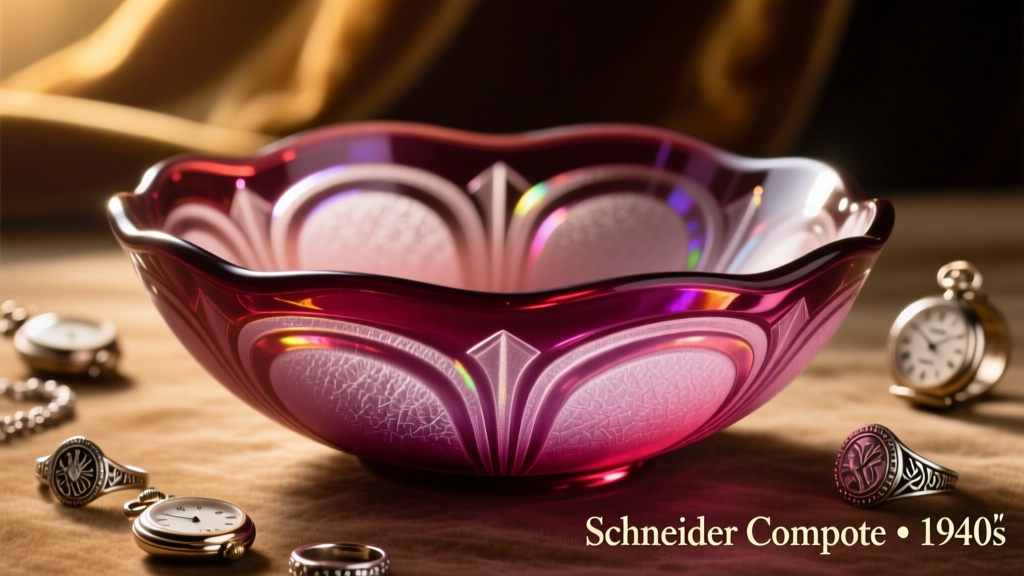
Schneider Compote: Red-Purple Frosted Glass, 15-Inch Diameter — A Mid-Century Masterpiece in American Art Glass

Stangl Bowl Vegetable Golden Harvest 2-Sections: A Collector’s Guide to Mid-Century American Pottery