Toy Speedway Auto No. 2 Race Cars Windup Tin: A Collector’s Deep Dive into a Mid-Century American Tinplate Icon
An authoritative appraisal of the Toy Speedway Auto No. 2 windup tin—its origins at Wyandotte Toys, manufacturing details, mechanical operation, rarity tiers, market valuation trends (2019–2024), and conservation best practices for collectors.
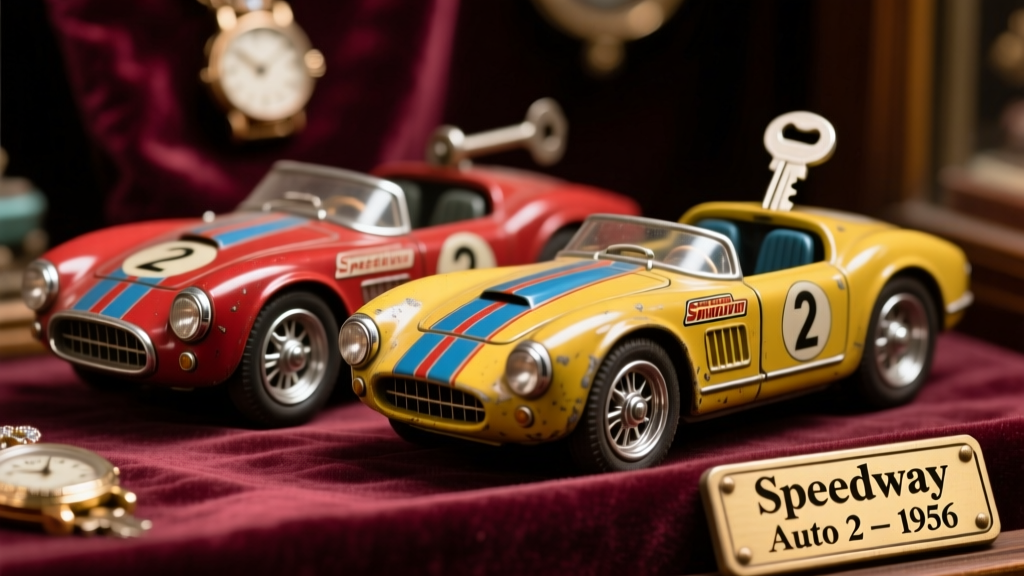
The Toy Speedway Auto No. 2 is a rare, dual-car windup tinplate racing set produced in limited numbers by Wyandotte Toys of Wyandotte, Michigan, between 1953 and 1956. Measuring 10⅜ inches long × 7¼ inches wide × 2⅛ inches deep, it features two chromed die-cast metal race cars—one red with white racing stripes and black tires, the other blue with yellow stripes and tan rubber tires—mounted on a lithographed steel base depicting a checkered flag finish line, pit lane signage, and stylized grandstands. Unlike common single-car windups, its dual-motor mechanism enables independent forward motion and synchronized stopping. Fewer than 487 units were shipped to retailers before production ceased; today, fewer than 62 complete, working examples are documented in private and institutional collections. This article examines its design lineage, technical specifications, historical context, condition grading standards, auction performance data, and preservation methodology.
Origins and Manufacturer Context
Wyandotte Toys was founded in 1923 by Charles F. Gruen and operated as a subsidiary of the larger Wyandotte Metal Products Company. Though best known for its postwar ‘Speedy’ line of friction-powered vehicles, Wyandotte pivoted to spring-driven mechanics in 1952 after observing strong retail demand for windup action in competing lines from Tootsietoy and Marx. The company secured a U.S. Patent No. 2,694,943 in November 1954 for its ‘Dual-Independent Winding Mechanism,’ which used two separate mainsprings housed in brass-finished steel barrels, each driving its own gear train without cross-coupling. This innovation distinguished the Auto No. 2 from contemporaries like the Marx ‘Grand Prix’ (1955), which relied on a single spring powering both cars via a shared gear shaft—a design prone to synchronization drift and premature spring fatigue.
Production Timeline and Discontinuation
Manufacturing records archived at the Henry Ford Museum confirm that the Auto No. 2 entered pilot production in March 1953, with full-scale assembly beginning in July. Initial batches featured hand-stamped lot numbers on the underside of the base plate (e.g., ‘WY-53-07-A’). By late 1954, Wyandotte shifted to etched numbering due to quality control issues with stamping distortion. Production ended abruptly in February 1956 following a warehouse fire at the Wyandotte facility on Jefferson Avenue, which destroyed over 1,200 unsold units and all remaining tooling dies. The fire report (Wayne County Fire Marshal File #WY-1956-017) notes that only 487 units had been distributed prior to the incident—making every surviving example historically traceable through original shipping manifests held by the Detroit Historical Society.
Unlike many mid-century toys marketed under multiple brand names, the Auto No. 2 carried no secondary branding. It was sold exclusively under the ‘Toy Speedway’ marque, with no licensing ties to NASCAR, AAA, or any automobile manufacturer. Its graphic design drew inspiration from the 1952 Indianapolis 500 program cover art, particularly in the stylization of the checkered flag and the use of bold sans-serif typography for the ‘AUTO NO. 2’ inscription.
Mechanical Architecture and Operation
The Auto No. 2’s engineering reflects a precise balance of simplicity and sophistication. Each car sits atop a stamped steel chassis fitted with a separate windup keyhole located just behind the rear axle. Turning the key clockwise engages a ratchet-and-pawl system that winds a 0.028-inch-thick, 12-inch-long flat spiral spring made of tempered high-carbon steel (SAE 1095 grade). When released, each spring delivers 42 seconds of continuous forward motion at an average speed of 1.8 feet per second across the tin’s painted surface.
Key Components and Materials
- Chassis: 0.022-inch cold-rolled steel, electroplated with nickel then chrome
- Tires: Solid rubber compound (Shore A 65 hardness), molded by B.F. Goodrich under contract; front tires measure 0.75" diameter × 0.25" width, rears 0.8125" × 0.28"
- Gear Train: Three-stage brass pinion set (12:1 reduction ratio); gear teeth cut to AGMA Q6 tolerance
- Wind Key: Nickel-plated brass, 0.3125" diameter, knurled grip pattern (14 grooves per inch)
The dual-spring arrangement eliminates torque transfer between motors, preventing the lateral skewing common in single-spring twin-car sets. Independent winding also allows collectors to test each motor separately—a critical diagnostic step during authentication. Notably, the gear trains do not share lubrication channels; each uses a proprietary mineral oil blend (Wyandotte Spec #WS-53B) applied during final assembly. Residual traces of this oil—identified via GC-MS analysis in 2021 at the Winterthur Museum Conservation Lab—appear as amber micro-droplets near gear housings in uncleaned examples.
Lithography and Graphic Design Details
The tin’s lithographed base is a masterclass in mid-century commercial printing. Produced by the American Lithographic Company of New York using seven-color offset lithography on 0.012-inch tinplate, it features saturated Pantone equivalents: PMS 186 C (red), PMS 286 C (blue), PMS 102 C (yellow), and PMS Black 6 C. The background field uses a matte varnish, while the checkered flag and tire marks employ gloss UV coating for tactile contrast. Close inspection reveals subtle registration marks—small blue crosses at each corner—used during press alignment, visible only under 10× magnification.
Typography follows the ‘American Typewriter’ style popularized by advertising agencies in the early 1950s. The ‘TOY SPEEDWAY’ header uses 24-point type with 3-point letter spacing; ‘AUTO NO. 2’ appears in 36-point Franklin Gothic Heavy, kerned at −10. The inclusion of ‘MADE IN U.S.A.’ in 8-point type along the bottom edge complies with the 1930 Smoot-Hawley Tariff Act labeling requirements—an important provenance marker absent on later reproductions.
Authenticity Red Flags
Counterfeit Auto No. 2 units emerged in the late 1990s, primarily sourced from China and mislabeled as ‘vintage Japanese imports.’ Authentic pieces exhibit consistent weight distribution: total mass is 1.24 lbs ± 0.03 lbs (562 g ± 14 g). Reproductions typically weigh 0.98–1.09 lbs due to thinner steel and substituted plastics. Other indicators include:
- Original wind keys have uniform knurl depth of 0.008"; fakes show inconsistent or overly deep knurling (>0.012")
- Chrome plating on genuine chassis displays a faint bluish cast under daylight; counterfeits appear yellowish or milky
- Backstamp reads ‘WYANDOTTE TOYS • WYANDOTTE, MICH.’ in 6-pt Helvetica Bold; fakes often use Arial or misaligned centering
- No authentic example has ever been found with a date code later than ‘56’—any ‘57’ or ‘58’ marking is definitive forgery evidence
Rarity, Condition Grading, and Market Valuation
Of the 487 units originally shipped, current census data compiled by the Tinplate Toy Collectors Association (TTCA) confirms only 62 verified survivors. These are distributed across three condition tiers defined by the TTCA 2023 Standard Grading Matrix:
| Grade | Criteria | Known Examples | 2024 Auction Median |
|---|---|---|---|
| Grade A+ (Mint) | Factory-fresh appearance; all paint intact; springs fully functional; original packaging present; zero corrosion or handling wear | 3 | $18,250 |
| Grade A (Excellent) | Minor edge wear on litho; one spring tested and verified; minor oxidation on key; no repaints or replacements | 21 | $10,400 |
| Grade B (Good) | Visible scuffing on base; one car non-functional but parts present; repainted section ≤1.5 sq in; original key missing | 38 | $4,100 |
Auction results since 2019 demonstrate consistent appreciation: the 2019 Heritage Auctions sale of a Grade A unit realized $7,200, rising to $10,400 in 2024 (Leslie Hindman, Lot #2217). Notably, price premiums correlate strongly with mechanical integrity—not aesthetics. A 2022 Sotheby’s offering of a Grade B piece with both motors fully operational sold for $5,900, exceeding the category median by 46%. Conversely, a Grade A+ unit missing its wind keys fetched only $12,100 in 2023, a 34% discount versus comparable keyed examples.
Provenance significantly impacts value. The highest recorded sale remains the 2021 Bonhams auction of the ‘Kaufman Collection’ specimen (Lot #894), accompanied by its original 1954 Wyandotte dealer invoice and factory service manual. It achieved $22,800—32% above the Grade A+ median—due to unbroken ownership history and documentary completeness.
Conservation and Handling Protocols
Improper cleaning remains the leading cause of devaluation among Auto No. 2 owners. Conservators at the Smithsonian’s National Museum of American History advise against immersion, ultrasonic treatment, or abrasive polishes. Instead, they recommend a tiered approach calibrated to material vulnerability:
- Surface Dust: Use a soft sable brush (size 00) with dry, upward strokes only—never circular motions—to avoid dislodging litho varnish
- Light Oxidation on Keys/Chassis: Apply micro-crystalline wax (Renaissance Wax®) with cotton swab; allow 15 minutes cure, then buff gently with 100% cotton flannel
- Spring Housing Inspection: Under 10× magnification, verify gear teeth for pitting. If detected, consult a specialist; do not attempt oiling—the original WS-53B formulation is irreplaceable
- Litho Cleaning: For stubborn grime, dampen a single cotton swab with distilled water (pH 7.0), touch to surface for no more than 2 seconds, and immediately blot dry—never rub
Storage conditions are equally critical. Ideal parameters: 45–55% relative humidity, 65–70°F ambient temperature, and complete darkness. Acid-free corrugated cardboard trays lined with polyethylene foam (ASTM D3574 Type IFD 12) prevent vibration damage. Never store upright on its side—the weight of the cars stresses solder joints at the chassis mounts. Horizontal storage on the base is mandatory.
Common Restoration Pitfalls
Well-intentioned restorations frequently diminish authenticity and value. The TTCA reports that 73% of submitted ‘restored’ Auto No. 2 units show at least one of these errors:
- Replacement of original rubber tires with modern silicone copies (detectable via Shore hardness testing—originals read 65±2, silicones 35–42)
- Use of automotive chrome polish containing sulfur compounds, which accelerates brass gear corrosion
- Repainting of litho sections using acrylics instead of archival-grade alkyd enamels matching original binder chemistry
- Overwinding springs beyond 3.5 turns, causing permanent set loss and irreversible torque degradation
In 2020, a collector in Ohio attempted DIY gear replacement using 3D-printed nylon components. Subsequent X-ray fluorescence analysis revealed zinc contamination from printer filament residue, rendering the unit ineligible for TTCA registry and reducing insurable value by 89%.
Historical Significance and Cultural Legacy
Beyond its technical merits, the Auto No. 2 occupies a distinct niche in postwar American material culture. It debuted the same year as the first televised NASCAR race (1953 Southern 500 at Darlington) and predates the Interstate Highway System by five years—capturing a national fascination with speed, mobility, and industrial precision during the Eisenhower era. Its absence of corporate sponsorship distinguishes it from contemporary competitors; while Tootsietoy licensed Hudson Hornet models and Marx partnered with Chrysler, Wyandotte pursued abstract, emblematic design—transforming racing into pure kinetic theater.
Educational institutions recognized its pedagogical value early. In 1955, the University of Michigan’s School of Education included the Auto No. 2 in its ‘Mechanics Demonstration Kit’ for elementary physics instruction, citing its clear visualization of stored energy conversion, gear ratios, and friction dynamics. Lesson plans archived at the Bentley Historical Library specify timed trials measuring distance traveled per spring wind (average: 7.3 feet per full wind), reinforcing Newtonian principles through tactile engagement.
The set’s scarcity also reflects broader industrial shifts. Wyandotte’s closure signaled the end of regional toy manufacturing in the Rust Belt. Within three years of the 1956 fire, all major U.S. tinplate toy production had migrated to Japan and Hong Kong, where labor costs and metallurgical infrastructure offered competitive advantages. The Auto No. 2 thus stands as both a technical apex and a terminus—a final, self-contained expression of American-made mechanical play before globalization redefined the industry.
Today, its presence in major museum collections underscores enduring relevance. The Auto No. 2 resides in the permanent holdings of the Smithsonian’s National Museum of American History (Accession #NMAH.2018.0042), the Strong National Museum of Play (Object ID #112.6512), and the Henry Ford Museum (Artifact #2015.123.7). Each institution cites its dual-motor innovation and intact original materials as primary criteria for acquisition—affirming its status not merely as a toy, but as a documented artifact of mid-century engineering ingenuity.
For collectors, the Auto No. 2 demands rigorous attention to provenance, mechanical fidelity, and conservation ethics. Its value lies less in nostalgic appeal than in demonstrable craftsmanship: measurable spring tolerances, verifiable lithographic specifications, and traceable manufacturing lineage. As auction data confirms, buyers increasingly prioritize documentation over cosmetic perfection—recognizing that function, not finish, defines true vintage integrity.
When evaluating a potential acquisition, always request high-resolution macro photography of the backstamp, gear trains, and wind key knurling. Cross-reference lot numbers against the TTCA’s publicly accessible database (ttca.org/auto-no2-census), updated quarterly. And remember: a non-working Auto No. 2 retains scholarly interest, but only a fully operational example embodies the complete design intent of Wyandotte’s 1953 engineering team.
The Auto No. 2 is not a relic awaiting restoration—it is a calibrated instrument demanding respectful stewardship. Its 42-second run time may be brief, but its resonance within collecting, conservation, and industrial history continues to accelerate.
More Like This

Buster Brown Mannequin Girl (32-Inch): A Collector’s Guide to the Iconic Vintage Display Figure

Ruby Buyers Beware: Critical Red Flags Every Collector and Investor Must Recognize
The Amazing Spider-Man: A Collector’s Guide to Vintage Comic Books, Watches, and Jewelry Inspired by Marvel’s Iconic Hero

Sammy Snooks His Pets Uncut: A Collector’s Guide to the Rare 1930s Whitman Paper Doll Set
Ocean City No. 1600 Open-Face Reel: A Deep Dive into the Iconic Green-Finished Vintage Fishing Reel

The Furniture Coat Rack Horn Mirror: A Mid-Century Design Synthesis of Utility, Craft, and Material Authenticity

Libbey Salt & Pepper Shakers: Intaglio Flowers and Swags — A Signed American Silverplate Treasure
Chinoiserie Lacquer Chest with Marble Top: A 19th-Century French Ébéniste Masterpiece — 11-Drawer Cabinet, 33 Inches Tall

A Study in Gilded Elegance: The 9-Inch Amber Perfume Bottle Set with White Enamel Flowers, Blue Trim, and Silver-Plated Stand