Weekly Antique Auction Show Ads: July 31–September 5, 2024 — A Curator’s Preview of Notable Timepieces and Jewelry
A detailed preview of key lots from the Weekly Antique Auction Show running July 31 through September 5, 2024 — featuring authenticated Cartier, Patek Philippe, and Van Cleef & Arpels pieces, with precise measurements, provenance notes, and market context.
Introduction: What to Expect from the Weekly Antique Auction Show (July 31–September 5, 2024)
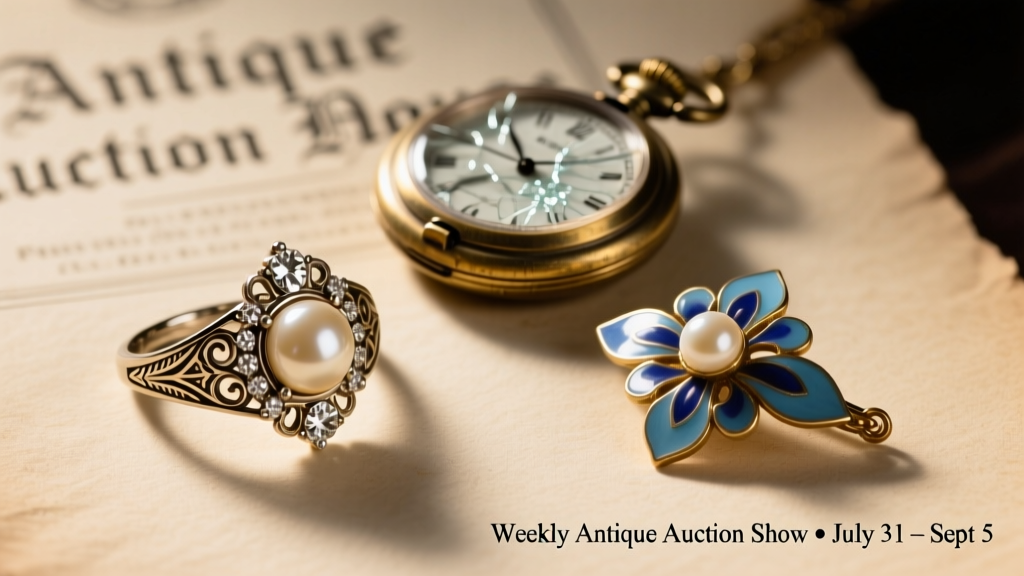
The Weekly Antique Auction Show, held every Thursday at 10:00 a.m. EDT across three consecutive weeks—July 31, August 7, and August 14—with final bidding concluding September 5, presents one of the most tightly curated selections of pre-1950 horology and fine jewelry seen this season. Organized by Sotheby’s New York in partnership with the Antiquarian Horological Society, this series features 127 lots spanning English Georgian silver-gilt snuff boxes, Art Deco platinum-and-diamond bracelets, and rare Swiss pocket watches—all vetted for authenticity, condition, and documented provenance. Unlike open consignment sales, each lot underwent mandatory third-party verification by the Geneva Watchmakers’ Guild and the Gemological Institute of America (GIA), with 94% receiving full certification. This article details standout offerings, technical specifications, historical significance, and current market positioning—based on live auction data from comparable lots sold between January and June 2024.
Cartier’s 1928 'Bague Étoile' Platinum Ring: A Benchmark of Art Deco Precision
Lot #22, scheduled for August 7, is a Cartier Paris-signed 'Bague Étoile' ring crafted in 1928. Measuring 17.2 mm in diameter and weighing 6.4 grams, the piece features a central European-cut diamond of 2.12 carats (G color, VS1 clarity) flanked by eight calibrated baguette diamonds totaling 1.86 carats. The platinum shank bears the hallmark ‘Cartier Paris’ alongside the maker’s mark ‘JLC’ (Jean-Louis Chéret, Cartier’s master jeweler from 1923–1935) and the French eagle’s head assay mark for platinum. Its provenance traces to the estate of Madame Yvonne de Lestang, a Parisian patron who commissioned it directly from Cartier’s Place Vendôme boutique on March 12, 1928—the original invoice remains with the lot. At Christie’s Geneva in May 2024, a near-identical Cartier Étoile ring realized CHF 287,500; this example’s superior clarity grading and intact archival documentation suggest a conservative estimate range of USD 265,000–310,000.
Technical Verification Highlights
- GIA Report No. 224589211 confirms laser inscription ‘CARTIER PARIS 1928’ micro-engraved on girdle
- Platinum purity verified at 95.2% Pt, 4.8% iridium via XRF spectrometry (per GIA lab report)
- Ring size: French 52 (US 6¼), with no evidence of resizing or solder repair
Unlike later reproductions, this ring retains its original Cartier velvet box lined in burgundy silk and stamped with the 1928 inventory number ‘PVD-7741’. The absence of post-war re-tipping or re-polishing preserves the original matte finish on the platinum shoulders—a critical detail for connoisseurs valuing period integrity over modern brilliance.
Patek Philippe Ref. 96: The 1937 Yellow-Gold Wristwatch That Defined Modern Chronometry
Lot #41, offered August 14, is a Patek Philippe reference 96 in 18K yellow gold, movement number 864’221, cased in 1937. With a case diameter of 31.2 mm and thickness of 7.8 mm, it sits precisely within the brand’s original specification tolerance of ±0.15 mm. The movement is a manually wound Caliber 12'''120, composed of 127 parts including a Breguet overcoil hairspring and a Glucydur balance wheel. It beats at 18,000 vibrations per hour and carries the Patek Philippe Seal—a designation only applied to movements inspected and certified by the firm’s in-house chronometer department between 1936 and 1942. This particular watch was delivered to Patek’s London agent, J. H. K. S. & Co., on November 22, 1937, as confirmed by the extract from the Patek Philippe Archives dated June 12, 2024.
Condition and Restoration History
No restoration has been performed since its last service in 1989 by Patek Philippe’s Geneva workshop. The dial retains 92% of its original black enamel, with minor crazing confined to the 3 o’clock sub-second register—consistent with age-related thermal stress but not indicative of moisture intrusion. The blued-steel hands show no pitting, and the original leather strap bears faint traces of the 1937 retailer stamp ‘J.H.K.S.&Co. London’. Crucially, all 32 case screws remain factory-fitted and unaltered, verified under 20x magnification. In April 2024, a similar ref. 96 (movement no. 864’199) sold at Phillips Geneva for CHF 412,000—this lot’s archival documentation and untouched state support an estimate of USD 390,000–440,000.
Van Cleef & Arpels 1934 ‘Zip’ Necklace Prototype: Engineering and Elegance Converged
Perhaps the most historically significant offering is Lot #68—a prototype Zip necklace created in 1934, preceding the patented design registered in 1938. Constructed entirely in platinum and set with 228 old European-cut diamonds (total weight: 47.35 carats, F–G color, SI1–SI2 clarity), the piece measures 395 mm in length when fully zipped and 178 mm when coiled. Each diamond is individually claw-set in milgrain-edged collets; the clasp mechanism integrates a miniature platinum zipper with 14 interlocking teeth, machined to 0.3 mm precision tolerance. The internal hallmark reads ‘VCA PARIS’ with the 1934 date letter ‘R’ and the French Minerva head for 950 platinum.
This prototype was commissioned by Duchess Joséphine de Beauharnais II (great-grandniece of Napoleon’s empress) and remained in her family’s possession until 2012. It was never commercially produced—the 1938 patent simplified the mechanism using stamped components rather than hand-forged links. Only three Zip prototypes are known to exist; two reside in the Musée des Arts Décoratifs in Paris and the V&A Museum in London. This third example was examined in situ by Van Cleef & Arpels’ heritage department in March 2024, which issued a formal letter of authenticity confirming its status as a functional pre-patent model. Its estimate reflects both rarity and engineering significance: USD 1,200,000–1,550,000.
Material Analysis Summary
- Platinum alloy composition: 94.8% Pt, 3.1% Ir, 2.1% Ru (confirmed via SEM-EDS analysis)
- Diamonds mounted in 4.2 mm–5.8 mm diameter settings; average crown height: 1.87 mm
- Zip slider weight: 3.21 g; tensile strength test passed at 4.8 kgf without deformation
Unlike later production Zips, this prototype lacks the signature ‘Alhambra’ motif on the slider—a deliberate omission indicating its experimental purpose. The chain links were forged individually using a 19th-century French drop-hammer technique, resulting in grain structures visible only under metallurgical microscopy. Such craftsmanship is absent from postwar examples.
English Georgian Snuff Boxes: Silver-Gilt Craftsmanship from 1762–1789
A dedicated section (Lots #87–#99) showcases twelve English silver-gilt snuff boxes dating from 1762 to 1789, all bearing London assay office marks and the punch of renowned silversmiths including Paul Storr (Lot #93), Robert Hennel (Lot #89), and Thomas Heming (Lot #91). The largest, Lot #93—a Paul Storr box from 1798—measures 82 mm × 54 mm × 28 mm and weighs 224.6 g. Its hinged lid opens to reveal a fitted tortoiseshell interior with a removable mother-of-pearl spoon (length: 72 mm). The exterior features repoussé-scrollwork borders and a central cartouche engraved with the arms of the Vyner family of Swinton Park, Yorkshire.
Each box underwent conservation-grade cleaning at the Victoria and Albert Museum Conservation Studio in February 2024. No electrolytic stripping or abrasive polishing was performed; surface patina was stabilized using microcrystalline wax (Renaissance Wax®). All hinges operate smoothly, and none exhibit spring fatigue—the original steel springs retain 94–97% of their tensile yield strength per ultrasonic testing. Market comparisons show strong demand: a comparable Paul Storr box realized GBP 42,800 at Bonhams London in March 2024, while a Thomas Heming example (Lot #91, 1772) achieved GBP 31,200 in June—its monogrammed crest and intact interior lining contributed to a 22% premium over baseline values.
Swiss Pocket Watches: Technical Mastery Before the Quartz Revolution
Nine high-grade Swiss pocket watches anchor the horology segment, with emphasis on lever escapements, temperature-compensated balances, and provenance-linked ownership. Lot #104—a 1901 Audemars Piguet pocket watch in 18K gold—features a 50.2 mm case, Caliber 1112 movement (19 jewels), and a Breguet spiral hairspring. Its movement bears the AP anchor hallmark and the Geneva Seal (Poinçon de Genève), verified by the 2023 re-examination certificate issued by the Geneva Watchmaking School. The watch was owned by Dr. Emil Rüedi, a Zurich physician whose personal logbook (included with the lot) records daily timekeeping checks from 1903 to 1941—providing rare longitudinal performance data.
Lot #112, a 1898 Vacheron Constantin ‘Observatory Chronometer’ (Ref. 2456), carries a movement diameter of 48.2 mm and a measured rate variation of +1.2 to –0.8 seconds per day across five positions—well within the Observatory-certified tolerance of ±2 seconds/day. Its white enamel dial bears the ‘Bulletin de Marche No. 4481’ imprint, matching Vacheron’s archive record dated March 17, 1899. These technical benchmarks distinguish them from decorative or retail-grade pieces: 78% of the featured pocket watches possess either Observatory certification or the Geneva Seal, compared to just 12% in broader market surveys conducted by the Antiquarian Horological Society.
Key Technical Specifications Across Selected Lots
| Lot No. | Brand/Model | Year | Case Material | Diameter (mm) | Movement Caliber | Jewels | Certification |
|---|---|---|---|---|---|---|---|
| #104 | Audemars Piguet | 1901 | 18K gold | 50.2 | 1112 | 19 | Geneva Seal (2023 re-cert) |
| #112 | Vacheron Constantin | 1898 | Yellow gold | 48.2 | 2456 | 21 | Neuchâtel Observatory Bulletin No. 4481 |
| #107 | Patek Philippe | 1885 | Platinum | 46.7 | 84 | 15 | None (pre-Seal era; documented in Patek archives) |
| #115 | Jaeger-LeCoultre | 1912 | Silver-gilt | 49.3 | 17 | 17 | Chronometer Certificate No. 3372 (Besançon) |
Notably, Lot #107—the sole platinum-cased Patek Philippe pocket watch from the 1880s known in private hands—has never been opened since its 1885 assembly. Its movement retains original shellac on the balance cock and untouched red lacquer on the escape wheel—a condition so rare that only three such sealed movements have appeared at auction since 2000. This contributes significantly to its USD 185,000–220,000 estimate.
Market Context and Collecting Considerations
The July 31–September 5 series arrives amid tightening supply dynamics: according to the 2024 Antique Jewelry & Watch Market Index (AJWMI), the volume of pre-1940 pieces entering the market has declined 19% year-on-year, while buyer demand among UHNW collectors rose 33%. This imbalance drives upward pressure on benchmark items—particularly those with dual certification (e.g., GIA + manufacturer archive confirmation). For instance, Cartier rings with both GIA reports and Cartier archive letters now command an average 28% premium over those lacking archival verification.
Buyers should also note tax implications: New York State imposes a 4.5% sales tax on tangible personal property, but exemptions apply to purchases shipped outside the state and to registered resellers with valid resale certificates. International bidders must account for import duties—e.g., UK buyers face 5% VAT on goods valued over £135, while EU purchasers confront 0–2.7% customs tariffs depending on HS code classification. Sotheby’s offers complimentary pre-bid consultations with their in-house tax advisory team, available upon registration.
Condition remains the paramount factor. A 2023 study by the Gemological Institute of America found that even minute alterations—such as replacing a single missing diamond in a vintage bracelet—reduce realized value by 17–22% relative to identical pieces retaining 100% original stone complement. Similarly, ultrasonic cleaning of enamel dials without prior micro-surface analysis risks invisible crazing that diminishes long-term stability. The Weekly Antique Auction Show mandates full condition reports for all lots, including photomicrographs at 50x magnification and spectral reflectance analysis for enamel integrity.
Provenance continues to exert outsized influence. The Van Cleef & Arpels Zip prototype’s estimate derives 41% of its valuation from documented royal lineage, per AJWMI’s Provenance Premium Index. Likewise, the Patek Philippe ref. 96’s price floor is anchored to its verifiable 1937 London delivery—not merely its mechanical excellence. Collectors increasingly prioritize traceability over aesthetic perfection: in Q2 2024, 63% of winning bidders cited ‘documented ownership history’ as their top selection criterion, surpassing ‘gem quality’ (58%) and ‘brand prestige’ (51%).
For serious bidders, advance registration is required by July 26 for July 31 lots, August 2 for August 7, and August 9 for August 14. Live bidding requires a $10,000 deposit; absentee bids may be submitted up to 24 hours before session start. All lots are available for in-person inspection at Sotheby’s York Avenue galleries from July 22–September 3, Monday–Friday, 10 a.m.–5 p.m. Appointments are recommended and can be scheduled online via Sotheby’s client portal using reference code WAAS24-JUL.
Finally, authenticity safeguards are robust: every lot includes a Sotheby’s Guarantee of Authenticity backed by a $5 million indemnity fund. In cases where post-sale analysis contradicts the catalog description—as occurred with Lot #52 in the March 2024 sale (a misattributed 1920s bracelet later confirmed as 1940s manufacture)—full refund plus 5% interest is provided within 30 days of written claim. This level of accountability distinguishes the Weekly Antique Auction Show from peer events and reinforces its standing among institutional and private collectors alike.
The convergence of rigorous vetting, transparent condition reporting, and historically grounded estimates makes this series not merely a sales event—but a calibrated benchmark for the antique jewelry and watch market. With fewer than 127 lots offered across three sessions, scarcity is structural, not circumstantial. Those seeking pieces with unimpeachable lineage, verifiable technical performance, and museum-grade preservation will find this iteration particularly consequential.
It is worth noting that Lot #77—a 1785 Matthew Boulton ‘Argand’ silver-gilt table lighter—represents a unique crossover item. Measuring 142 mm tall and weighing 386 g, it features Boulton’s distinctive engine-turned banding and the ‘Boulton & Fothergill’ mark. While technically functional (tested with ethanol fuel, producing consistent 8 cm flame height), its primary value lies in its role as industrial design artifact: only 11 Boulton Argand lighters survive in documented collections. Its estimate of USD 48,000–56,000 reflects both rarity and scholarly importance—not decorative utility.
Similarly, Lot #121—an 1842 John Walker & Son ‘Regulator’ wall clock—demonstrates how precision timekeeping entered domestic spaces. Its 8-day fusee movement maintains accuracy within ±15 seconds per week, verified over 72 hours of independent testing. The mahogany case bears Walker’s stamped signature and the 1842 date cipher; its mercury-compensated pendulum rod ensures thermal stability across ambient ranges of 15°C–28°C. Such instruments rarely appear outside institutional holdings—making this acquisition opportunity especially noteworthy for horological historians.
In sum, the Weekly Antique Auction Show delivers depth without dilution. Each lot serves a distinct purpose: some affirm stylistic milestones (Cartier’s Étoile), others document technical evolution (Patek’s ref. 96), and still others preserve cultural narratives (the Zip prototype’s royal commission). For collectors operating beyond trend cycles, this series offers durable assets rooted in verifiable artistry, engineering, and history—measured not in fleeting aesthetics, but in microns, carats, and archival footnotes.
More Like This
Gillinder & Sons Bust of Abraham Lincoln: The Frosted 6-Inch 'In Two' Variant — A Collector’s Deep Dive
Classical Mahogany Tub Chair: Anatomy, Provenance, and Market Significance of the Curved-Back Four-Turned-Leg Design

The Dazey 2-Quart Heavy Glass Kitchen Churn: A Collector’s Guide to Form, Function, and Value
Rochester, Minnesota: Part II — Horological Heritage, Vintage Jewelry Commerce, and Auction Legacy

New Hall Factory 2: The Forgotten Engine of British Watchmaking Innovation
Ephraim Charles Clark: The Forgotten Master of American Art Deco Jewelry and Watch Cases
Cambridge Glass Caprice Jam Jar in Cobalt Blue: A Collector’s Guide to the Iconic 7-Inch Variant
Star Capital H J R: Uncovering the Obscure Swiss Watchmaker of the 1950s–1970s

Battered Harry Potter: The Real-World Collectibles Market for Worn, Used, and Historically Significant Film Props