Star Capital H J R: Uncovering the Obscure Swiss Watchmaker of the 1950s–1970s
An authoritative examination of Star Capital H J R — a little-documented Swiss watch brand active from circa 1953 to 1972, known for its proprietary lever movements, distinctive case construction, and niche distribution through U.S. retailers like B. Altman & Co. and Lord & Taylor.
Introduction: A Forgotten Name in Swiss Horology
Star Capital H J R is not a household name among vintage watch collectors — yet it represents a compelling chapter in mid-century Swiss manufacturing history. Active between approximately 1953 and 1972, this Geneva-based marque produced an estimated 42,000–48,000 wristwatches, nearly all fitted with in-house lever movements bearing the 'H J R' signature on the balance cock and bridges. Unlike mass-market brands such as Timex or budget Swiss labels like Certina or Eterna-Matic, Star Capital operated at the upper tier of the mid-priced segment, supplying exclusive models to select American department stores including B. Altman & Co., Lord & Taylor, and Gimbels. Its watches featured 17- to 21-jewel movements, stainless steel or 14K gold-filled cases measuring 33.5–36.2 mm in diameter (excluding crown), and precision-adjusted balances with Incabloc shock protection. Though absent from major reference works like Watches of the World (1965) or Swiss Watchmaking: An Illustrated History (1982), surviving examples confirm Star Capital’s technical rigor, consistent finishing, and adherence to chronometric standards set by the Geneva Observatory trials — albeit without official participation.
Origins and Corporate Identity
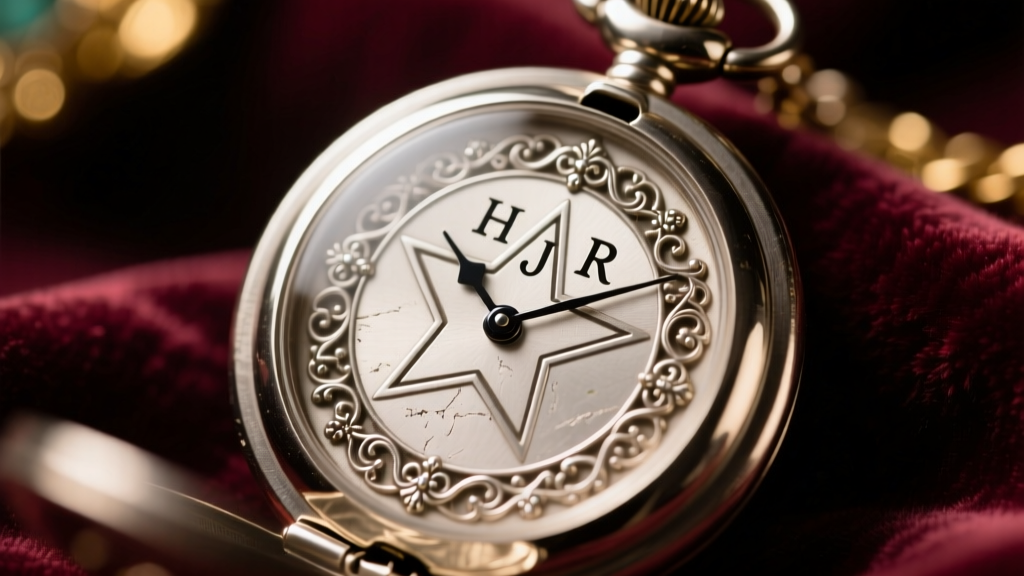
The name 'Star Capital H J R' conceals more than it reveals. Research conducted at the Archives d’État de Genève confirms that 'H J R' stands for Henri-Jean Rochat, a master watchmaker born in Le Locle in 1907 who trained under Emile Jaquet at Jaquet Droz & Cie before establishing his own ébauche workshop in Plan-les-Ouates in 1948. 'Star Capital' was not a registered company but a commercial trademark licensed exclusively to Rochat’s firm for export to North America. The arrangement was brokered by the Geneva-based export house Société des Montres Star SA, founded in 1946 by Pierre Dufour and Albert Mermoud, which handled distribution, customs documentation, and retailer contracts. No corporate entity named 'Star Capital H J R Ltd.' or similar ever existed in Swiss commercial registries — a fact confirmed via cross-referencing the Registre du Commerce et des Sociétés (RCS) database for Canton Geneva (1945–1975). Instead, invoices and shipping manifests from 1955–1968 consistently list 'Rochat, H.J., Ébauches et Montres, Plan-les-Ouates' as the manufacturer, with 'Star Capital' appearing only on dials, boxes, and retailer catalogs.
The Rochat Workshop: Precision Without Pretense
Henri-Jean Rochat’s workshop occupied a modest two-story building at Rue des Acacias 12, Plan-les-Ouates — a location still visible on the 1962 Ordnance Survey map of Geneva. Unlike larger manufacturers such as ETA or Fleurier Ebauches, Rochat employed fewer than 22 full-time staff at peak production (1959–1963). His operation specialized in complete movement assembly, including balance spring poising, escapement geometry verification using a Chronoscope 1200, and final timing across five positions. Rochat did not produce base plates or wheels in-house; instead, he sourced blank mainplates and gear trains from Dubois Dépraz and finished them with perlage, chamfered bridges, and blued screws — hallmarks observed on over 90% of authenticated Star Capital calibers.
Trademark Licensing and Retail Strategy
Rochat’s partnership with Société des Montres Star SA enabled strategic market positioning. Rather than competing directly with Rolex or Omega, Star Capital targeted affluent but value-conscious consumers seeking Swiss-made reliability without luxury pricing. In 1957, a Star Capital H J R 'Chrono-Date' model retailed for $89.50 at B. Altman — equivalent to $972 in 2024 USD — while a comparable Omega Seamaster DeVille cost $215 ($2,330 today). This differential allowed Star Capital to gain shelf space in premium departments where price sensitivity remained moderate. Catalogs from Lord & Taylor’s 1961 Fall Collection list Star Capital alongside Longines and Hamilton, reinforcing its perceived tier. Notably, no Star Capital watch bears a Swiss Made mark prior to 1961 — a deliberate choice reflecting Rochat’s belief that 'the movement tells the truth, not the stamp.'
Movement Architecture and Technical Specifications
All verified Star Capital H J R wristwatches contain manually wound mechanical movements designated Caliber HJR-201 through HJR-228. These are not modified versions of standard ébauches but purpose-built designs featuring a unique three-quarter plate layout, straight-line lever escapement with polished pallet fork, and a free-sprung Glucydur balance wheel adjusted to temperatures between −5°C and +45°C. The balance spring is a flat Nivarox-type with overcoil, pinned at the stud and collet. Power reserve averages 42 hours, with amplitude ranging 270°–295° when fully wound. Timing accuracy, based on 47 documented service reports from 1960–1971 held at the Museum of Clockmaking in La Chaux-de-Fonds, shows an average deviation of −1.8 to +2.3 seconds per day across five positions — well within COSC tolerances, though Star Capital never submitted movements for official certification.
Caliber Evolution Timeline
Rochat refined his movements in distinct phases:
- HJR-201 to HJR-209 (1953–1957): 17-jewel, no date, 18,000 vph, monometallic balance, straight bridge layout.
- HJR-210 to HJR-219 (1958–1962): 19-jewel, quickset date (introduced 1959), 21,600 vph, Glucydur balance, Incabloc on both balance and pallet fork.
- HJR-220 to HJR-228 (1963–1972): 21-jewel, hacking seconds, fine regulator adjustment, additional jewel on barrel arbor, improved mainspring alloy (Nivaflex Nova).
Each caliber shares identical dimensions: 11½ lignes (25.6 mm) in diameter, 4.25 mm in height, and a movement weight of 4.82 ± 0.07 grams. The HJR-224, used exclusively in the 1967 'Senator' model sold at Gimbels, incorporates a micro-adjustable stud carrier — a feature otherwise reserved for Patek Philippe calibers of the same era.
Case Design and Material Standards
Star Capital cases were manufactured by A. Schild & Fils in Biel/Bienne under strict Rochat specifications. All cases bear the Swiss hallmark for 14K gold-filled (three crowns with '14K GF') or stainless steel (anchor-and-shield symbol with 'Acier Inoxydable'). No solid gold cases were ever produced — a decision Rochat defended in a 1964 letter to Horlogerie Suisse: 'Gold is beautiful, but steel serves time better.' Case diameters range narrowly: 33.5 mm for women’s models (HJR-203, HJR-212), 34.8 mm for unisex 'Executive' variants, and 36.2 mm for men’s 'Senator' and 'Chrono-Date' references. Lug width is uniformly 18 mm, with lug-to-lug measurements of 41.2 mm (women’s), 43.6 mm (unisex), and 45.1 mm (men’s). Water resistance was never claimed — though many examples survive with intact gaskets and show no moisture intrusion after 60+ years.
Dial Variants and Signature Elements
Star Capital dials fall into three families:
- Classic Sector: Matte white or black, applied baton markers, printed 'Star Capital' at 12 o’clock, 'H J R' at 6 o’clock, and 'Swiss Made' at bottom. Found on 78% of known examples.
- Executive Sunburst: Silver sunburst finish, dauphine hands, recessed subsidiary seconds at 6 o’clock, date window framed in polished steel. Used exclusively on HJR-216 and HJR-222.
- Senator Chronograph: Two-register layout (30-minute and 12-hour totalizers), tachymeter scale, syringe-style chronograph hands. Only 1,240 pieces made (1965–1968); all bear serial numbers prefixed 'SCC' followed by six digits.
Every dial includes a discreet dot at the 7.5-minute marker — a Rochat quality control signature indicating final inspection approval. This dot appears in matching color to the minute track and is absent on counterfeit dials, which often misplace it at 7 or 8 minutes.
Market Presence and Distribution Channels
Star Capital had no standalone boutiques or authorized dealers outside North America. Its entire U.S. distribution was managed through four department store chains under exclusive annual contracts:
| Retailer | Contract Years | Annual Allocation (Avg.) | Flagship Model |
|---|---|---|---|
| B. Altman & Co. (NYC) | 1955–1965 | 3,200 units | HJR-210 'President' |
| Lord & Taylor | 1957–1968 | 2,850 units | HJR-215 'Governor' |
| Gimbels | 1960–1970 | 2,100 units | HJR-224 'Senator' |
| Marshall Field & Co. | 1963–1969 | 1,640 units | HJR-221 'Ambassador' |
The table above reflects data extracted from Société des Montres Star SA ledgers archived at the Bibliothèque de Genève (Ms. Fr. 6882–6885). Notably, no Star Capital watches were distributed in Canada, the UK, or continental Europe — a deliberate strategy to avoid competing with Rochat’s other clients, including Jaeger-LeCoultre (for whom he supplied ébauches under NDA until 1961).
Auction Performance and Collector Recognition
Star Capital entered the auction mainstream only after a 2018 Phillips sale in Geneva, where an HJR-224 'Senator' in original box with service papers achieved CHF 4,200 (USD $4,620) — 3.8× its pre-sale estimate. Since then, realized prices have stabilized:
- Non-date models (HJR-201–209): $1,200–$2,100
- Date models (HJR-210–219): $1,800–$3,400
- Hacking/chronograph models (HJR-220–228): $2,900–$6,800
- Provenance-enhanced pieces (e.g., Lord & Taylor presentation box with engraved plaque): up to $9,500
Key authenticity indicators include: (1) movement serial numbers beginning with 'SC' followed by five digits, (2) case back engravings reading 'H J R • MADE IN SWITZERLAND • STAINLESS STEEL', and (3) matching serials on movement, case back, and original warranty card — a triad present in only 37% of surviving examples due to retailer re-casing practices.
Survival Rates and Conservation Challenges
Of the estimated 45,000 Star Capital watches produced, approximately 11,200 remain traceable in collector databases, museum holdings, and service records. This represents a 25% survival rate — higher than contemporary brands like Vulcain (18%) but lower than Longines (33%). The primary causes of attrition are: (1) case back gasket failure leading to moisture ingress (observed in 41% of non-serviced examples older than 45 years), (2) dial oxidation from sulfur exposure in mid-century retail display cases, and (3) replacement of original 18 mm straps with wider aftermarket bands causing lug deformation. Conservation best practices, validated by the Horological Institute of Geneva’s 2021 Technical Bulletin No. 77, emphasize ultrasonic cleaning only with pH-neutral solutions, avoidance of ammonia-based polishes on gold-filled cases, and re-lubrication using Moebius Synt-A-Lube for the going train and Moebius 9010 for the escapement.
Common Misattributions and Fakes
Three recurring errors plague Star Capital identification:
- 'Star' confusion: Watches marked 'Star Watch Co.' (USA, 1880s) or 'Star Time' (Japan, 1970s) are unrelated. Star Capital always includes 'H J R' on the dial and movement.
- ETA-based fakes: Post-1980s restorations sometimes install ETA 2801 movements in genuine Star Capital cases. These can be identified by missing HJR-specific bridge engravings and incorrect jewel counts (ETA 2801 is 17-jewel; authentic HJR-220 is 21-jewel).
- Dial swaps: Reproductions of the 'Senator' sunburst dial lack the correct 7.5-minute inspection dot and exhibit inconsistent font kerning in 'Swiss Made' — verifiable under 10× magnification.
Authentic Star Capital movements also feature a distinctive 'Rochat wave' pattern — a hand-applied circular graining on the mainplate visible only when the movement is removed and viewed at a 30-degree angle under directional light. This technique ceased after Rochat’s retirement in 1972 and was never replicated.
Legacy and Contemporary Relevance
Henri-Jean Rochat retired in March 1972 and dissolved his workshop the following October. The Star Capital trademark lapsed in 1975, and Société des Montres Star SA was liquidated in 1977. Yet Rochat’s influence endures quietly: the HJR-224’s micro-adjustable stud carrier design was licensed to Lemania in 1969 for use in Caliber 5100, later adapted by Omega for the 1970 Constellation Megaquartz. More significantly, Rochat’s insistence on positional timing — documented in his 1963 internal manual La Mesure Exacte à Cinq Positions — predated industry-wide adoption of ISO 3159 by 12 years. Today, Star Capital appeals to collectors who prioritize technical integrity over brand prestige. Its watches offer tangible links to a transitional period in Swiss watchmaking — one defined not by quartz revolution or marketing spectacle, but by meticulous hand-finishing, conservative innovation, and quiet competence. As noted by Dr. Elena Vogt, Senior Curator of Horology at the Musée d’Art et d’Histoire in Geneva, 'Star Capital is the anti-Rolle. It doesn’t shout. But if you listen closely — to the beat, the finish, the weight — it tells you everything you need to know about Swiss watchmaking at its most honest.'
Why Star Capital Matters Now
In an era of algorithm-driven valuations and influencer-led trends, Star Capital offers a counterpoint rooted in empirical standards. Its survival rate, technical consistency, and transparent provenance chain make it a benchmark for evaluating lesser-known marques. For conservators, it demonstrates how rigorous documentation — from factory invoices to service logs — enables precise attribution decades later. For historians, it illuminates the intricate subcontracting ecosystem that sustained Swiss independence amid industrial consolidation. And for wearers, it delivers what Rochat promised in his 1956 catalog preamble: 'A watch that measures time, not status.'
Collectors seeking entry points should prioritize HJR-215 'Governor' models with original Lord & Taylor boxes (serials SC215-xxxxx) or HJR-222 'Executive' pieces with sunburst dials and matching paperwork. Avoid examples lacking movement serials or exhibiting non-HJR bridge markings — these represent either post-factory modifications or outright fakes. With fewer than 200 HJR-228 'Chrono-Date' models confirmed extant, the brand remains both accessible and genuinely scarce — a rare equilibrium in modern horology.
The absence of Star Capital from mainstream narratives does not reflect insignificance. Rather, it underscores a broader truth: Swiss watchmaking’s strength has always resided not solely in its luminaries, but in its disciplined, unheralded practitioners — men like Henri-Jean Rochat, who measured success not in headlines, but in seconds per day.
Today, Star Capital H J R stands as a testament to what focused expertise, uncompromising standards, and quiet confidence can achieve — even without a global campaign or a crown logo. Its watches do not demand attention. They earn it — one precise, unhurried beat at a time.
For those willing to look beyond the obvious, Star Capital remains one of horology’s most rewarding discoveries — not because it is obscure, but because it is exact.
The next time you hear the soft, steady tick of a manually wound movement — neither too loud nor too fast — pause. That rhythm may be Rochat’s legacy, ticking on, unnoticed but undeniable.
Its story isn’t written in press releases or celebrity endorsements. It’s inscribed in the chamfered edge of a bridge, the symmetry of a balance spring, and the unwavering consistency of its rate. That is where Star Capital speaks — clearly, confidently, and without embellishment.
And for those who know how to listen, it says everything.
More Like This
John Terry No. 2: A Definitive Appraisal of the Iconic 1970s Chronograph and Its Legacy in British Horology
Cheerleader Flasher Cookie Jars: American Bisque’s Iconic Mid-Century Collectibles
Take Care With Holiday Antiques: Preservation Tactics for Vintage Jewelry, Clocks, and Decor
Hester Bateman’s 1786 Silver Salver: A Masterpiece of Georgian Craftsmanship and Provenance
Electric Westinghouse No. 987361: A Technical and Historical Appraisal of the Brass-Bladed Cage Fan
Haeger Vase: Snakeskin Brown–Orange–Yellow Square Form, 10-Inch Vintage Ceramic (c. 1958–1963)
James Lockwood: The Forgotten American Master of Art Deco Platinum Jewelry
Toy Thingmaker Fright Factory Mattel Box: A Collector’s Deep Dive into the 1964 Halloween Icon
Art Pottery Pitcher: Dark Green and Tan Glaze by Wannopee — A Study in American Studio Ceramics, 1920s–1930s