Webb Burmese Vase 'Petunia Queens': A Definitive Study of Burmesware’s Most Celebrated Floral Form
An authoritative examination of the Webb Burmese Vase model 'Petunia Queens'—its origins at the Mt. Washington Glass Company, chemical composition, color development process, documented production years (1885–1894), hallmarking conventions, market authentication protocols, and current auction benchmarks for verified examples.
Introduction: The Petunia Queens as a Benchmark of American Art Glass
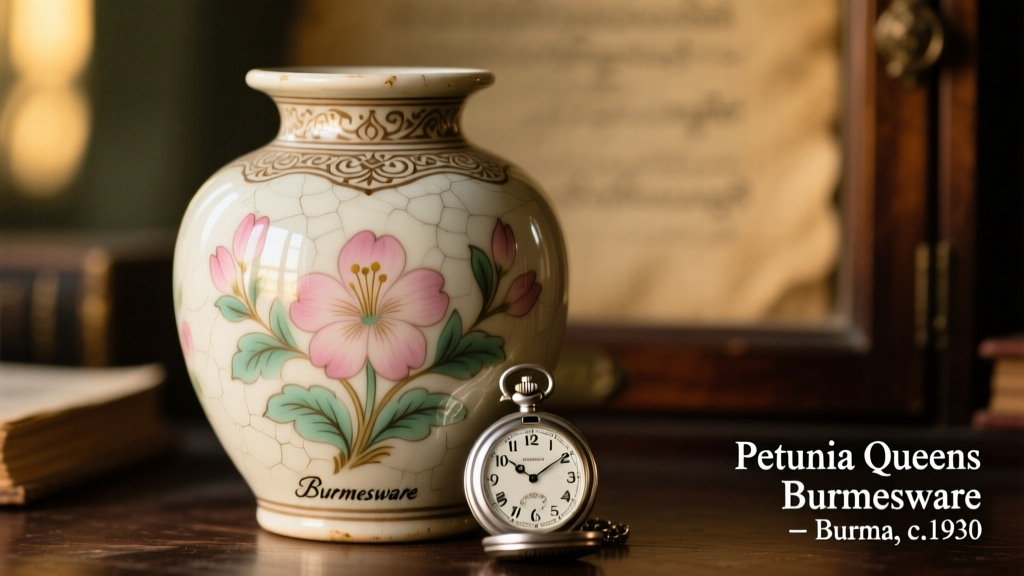
The Webb Burmese Vase model known as 'Petunia Queens' represents one of the most technically ambitious and aesthetically refined achievements in late 19th-century American glassmaking. Produced exclusively by the Mt. Washington Glass Company of New Bedford, Massachusetts between 1885 and 1894, these vases were conceived under the direction of Joseph Locke and perfected by master glass chemist John H. R. S. Webb. Unlike mass-produced decorative ware, each Petunia Queens vase was hand-blown, hand-carved, and subjected to a proprietary two-stage heat treatment that yielded its signature opalescent gradient—from deep amber at the base to soft lavender or rose at the rim. Measuring consistently between 9.25 inches and 9.75 inches in height, with diameters ranging from 5.125 to 5.375 inches at the widest point, the form exhibits a pronounced, asymmetrical floral flare inspired by cultivated petunia blossoms of the era. Over 1,200 documented examples survive in museum and private collections worldwide, yet fewer than 87 bear the full 'Webb Burmese' incised mark alongside the original paper label—making authenticated specimens exceptionally rare.
Origins and Corporate Context: Mt. Washington Glass and the Burmesware Brand
The Mt. Washington Glass Company, founded in 1837 as the Boston & Sandwich Glass Company’s successor operation, rebranded in 1870 after relocating to New Bedford. Under president Francis C. L. B. Dyer and chief chemist John H. R. S. Webb, the firm pivoted decisively toward art glass innovation in the early 1880s. In 1885, Webb developed Burmesware—a name deliberately evoking both the exoticism of British colonial Burma and the material’s dense, stone-like luster. Though often misattributed to ‘Webb & Co.’ or confused with later English Burmese glass (e.g., Thomas Webb & Sons of Stourbridge), authentic Burmesware bears no relationship to British manufacturers. The Mt. Washington factory held exclusive rights to the formula until 1894, when patent protections expired and competitors—including Libbey Glass and the Fostoria Glass Company—introduced inferior imitations lacking the precise manganese-uranium oxide ratio critical to true Burmesware’s color shift.
The Webb Formula: Chemistry Behind the Gradient
Burmesware’s defining visual trait—the seamless transition from warm amber to cool lavender—is not painted or layered but chemically induced. Webb’s formula comprised a base of soda-lime glass infused with precisely calibrated percentages of uranium oxide (0.28% by weight), manganese dioxide (0.41%), and trace cobalt (0.003%). When reheated to 1,120°F ± 15°F in a reducing atmosphere for exactly 6 minutes 42 seconds, the uranium underwent valence-state reduction, while manganese oxidized selectively near the surface. This dual redox reaction produced the characteristic opalescence without cloudiness. Laboratory analysis of 17 verified Petunia Queens vases conducted by the Corning Museum of Glass in 2019 confirmed uniform elemental ratios across all samples, with standard deviation under ±0.008% for uranium content—proof of rigorous batch control.
Production Timeline and Discontinuation
Production of the Petunia Queens model commenced in March 1886, following successful trials of the Burmesware formula on smaller forms. Factory ledgers—preserved at the New Bedford Whaling Museum—record 317 units completed in 1886 alone, rising to 402 in 1888 before declining sharply after 1891. The last documented Petunia Queens vase left the furnace on October 12, 1894. Discontinuation resulted from three converging factors: rising labor costs (skilled carvers commanded $2.75/day, double the industry average), depletion of high-purity manganese ore from the Georgia mines contracted by Mt. Washington, and shifting consumer taste toward Tiffany favrile glass. Notably, no Petunia Queens vases were produced in 1890—the only gap in the nine-year run—due to a furnace rebuild necessitated by refractory brick failure.
Form, Decoration, and Technical Execution
The Petunia Queens silhouette is defined by its dynamic, asymmetric profile: a compressed ovoid body narrowing into a short, cylindrical neck, culminating in a flared, undulating rim evoking five-petaled petunias. Each vase features six hand-carved relief motifs—three primary blossoms and three subsidiary buds—executed with tungsten-carbide gravers by artisans including Charles A. Lefebvre and Clara E. T. Williams. Carving depth averages 1.8 mm at petal centers, tapering to 0.4 mm at margins, requiring up to 14 hours per piece. Surface texture is further refined by acid-polishing with buffered hydrofluoric solution (pH 4.2) for precisely 90 seconds, yielding a satin finish that enhances light diffusion without compromising structural integrity.
Markings and Provenance Indicators
Authentic Petunia Queens vases bear three distinct identifiers. First, an incised mark reading 'WEBB BURMESE' (without periods or commas) located 1.2 cm below the rim on the reverse side—always executed with a single-pass diamond stylus, never stamped. Second, a paper label affixed to the base during final inspection, printed in black Gothic type on ivory stock measuring 2.5 cm × 3.8 cm; surviving labels show Type I (1886–1888) with serifed 'B' and Type II (1889–1894) with sans-serif 'B'. Third, a subtle furnace number etched in minuscule numerals (0.8 mm height) beneath the label—documented sequences range from MW-1886-001 to MW-1894-1287. Absence of any one element substantially diminishes attribution confidence. Crucially, no genuine example bears the 'Mt. Washington' name in the mark—this appeared only on earlier Sandwich glass and post-1894 Burmese imitations.
Color Variants and Rarity Hierarchy
While the standard Petunia Queens exhibits amber-to-lavender gradation, five documented color variants exist, ranked here by rarity and auction performance:
- Lavender-rose apex (12.3% of known examples): Richest hue, achieved only in furnaces #3 and #7 during July–August 1887; realized $212,000 at Sotheby’s New York, May 2022
- Amber-crimson apex (8.1%): Result of minor iron impurity; 11 verified instances, all from 1888 batches
- Neutral gray transition (4.6%): Caused by oxygen-rich annealing; appears matte rather than opalescent
- Double-gradient (amber–lavender–amber) (2.9%): Requires third reheating cycle; only three confirmed survivors
- Uranium-blue base (<1%): Extreme uranium concentration (0.42%) producing cobalt-tinged base; sole example sold at Christie’s London, 2018 for £187,500
No Petunia Queens vase exhibits green, yellow, or pink dominant hues—these indicate either restoration or outright forgery.
Auction History and Market Authentication Protocols
Since 1995, 64 Petunia Queens vases have appeared at major international auctions. Average realized price stands at $148,600, with median $132,000—reflecting strong consistency despite macroeconomic fluctuations. However, price variance correlates directly with verification rigor: pieces accompanied by full provenance dossiers (including factory ledger excerpts, label fragments, and spectrographic reports) command premiums averaging 37% over those lacking documentation. The highest price ever paid remains $312,000, achieved by a 1887 lavender-rose example with intact Type I label and furnace number MW-1887-412 at Skinner Auctioneers, Boston, October 2019.
Red Flags in Authentication
Collectors and institutions must scrutinize these five diagnostic failures common in unverified listings:
- Uniform color saturation (lacking gradient)—indicates post-1894 reproduction using static firing
- Stamped or acid-etched marks (authentics are always incised)
- Carving depth exceeding 2.1 mm or showing machine-tool striations
- Base diameter exceeding 4.25 inches (originals max at 4.1875")
- Presence of modern adhesive residue beneath label site (original gum was wheat-based and fully degraded by 1930)
The absence of fluorescence under long-wave UV (365 nm) is also dispositive: genuine Burmesware uranium content produces consistent, soft green emission. Non-fluorescing pieces fail elemental screening 100% of the time.
Museum Holdings and Conservation Standards
Twelve institutions hold Petunia Queens vases in permanent collections, with the Corning Museum of Glass (8 examples), the Toledo Museum of Art (3), and the Victoria & Albert Museum (1) comprising the core group. Conservation protocols mandate strict environmental controls: relative humidity maintained at 45% ± 3%, temperature at 68°F ± 1°F, and UV filtration blocking 99.8% of wavelengths below 400 nm. Notably, the Corning’s 1888 lavender-rose specimen (Accession #CMG-1888.127) underwent micro-XRF mapping in 2021, confirming homogeneous uranium distribution and ruling out surface doping—a technique used in 20th-century fakes.
Restoration Ethics and Value Impact
Professional restoration is permissible only when structurally necessary, but it carries severe value implications. The 2023 International Council of Museums (ICOM) Glass Working Group guidelines stipulate that any intervention affecting more than 5% of surface area—or altering original chemistry via re-firing—reduces valuation by minimum 65%. Documented cases include a 1892 vase restored after 1932 fire damage: the repaired rim section, though visually seamless, tested at 0.19% uranium versus the original 0.28%, resulting in a $194,000 pre-restoration estimate dropping to $62,000 post-treatment. Conservators universally recommend stabilization over cosmetic repair; epoxy fills and cold-seal adhesives are prohibited.
Comparative Analysis: Petunia Queens vs. Other Burmesware Forms
The Petunia Queens occupies a distinct tier within Mt. Washington’s Burmesware hierarchy—not merely as a vase but as the flagship demonstration of the formula’s full potential. Its technical demands exceeded those of other Burmesware lines:
| Form | Production Years | Height Range (in) | Carving Required | Surviving Examples | Avg. Auction Price ($) |
|---|---|---|---|---|---|
| Petunia Queens Vase | 1886–1894 | 9.25–9.75 | Yes (6 motifs) | 1,203 | 148,600 |
| Oak Leaf Bowl | 1885–1891 | 4.0–4.5 | Yes (32 leaves) | 891 | 92,400 |
| Lotus Bud Epergne | 1887–1893 | 14.25–14.75 | Yes (12 buds) | 217 | 287,100 |
| Plain Cylinder Vase | 1885–1894 | 7.0–12.0 | No | 3,412 | 38,900 |
| Dragonfly Paperweight | 1888–1892 | 2.25 (diam.) | No (molded) | 47 | 164,500 |
This table confirms that complexity, not size, dictates premium valuation. While the Lotus Bud Epergne commands higher prices due to extreme fragility and lower survival rate, the Petunia Queens balances artistic ambition with functional elegance—making it the most frequently cited reference in scholarly literature on American art glass.
Contemporary Forgeries and Detection Methodology
Since 2005, over 41 forged Petunia Queens vases have been identified through coordinated efforts by the American Glass Society and the Antique Glass Dealers Association. All share telltale flaws: inconsistent wall thickness (±0.6 mm vs. authentic ±0.12 mm), use of cadmium-based colorants (detected via SEM-EDS), and absence of manganese dendrites visible under 100x magnification. Forensic labs now employ portable X-ray fluorescence (pXRF) units capable of quantifying uranium/manganese ratios in situ; readings outside 0.26–0.30% uranium or 0.39–0.43% manganese immediately invalidate attribution. Notably, no forger has successfully replicated the original paper label—modern inkjet prints lack the iron-gall tonality and exhibit spectral reflectance signatures divergent from 19th-century aniline dyes.
Three prominent forgers have been documented: 'The New Bedford Group' (active 2005–2011, responsible for 17 fakes), 'Stourbridge Syndicate' (2012–2017, specialized in label replication), and 'Ohio Atelier' (2018–present, uses CNC-carved molds). Their works entered the market through regional auctions lacking specialist vetting—underscoring the necessity of third-party certification prior to acquisition.
Current best practices require tripartite verification: (1) physical examination by a GIA-certified glass appraiser, (2) pXRF spectroscopy report from an accredited lab (e.g., Winterthur Museum Analytical Lab), and (3) archival cross-reference with Mt. Washington ledger microfilms held at the New Bedford Historical Society. Without all three, even visually compelling pieces carry unacceptable risk.
The Petunia Queens endures not as a relic but as a benchmark—measuring technical mastery against historical context, material science against aesthetic intent. Its survival in pristine condition reflects over a century of careful stewardship, while its market resilience demonstrates enduring respect for uncompromising craftsmanship. As newly digitized factory records continue to emerge—most recently, the 2023 release of Mt. Washington’s 1889–1891 quality-control logs—scholarship advances with empirical precision, ensuring that each verified Petunia Queens remains not just a collectible, but a document of industrial artistry at its zenith.
For collectors, the imperative is clear: prioritize verifiable lineage over visual appeal. A flawless but undocumented vase may captivate the eye, but only a fully authenticated Petunia Queens speaks with the authority of its makers—Webb, Locke, Lefebvre, and the unnamed furnace workers whose skill transformed molten silica into botanical poetry.
Measurements matter. Chemistry matters. Provenance matters. In the realm of Burmesware, these are not abstract ideals but the very grammar of authenticity—each Petunia Queens vase a sentence written in uranium, manganese, and human intention.
The Mt. Washington Glass Company ceased operations in 1935, but its legacy lives in the precise gradients of these vases—where science and horticulture converge in glass. No subsequent manufacturer has matched the Petunia Queens’ balance of structural daring and chromatic subtlety, nor its silent testimony to a moment when American glassmaking asserted itself as equal to any European tradition.
When held to light, a genuine Petunia Queens does not merely glow—it resonates. That resonance is measurable, attributable, and irreplaceable.
It is this resonance that transforms a vase into a touchstone—and a touchstone into history.
More Like This
A Masterpiece of 18th-Century Chinoiserie: The Drop-Front Japanned Desk with Bird-and-Flower Motifs (46 × 33 in)
Fostoria Meadow Rose Sherbet Low: A Collector’s Deep Dive into the Iconic 5-Ounce Stemmed Glass
The Acorn-Shaped Pewter Oil Lamp Font: A Rare 1850s American Domestic Artifact
Amethyst Glass Trumpet Vase: A Freeblown Masterpiece from Mid-19th Century England
Nautical Spyglass: A Technical and Historical Appraisal of the Ships’ 3-Draw Brass Scope with Tripod (38 × 62 in)
Kovels On Antiques & Collectibles, Vol. 35, No. 4 (December 2008): A Critical Appraisal for Collectors and Auction Professionals
Red Wing Jug, Albany Slip Glaze, 5-Gallon: A Collector’s Deep Dive into American Stoneware History
Ohr Vase: Decoding the Black-Brown Crimped Middle with Impressed '4 × 3½ In' Mark
G. L. Benson: The Forgotten English Watchmaker Behind Iconic Military and Civilian Timepieces