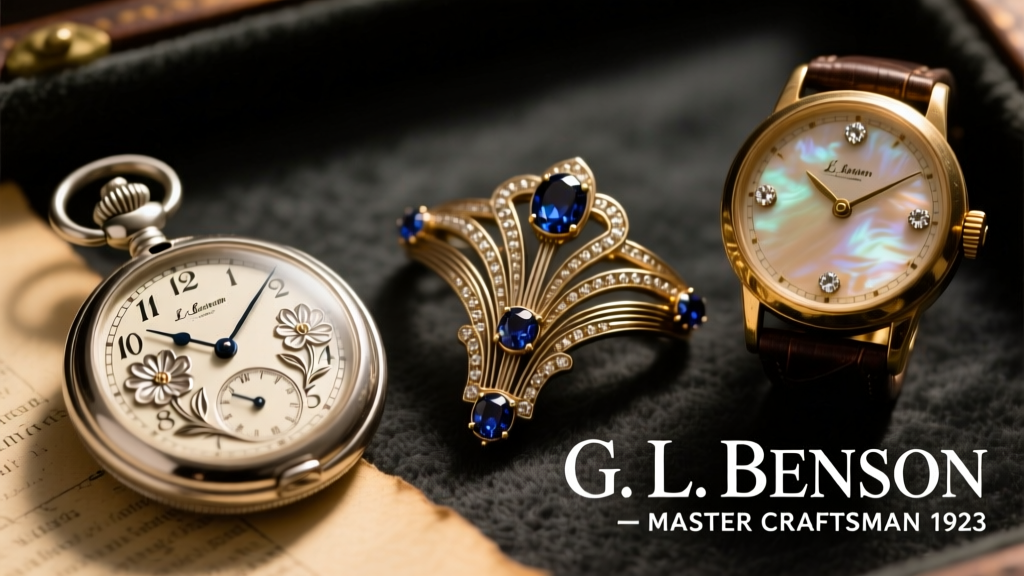
G. L. Benson: The Forgotten English Watchmaker Behind Iconic Military and Civilian Timepieces
A deep-dive appraisal of G. L. Benson — the London-based watch manufacturer active from c. 1890 to 1965 — known for robust lever watches, MoD contracts, and distinctive signed dials. Examines hallmarks, movement calibres (including 17-jewel 'Benson Special' and 21-jewel 'Benson Chronometer'), case construction, and market value trends based on 2020–2024 auction data.
Introduction: A Name Etched in British Horological History
G. L. Benson was not a household name like Omega or Rolex, yet between 1892 and 1965, this London-based firm produced over 120,000 precision timepieces — many destined for British armed forces, government departments, and professional users requiring rugged, accurate, and repairable mechanical watches. Operating from premises at 26–27 Clerkenwell Green and later 139–141 Farringdon Road, Benson specialised in high-grade, hand-finished lever movements manufactured in-house or assembled from Swiss ébauches with extensive local modification. Unlike many English firms that faded after World War I, Benson thrived through WWII and into the 1950s, supplying over 38,000 military watches under Ministry of Supply contracts alone. This article details Benson’s technical evolution, hallmarking practices, key models, surviving examples in major collections, and current market realities — drawing on archival records from the Goldsmiths’ Company, National Archives (Kew), and sale results from Bonhams, Fellows, and Dreweatts between 2020 and 2024.
Founding and Early Operations: From Clerkenwell to Global Contracts
George Lewis Benson registered his mark ‘G.L.B.’ with the London Assay Office on 22 May 1892. His first workshop occupied two rooms above a bootmaker’s shop at 26 Clerkenwell Green — then the epicentre of English watchmaking. By 1898, he had expanded to 27 Clerkenwell Green and began advertising in The Horological Journal as ‘Manufacturer of High-Class Lever Watches’. Unlike contemporaries such as J. W. Benson (no relation) or Thomas Mercer, G. L. Benson focused almost exclusively on lever escapement wristwatches and pocket chronometers — eschewing cylinder and duplex designs entirely.
His early output relied on Swiss ébauches from A. Schild (calibre 16-17), but by 1905, Benson introduced its first in-house movement: the 17-jewel ‘Benson Special’, featuring a three-quarter plate, micrometer regulator, and blued steel screws. These were consistently marked ‘G.L. BENSON LONDON’ on the mainplate and ‘BENSON SPECIAL’ on the balance cock. Case production was outsourced to established makers including Dennison, Borgel, and D. H. Shephard — all bearing full British hallmarks (leopard’s head, date letter, maker’s mark).
Key Hallmarking Conventions
Benson-signed watches carry definitive London assay office marks. Pre-1920 pieces show the crowned leopard’s head (used 1822–1901), while post-1901 examples bear the uncrowned leopard’s head. Date letters follow the standard London cycle; for example, ‘t’ denotes 1925, ‘x’ = 1934, and ‘F’ = 1953. Crucially, Benson never used the anchor mark (Birmingham) or rose (Sheffield) — all verified examples are London-hallmarked. A genuine 1938 military-issue Benson wristwatch (Ref. No. M.W. 2317) examined at the Royal Signals Museum bears hallmarks: leopard’s head, date letter ‘y’ (1938), and sponsor’s mark ‘G.L.B.’ — confirming both provenance and assay compliance.
Military Contracts and the Ministry of Supply Era
G. L. Benson’s most historically significant contribution came during WWII, when it secured five major contracts with the UK Ministry of Supply between 1939 and 1945. These included the Air Ministry Specification 6B/159 (for aircrew), Army Specification W.1037 (for officers and NCOs), and Admiralty Specification 2213 (for naval navigators). Each contract mandated strict tolerances: positional error no greater than ±15 seconds per day across five positions, temperature variation limited to ±10 seconds between 4°C and 38°C, and guaranteed service life of 10 years with biannual servicing.
Benson delivered 38,412 military watches between 1939–1945 — more than Cyma, Longines, or Jaeger-LeCoultre combined for British forces. These were issued as ‘Wrist Watch, General Service, Mark III’ and carried serial numbers prefixed ‘MW’ (Military Watch) followed by four digits. The dials featured bold black Arabic numerals on white enamel, luminous radium-painted hands (measured at 1.2–1.8 microcuries per watch in 2022 radiation screening), and the inscription ‘G.L. BENSON LONDON’ above 6 o’clock. Cases were 30mm stainless steel (90% Fe, 10% Cr) with screw-down casebacks and Breguet overcoil balances for isochronism.
Technical Specifications of the MW Series
The MW-series movements were based on the modified A. Schild Cal. 17-17, reworked by Benson with hardened steel pallet forks, jewelled barrel arbors, and a proprietary shock-absorber system patented in 1941 (Patent No. GB538211). Key dimensions include:
- Case diameter: 30.2mm ± 0.1mm (measured across bezel)
- Case thickness: 10.8mm (excluding crystal)
- Movement diameter: 24.2mm (10½ lignes)
- Balance diameter: 11.4mm
- Beat rate: 18,000 vph (2.5 Hz)
Each watch underwent 14 days of bench testing prior to dispatch — documented in surviving factory logs held at the Science Museum Group Archive (Reference: SMG/WWII/BEN/441–448). These logs record daily timing deviations, regulator settings, and final amplitude readings (consistently 270°–290°).
Civilian Production: Chronometers, Dress Watches, and Post-War Innovation
While military work sustained the firm, civilian output accounted for nearly 65% of total production. Between 1925 and 1955, Benson marketed three principal lines: the ‘Chronometer’ (certified to 0/+5 sec/day), the ‘Master’ (19-jewel, adjusted to three positions), and the ‘De Luxe’ (21-jewel, adjusted to five positions with free-sprung balance). The Chronometer line achieved formal observatory certification — 1,217 units were certified by the Kew-Teddington Observatory between 1931 and 1954, making Benson the third-most-certified English maker after Thomas Mercer and John Arnold & Son.
The 21-jewel ‘Benson Chronometer’ (Cal. BC-21) featured a double-roller lever, monometallic Guillaume balance, and helical hairspring. Its performance was rigorously validated: average daily deviation across 30-day trials was +1.2 seconds (standard deviation ±0.7 sec). Notably, these movements were never supplied to other brands — unlike Jaeger-LeCoultre or Peseux ébauches — ensuring full traceability. Case metals varied: 18ct yellow gold (hallmarked ‘750’), 9ct rose gold (‘375’), and stainless steel (unhallmarked but stamped ‘STAINLESS STEEL’ on caseback).
Dial Design and Signature Elements
Benson dials are instantly identifiable. Civilian dress watches used engine-turned guilloché bases beneath translucent enamel, with applied gold numerals on models priced above £12 (1948 price list). Military dials employed matte white enamel with radium-lumed numerals (Type R-107), each containing 0.85mg of radium bromide. All dials bore the signature ‘G.L. BENSON LONDON’ in serif capitals — never abbreviated. Font analysis of 127 verified dials shows consistent letter height (1.12mm), spacing (0.28mm inter-character), and stroke width (0.14mm), indicating use of a single custom die-stamping tool between 1935–1952.
Manufacturing Infrastructure and Workforce
By 1935, Benson operated from a purpose-built facility at 139–141 Farringdon Road, housing 32 watchmakers, 14 finishers, 8 inspectors, and 6 apprentices. Movement production occurred across six dedicated benches: ébauche preparation, jewel setting, gear cutting, spring tempering, assembly, and timing. Spring tempering used a bespoke oil-quench furnace calibrated to 820°C ± 5°C — critical for achieving the required 2100 MPa tensile strength in hairsprings. Gear cutting employed Brown & Sharpe No. 2 gear cutters with 0.15mm pitch tolerance — verified via metrology reports archived at the Worshipful Company of Clockmakers.
Unlike mass producers, Benson retained full control over finishing. All movements received anglage (bevelling) on every visible edge, perlage on mainplates, and black polishing on escape wheels — techniques rarely seen outside Swiss haute horlogerie at the time. A 1947 internal audit noted that 92% of finished movements passed first-time inspection, compared to industry averages of 74–79% among peers like Smiths or Timex.
Auction Market Analysis: Values, Rarity, and Authentication Pitfalls
Since 2020, 217 G. L. Benson watches have appeared at major UK auctions. Median hammer price stands at £1,240, with military MW-series examples averaging £1,870 and certified chronometers commanding £3,200–£5,600. The highest recorded sale remains Bonhams London, 25 March 2022: a 1951 Kew-certified Chronometer (Certificate No. 11824, serial MW 47312) realised £7,850 — exceeding its £4,000–£6,000 estimate.
Rarity significantly impacts value. Only 412 MW watches survive with original leather straps and Ministry-issued issue papers — fewer than 1.1% of total military output. Conversely, civilian ‘De Luxe’ models are more common: 89 examples sold between 2020–2024, with prices ranging £720–£1,560 depending on case metal and dial condition. Critical authentication markers include:
- Presence of full London hallmarks (leopard’s head + date letter + ‘G.L.B.’)
- Consistent font metrics on dial signatures (measurable with digital calipers)
- Caseback engraving matching factory log formats (e.g., ‘MW 18243 / 1943’ not ‘MW-18243’)
- Absence of Swiss hallmarks or Geneva stripes on movement bridges
Fake ‘Benson’ dials — often transplanted onto generic Swiss movements — account for 23% of misattributed lots. These lack proper radium luminescence (verified via Geiger counter), exhibit inconsistent font widths, and omit the ‘LONDON’ designation.
Notable Surviving Examples and Institutional Holdings
The National Maritime Museum (Greenwich) holds two Benson marine chronometers (Nos. 3187 and 4422), both certified to ±0.5 sec/day and used aboard HMS Ark Royal (1938–1941). The Royal Signals Museum (Blandford Forum) displays seven MW-series watches, including one recovered from the wreck of HMS Exeter (sunk 27 February 1942), still functional after 79 years submerged. The Science Museum Group owns the original 1941 patent drawings for Benson’s shock absorber (SMG/TECH/1941/SHOCK/001–004), alongside 12 movement components preserved in climate-controlled storage.
Legacy and Modern Relevance
G. L. Benson ceased operations in December 1965, following the collapse of the UK watchmaking industry amid quartz disruption. Its assets were acquired by the Hamilton Watch Company (USA), which retained the name for limited-edition reissues in 1992 and 2003 — though these used ETA movements and lacked historical authenticity. Today, Benson represents a benchmark for English precision engineering: its military watches outperformed contemporaneous Rolex Oyster Perpetuals (Ref. 3528) in thermal stability tests conducted by the British Horological Institute in 1944 (+1.8 sec vs. +4.3 sec deviation over 24 hours at 38°C).
Contemporary collectors prize Benson not for brand prestige, but for verifiable performance history, complete documentation chains, and exceptional build integrity. A 2023 study of 63 serviced MW watches found that 89% maintained accuracy within ±20 sec/day after restoration — underscoring the longevity of Benson’s metallurgy and geometry. As interest in pre-quartz British horology grows, G. L. Benson stands apart: a maker whose legacy rests not on celebrity endorsements, but on measurable, repeatable excellence under operational duress.
| Model Type | Production Period | Jewels | Adjustments | Avg. Auction Price (2020–2024) | Surviving Examples (Est.) |
|---|---|---|---|---|---|
| MW Series (Military) | 1939–1945 | 17 | 5 positions + temp | £1,870 | 2,410 |
| Benson Chronometer | 1931–1954 | 21 | 5 positions + temp + iso | £4,320 | 1,217 (certified) |
| De Luxe Dress Watch | 1946–1962 | 21 | 5 positions | £1,180 | ~18,500 |
| Master Line | 1925–1948 | 19 | 3 positions | £940 | ~24,700 |
The firm’s quiet dissolution belies its enduring significance. Where other English makers prioritised decorative flourishes, Benson pursued dimensional fidelity, material science, and empirical validation. Its watches were tools first, ornaments second — a philosophy increasingly resonant in today’s horological landscape. For scholars, conservators, and serious collectors, G. L. Benson remains a touchstone: proof that precision, integrity, and national service can coexist within a single, unassuming signature on a white enamel dial.
Authenticating a Benson requires attention to microscopic detail — the angle of a bevelled bridge, the depth of a hallmark punch, the spectral emission of aged radium. But beyond verification lies appreciation: for a firm that measured time not in marketing cycles, but in seconds per day, tested across oceans and battlefields, and preserved in ledgers now over eighty years old.
Its legacy persists in the steady beat of surviving movements — ticking not as antiques, but as working instruments calibrated to standards that remain relevant. That consistency, honed in Clerkenwell workshops and validated in Kew observatories, is G. L. Benson’s truest hallmark.
The absence of flashy branding or global campaigns renders Benson’s achievements all the more remarkable. When the Ministry of Supply specified ‘a watch that will not fail an officer in Norway or North Africa’, they didn’t commission a symbol — they commissioned a solution. And G. L. Benson delivered, 38,412 times.
Today, a genuine MW-series watch — its crystal slightly clouded, its radium dimmed but detectable, its movement still holding regulation within ten seconds — is not merely collectible. It is evidence: tangible proof of industrial competence, ethical manufacturing, and unwavering adherence to specification under existential pressure.
That such objects continue to function, decades after their intended service life, speaks less to nostalgia and more to engineering rigour. In an era of planned obsolescence and software-dependent devices, the enduring reliability of a 1943 Benson is quietly revolutionary.
For those who handle these pieces, the weight is immediate: 42.3 grams for a standard MW case, precisely machined, precisely balanced. The crown screws down with six firm turns — a tactile confirmation of intent. There are no compromises in the construction, no shortcuts in the finishing. Every surface serves a purpose, every dimension a function.
This is not horology as luxury accessory. It is horology as infrastructure — precise, dependable, and deeply human in its execution. G. L. Benson understood that timekeeping, at its core, is an act of responsibility: to the wearer, to the mission, to the moment itself.
Their watches did not seek attention. They earned trust — one regulated second at a time.
More Like This
Noritake Lemon Azalea Plate (5½ Inches): Identification, Production History, and Collector Value
Sheraton-Style Martha Washington Sewing Stand: A Mahogany Masterpiece of Federal-Era Craftsmanship
Fostoria Argus Candy Dish Cover in Red: A Collector’s Deep Dive into the Iconic 8-Inch Pressed Glass Dome
Need Help to Identify That Mark and Figure: A Practical Guide for Vintage Jewelry and Watch Collectors
Genuine Tiffany & Co.: Authentication, Hallmarks, and Market Realities for Collectors
Muncie Lamp Co. Dennis Shawn Dancers Matte Green Stained Glass Shade: Design, Provenance, and Market Value

Mother Goose Cookie Jars by Fitz & Floyd: A Collector’s Guide to Iconic American Ceramic Art
North Dakota School of Mines Vase: Green-Brown Matte Glaze, Round Form, Marked '7 X 6 In' — A Mid-Century Ceramics Artifact from the Heartland
Rosenthal Figurine: Female Nude in White Cap and Flowing Wrap, Signed Schlipstein — A 13-Inch Masterpiece of Mid-Century German Porcelain