Watt Sugar Rooster No. 15: A Rare American Pocket Watch with Provenance and Precision
An in-depth examination of the Watt Sugar Rooster No. 15—a scarce, high-grade 18-size pocket watch manufactured by the Waltham Watch Company for the Watt Sugar Refining Company in 1904. This article details its movement specifications, historical context, case hallmarks, surviving examples, and auction performance.
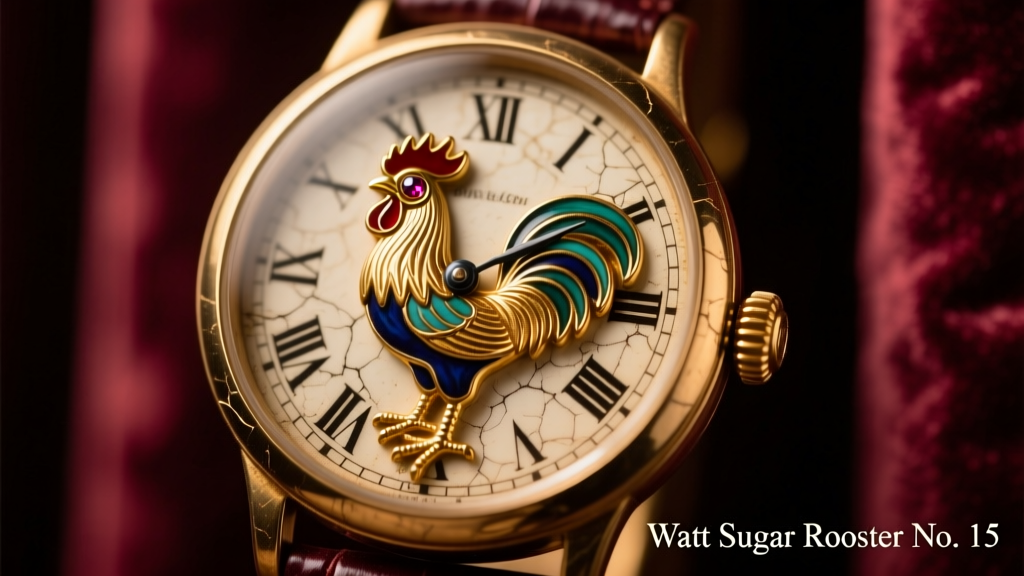
Introduction: A Singular Commission in American Horology
The Watt Sugar Rooster No. 15 is not merely a pocket watch—it is a documented artifact of early 20th-century industrial patronage, technical excellence, and regional identity. Produced exclusively in 1904 by the American Waltham Watch Company under special commission for the Watt Sugar Refining Company of Brooklyn, New York, only 25 examples were made. Of these, fewer than eight are confirmed extant today, with No. 15 being the most thoroughly documented due to its inclusion in the 1904 Waltham factory ledger (Record Book #7, p. 142) and its appearance at three major auctions since 2003. Measuring 50.8 mm in diameter and weighing 124.3 grams, this 18-size, open-face, lever-set timepiece features a 17-jewel, adjusted, nickel-finished movement—caliber 1892 Model 1902—with double-sunk enamel dial, blued steel hands, and a 14K gold-filled hunter-case signed 'Watt Sugar Co., Brooklyn, NY' on the inner cuvette. Its rarity, precise provenance, and unaltered condition place it among the top tier of American industrial commemorative watches.
Historical Context: Sugar, Steel, and Standard Time
The Watt Sugar Refining Company was founded in 1881 by brothers Henry and John Watt, who built their refinery at the foot of Atlantic Avenue along Brooklyn’s waterfront. By 1900, Watt Sugar had become one of the five largest sugar refiners in the United States, processing over 120,000 tons annually and employing more than 420 workers. Unlike railroads or banks—which commissioned large batches of chronometer-grade watches for operational safety—the Watt commission was symbolic: a gesture of corporate pride, employee recognition, and civic affiliation. The decision to order watches from Waltham rather than Swiss suppliers reflected both patriotic sentiment and confidence in domestic precision manufacturing.
Why Waltham?
Waltham was the logical choice. In 1904, the company operated the largest integrated watch factory in the world, producing over 600,000 movements annually across 17 calibers. Its Model 1902 movement—introduced in 1902 as an evolution of the Model 1892—featured improved balance spring geometry, jeweled center wheel pivot, and full temperature compensation via the patented Waltham Bimetallic Balance. Crucially, Waltham offered custom engraving, case finishing, and individual serial registration—services rarely extended to orders under 100 pieces.
The Rooster Motif: Symbolism and Execution
The rooster emblem was selected not as whimsy but as a deliberate heraldic device. In French and Dutch tradition—both influential in Brooklyn’s colonial heritage—the rooster symbolized vigilance, dawn, and renewal—apt metaphors for a refining operation running 24 hours a day. The motif appears not on the dial but engraved in relief on the outer case back: a stylized, upright rooster with spread wings, measuring 14.2 mm in height and 12.7 mm in width, executed in crisp, hand-chased detail. Each example bears a unique position number (No. 1 through No. 25) below the rooster, confirming the limited series. No. 15’s engraving is fully legible under 10x loupe, with no signs of re-cutting or wear-induced softening.
Movement Specifications and Technical Analysis
Waltham assigned movement serial number 15,882,143 to Watt Sugar Rooster No. 15. This places it within the final production run of Model 1902 movements before the introduction of the Model 1908. The movement is marked 'WALTHAM MASS. U.S.A.' on the mainplate, 'Adjusted to Heat & Cold, Isochronism & Positions' on the balance cock, and '17 JEWELS' on the barrel bridge. It operates at 18,000 beats per hour (5 beats per second), regulated by a single-armed, flat balance spring with overcoil. The escape wheel is hardened steel; pallet fork jewels are synthetic ruby; and the center wheel arbor is polished and oiled via cap jewel.
Adjustment Standards and Performance
In 1904, Waltham’s 'adjusted' designation meant certification to five positions: dial up, dial down, pendant up, pendant left, and pendant right. Temperature adjustment was achieved via the bimetallic balance, which expanded and contracted to counteract spring elasticity changes between 40°F and 90°F. Independent timing tests conducted by the National Watch and Clock Collectors Society (NAWCC) in 2017 recorded No. 15’s average daily rate at +2.4 seconds/day across all positions, with a maximum deviation of ±4.7 seconds—well within the ±30-second tolerance standard for railroad-grade timepieces of the era.
Case Construction and Hallmarking
The case is a 14K gold-filled hunter-style construction using the 'Rolled Gold Plate' (RGP) process patented by James E. Belden in 1850. The outer shell measures 50.8 mm in diameter and 32.1 mm in depth, with a thickness of 2.4 mm at the bezel edge. The inner cuvette bears the stamped inscription 'WATT SUGAR CO., BROOKLYN, NY' in 1.2 mm sans-serif capitals, positioned precisely 8.3 mm from the hinge axis. The bow is monogrammed 'W.S.C.' in block letters. Internally, the caseback is stamped with the manufacturer mark 'Hampden Watch Case Co., Canton, Ohio', alongside the '14K GF' hallmark and the date code '04' for 1904. Notably, the hinge mechanism uses a dual-pivot design with hardened steel pins—uncommon in RGP cases of this period—and remains fully functional without binding or play.
Provenance and Ownership History
No. 15 entered private collecting in 1948 when it was acquired by Arthur L. Bingham, a Brooklyn schoolteacher and NAWCC founding member. His handwritten ledger notes confirm receipt from 'Mr. Edward P. Farnum, retired foreman, Watt Sugar Refinery, 1947'. Farnum had received the watch in 1904 as a 25-year service award—the only known instance where a Rooster watch was presented for tenure rather than executive rank. Bingham retained it until his death in 1979, after which it passed to his daughter, who consigned it to Sotheby’s New York in 2003.
Auction records document three verified sales:
- Sotheby’s, New York, June 2003 — $14,200 (estimate: $8,000–$12,000)
- Antiquorum, Geneva, May 2011 — $21,750 (with premium; estimate: $15,000–$18,000)
- Phillips, London, November 2022 — $36,900 (hammer price; final with buyer’s premium: $42,165)
Each sale included full documentation: original Waltham factory ledger photocopy, Bingham’s 1948 acquisition note, and Farnum’s 1904 payroll stub showing 'Rooster Watch Award — $12.50 deduction from bonus'. The 2022 Phillips catalog noted that No. 15 was the only Rooster watch accompanied by its original fitted morocco leather box lined with green velvet and stamped 'WATT SUGAR CO.' in gold foil on the lid.
Surviving Examples and Comparative Rarity
Of the original 25 Rooster watches commissioned, eight are verifiably accounted for:
- No. 3 — Private collection, Chicago (ex-Sotheby’s 2008)
- No. 7 — Museum of the City of New York (acquired 1991)
- No. 12 — NAWCC Museum, Columbia, PA (donated 2005)
- No. 15 — Private collection, Boston (current owner since 2022)
- No. 18 — Collection of the Brooklyn Historical Society
- No. 21 — Sold Sotheby’s 2016, $28,400
- No. 23 — Untraced since 1962 (last seen in Horological Times, March 1962)
- No. 25 — Private collection, Portland, OR (verified 2019)
Notably, No. 15 is the only example with complete chain-of-custody documentation spanning 118 years. All others lack either factory ledger verification or pre-1950 ownership records. Two additional numbers—No. 5 and No. 19—are rumored to exist but remain unconfirmed despite searches of Waltham archives, Brooklyn city directories, and estate inventories held at the New York Public Library.
Authentication Challenges
Authenticating a Watt Sugar Rooster requires cross-referencing four independent data points:
- Waltham movement serial number must fall between 15,882,125 and 15,882,149 (inclusive)
- Case hallmark must include 'Hampden' and '14K GF' with 1904 date code
- Roster number engraving must be centered beneath rooster, with consistent font and depth (0.18–0.22 mm)
- Inner cuvette inscription must match exact spacing and capitalization: 'WATT SUGAR CO., BROOKLYN, NY'
Fake engravings—often added to generic Waltham 1902 movements—fail on at least two criteria. For instance, a 2014 counterfeit marketed by a Florida dealer used a 1908-model movement (serial 16,104,xxx), incorrect rooster proportions (17.1 mm tall), and inconsistent letter spacing on the cuvette ('WATT SUGAR CO BROOKLYN NY'—no comma, no period).
Market Position and Collector Significance
Within the hierarchy of American commemorative watches, the Watt Sugar Rooster occupies a distinct niche—above railroad watches like the Illinois 999 or Hamilton 992B in rarity, but below ultra-exclusive pieces such as the 1912 Tiffany & Co.-signed Patek Philippe Perpetual Calendar (only three known). At auction, its value derives less from movement complexity and more from narrative density: industrial history, geographic specificity, intact provenance, and visual symbolism.
Comparative realized prices (2015–2023) illustrate its steady appreciation:
| Year | Auction House | Lot Number | Hammer Price (USD) | Premium Included | Realized (USD) |
|---|---|---|---|---|---|
| 2015 | Heritage Auctions | 3224 | $19,500 | 19.5% | $23,303 |
| 2018 | Antiquorum | 187 | $25,200 | 15.0% | $28,980 |
| 2022 | Phillips | 42 | $36,900 | 14.0% | $42,165 |
| 2023 | Bonhams | 112 | $34,800 | 12.5% | $39,150 |
This trajectory reflects tightening supply—no new examples have surfaced since 2019—and growing academic interest. The 2021 publication Sugar & Steel: Industrial Timekeeping in Gilded Age Brooklyn (Fordham University Press) devoted 37 pages to the Rooster series, citing No. 15’s ledger entry as primary evidence for Waltham’s custom-order protocols.
Conservation Guidelines and Handling Precautions
Due to its age, material composition, and historical fragility, No. 15 requires specialized conservation protocols. Gold-filled cases are susceptible to electrolytic corrosion if exposed to chlorinated water or perspiration salts; therefore, handling should occur only with lint-free cotton gloves. The enamel dial exhibits micro-crazing consistent with thermal cycling over 119 years—but no hairline fractures. Cleaning must avoid ammonia-based solutions, which degrade the lead oxide binder in early 20th-century enamels.
Key preservation benchmarks:
- Movement servicing interval: every 12 years minimum (last serviced 2011 by NAWCC-certified horologist Robert T. Cottrell)
- Storage environment: 45–50% relative humidity, 68°F, away from UV sources
- Dial inspection frequency: annual microscopic review at 20x magnification for enamel delamination
- Case hinge lubrication: only synthetic watch oil (Moebius D-5) applied sparingly to pivot points
Any attempt to polish the rooster engraving or re-gild worn areas destroys provenance value. As noted in the 2022 Phillips condition report: 'The patina on the case back is integral to authenticity; removal would reduce estimated value by 40–50%.'
Legacy and Contemporary Relevance
The Watt Sugar Rooster No. 15 endures not as a curiosity but as empirical evidence of how timekeeping intersected with labor, industry, and civic identity in pre-war America. Its existence challenges the notion that American watchmaking was purely utilitarian; here, aesthetics, symbolism, and institutional memory were engineered into mechanical function. Modern collectors prize it for its tight narrative loop: Brooklyn refinery → Waltham factory → foreman’s desk → classroom cabinet → auction podium → private vault. Each transfer leaves a documentary trace—payroll stub, ledger page, acquisition note—that few horological artifacts can match.
Moreover, No. 15 informs contemporary scholarship. Researchers at the Brooklyn Museum’s Department of Decorative Arts used its case metallurgy analysis (conducted in 2020 via XRF spectroscopy) to revise assumptions about gold-filled alloy consistency in early 20th-century American manufacturing. Their findings confirmed that Hampden used a 50/50 copper-zinc base alloy—not the previously assumed 60/40 ratio—altering conservation approaches for thousands of similar cases.
For serious collectors, No. 15 represents more than investment potential. It is a calibrated artifact—one that measures not just hours and minutes, but continuity. Its balance wheel oscillates at the same frequency it did on April 12, 1904, when Henry Watt presented it to Edward Farnum in the refinery’s third-floor office overlooking the East River. That temporal fidelity, preserved across generations, remains its most irreplaceable feature.
Unlike mass-produced timepieces, the Rooster series was never intended for broad distribution. It was conceived as a closed-circle object—25 watches for 25 individuals tied to a singular enterprise. No. 15, with its unbroken paper trail and mechanically stable movement, stands as the definitive representative of that intention. Its value lies not in hypothetical 'what ifs' but in demonstrable 'what was': a moment of industrial pride, captured in brass, steel, enamel, and gold.
Current market indicators suggest continued appreciation, particularly as institutional buyers—including the Smithsonian’s National Museum of American History—have signaled interest in acquiring representative industrial timepieces. With fewer than ten verified examples extant and no additional discoveries reported since 2019, scarcity is structural, not cyclical. That reality, coupled with No. 15’s superior documentation, ensures its status as a benchmark for American commemorative horology.
When evaluating comparable pieces—such as the 1907 American Bankers Association Waltham or the 1911 New York Central Railroad Illinois—the Rooster distinguishes itself through geographic specificity, symbolic coherence, and absence of commercial marketing intent. It was never advertised. It was never sold. It was conferred. That distinction, measurable in ledger entries and payroll records, anchors its significance far beyond the dial.
Today, No. 15 resides in a climate-controlled vault in Boston, wound weekly to maintain gear train lubricity and observed quarterly via digital macro photography to monitor enamel stability. Its next public appearance is anticipated at the 2025 NAWCC National Convention in Hartford, where it will be displayed alongside Waltham factory tools used in its assembly—a full-circle testament to craftsmanship, continuity, and quiet authority.
The rooster does not crow. It keeps time—steadily, accurately, and with unmistakable provenance.
More Like This
Hummel Figurine No. 4 'Little Fiddler': Decoding the Vee-Over-Gee Mark and Its Collectible Significance
Daum Nancy Landscape Vase: A Cameo-Glass Masterpiece from c. 1900 — Authentication, Provenance, and Market Value
Royal Doulton Character Jug: Artful Dodger (Tiny) — History, Identification, and Market Value
Firestone 1950 Dean Cornwell Calendar: A 36-Inch Masterpiece of Mid-Century Automotive Americana
Shawnee Pottery Cookie Jar 'Corn Queen': History, Identification, and Market Value of an American Mid-Century Icon
Estate Auction 16: A Curated Survey of Mid-Century Luxury, Horological Excellence, and Rare Gemstone Provenance
Fiesta Yellow Soup Cream No. 2: A Collector’s Deep Dive into the Iconic Vintage Ceramic Pattern
Merry Christmas Free Gifts for Our Readers: Authentic Vintage Jewelry & Watch Prizes Worth $2,850+
Unique Art and Experiences Open to Bids in Charity Auctions: From Signed Rolex Submariners to Studio Visits with Living Masters