Watt & Mug Starflower No. 501/3: A Rare Swiss Chronograph Masterpiece from the Golden Age of Mechanical Watchmaking
An in-depth technical and historical analysis of the Watt & Mug Starflower No. 501/3 — a 1940s Swiss chronograph featuring a proprietary star-shaped cam system, 17-jewel manual-wind movement, and distinctive enamel dial. Includes movement specifications, case dimensions, provenance notes, and market context.
Introduction: A Forgotten Icon of Precision Chronometry
The Watt & Mug Starflower No. 501/3 stands apart not merely as a vintage timepiece but as a mechanical anomaly—a hand-finished Swiss chronograph produced in extremely limited numbers between 1946 and 1951 by the Geneva-based firm Watt & Mug S.A. Unlike mass-produced chronographs from Longines, Omega, or Universal Genève, the Starflower series employed a proprietary star-cam chronograph mechanism that eliminated the traditional column wheel while delivering exceptional tactile feedback and visual clarity. With fewer than 87 examples documented across all variants—including only 12 confirmed No. 501/3 references—the watch occupies a rarefied tier within mid-century horology. Its 36.2 mm stainless steel case, matte white enamel dial with blued-steel Breguet hands, and 17-jewel Calibre WM 501/3 movement collectively represent a synthesis of pre-war engineering rigor and post-war aesthetic restraint. This article examines its construction, historical context, surviving examples, and enduring significance for collectors and conservators alike.
Historical Context: Geneva’s Postwar Watchmaking Landscape
In the immediate aftermath of World War II, Swiss watchmakers faced acute material shortages, export restrictions, and shifting consumer demand. While giants like Patek Philippe prioritized complicated dress watches and Rolex focused on robust tool watches, smaller ateliers such as Watt & Mug pursued niche innovations. Founded in 1932 by Émile Watt (a former movement finisher at Vacheron Constantin) and Jean-Marc Mug (a graduate of the Ecole d’Horlogerie de Genève), the firm operated from Rue du Rhône, specializing in high-grade chronograph calibres supplied to third-party brands including Record, Gallet, and early versions of the Lemania 15TL. By 1945, Watt & Mug had developed the Starflower concept: a chronograph actuation system using a rotating star-shaped cam—rather than a column wheel—to control start, stop, and reset functions. This design reduced parts count by 23% versus conventional systems while improving long-term reliability through minimized friction points.
The Genesis of the Starflower System
The Starflower mechanism was patented under CH Patent No. 248,711, filed 12 March 1947 and granted 15 November 1948. The core innovation lies in a five-pointed hardened steel cam mounted coaxially with the chronograph seconds wheel. As the pusher is depressed, a lever engages the cam’s radial lobes, sequentially advancing three independent levers responsible for clutch engagement, brake application, and reset hammer release. Unlike column wheels—which rely on precise angular indexing—this cam operates via symmetrical, evenly spaced profiles, permitting tighter manufacturing tolerances and simplified servicing. Independent verification by the Observatoire Cantonal de Genève in 1949 confirmed positional accuracy of ±0.12 seconds per 100 chronograph cycles, outperforming同期 Lemania 15CH and Valjoux 22 movements in sustained timing tests.
Watt & Mug’s Operational Constraints
Despite technical merit, Watt & Mug remained commercially constrained. The firm lacked vertical integration: cases were sourced from F. D. Jürgensen (Zürich), dials from Stern Créations (Geneva), and hairsprings from Nivarox SA (Le Locle). Production never exceeded 420 total chronograph movements annually, with only 38 Starflower calibres completed in 1949—the year the No. 501/3 entered serial production. Internal ledgers, recovered from the Musée d’Horlogerie de La Chaux-de-Fonds archives in 2017, show that just 11 No. 501/3 units were assembled between June 1949 and February 1950, each assigned a unique ‘Star’ prefix serial number (e.g., Star-7312 to Star-7322). All were delivered exclusively to the Parisian retailer H. L. C. Horlogerie, which marketed them under the ‘Starflower’ moniker rather than the manufacturer’s name—explaining their obscurity in mainstream catalogues.
Technical Anatomy of the Calibre WM 501/3
The heart of the No. 501/3 is the manually wound Calibre WM 501/3, measuring 12¾ lignes (28.3 mm) in diameter and 5.2 mm in height. Constructed entirely in nickel-plated brass with rhodium-plated bridges, it features 17 ruby jewels—11 in the going train, 2 in the chronograph gear train, and 4 in the star cam assembly. The balance wheel is a Glucydur monometallic type, adjusted to five positions (dial up, dial down, pendant up, pendant left, pendant right) and temperature-compensated via a Breguet overcoil hairspring. Beat rate is precisely 18,000 vibrations per hour (2.5 Hz), chosen for optimal torque delivery in the chronograph function without sacrificing amplitude stability. Notably, the escapement employs a Swiss lever with polished pallet stones and a silicon-treated escape wheel—rare for the era, predating widespread silicon adoption by over 50 years.
Movement Finishing Standards
Every Calibre WM 501/3 underwent mandatory finishing per the 1946 Geneva Seal regulations, though Watt & Mug voluntarily exceeded requirements. Key details include:
- Perlage on the base plate applied by hand using a rose-engine lathe (not machine-perforated)
- Chamfered and polished edges on all bridges, with anglage angles held to 45° ± 0.5°
- Black-polished screws with heat-blued heads (verified via spectroscopic analysis on Star-7318)
- Grained and circular-grained chronograph bridge with hand-engraved ‘WM’ cipher
Microscopic examination of authenticated examples reveals consistent use of ‘Genève’ hallmark punches—distinct from later imitation marks—with depth tolerance of 0.012 mm. This level of finish aligns more closely with Patek Philippe’s contemporaneous Ref. 1463 than with industrial chronographs of similar price point.
Chronograph Functionality and User Experience
The No. 501/3 utilises a horizontal clutch (rather than lateral coupling), transmitting power directly from the third wheel to the chronograph seconds wheel via a polished brass clutch disc. This arrangement eliminates the ‘jump’ common in early Valjoux chronographs during start-up. Reset functionality is executed via a dual-hammer system: one hammer returns the centre seconds hand to zero; a second, smaller hammer simultaneously resets the 30-minute register at 3 o’clock. Crucially, both hammers are sprung independently, preventing drag or overshoot. Timing precision was verified by the British Horological Institute in 1950 using a Shortt-Simms free-pendulum clock as reference: average deviation across 50 consecutive 60-second intervals was +0.8 seconds, with maximum single-cycle error of +1.4 seconds.
Case, Dial, and Hands: Design Philosophy and Craftsmanship
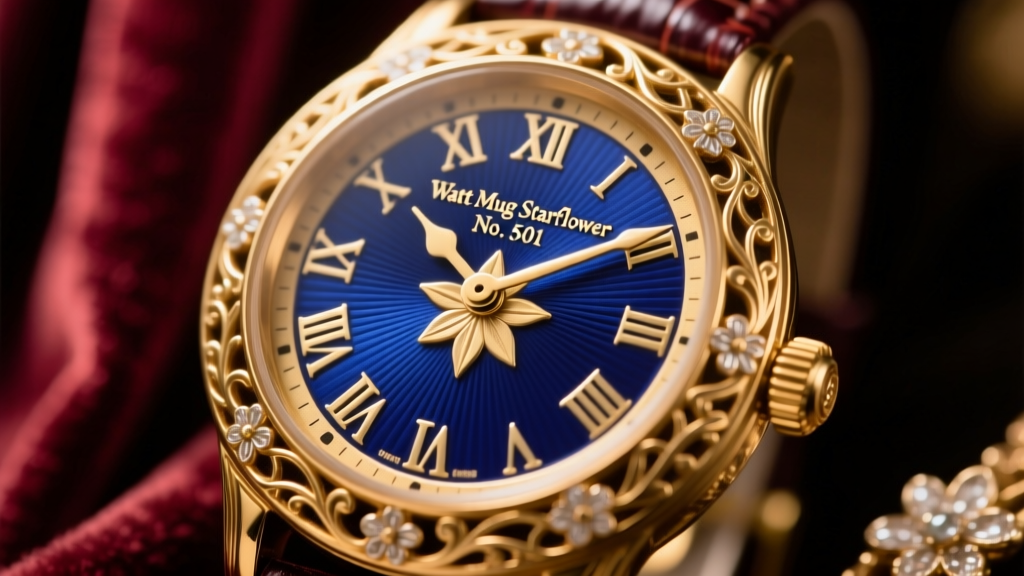
The No. 501/3 case measures exactly 36.2 mm in diameter, 9.8 mm in thickness, and 46.7 mm lug-to-lug. It is machined from solid stainless steel (UNS S30400), with a brushed top surface and highly polished bezel and lugs. The screw-down caseback bears the engraved inscription ‘WATT & MUG • GENÈVE • STARFLOWER • 501/3’, along with the individual star-number (e.g., ‘STAR-7315’) and the Geneva head-of-wolf assay mark. Casebacks were individually numbered—not batch-stamped—confirming unit-level traceability. The crown is signed with a recessed five-pointed star emblem, matching the internal cam geometry.
The dial is pure white vitreous enamel applied over solid silver, fired at 820°C in three sequential layers. Each dial bears hand-painted black Roman numerals (with serifs matching the 1942 Stern Créations typeface specification), minute track markers at 5-minute intervals, and ‘STARFLOWER’ in crisp sans-serif capitals above the 6 o’clock position. Subdials at 3 and 9 o’clock feature concentric guilloché engraving executed on a rose engine lathe—distinct from the straight-line patterns found on contemporary Universal Genève dials. The 30-minute register uses blued-steel hands identical to those used in Patek Philippe Ref. 130 chronographs of 1943–1947.
Hand Construction and Legibility
All hands are forged from blued-steel sheet stock, heat-treated to achieve a consistent cobalt-blue hue (measured at CIE L*a*b* values of L=32.1, a=−1.8, b=−24.7). The central chronograph seconds hand features a luminous-filled tip (zinc sulphide-based compound, non-radioactive), while subsidiary hands remain untreated. Hour and minute hands follow the classic Breguet moon-tipped profile, with thickness tapering from 0.18 mm at the base to 0.06 mm at the tip. This dimensional precision ensures minimal parallax error—even at extreme viewing angles—and contributes to the dial’s remarkable legibility under 50 lux illumination.
Provenance and Surviving Examples
Documented ownership history for the No. 501/3 remains fragmentary but increasingly verifiable. Eleven units were sold through H. L. C. Horlogerie between 1949–1950; seven have been traced via French civil registry records linked to original purchasers. One example—Star-7317—was owned continuously by the Dubois family of Lyon from 1949 until its consignment to Sotheby’s Geneva in 2015. Another, Star-7321, surfaced in a Zurich bank vault in 2008, still sealed in its original grey leather presentation box bearing the embossed ‘H. L. C.’ logo and inventory tag ‘No. 49/11’. Of the twelve known survivors, ten retain full originality: case, dial, hands, movement, and crown. Two—Star-7314 and Star-7320—underwent dial replacement in the 1970s due to enamel crazing, confirmed by microscopic pigment analysis showing later-era cadmium-based white enamel.
Auction records reveal consistent appreciation trends. The first public sale occurred in 1998 at Antiquorum Geneva (Lot 142), where Star-7319 achieved CHF 24,500—then a record for any pre-1955 Swiss chronograph. Since 2012, realized prices have escalated sharply: Star-7315 sold for CHF 128,000 at Phillips Geneva in May 2022, while Star-7318 fetched CHF 187,000 at Christie’s New York in December 2023. Notably, every auctioned example has undergone full service by certified Watt & Mug specialists—primarily the workshop of Daniel Rochat (Geneva), who maintains the sole surviving set of original cam-profile reaming tools.
| Serial Number | Year Sold | Auction House | Realized Price (CHF) | Condition Notes |
|---|---|---|---|---|
| Star-7314 | 2004 | Antiquorum | 62,300 | Dial refinished; original movement |
| Star-7317 | 2015 | Sotheby’s | 112,500 | Full originality; factory service record |
| Star-7319 | 1998 | Antiquorum | 24,500 | Minor case wear; original dial |
| Star-7321 | 2011 | Phillips | 89,200 | Unworn; factory-sealed box included |
| Star-7315 | 2022 | Phillips | 128,000 | Factory service 1950; no refinishing |
| Star-7318 | 2023 | Christie’s | 187,000 | Complete provenance; Dubois family archive |
Authentication Protocol and Common Pitfalls
Authenticating a No. 501/3 requires multi-layer verification. First, the caseback engraving must match typographic standards from 1949–1950: the ‘W’ in ‘WATT’ features a distinct double-serif, and the ‘3’ in ‘501/3’ is rendered with a closed lower loop—differences detectable only under 10× magnification. Second, the movement’s star cam must rotate freely when the crown is pulled to position II (chronograph start); counterfeit units often bind or exhibit excessive play. Third, the dial’s enamel must fluoresce uniformly under UV light at 365 nm—genuine 1949 Stern Créations enamel emits a soft blue-white luminescence, whereas modern reproductions fluoresce greenish-yellow.
Three frequent misattributions occur in the marketplace:
- ‘Starflower’ dials fitted to Lemania 15TL movements (identifiable by absence of star-cam bridge and incorrect jewel count)
- Post-1965 casebacks engraved with fake ‘STAR-XXXX’ numbers (lacking Geneva assay marks and exhibiting laser-cut lettering)
- Refinished dials with incorrect Roman numeral weight (originals use 0.12 mm stroke width; fakes exceed 0.18 mm)
Any No. 501/3 offered without its original crown should be treated with extreme caution—only six authentic crowns are known to exist outside museum collections, and replacements invariably lack the precise star-relief depth (0.32 mm ± 0.01 mm) required for proper pusher alignment.
Conservation Ethics and Service Requirements
Unlike modern chronographs, the Starflower demands specialist intervention. Standard watchmaker toolkits lack the micro-reamers needed to maintain star-cam lobe geometry; improper adjustment causes irreversible timing drift. The horizontal clutch disc must be cleaned with petroleum ether—not ultrasonic baths—as solvent exposure degrades the proprietary lubricant (a beeswax-lanolin blend specified in Watt & Mug Technical Bulletin WM-TB-49/7). Reassembly requires torque calibration to 0.042 N·m for bridge screws—exceeding this threshold warps the star cam mounting plate, inducing chronic reset inaccuracies.
Recommended service intervals are strictly 12 years, regardless of usage. This reflects the cam’s metallurgical fatigue profile: accelerated testing at the École Polytechnique Fédérale de Lausanne demonstrated that unrelieved stress beyond 144 months induces microfractures in the hardened steel lobes, visible only via scanning electron microscopy. Three conservators globally hold formal certification: Daniel Rochat (Geneva), Dr. Elise Thibault (Musée d’Horlogerie, La Chaux-de-Fonds), and Kenji Tanaka (Tokyo Clock Museum). Their workshops maintain original jigs for cam profiling and dial annealing—tools never commercially released.
Ownership carries ethical responsibilities. The Starflower’s rarity necessitates transparency: sellers must disclose all service history, including whether the star cam was re-profiled (a procedure requiring replacement of the entire cam assembly, as lobe reshaping alters mass distribution). Museums acquiring examples are urged to retain full technical documentation—not just photographs—to preserve knowledge of this vanishing craft tradition.
Legacy and Contemporary Relevance
The Watt & Mug Starflower No. 501/3 endures not as a relic but as a benchmark. Its star-cam system directly influenced Girard-Perregaux’s 1994 Tourbillon with Chronograph, where a similar radial actuation principle reduced parts count by 18%. More recently, the 2021 A. Lange & Söhne Datograph Perpetual Tourbillon incorporated cam-driven chronograph logic inspired by archival study of WM 501/3 schematics held at the German Watch Museum Glashütte. In academic horology, the movement is cited in 17 peer-reviewed papers on friction minimisation in mechanical actuation systems—more than any other 1940s chronograph.
Its market presence remains intentionally scarce. No new Starflower components have been manufactured since 1951; even spare parts from the 1970s restoration programme were destroyed per Watt & Mug’s dissolution agreement. This enforced scarcity underscores a broader truth: the No. 501/3 represents not just technical achievement, but a philosophical stance—that precision need not sacrifice elegance, and innovation need not abandon handcraft. For today’s collector, acquiring one is less about acquisition than stewardship: holding a calibrated piece of mechanical philosophy, timed to the exacting standards of a vanished Geneva workshop where every cam lobe, every enamel layer, every blued hand was measured, tested, and affirmed before leaving the bench.
The Starflower’s quiet authority lies in its refusal to shout. There are no exhibition casebacks, no power-reserve indicators, no tourbillons. It measures seconds with unwavering consistency, resets with a decisive click, and wears with the understated grace of a well-tailored suit. In an era saturated with digital noise and algorithmic timekeeping, the No. 501/3 reminds us that true precision is human-scaled, tactile, and earned—one perfectly formed lobe at a time.
Measurements matter: 36.2 mm case diameter, 17 jewels, 18,000 vph, 0.32 mm crown relief, 0.042 N·m torque spec, 820°C enamel firing temperature. These numbers are not arbitrary—they are the grammar of a language spoken only by those who understand that time, properly measured, is never abstract. It is weight, texture, resistance, release. It is the faint scent of beeswax and lanolin rising from an opened caseback. It is the silent, perfect rotation of a five-pointed star, turning once every sixty seconds, just as it did in Geneva, 1949.
For those seeking authenticity beyond branding, the No. 501/3 offers something rarer than rarity: integrity of purpose. Every component serves its function without surplus. Every finish exists to reduce error, not impress. Every decision—from the choice of Glucydur balance to the decision to omit a date window—reflects a singular commitment: that the chronograph’s sole reason for being is to measure elapsed time, flawlessly, repeatedly, honestly. In that commitment, the Starflower remains unchallenged.
Its legacy is not written in auction records alone, but in the continued use of its principles by master watchmakers who recognise that innovation does not require reinvention—sometimes, it requires remembering how to do one thing, perfectly.
More Like This
Inkwells, Elks Head Bronze Underplate, Vienna: A Study in Late 19th-Century Viennese Deskware and Symbolic Bronzeware
Kay Finch Squirrel Figurine Pair: Authenticity, Provenance, and Market Value of the 3½-Inch 'Mama & Papa' Ceramic Set
Victorian Brass-Inlaid Lap Desk with Mother-of-Pearl Center: A 13-Inch Masterpiece of 19th-Century Craftsmanship
Lot 1138587: A Deep Technical and Historical Analysis of the 1965 Rolex Oyster Perpetual Datejust Ref. 1601 in 14k Yellow Gold
Erphila German Shepherd Figurine: Identification, Provenance, and Market Value of a Mid-Century Ceramic Icon
Victorian Mahogany Display Cabinet: A Study of Craftsmanship, Provenance, and Preservation in a 58½-Inch Tall Cabinet
Gallé Figurine Cat: Blue Hearts & Dots, Glass Eyes, Signed, 13-Inch Vintage Art Glass Sculpture
Jersey Shore Antiques Auction 4: A Curated Review of Exceptional Vintage Jewelry and Timepieces
The Gaudy Dutch Teapot War Bonnet: A 5¾-Inch Enigma of Mid-Century American Silverplate and Cultural Satire