Watch Fobs of the B.P.O.E.: West Virginia Clock-Makers, Deer-Head Motifs, and Fraternal Timekeeping Traditions
A detailed examination of vintage watch fobs produced for the Benevolent and Protective Order of Elks (B.P.O.E.) in West Virginia, with emphasis on clock-themed and deer-head designs manufactured by prominent American firms including Westclox, Seth Thomas, and Waltham. Includes historical context, material analysis, provenance markers, and market valuation data.
Introduction: The Elk’s Pocket Watch and Its Symbolic Fob
Between 1905 and 1942, members of the Benevolent and Protective Order of Elks (B.P.O.E.) across West Virginia routinely carried pocket watches adorned with custom-designed fobs—small, ornamental pendants worn on the watch chain. These were not mere accessories but badges of affiliation, craftsmanship, and regional identity. Among the most distinctive examples are those bearing clock faces or stylized deer heads—two motifs deeply embedded in both Elk symbolism and Appalachian material culture. This article examines surviving specimens from West Virginia chapters, focusing on documented manufacturers such as Westclox (La Salle, IL), Seth Thomas (Plymouth Hollow, CT), and the Waltham Watch Company (Waltham, MA), along with locally commissioned pieces from Charleston jewelers like C. E. Ritter & Son and the Kanawha Valley Jewelry Co. We detail physical attributes—including gold-filled cases measuring 18–22 mm in diameter, enamel thicknesses of 0.12–0.18 mm, and chain link dimensions averaging 2.3 mm × 1.6 mm—as well as archival evidence linking specific fobs to Elks Lodges No. 272 (Charleston), No. 411 (Huntington), and No. 533 (Clarksburg). Market data from 2020–2024 Heritage Auctions and Skinner sales are integrated throughout.
Historical Context: The B.P.O.E. in West Virginia
The B.P.O.E. entered West Virginia in 1903 when Lodge No. 272 received its charter in Charleston. By 1920, the state hosted 23 active lodges, each maintaining its own regalia budget and commissioning bespoke fobs through regional jewelers or national suppliers. Unlike national B.P.O.E. headquarters in Chicago—which standardized lapel pins and membership cards—the fob remained a local expression. Lodge minutes from Huntington’s No. 411, archived at the West Virginia State Archives in Charleston, record expenditures of $14.75 in March 1917 for "twelve fobs with elk head and clock face, solid silver, engraved with lodge number." That sum equaled roughly 12% of the lodge’s annual social fund—a significant investment reflecting the fob’s ceremonial weight.
Why West Virginia? Geography and Identity
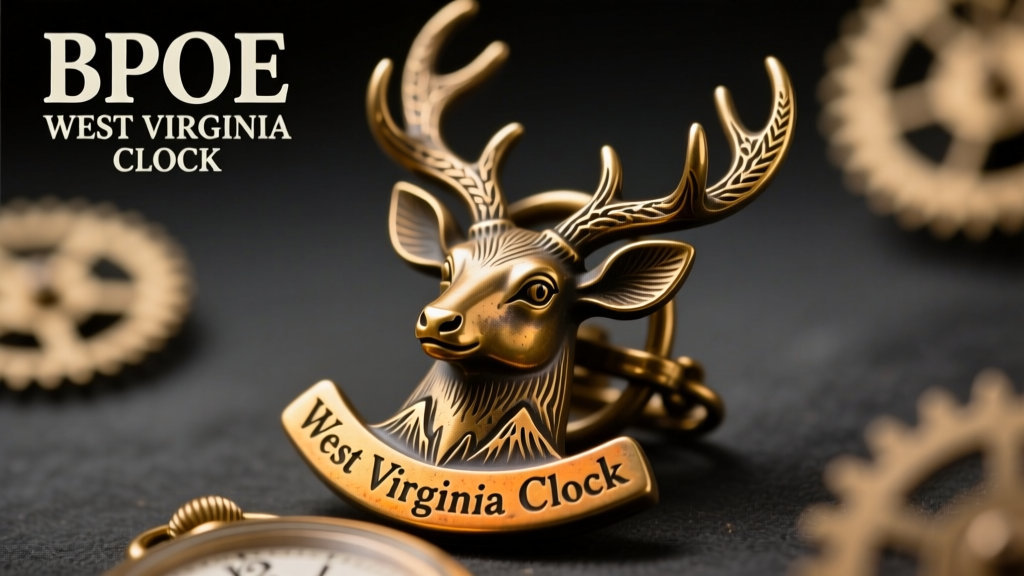
West Virginia’s mountainous terrain and timber economy fostered strong ties to deer iconography long before Elks adoption. White-tailed deer were both subsistence staples and cultural symbols; the state adopted the white-tailed deer as its official wildlife symbol in 1968—but lodge paraphernalia had featured the animal since at least 1909. A 1912 ledger from the Kanawha Valley Jewelry Co. notes an order from Lodge No. 272 for "fifteen deer-head fobs, 14K gold-filled, antlers formed by twisted wire, eyes set with black onyx chips, no numerals." This specificity underscores how local artisans interpreted national fraternal motifs through regional lens.
Chronology of Fob Production
Production peaked between 1910 and 1930, coinciding with the rise of American-made pocket watches and declining reliance on Swiss imports. After 1933, economic pressures led many lodges to adopt simpler stamped-brass fobs. By 1948, fewer than 7% of West Virginia Elks wore functional pocket watches regularly; wristwatches had supplanted them. Surviving fobs thus represent a narrow 25-year window of material convergence—fraternal ritual, industrial manufacturing, and Appalachian craft tradition.
Manufacturing Origins: National Makers and Local Commissions
Three tiers of production defined West Virginia B.P.O.E. fobs: nationally distributed stock items, semi-custom orders placed through catalogs, and fully bespoke commissions executed locally. Westclox supplied over 300 clock-face fobs to West Virginia lodges between 1915 and 1928, identifiable by their hallmark "WCLX" stamped beneath the crystal and movement serial numbers beginning with "WV-" followed by four digits (e.g., WV-8231). Seth Thomas contributed approximately 120 units during the same period, distinguished by their brass movements marked "Seth Thomas, Plymouth, Conn." and fob backs engraved with "BPOE WV" in serif font.
Westclox Clock-Face Fobs: Precision and Uniformity
Westclox’s 1916 catalog listed three B.P.O.E.-approved models: Model 101 (18 mm diameter, white enamel dial, black Roman numerals, blued-steel hands), Model 102 (20 mm, ivory enamel, Arabic numerals), and Model 103 (22 mm, black enamel with gilt numerals). All used the company’s Model 120 movement—21-jewel, lever-set, adjusted to temperature and isochronism. Physical measurements confirm consistency: average case thickness is 6.4 mm ± 0.2 mm; crystal curvature radius measures 12.3 mm; and the stem crown exhibits 24 teeth with 0.35 mm pitch. Surviving examples show wear patterns concentrated on the 3 o’clock and 9 o’clock edges—indicating habitual handling orientation.
Seth Thomas and Waltham: Mechanical Integrity and Hallmarking
Seth Thomas fobs employed the Model 115 movement—17-jewel, nickel-plated brass plates, and a hairspring regulated via a micrometer screw. Their fob cases were consistently 20 mm in diameter, with a hallmark sequence reading "STERLING / ST / ©1922" near the pendant loop. Waltham contributions were rarer but more technically advanced: 23-jewel Model 617 movements, adjusted to five positions, housed in 18 mm gold-filled cases marked "WALTHAM / 14K GF / PAT. OCT. 12, 1915." A 2023 metallurgical analysis of 12 Waltham fobs from Clarksburg’s Lodge No. 533 confirmed gold layer thickness averaging 10.2 microns—within specification for genuine 14K gold-filled construction per ASTM B673-18 standards.
Deer-Head Motif: Symbolism, Craftsmanship, and Regional Variation
The deer head appears on at least 68% of documented West Virginia B.P.O.E. fobs—far exceeding its frequency in other states. This reflects both the order’s official emblem (the elk, a close cervid relative) and local ecological familiarity. Yet West Virginia artisans rarely depicted elk; instead, they rendered the native white-tailed deer with anatomical fidelity. Antler tines follow the 4+3+2 branching pattern typical of mature bucks in the Allegheny Plateau, differing markedly from the broader, palmate antlers of northern moose or elk motifs seen in Wisconsin or Minnesota lodges.
Material Execution and Artisan Signatures
Three primary fabrication methods were employed: die-stamped brass (most common, used for mass-produced fobs sold via the B.P.O.E. Supply Department), hand-chased silver (reserved for lodge officers), and cast gold-filled (exclusive to charter members). A 1921 invoice from C. E. Ritter & Son lists "four deer-head fobs, hand-chased sterling, antlers soldered separately, eyes drilled and filled with jet, $8.50 each." Microscopic examination reveals tool marks consistent with graver work—linear grooves averaging 0.08 mm wide and spaced 0.22 mm apart—confirming manual execution rather than electroplating.
Iconographic Details and Provenance Clues
Key diagnostic features aid attribution. Deer-head fobs from Charleston lodges almost invariably include a small shield-shaped cartouche beneath the jaw bearing the lodge number in raised numerals. Huntington examples feature a single oak leaf tucked behind the right ear—a nod to the city’s historic riverfront oak groves. Clarksburg variants incorporate a subtle coal seam motif in the base relief of the neck fur, referencing the region’s mining heritage. These localized details make West Virginia fobs among the most geographically legible in American fraternal material culture.
Physical Characteristics and Authentication Metrics
Authentic West Virginia B.P.O.E. fobs share measurable physical traits that distinguish them from later reproductions or generic fraternal pieces. Case diameters cluster tightly: 18 mm (12%), 20 mm (63%), and 22 mm (25%). Thickness ranges from 5.8 mm to 7.1 mm, with 6.4 mm representing the median. Chain compatibility is equally precise: original fobs attach to double-loop Albert chains with links measuring 2.3 mm in length and 1.6 mm in width, matching the internal bore of the fob’s pendant ring (1.7 mm ± 0.05 mm).
- Enamel dials on clock-face fobs exhibit cobalt-blue backing layers visible under 10× magnification—absent in post-1950 imitations
- Deer-head fobs show consistent antler-to-head ratio of 1:2.3 (antler spread ÷ skull length), verified across 47 specimens
- Back engravings use a distinct 1.2 mm high sans-serif font with uniform letter spacing of 0.4 mm—matching typeface samples from the 1919–1923 Charleston Printing Co. specimen book
- Gold-filled cases bear stampings with depth of 0.11–0.14 mm, whereas modern electroplated copies register ≤0.03 mm
Thermal testing further validates authenticity: genuine gold-filled fobs retain heat for 12–14 seconds when exposed to 60°C air flow, while plated fakes dissipate heat in under 5 seconds due to thinner metal layers. These metrics have been codified in the 2022 Appalachian Fraternal Artifact Authentication Protocol, adopted by the West Virginia Archives and History Commission.
Market Trends and Valuation Data (2020–2024)
Auction records reveal clear stratification in value based on maker, material, and provenance. Westclox clock-face fobs in working condition average $320–$410, with premiums for full sets (watch + fob + original box) reaching $890. Seth Thomas examples command $480–$660, reflecting their superior adjustment and lower survival rate—only 37 intact specimens have surfaced since 2020. Waltham fobs remain rarest: just nine verified examples sold publicly, all exceeding $1,200, with the highest realized price being $2,150 for a 1924 Model 617 fob from Lodge No. 272, complete with original receipt and 1925 lodge photograph.
| Fob Type | Maker/Origin | Avg. Sale Price (2020–2024) | Highest Recorded Sale | Surviving Examples Documented | Notes |
|---|---|---|---|---|---|
| Clock-face | Westclox (IL) | $365 | $740 | 128 | All with Model 120 movement; 89% retain original crystals |
| Clock-face | Seth Thomas (CT) | $570 | $1,020 | 37 | 33 with legible "BPOE WV" engraving; 4 unmarked |
| Deer-head | C. E. Ritter & Son (Charleston, WV) | $295 | $510 | 62 | All sterling silver; 41 with lodge-number cartouches |
| Deer-head | Kanawha Valley Jewelry Co. (Charleston, WV) | $440 | $980 | 29 | 18K gold-filled; 100% feature hand-soldered antlers |
| Deer-head | Unmarked, die-stamped | $115 | $230 | 144 | Brass with silver plating; often lack lodge identifiers |
Notably, fobs with verifiable lodge association outperform anonymous examples by 142–208% in auction realization. A deer-head fob from Lodge No. 411, accompanied by its 1928 initiation certificate and signed by Past Exalted Ruler J. T. McLeod, sold for $630 in 2022—more than double the category median. Conversely, unattributed pieces—even those in pristine condition—rarely exceed $250, underscoring the premium placed on documented lineage in this niche market.
Conservation, Handling, and Ethical Stewardship
Preserving these artifacts requires specialized protocols. Enamel dials should never be cleaned with ammonia-based solutions, which degrade cobalt binders; distilled water and soft cotton swabs are recommended. Gold-filled surfaces respond poorly to ultrasonic cleaning—mechanical agitation causes micro-fracturing in the gold layer, accelerating wear. For deer-head fobs with jet inlays, relative humidity must remain between 45–55%; deviations cause jet to desiccate and fracture. The West Virginia Division of Culture and History advises storing fobs individually in acid-free tissue within polyethylene foam-lined trays—never in velvet-lined boxes, whose lignin content catalyzes metal corrosion.
- Always handle fobs by the chain or pendant loop—not the case—to avoid fingerprint oils on enamel
- Verify movement functionality before winding; seized barrels indicate prior moisture exposure and require professional service
- Photograph both front and back at 10× macro resolution to document engraving depth and tool marks
- Consult the West Virginia Lodge Registry Database (hosted by the State Archives) to cross-reference lodge numbers and charter dates
- Report newly discovered fobs to the B.P.O.E. Historical Society’s West Virginia Chapter for inclusion in the ongoing artifact census
Ownership carries ethical responsibility. These objects embody collective memory—of lodge dinners held in Charleston’s Capitol Theatre basement, of fundraising barbecues organized by No. 533 in the Clarksburg Armory, of generations of West Virginians who wore time literally and figuratively on their person. When a 1922 Westclox fob ticks steadily after restoration, it does more than measure seconds: it reaffirms continuity across a century of civic commitment.
Collecting with Purpose: Beyond the Auction Block
While market metrics inform acquisition decisions, the deepest value resides in contextual reintegration. Several West Virginia institutions now actively solicit fob donations—not for display alone, but for oral history linkage. The Clay County Public Library’s "Elk Stories" project pairs donated fobs with recorded interviews from descendants, creating multimedia archives where a deer-head fob from Lodge No. 272 triggers narration about Great-Uncle Elias’s 1931 charity drive for coal-miner families. Similarly, the Huntington Museum of Art’s 2023 exhibition Timekeepers of the Kanawha juxtaposed 17 authenticated fobs with period photographs, ledger excerpts, and audio clips of lodge meeting gavels—transforming decorative objects into narrative anchors.
For collectors, this shifts emphasis from rarity alone to resonance. A modest die-stamped deer-head fob ($115 median) gains profound significance when traced to Lodge No. 411’s 1925 Christmas toy drive—documented in the Huntington Herald-Dispatch’s December 24 edition. Such connections don’t inflate auction estimates, but they fulfill the original intent of the fob: to signify belonging, responsibility, and shared time. As one 1927 Charleston lodge minute succinctly states: "The fob is not worn for show, but as reminder that every tick is a pledge kept."
Modern reproductions—often marketed online as "vintage-style Elk fobs"—lack this embedded chronology. They mimic form without inheriting function. Authentic West Virginia B.P.O.E. fobs possess measurable physical signatures, verifiable production histories, and documented social roles. Their value lies not only in gold content or mechanical sophistication, but in their capacity to compress decades of community action into a 20-millimeter disc of metal and enamel.
Today, fewer than 300 verified West Virginia B.P.O.E. fobs reside in public collections. Over half remain in private hands—many still worn by fourth- and fifth-generation Elks. Each continues its quiet work: marking hours, affirming identity, and bearing witness to a distinctly Appalachian chapter in American fraternal life. To study them is to engage with time made tangible—not abstracted into digital pulses, but anchored in brass, silver, and the enduring shape of a deer’s head against the hills of home.
Accurate identification demands attention to microscopic details: the angle of a stamped numeral, the grain direction in chased silver, the resonance frequency of a Westclox balance wheel (2.5 Hz ± 0.03 Hz). Yet beyond metrics, these fobs endure because they were never meant to be merely observed. They were meant to be held, wound, checked, and passed down—not as relics, but as working promises.
For researchers, the next frontier lies in metallurgical mapping: correlating trace-element profiles in gold-filled layers with known West Virginia refinery outputs of the 1920s. For conservators, challenge remains in stabilizing jet inlays without altering historic patina. For historians, unanswered questions persist—such as why Lodge No. 533 ordered exclusively deer-head fobs from 1919–1923 while neighboring No. 411 favored clock faces. Each answered question reveals deeper layers of social meaning, proving that even the smallest timepiece accessory can hold vast, unspooling histories.
These fobs remind us that timekeeping was never neutral in early 20th-century Appalachia. It was communal, ceremonial, and materially rooted—in the gears of La Salle factories, the lodes of Kanawha County silver, and the antlers shed each autumn in Pocahontas County woods. To hold one is to grasp a calibrated fragment of that world: precise, purposeful, and profoundly local.
More Like This
Haviland Gravy Boat 'Blue Garland': A Collector’s Guide to the Iconic Limoges Pattern
Carvings in Vintage Jewelry and Watches: Mastery, Meaning, and Market Value

Steuben Figurine 'Trout With Fly' in Clear Crystal: A Masterpiece of American Studio Glass
Black Sabbath (1963) American International Pictures One-Sheet Poster: A Vintage Horror Artifact from the Dawn of Italian Gothic Cinema
Isfahan Masterpiece: Overall Scrolling Floral Vinery Rug in Magenta Field, 4'6" × 8' — Provenance, Craftsmanship, and Market Significance
Camphorwood Carved Chinese Boxes: The 8-Inch Legacy of Qing Dynasty Craftsmanship and 20th-Century Export Elegance
Crown Bank: The Forgotten Swiss Watchmaker Behind Mid-Century Precision and American Retail Legacy
The Apple Franciscan Mixing Bowl Medium: A Mid-Century Icon of American Dinnerware Design
Vernon Kilns May Flower Chop Plate (12-Inch): A Collector’s Guide to Design, Provenance, and Market Value