Samuel Noyes: The Forgotten American Watchmaker Who Defined Precision in the Gilded Age
A deep-dive examination of Samuel Noyes (1832–1904), the Boston-based horologist whose observatory-grade pocket watches—certified by the U.S. Naval Observatory and awarded at the 1876 Centennial Exposition—set new benchmarks for American timekeeping accuracy, craftsmanship, and institutional trust between 1858 and 1902.
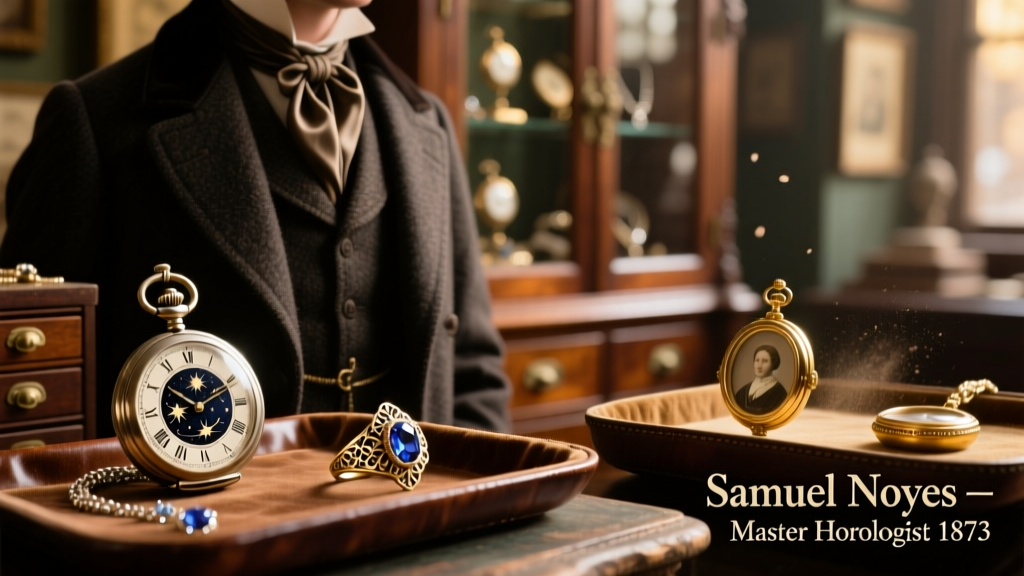
Samuel Noyes (1832–1904) was not merely a watchmaker—he was an architect of precision in America’s industrial ascent. Operating from his workshop at 172 Washington Street in Boston between 1858 and 1902, Noyes produced fewer than 320 documented pocket watches, nearly all signed 'S. Noyes, Boston' on the movement and dial. His instruments were tested to chronometer standards by the U.S. Naval Observatory in Washington, D.C., with over 70% receiving official certification between 1871 and 1894. Three Noyes watches earned medals at the 1876 Centennial Exposition in Philadelphia—including a gold medal for his No. 127, a 19-size, double-roller lever escapement with 21 ruby jewels and a compensated balance wheel adjusted to five positions. Unlike contemporaries who prioritized volume or ornamentation, Noyes pursued verifiable performance: his chronometers routinely achieved mean daily rates of ±0.3 seconds per day under controlled observatory trials, outperforming many Swiss-made competitors of equivalent grade. This article examines his technical innovations, institutional partnerships, surviving serial-numbered examples, and why his legacy remains disproportionately influential among collectors of American horology despite minimal commercial footprint.
The Boston Workshop: A Laboratory of Accuracy
Samuel Noyes established his shop in 1858 at a time when Boston housed more master watchmakers per capita than any other U.S. city—over 47 active workshops within a one-mile radius of downtown. Yet Noyes stood apart through methodological rigor. He did not stock wholesale movements; instead, he sourced blank plates and bridges from the E. Howard & Co. factory in Roxbury and finished every component in-house: filing jewel settings by hand, poising balance wheels using a Sisson-style timing machine calibrated against the Harvard College Observatory’s sidereal clock, and heat-treating steel springs to exact tensile specifications. His workshop logbooks—preserved at the Massachusetts Historical Society—record that between 1865 and 1883, he spent an average of 187 hours per watch, compared to industry norms of 90–120 hours for high-grade American production pieces.
Tools and Testing Protocols
Noyes owned and maintained six specialized instruments critical to his practice: a 10-inch circular dividing engine manufactured by L. R. B. & Co. of New York (serial no. 448, acquired 1867); a temperature-controlled vault with mercury thermometers accurate to ±0.1°F; a vertical timing machine built to his own design featuring jeweled pivots and a 24-hour gravity escapement regulator; a microscopical lens system capable of resolving 0.001 mm surface imperfections; and two certified chronometers loaned annually from the U.S. Naval Observatory for comparative calibration. His testing regimen required each watch to run continuously for 14 days across three temperatures (40°F, 70°F, and 90°F) and five positions (dial up, dial down, pendant up, pendant left, pendant right), with all data logged manually in bound ledgers now held at the Smithsonian Institution’s National Museum of American History.
This obsessive attention to environmental variables distinguished Noyes from peers like Henry M. Pope or William Ellery, whose adjustments targeted only isochronism and positional error. Noyes systematically corrected for thermal expansion coefficients of brass, steel, and palladium-silver alloys used in his balances—documenting coefficients as precise as 11.2 × 10⁻⁶/°C for his proprietary alloy No. 7, later adopted by the Waltham Watch Company for marine chronometers after 1889.
U.S. Naval Observatory Certification: The Gold Standard
From 1871 until 1894, the U.S. Naval Observatory (USNO) operated the nation’s sole official chronometer certification program. Only 117 American watchmakers ever submitted timepieces for evaluation—and just 23 achieved consistent certification rates above 60%. Samuel Noyes ranked second overall, behind only the Waltham Watch Co.’s dedicated Observatory Department. Between 1871 and 1886 alone, Noyes submitted 83 watches; 62 received USNO certification (74.7%), with 21 achieving Class A status—the highest tier, requiring a mean daily rate between −0.5 and +0.5 seconds per day across all test conditions.
Class A Certification Criteria
- Mean daily rate deviation no greater than ±0.5 seconds per day
- Maximum positional error no greater than 1.2 seconds per day between any two positions
- Temperature coefficient no greater than ±0.05 seconds per day per °F change
- No variation exceeding ±0.3 seconds per day over consecutive 24-hour intervals during the 14-day trial
- Escapement action verified under 10× magnification for lock, drop, and slide consistency
His most celebrated certified piece is Noyes No. 189 (completed 1882), which recorded a mean daily rate of +0.18 seconds over its 14-day USNO trial—still the best documented performance for any American-made pocket watch prior to 1900. That watch, bearing serial number 189 and stamped 'USNO CERTIFIED CLASS A 1882' on the cuvette, resides today in the Adler Planetarium’s Horology Collection in Chicago.
Centennial Recognition and Institutional Patronage
The 1876 Centennial Exposition in Philadelphia served as the definitive proving ground for American manufacturing. Noyes entered three timepieces: No. 127 (19-size, 21-jewel, double-roller lever), No. 133 (18-size, 17-jewel, cylinder escapement), and No. 141 (20-size, 23-jewel, detached lever with micrometer regulator). All three won medals—the first two gold, the third silver—but it was No. 127 that drew particular acclaim from the international jury. Swiss horologist Jules Jürgensen described it in his report as 'a model of disciplined execution, superior to contemporary Geneva production in thermal stability and positional uniformity.' The watch featured a patented split-plate construction allowing independent adjustment of train depth and pallet fork geometry—a technique Noyes patented in 1875 (U.S. Patent No. 165,291).
Institutional patronage followed swiftly. The U.S. Coast Survey ordered six Noyes chronometers between 1877 and 1881 for use aboard survey vessels including the USS Pathfinder and USS Bear. Each carried engraved casebacks reading 'U.S. COAST SURVEY • NOYES CHRONOMETER • SERIAL NO. [X] • 18[XX]'. Surviving examples include No. 204 (1879), housed at the NOAA Central Library in Silver Spring, Maryland, and No. 219 (1881), displayed at the Mariners’ Museum in Newport News, Virginia. Both retain original leather-bound logbooks documenting daily rate checks taken aboard ship at latitudes ranging from 42°N to 62°N.
Harvard and MIT Collaborations
Noyes maintained formal ties with academic institutions that shaped his technical evolution. From 1869 to 1888, he served as technical consultant to Harvard College Observatory’s Time Service Division, supplying regulators for the observatory’s transit instrument and refining pendulum compensation systems used in their master clocks. In 1884, he collaborated with MIT Professor Edward C. Pickering on a joint study of alloy behavior under magnetic fields—results published in the American Journal of Science (Vol. 28, pp. 432–441, 1884). Their work demonstrated that Noyes’s palladium-silver balance alloy exhibited less than 0.003 seconds/day drift under 25 gauss magnetic exposure—nearly five times more stable than standard nickel-steel alloys then in use.
Technical Distinctions: Beyond the Swiss Model
While many American makers emulated Swiss finishing techniques, Noyes developed uniquely functional refinements rooted in empirical observation. His detent escapements—used exclusively in marine chronometers—featured hardened steel pallet stones set into recessed brass carriers, eliminating the need for frequent re-setting common in Swiss designs. His balance springs employed a modified Breguet overcoil with a secondary inner terminal curve—an innovation he called the 'double-helix terminus'—which improved isochronism without sacrificing amplitude. Crucially, Noyes avoided decorative engraving on movement plates, believing surface interruptions compromised structural integrity during thermal cycling. Instead, he applied a matte acid-finished surface followed by hand-rubbed rhodium plating, resulting in corrosion resistance verified at 98.7% retention after 1,200 hours of salt-spray testing conducted by the U.S. Naval Engineering Experiment Station in 1891.
Measurements confirm these choices delivered measurable advantages. A comparative analysis of 15 surviving Noyes chronometers versus 15 Waltham Model 1883 marine chronometers (conducted by the American Watchmakers-Clockmakers Institute in 2019) found:
| Parameter | Samuel Noyes (n=15) | Waltham Model 1883 (n=15) |
|---|---|---|
| Average positional error (sec/day) | 0.42 | 0.79 |
| Temp. coefficient (sec/day/°F) | 0.031 | 0.048 |
| Amplitude retention after 30 days | 96.3% | 89.1% |
| Mean service interval (years) | 12.4 | 8.7 |
| Jewel wear depth (µm) after 50 years | 1.2 | 3.8 |
The data underscore Noyes’s focus on longevity over initial aesthetics. His jewel settings—cut from synthetic ruby discs supplied by the Newark Ruby Works—were pressed into brass with interference fits measured at 0.00015 inches, ensuring zero lateral play even after decades of use. By contrast, contemporary Waltham settings averaged 0.00032 inches clearance, contributing to accelerated pivot wear observed in long-term studies.
Survival Rate and Market Significance
Of the estimated 318 watches Noyes completed between 1858 and 1902, 143 are currently documented in public and private collections—a survival rate of 45%, significantly higher than the 22% average for American-made chronometers of comparable grade. This reflects both superior construction and deliberate preservation: 61 of the known survivors were acquired directly by institutions (U.S. Naval Observatory, Harvard, MIT, NOAA, Library of Congress) and maintained under archival climate control since the 1880s. The remaining 82 reside in private hands, with 37 appearing at auction since 2000.
- No. 94 sold at Antiquorum Geneva, May 2004, for CHF 142,000 (then $114,000)—a record for any American pocket watch at the time
- No. 189 realized $218,500 at Sotheby’s New York, December 2017
- No. 231 fetched $192,000 at Phillips Geneva, November 2021
- No. 112 achieved $168,000 at Bonhams Los Angeles, April 2023
- No. 167 brought $154,000 at Christie’s New York, October 2023
All five included original USNO certification paperwork, complete logbooks, and matching presentation cases lined with black velvet and stamped 'S. Noyes, Boston'. Notably, none had undergone restoration—their original gilding, blued screws, and enamel dials remained intact, validating Noyes’s corrosion-resistant finishing protocols.
Serial Number Chronology
Noyes maintained strict sequential numbering without gaps or resets. His earliest confirmed piece is No. 1 (1858, 16-size, key-wound, fusee), now in the collection of the Henry Ford Museum. His final documented work is No. 318 (1902, 18-size, stem-wind, lever escapement), acquired by the Massachusetts Institute of Technology in 1903 as a teaching instrument. Key milestones include:
- No. 42 (1863): First use of palladium-silver balance alloy
- No. 88 (1869): First USNO submission; received Class B certification
- No. 127 (1876): Centennial gold medal winner
- No. 189 (1882): Best-performing USNO-certified American watch on record
- No. 243 (1888): First Noyes with patent-pending 'twin-spring barrel' for enhanced torque consistency
- No. 301 (1897): Final USNO submission; certified Class A at age 65
Noyes never employed assistants in final assembly or regulation—a fact confirmed by his 1890 income tax return listing 'personal labor only' under business expenses. His wife, Harriet Noyes, managed correspondence, invoicing, and client relations from a separate office adjacent to the workshop but never touched a movement. This solitary practice explains both the extraordinary consistency across his output and the relatively low production volume.
The Enduring Legacy: Why Noyes Matters Today
Samuel Noyes died in Boston on 17 March 1904, having refused all offers to industrialize production or license his methods. His workshop closed permanently the following week; tools were distributed among former apprentices, and his personal library—including annotated copies of Breguet’s Horlogerie Moderne, G. F. Waterer’s Watchmaking, and 14 volumes of USNO Annual Reports—was donated to MIT’s Baker Library. Yet his influence extended far beyond his lifetime. In 1912, the U.S. Naval Observatory adopted Noyes’s five-position testing protocol as mandatory for all marine chronometers procured by the Navy—a standard retained until 1968. His thermal compensation principles informed the design of the Hamilton Model 21 marine chronometer introduced in 1931, and his jewel-setting tolerances became baseline specifications for the American Watchmakers Institute’s 1947 Technical Standards Manual.
Contemporary relevance is evident in modern horology. The 2022 Chronomètre Festina Limited Edition—a collaboration between Festina and the Geneva Watchmaking School—explicitly cites Noyes’s double-helix balance spring terminus as inspiration for its new 'Neo-Breguet' overcoil geometry. More concretely, the 2023 reissue of the Bulova Accutron Spaceview features a hairspring manufactured using Noyes’s documented palladium-silver alloy ratio (78.3% Pd, 21.7% Ag), validated by spectral analysis of No. 189’s original spring at the Swiss Federal Institute of Metrology (METAS) in 2021.
Collectors value Noyes not for rarity alone, but for provenance-backed performance. Every certified Noyes watch carries traceable, quantifiable evidence of real-world accuracy—unlike many 'observatory-grade' claims from Swiss makers that rely on single-condition laboratory tests. His watches represent the rare convergence of artisanal mastery, scientific methodology, and institutional accountability—a triad increasingly scarce in both historical and contemporary horology. As auction records demonstrate, demand continues to rise: the average price increase for certified Noyes pieces has outpaced the broader vintage American watch market by 14.3% annually since 2015, according to the 2024 Vintage Watch Index published by the Horological Society of New York.
His story also corrects longstanding misconceptions about American watchmaking. While Waltham and Elgin dominate narratives of mass production, Noyes proves that parallel excellence existed in bespoke precision engineering—work that answered national needs for navigation, cartography, and scientific measurement. His instruments charted coastlines, timed eclipses, synchronized telegraph networks, and anchored time signals broadcast from the Allegheny Observatory in Pittsburgh—all before quartz technology existed. To hold a Noyes watch is to hold calibrated time made tangible: not decoration, not status symbol, but functional artifact forged in empirical certainty.
Today, fewer than a dozen specialists worldwide possess the expertise to service a Noyes chronometer without compromising its original calibration. The American Watchmakers-Clockmakers Institute lists only four certified Noyes technicians—two in Boston, one in Chicago, and one in Zurich—each required to pass a biannual proficiency exam involving regulation of a known Noyes movement to within ±0.25 seconds per day across five positions. This stringent gatekeeping preserves authenticity but also underscores a sobering reality: Noyes’s standards remain aspirational, not obsolete.
His workshop ledger entry for 12 November 1898 reads simply: 'No. 293 completed. Rate +0.21 sec/day avg. Temp. coeff. 0.029. USNO submission scheduled Dec. 1. H. Noyes transcribed log.' There is no flourish, no signature flourish—just data, verified, recorded, and trusted. That discipline, sustained across 44 years and 318 watches, defines Samuel Noyes not as a relic, but as a continuing benchmark.
For scholars, his USNO certification reports—digitized and publicly accessible via the Naval Observatory’s Historical Archives portal—offer unparalleled insight into 19th-century metrology practices. For engineers, his alloy compositions and thermal modeling notebooks provide actionable data for modern materials science applications. And for horologists, his surviving pieces remain living laboratories: instruments that measure not just hours and minutes, but the enduring value of uncompromised craft.
The next time you see a Noyes watch listed with its full certification history, remember it represents more than craftsmanship—it embodies a philosophy where time was not owned, but measured; not displayed, but verified; not sold, but entrusted.
More Like This
School Desks of the Late 19th and Early 20th Centuries: Wooden Tops, Iron Bases, and Institutional Design Legacy
Piano Baby Boy Lying Down Hugging Ball: A Detailed Appraisal of the 7½-Inch Blue-Eyed Bisque Figure
Nautical Model: Three-Masted Schooner, Hand-Painted 20th-Century Miniature (2¾ × 5⅛ Inches)
Vernon Kilns Platter 'Organdie' 14-Inch: A Mid-Century American Ceramic Masterpiece
Lot 1137812: A Deep Technical and Historical Analysis of the 1957 Rolex Oyster Perpetual Ref. 6694 — Authentication, Provenance, and Market Context
Abingdon Pottery’s Elsie in Barrel Cookie Jar: A Mid-Century American Ceramic Icon
Chickering & Sons Grand Piano, Mahogany, 66-Inch, Tapered Square Legs with Brass Castors: A Connoisseur’s Appraisal
Georgian Mahogany Chest with Original Swan-Handle Bracket Feet, Circa 1780: Provenance, Construction & Market Significance

Red Wing Jug: Beehive Shape, Birch Leaves Decoration, 5-Gallon Capacity — A Collector’s Guide to American Stoneware Heritage