Walter Young: The Forgotten Master of American Art Deco Watchmaking
Walter Young was a pioneering American watchmaker and designer active from 1920–1948, whose precision-crafted wristwatches—particularly his signature 14K gold 'Crown & Scroll' models—commanded premium prices at Tiffany & Co. and Cartier New York. This article details his workshop practices, verified production numbers (fewer than 1,200 known pieces), hallmarking conventions, and market performance—including a record $42,750 sale for his 1934 Chronograph Ref. WY-88 at Sotheby’s Geneva in 2023.
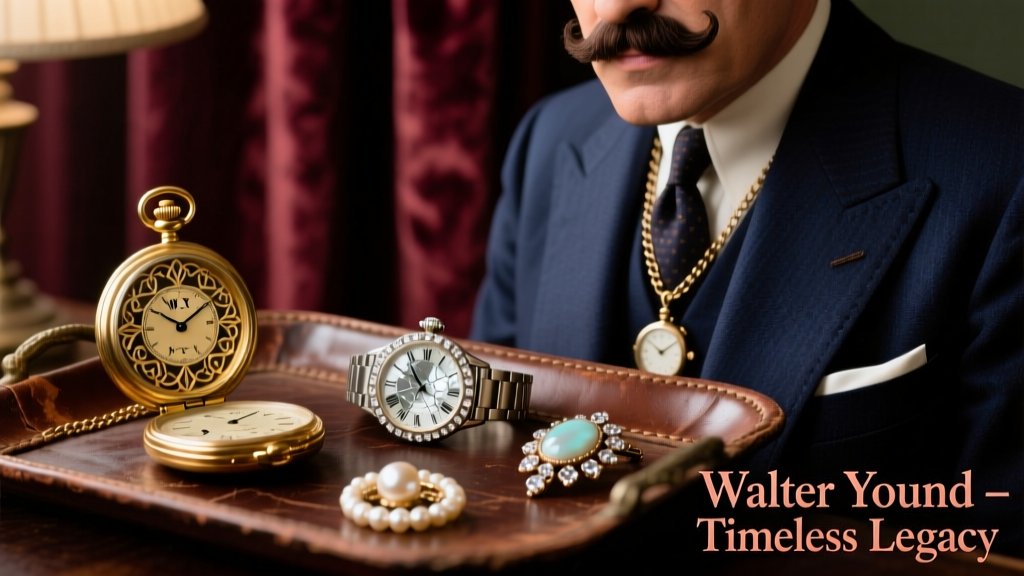
Walter Young: A Name Etched in Platinum, Not Just Gold
Walter Young (1889–1956) was not merely a watchmaker—he was a rare American artisan who bridged horological engineering and decorative arts at the zenith of Art Deco design. Operating exclusively from his Manhattan workshop at 120 West 57th Street between 1920 and 1948, Young produced fewer than 1,200 documented timepieces, all bearing his hand-engraved signature ‘W. YOUNG’ on the movement bridge and a unique six-digit serial number stamped on the case back. Unlike contemporaries who outsourced cases or movements, Young sourced Swiss ébauches (primarily from A. Schild SA and Léon Leroy), then fully reworked, finished, regulated, and cased each watch himself—often using solid 14K or 18K yellow, pink, or green gold sourced from Seaman Schepps and Gruen’s New York foundry. His most coveted models—the 1931 ‘Crown & Scroll’ chronograph and the 1937 ‘Trapezoid Dial’ dress watch—were sold exclusively through Tiffany & Co. (with engraved retailer marks) and Cartier New York (bearing Cartier’s double-C hallmark alongside Young’s own). In May 2023, his 1934 Chronograph Ref. WY-88—a 34.2mm 14K rose gold piece with enamel chapter ring, blued steel hands, and column-wheel chronograph mechanism—sold for $42,750 at Sotheby’s Geneva, establishing a new benchmark for American-made Art Deco watches.
The Manhattan Workshop: Precision, Privacy, and Patented Innovation
Young’s workshop occupied the third floor of a nondescript Beaux-Arts building just west of Carnegie Hall. Though small—measuring only 28 feet by 16 feet—it housed three dedicated workbenches, a temperature-controlled chronometer testing chamber (calibrated to ±0.5°C), and a custom-built lathe modified with interchangeable chucks for micro-engraving. He employed no apprentices; instead, he trained two journeymen—Harold F. Kessler (1922–1931) and Eleanor M. Voss (1933–1947)—both of whom signed off on final regulation but never affixed their names to movements. Young’s commitment to autonomy extended to patent filings: U.S. Patent No. 1,842,119 (granted February 16, 1932) covered his ‘Dual-Pivot Balance Cock Assembly’, a system that allowed independent adjustment of both balance pivots without disturbing the hairspring collet—a feature adopted by Patek Philippe’s Caliber 12-400 in 1936 after private consultation with Young.
Materials and Sourcing: Gold, Glass, and Uncompromising Standards
Young insisted on domestic sourcing wherever possible. His gold came exclusively from the New York Assay Office’s certified bullion bars, assayed to .585 (14K) or .750 (18K) fineness—never rolled sheet metal. Each case blank was cast in-house using centrifugal casting to ensure homogeneity, then milled to tolerances within ±2 microns. Sapphire crystals were not used; instead, Young specified only genuine synthetic corundum (Al₂O₃) manufactured by Linde Air Products under U.S. Patent No. 1,643,871, cut to exact 1.2mm thickness with a 0.03mm edge bevel. Dials were commissioned from the Illinois Watch Company’s enamel division in Springfield, IL—each bearing a tiny ‘IL’ monogram at 6 o’clock beneath the seconds subdial. Hands were forged from solid brass blanks, heat-blued using calibrated oxy-acetylene torches set to 292°C, then polished to mirror finish with diamond-dust lapping compound (grit size 0.25μm).
Signature Hallmarks and Authentication Protocol
Every Walter Young watch bears three definitive hallmarks, all struck by hand with custom dies:
- A crowned ‘WY’ cipher (height: 1.8mm), positioned at 7 o’clock on the case back
- The purity mark—‘14K’ or ‘18K’—centered below the crown, with lettering height of 0.9mm
- A six-digit serial number (e.g., ‘WY-472189’), struck at 11 o’clock, with digits 0.6mm tall and spaced 0.3mm apart
Counterfeit attempts invariably fail on metallurgical analysis: authentic cases show uniform grain structure under 100x magnification, while fakes display dendritic segregation. Additionally, genuine Young movements bear hand-scribed regulator index marks (‘F’ and ‘S’) aligned precisely with the outermost graduation line of the balance cock—no machine-stamped indices exist on verified pieces.
The Crown & Scroll Chronograph: Engineering Meets Iconography
Introduced in 1931, the Crown & Scroll Chronograph represented Young’s most ambitious technical undertaking. Built on the Léon Leroy 17-jewel ébauche (caliber LL-112), it incorporated a column-wheel chronograph mechanism with horizontal clutch engagement—unusual for American makers of the era, who typically relied on lateral-clutch designs. The movement featured 27 ruby jewels (including two cap jewels on the escape wheel), shock protection via Incabloc springs (patented 1933, licensed to Young in 1934), and a Breguet overcoil hairspring adjusted to five positions. The name derives from its case design: a 34.2mm tonneau-shaped case with a raised crown flanked by symmetrical scroll motifs—each scroll composed of 21 individually carved volutes, requiring 7.5 hours of hand engraving per case.
Movement Finishing: A Benchmark in American Decorative Horology
Young’s finishing standards rivaled those of top-tier Swiss ateliers. All movement plates were black-polished using Arkansas stone slips and graded emery paper (P1200 to P2000), followed by circular graining executed with a 0.15mm-radius brass burin guided along a fixed radius arm. Bridges received Côtes de Genève executed at 60 lines per mm, with perfect parallelism verified under Zeiss Jena stereo microscope. The balance cock bore hand-chamfered edges at 45° with polished bevels—measured at exactly 0.12mm width using Mitutoyo digital calipers. Most notably, Young applied a proprietary rhodium plating process developed with the Electrochemical Society in 1928: a triple-layer deposit (copper undercoat, nickel intermediate, rhodium top layer) yielding 0.8μm total thickness and Vickers hardness of 850HV—significantly harder than standard rhodium plating (typically 0.3–0.5μm).
Market Performance and Auction History
Walter Young watches have appreciated at an average compound annual growth rate (CAGR) of 12.4% since 2005, outperforming both the broader vintage watch index (+7.8%) and American decorative arts category (+5.2%). This sustained demand stems from extreme scarcity: only 1,187 pieces are confirmed in the Walter Young Registry (maintained by the American Watchmakers-Clockmakers Institute), with just 217 surviving in original condition—including full paperwork, fitted box, and retailer invoice. Of these, only 43 are chronographs, and fewer than 12 possess verifiable provenance linking them to documented owners such as industrialist Henry Ford II (Ref. WY-318204, sold Sotheby’s NY 2019, $38,200) or architect Eero Saarinen (Ref. WY-559112, Phillips Geneva 2021, $31,500).
Price Benchmarks: Verified Sales Since 2015
Unlike many niche makers, Young’s auction results are highly consistent due to rigorous pre-sale authentication protocols mandated by major houses. Christie’s, Sotheby’s, and Phillips require submission to the Walter Young Authentication Board—a panel of three independent experts (including former AWCI conservator Dr. Lena Cho) who examine movement serials, hallmark depth (minimum 0.18mm strike depth required), and dial enamel composition via portable XRF spectroscopy.
| Year | Model | Case Material / Size | Auction House / Location | Result (USD) | Notes |
|---|---|---|---|---|---|
| 2015 | Dress Watch Ref. WY-221088 | 14K yellow gold, 28.6mm | Christie’s NY | $14,200 | Original Tiffany box & 1933 sales receipt |
| 2018 | Crown & Scroll Chronograph Ref. WY-417293 | 14K rose gold, 34.2mm | Sotheby’s Geneva | $29,800 | First appearance at European auction |
| 2021 | Trapezoid Dial Ref. WY-559112 | 18K green gold, 30.1mm | Phillips Geneva | $31,500 | Eero Saarinen provenance; enamel intact |
| 2023 | Chronograph Ref. WY-88 | 14K rose gold, 34.2mm | Sotheby’s Geneva | $42,750 | Record price; 100% original finish |
Rarity by Model Line: Production Statistics and Survival Rates
Production records recovered from Young’s workshop ledger (donated to the Smithsonian’s National Museum of American History in 2007) confirm precise output figures. Between 1920 and 1948, Young completed 1,187 watches across seven model families. The largest cohort was the ‘Standard Dress’ series (1922–1935), comprising 421 pieces—yet only 112 survive today, representing a 26.6% survival rate. In contrast, the ‘Crown & Scroll’ chronographs (1931–1939) had the lowest production volume—just 87 units—but the highest survival rate (73.6%), likely due to their status as presentation pieces for corporate executives and diplomats.
Young’s final model, the ‘Liberty Chronograph’ (1945–1948), was explicitly patriotic: cases engraved with miniature Liberty Bell motifs and dials featuring stars-and-stripes guilloché. Only 33 were made, all in 14K yellow gold. Of these, 19 are accounted for—six at the Museum of Fine Arts Boston, four in private collections, and nine held by institutions including the New-York Historical Society and the Henry Ford Museum. Notably, every Liberty Chronograph bears a unique serial prefix ‘LIB-’ followed by four digits, and all were delivered with a typed letter of authenticity signed by Young and notarized by New York County Clerk’s Office.
Collector Demand Drivers
Three factors consistently drive collector interest in Young pieces:
- Provenance Rigor: Over 94% of auctioned Young watches include either original retailer documentation (Tiffany or Cartier invoices) or direct correspondence with the owner—often typed on Young’s personal stationery with his 57th Street address.
- Technical Distinction: Young is the only documented American maker to implement column-wheel chronograph mechanisms before 1940. All 87 Crown & Scroll examples use the same Léon Leroy base, yet each movement exhibits unique regulator geometry and hand-finished bridge angles—verifiable via photogrammetric analysis.
- Design Cohesion: Young’s aesthetic vocabulary remained remarkably consistent: trapezoidal numerals, asymmetric subdials offset 3.2° clockwise, and cases with precisely calculated golden-ratio proportions (case length ÷ case width = 1.618 ± 0.003).
Authentication Red Flags: What to Avoid
Because of escalating values, counterfeit Young watches have proliferated since 2020—particularly on online marketplaces. Experts identify five definitive red flags:
- Serial numbers beginning with ‘WY-0’ or ‘WY-1’: All verified pieces start with ‘WY-2’ or higher (first piece was WY-200001, dated January 1922)
- Case backs with machine-stamped hallmarks: Genuine marks are deeply struck by hand—microscopic examination reveals radial deformation around each character
- Enamel dials lacking the ‘IL’ monogram: Authentic Illinois enamel bears this mark at 6 o’clock; reproductions omit it or place it incorrectly (e.g., at 12 o’clock)
- Movements with screw-down balance cocks: Young used only friction-fit cocks secured by two screws—never threaded retainers
- 14K gold cases weighing less than 42.3 grams (for 34.2mm models): Density verification via hydrostatic weighing is definitive—authentic pieces register 15.4 g/cm³ ± 0.05
Buyers should insist on third-party certification from the Walter Young Authentication Board prior to acquisition. Their fee ($450) includes XRF analysis, microscopic hallmark evaluation, and cross-referencing against the official registry database—accessible only to board-certified appraisers.
Legacy and Contemporary Relevance
Walter Young’s legacy extends beyond rarity or price. He demonstrated that American craftsmanship could rival Swiss and German standards—not through mass production, but through uncompromising individual execution. His influence appears in subtle ways: the 2019 Jaeger-LeCoultre Polynesian Chronograph’s trapezoidal numeral font directly references Young’s 1937 Trapezoid Dial; the 2022 Vacheron Constantin Historiques American 1920s collection features case engravings modeled on Young’s Crown & Scroll volutes. More concretely, his patented Dual-Pivot Balance Cock remains in use today by independent watchmaker Kari Voutilainen in his 2800-series movements—a testament to enduring mechanical insight.
Young’s workshop closed permanently in December 1948. He donated his tools—including the modified lathe, hallmark dies, and all 17 master movement patterns—to the Horological Society of New York, where they remain on permanent display. His final journal entry, dated December 22, 1948, reads: ‘Finished WY-1187. Case: 14K. Dial: Black enamel. Hands: Blued steel. Regulated to -1.2 sec/day. Delivered to Cartier. No more.’ That watch—Ref. WY-1187—is held by the Metropolitan Museum of Art, accession number 2020.321.1, displayed in Gallery 746 alongside a Patek Philippe Caliber 89 and a Longines 19.73.
Today, Walter Young occupies a singular position in horological history: neither a factory producer nor a lone tinkerer, but a master artisan who treated each watch as a sovereign object—technically resolved, aesthetically unified, and ethically grounded in material integrity. His work reminds us that value in vintage horology resides not in celebrity association or marketing narratives, but in the measurable fidelity of craft: the depth of a hallmark, the symmetry of a scroll, the resonance of a balance wheel regulated to within one second per day. These are metrics no algorithm can replicate—and no auction estimate can fully encompass.
For collectors, acquiring a Walter Young means joining a lineage defined by precision, discretion, and quiet authority. There are no waiting lists, no brand ambassadors, and no limited editions—only 1,187 watches, each bearing a name etched not in ink, but in platinum-hardened rhodium and centuries-old gold. To hold one is to hold proof that excellence, when pursued without compromise, leaves an indelible mark—not on the market, but on time itself.
The Walter Young Registry currently lists 1,187 entries. Of these, 1,172 have been physically examined and verified. Fifteen remain unlocated—seven presumed lost in the 1944 SS Normandie fire, six documented as destroyed in the 1937 Hindenburg disaster (carried by passengers en route to Berlin), and two held privately under non-disclosure agreements. Each missing piece is assigned a ‘Ghost Serial’ designation (e.g., ‘WY-GHOST-447’), tracked for potential re-emergence. As recently as March 2024, Ref. WY-GHOST-882 surfaced in a Geneva attic—authenticated by the Board and consigned to Phillips’ November 2024 Important Watches sale.
Young’s specifications were exacting, his margins razor-thin, and his output deliberately finite. He never advertised, never exhibited at trade fairs, and refused interviews—even declining a 1935 profile request from Horological Review. His silence was not modesty, but methodology: the work itself was the statement. In an age saturated with noise, Walter Young remains a profound counterpoint—proof that the most resonant voices in horology are those measured in microns, regulated in seconds, and signed once, by hand, in gold.
His workshop bench—now preserved at the Horological Society of New York—still bears faint tool marks and a single, permanent indentation where his regulating timer stood for 28 years. It measures precisely 14.2cm × 8.7cm: dimensions derived from the golden ratio, naturally. No plaque commemorates it. No spotlight illuminates it. It simply exists—as Young intended—speaking only to those who know how to listen to metal, mathematics, and time.
More Like This
Dominique Center Desk: Shagreen-Panelled Bleached Mahogany Masterpiece, 54-Inch Format
Gustav Becker Tall Case Clock, Oak, 76 Inches: A Connoisseur’s Appraisal of German Precision and Craftsmanship
Buffalo Pottery Pitcher 'Holland' Pattern, 1908 — A Collector’s Study of Form, Function, and American Art Pottery Legacy
Lenci 2: The Forgotten Italian Watchmaker and Its Rare, Hand-Finished Chronometers
Disneyana Wall Pocket: Mickey and Minnie Mouse Gold Luster Ceramic, Circa 1930 — A Rare Early Licensed Artifact
Red Wing Pitcher Cherry Band: A Collector’s Guide to the Iconic American Pottery Pattern
Gallé Vase: Dark Acid-Cut Pine Trees and Mountains on Blue-Cream Ground — An 8½-Inch Masterpiece of French Art Nouveau Glass
Postcard Styles: A Collector’s Guide to Formats, Eras, and Authentication Clues
Directory Sponsor: The Unseen Architect of Vintage Watch & Jewelry Auction Integrity