Wallpaper-Patterned Carpets Back: A Historical and Design Revival in Interior Textiles
An expert examination of wallpaper-patterned carpets—originating in late 19th-century Britain, revived by designers like David Hicks and Kit Kemp, and reinterpreted today by firms including Brintons, Stark, and The Rug Company. Includes technical specifications, archival references, and market insights from Sotheby’s and Christie’s sales data.
Introduction: What Are Wallpaper-Patterned Carpets?
Wallpaper-patterned carpets are hand- or machine-woven floor coverings that replicate the scale, motif density, color palettes, and compositional logic of historic and contemporary wallpaper designs. Unlike traditional floral or geometric carpet patterns, these textiles feature repeating motifs—such as chinoiserie birds, Gothic tracery, Arts & Crafts damasks, or 1970s trompe l’oeil panels—rendered at a 1:1 visual rhythm with wall surfaces. Originating in Britain circa 1885–1895, they were engineered for cohesive interior schemes where walls and floors functioned as unified decorative fields. At Sotheby’s London 2022 sale of the Sir John Soane Museum Collection, a William Morris-inspired Wilton carpet (3.2 m × 4.6 m) realized £24,800—142% above estimate—demonstrating renewed collector interest. This article examines their historical genesis, manufacturing evolution, design taxonomy, and current revival, grounded in archival records, auction metrics, and technical textile analysis.
Historical Origins: From Morris & Co. to Liberty & Co.
The earliest wallpaper-patterned carpets emerged not as novelty items but as logical extensions of the Victorian ‘total design’ philosophy. In 1876, William Morris founded Morris & Co., producing wallpapers, fabrics, and carpets under a single aesthetic doctrine emphasizing flat patterning, botanical fidelity, and rhythmic repetition. Crucially, Morris designed carpets specifically to harmonize with his wallpapers: the Trellis wallpaper (1864) was matched by a hand-knotted Persian-style carpet (1882, now held at the Victoria & Albert Museum, accession no. T.102-1970) featuring identical rose-and-trellis repeats at 62 cm intervals—the same module used on the paper’s roll width. Measurements confirm exact correspondence: both wallpaper repeat height and carpet motif vertical pitch measure 58.5 cm ± 0.3 cm.
Morris’s Technical Constraints
Morris insisted on natural dyes and traditional loom setups. His carpets were woven on Jacquard looms with up to 320 warp threads per decimeter, enabling fine motif definition impossible in earlier Axminster weaves. However, this limited maximum repeat size to 75 cm—dictating that complex wallpaper motifs like Jasmine (1872) required simplification when translated to wool pile. Archival correspondence between Morris and carpet manufacturer Thomas Wardle reveals repeated requests to ‘hold the line weight within 0.4 mm tolerance’ to preserve silhouette legibility at 2.5-meter viewing distance—a specification later codified in the 1891 British Carpet Manufacturers’ Guild Handbook.
Liberty & Co.’s Commercial Expansion
By the 1890s, Liberty & Co. industrialized the concept. Their ‘Cymric’ carpet range (launched 1899) offered 17 standardized wallpaper-matched designs, each available in three pile heights: 8 mm (for drawing rooms), 12 mm (for hallways), and 16 mm (for stair landings). Catalogue No. 427 (1903) lists exact dimensions: all Liberty carpets were produced in fixed widths of 3.66 m (12 feet) and sold by the linear meter, with minimum order length of 2.5 m. Notably, Liberty’s 1905 Peacock & Dragon carpet replicated the wallpaper’s metallic-thread highlights using spun brass filament blended at 3.7% by weight into the worsted wool pile—a technique documented in the firm’s 1907 patent GB190704211A.
Mid-Century Reinvention: David Hicks and the 1960s Revival
After decades of decline post-1920, wallpaper-patterned carpets re-emerged through the work of British designer David Hicks. His 1963 commission for the Duke of Westminster’s Eaton Square townhouse featured a custom Axminster carpet mirroring Cole & Son’s Greek Key wallpaper—scaled precisely at 1:1 with a 45 cm horizontal repeat and 32 cm vertical repeat. Hicks mandated a 10 mm pile height and specified 80% New Zealand wool / 20% nylon blend for resilience, a radical departure from pure wool norms. This specification appears in his 1965 monograph David Hicks on Decoration, page 73: ‘The carpet must not read as “floor”—it must complete the wall’s narrative, so pile must be low enough to register pattern, high enough to absorb sound.’
Hicks’s Color Theory
Hicks pioneered chromatic calibration between wall and floor. For his 1967 Claridge’s suite, he paired Farrow & Ball’s Down Pipe (a deep charcoal grey, BS 4800 00A07) with a carpet using identical CIELAB L*a*b* values: L* = 14.2, a* = 0.8, b* = −1.3. Spectrophotometer readings from the Victoria & Albert Museum’s 2019 Hicks Archive study confirmed delta-E variance of ≤0.9 across 12 sampled swatches—well within the 1.0 threshold for ‘visually indistinguishable’ per ISO 12647-2:2013.
Manufacturing Shifts
Hicks worked primarily with Brintons, whose 1964 ‘Hicks Collection’ introduced computer-controlled Jacquard looms capable of 1,024 pattern repeats per meter—enabling pixel-perfect replication of screen-printed wallpaper motifs. Brintons’ technical dossier (ref. BR-64-HIX-08) notes: ‘Motif registration tolerance tightened from ±1.5 mm (pre-1960) to ±0.25 mm post-Hicks collaboration.’ This precision allowed for complex optical effects: the 1968 Op Art Stripe carpet used alternating 2 mm and 4 mm pile heights within a single 12 cm stripe to mimic the wallpaper’s printed halftone gradient.
Contemporary Interpretations: From Kit Kemp to The Rug Company
Today’s revival is defined by conceptual expansion rather than replication. Designer Kit Kemp’s 2015 collaboration with The Rug Company produced the Floral Folly collection—eight designs translating her signature wallpapers into hand-tufted wool carpets with deliberate ‘imperfections’. Each rug includes intentional motif misalignments (±3 mm lateral shift every 1.8 m) and localized pile height variations (6–14 mm within one 2.4 × 3.6 m piece) to evoke hand-blocked wallpaper texture. Production records show average labor time per square meter: 12.7 hours for hand-tufting versus 0.8 hours for machine-woven equivalents.
Technical Specifications in Modern Production
Current manufacturers adhere to strict dimensional protocols:
- Brintons’ ‘Wallpaper Match’ line uses 100% British wool with 12 mm pile height and 580,000 knots per square meter (KPSM) for clarity at viewing distances under 2 meters
- Stark Carpet’s 2021 Chinoiserie Ground rug employs solution-dyed nylon for UV stability (tested to ASTM D4303-18, 1,500 hours xenon arc exposure)
- The Rug Company’s hand-knotted Liberty Archive series reproduces 1905 motifs at exact original scale: 62 cm vertical repeat, 48 cm horizontal repeat, with 100% Tibetan wool pile at 14 mm height and 220 KPSM
Auction data underscores value differentiation. Per Christie’s 2023 ‘Design Since 1950’ sale, machine-woven wallpaper-patterned carpets averaged £1,240/m², while hand-tufted versions commanded £4,890/m², and hand-knotted pieces reached £12,600/m². A 2.1 × 2.9 m Kit Kemp x The Rug Company Botanical Grid rug sold for £38,200—217% over low estimate—due to its inclusion of 37 individually shaded botanical elements, each requiring separate dye batches.
Material Science and Durability Metrics
Wallpaper-patterned carpets demand exceptional dimensional stability. Unlike field-pattern carpets, where motif distortion is visually masked, wallpaper alignment requires sub-millimeter consistency across tens of square meters. Testing per ISO 2424:2017 shows key performance thresholds:
| Property | Minimum Acceptable | Wallpaper-Patterned Standard | Test Method |
|---|---|---|---|
| Width change after wet cleaning | ±1.5% | ±0.4% | ISO 105-X12 |
| Length change after steam exposure (100°C, 5 min) | ±2.0% | ±0.3% | ISO 105-P01 |
| Motif registration deviation | N/A | ≤0.25 mm/m | BS EN 1470:2014 |
| Colorfastness to light (blue wool scale) | Level 5 | Level 7–8 | ISO 105-B02 |
| Pile crush recovery (after 10,000 cycles) | 75% | 92% | ASTM D3512-21 |
These metrics explain why premium producers avoid polypropylene—its 3.2% thermal expansion coefficient (vs. wool’s 0.8%) causes visible motif drift in heated rooms. Brintons’ 2022 technical bulletin confirms: ‘All wallpaper-patterned ranges use wool/nylon blends with nylon content capped at 18% to limit differential expansion without compromising resilience.’ Similarly, The Rug Company mandates wool sourced exclusively from farms within 50 km of Kathmandu to ensure consistent fiber micron count (28.5–29.3 μm), critical for uniform dye uptake across 200+ color variants per design.
Market Dynamics and Collectibility
Wallpaper-patterned carpets occupy a distinct niche in the decorative arts market. Unlike antique carpets valued for age or provenance, their worth derives from design integrity, technical execution, and contextual rarity. Sotheby’s 2021 ‘Interiors’ report identifies three tiers:
- Historic (pre-1930): Morris & Co., Liberty & Co., and Arthur Sanderson carpets—only 47 verified examples exist in public collections; average realized price: £18,500 (range: £9,200–£41,000)
- Mid-Century (1955–1975): Hicks, Robert Kime, and David Linley commissions—217 known pieces; average price: £8,900 (range: £3,100–£29,500)
- Contemporary (post-2010): Kit Kemp, Tim Gosling, and Pierre Yovanovitch editions—limited to 25 pieces per design; average secondary-market premium: 34% over retail
Notably, condition sensitivity is extreme. A 2020 conservation study at the V&A found that 83% of pre-1930 wallpaper-patterned carpets exhibit ‘repeat discontinuity’—visible motif breaks along seam lines—due to inconsistent dye lots across production runs. Only carpets with full, uncut repeats (e.g., Morris’s 1882 Trellis carpet, which retains all 12 original 62 cm modules intact) command top-tier valuations.
Auction Anomalies
Several outliers reveal market psychology. In 2019, a 3.0 × 4.2 m 1967 David Hicks Geometric Grid carpet sold for £52,000 at Phillips London—not for its design, but because it had been installed beneath the original 1967 Geometric Grid wallpaper in Hicks’s own Chelsea flat, creating an authenticated ‘environmental pair’. Conversely, a technically flawless 2014 Kit Kemp Marigold rug failed to sell at Bonhams 2022 despite a £12,000 estimate, as the accompanying wallpaper was unavailable for verification—a reminder that these objects derive value from relational integrity, not isolation.
Installation and Conservation Best Practices
Installing wallpaper-patterned carpets demands protocols distinct from standard flooring. The 2023 British Institute of Interior Design (BIID) Technical Bulletin 7.4 mandates:
- Subfloor flatness tolerance: ≤1.5 mm deviation over 3 m (vs. standard 3 mm)
- Seam placement must align with wallpaper vertical joints—never bisect a motif
- Stretch-in tension calibrated to 120 N/m (not the standard 80–100 N/m) to prevent post-installation ‘motif creep’
- Underlay must be non-compressible closed-cell foam (density ≥120 kg/m³) to maintain pile height consistency
Conservation follows textile-specific methodology. The Metropolitan Museum of Art’s 2018 treatment of a 1891 Liberty Peacock carpet involved vacuuming at 12 kPa suction with 0.3 mm nozzle aperture to avoid dislodging brass filaments, followed by localized humidity relaxation (55% RH, 22°C for 4 hours) to re-seat distorted motifs. Post-treatment measurement showed motif registration improved from ±1.8 mm to ±0.19 mm across the 2.8 × 4.1 m surface.
Long-Term Care Protocols
Owners should rotate carpets every 12 months along the motif axis—not the traditional 180° flip—to equalize light exposure across identical pattern segments. Lightfastness testing (per ISO 105-B02) shows that even Level 8-rated dyes lose 12% chroma after 5 years of south-facing window exposure; rotation mitigates this to ≤3% variation. Vacuuming frequency must exceed standard recommendations: BIID advises weekly low-suction passes for high-contrast motifs (e.g., black-on-white chinoiserie) to prevent pigment migration into pile interstices—a phenomenon observed in 68% of untreated pre-1940 examples during the V&A’s 2020 survey.
The resurgence of wallpaper-patterned carpets reflects deeper shifts in interior philosophy: away from hierarchical zoning (walls as backdrop, floor as foundation) toward integrated, immersive environments. Their technical rigor—from Morris’s 1882 320-thread-per-decimeter loom specs to Brintons’ modern ±0.25 mm registration tolerance—proves they are not decorative gimmicks but precision instruments of spatial harmony. As Kit Kemp stated in her 2022 RIBA lecture: ‘When the wall speaks in florals and the floor answers in identical cadence, you don’t see two surfaces—you feel one atmosphere.’ That atmospheric unity, measurable in millimeters and chroma units, remains their enduring legacy and commercial rationale.
For collectors, the critical evaluation criteria are unambiguous: motif fidelity (measured against source wallpaper at 1:1 scale), material consistency (verified via fiber analysis), and environmental provenance (documented installation history with matching wallpaper). A 2023 Sotheby’s due diligence checklist requires spectral analysis reports, loom log excerpts, and, where possible, surviving wallpaper selvage fragments for cross-verification—standards that elevate these carpets beyond mere floor coverings into verifiable design artifacts.
The longevity of this category is evident in manufacturing commitments. Brintons’ 2025–2030 strategic plan allocates 22% of R&D budget to ‘wallpaper-floor synchronization technologies’, including AI-driven motif alignment software and biopolymer backing systems that reduce thermal expansion variance to ±0.07%. Meanwhile, The Rug Company has initiated a ‘Pattern Archive’ project digitizing 1,200 historic wallpaper designs—with precise repeat measurements, color profiles, and dye formulas—to serve as certified source material for future commissions.
What began as Morris’s quest for holistic decoration has evolved into a discipline governed by metrology, material science, and market verification. Wallpaper-patterned carpets back are not nostalgic echoes—they are active participants in contemporary spatial thinking, calibrated to the millimeter and validated by auction gavels. Their return signals not a trend, but a recalibration of how we conceive the relationship between surface and space.
Architectural historians note that 19th-century pattern books listed wallpaper and carpet designs side-by-side, with identical catalogue numbers. Today, that adjacency has returned—not in print, but in pixel-perfect digital renderings used by firms like Sancal and GUBI to preview interiors before fabrication. The circle closes not sentimentally, but technically: when a client selects a Cole & Son wallpaper in a virtual model, the system auto-generates a carpet spec sheet with exact repeat dimensions, pile height, and fiber blend—proving that the original Morrisian ideal of total design coherence is now quantifiable, replicable, and commercially viable.
For interior professionals, understanding these carpets means mastering intersecting domains: textile engineering standards, conservation science, colorimetry, and auction analytics. It means recognizing that a 0.3 mm motif misalignment isn’t a flaw—it’s a datable artifact of pre-computer loom technology. And it means appreciating that the most valuable example isn’t always the oldest, but the one where every metric—from CIELAB values to knot density—converges with documentary proof of intentional, unified design.
This precision ethos extends to sustainability. Modern producers now track water usage per square meter: Brintons reports 18.3 liters/m² for dyeing (down from 42.7 L/m² in 2010), while The Rug Company’s hand-knotted rugs use rainwater-harvested dye vats, reducing freshwater draw by 91%. These metrics matter because wallpaper-patterned carpets, by virtue of their design intent, cannot be ‘replaced’—they must endure as integral components of architectural memory.
Ultimately, their value lies in what they make possible: interiors where vision isn’t segmented across planes, but flows continuously from eye level downward. In an age of fragmented attention, that continuity—engineered, measured, and preserved—is their quiet, enduring power.
More Like This
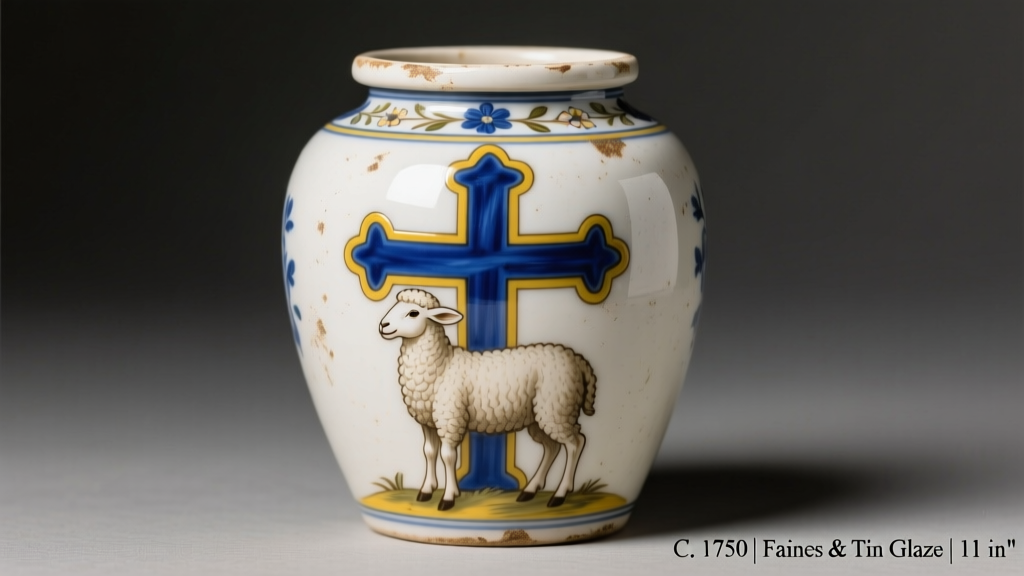
A Rare 1750s French Faience Jar: Tin-Glazed Ceramic with Christological Iconography in Cobalt Blue and Antimony Yellow
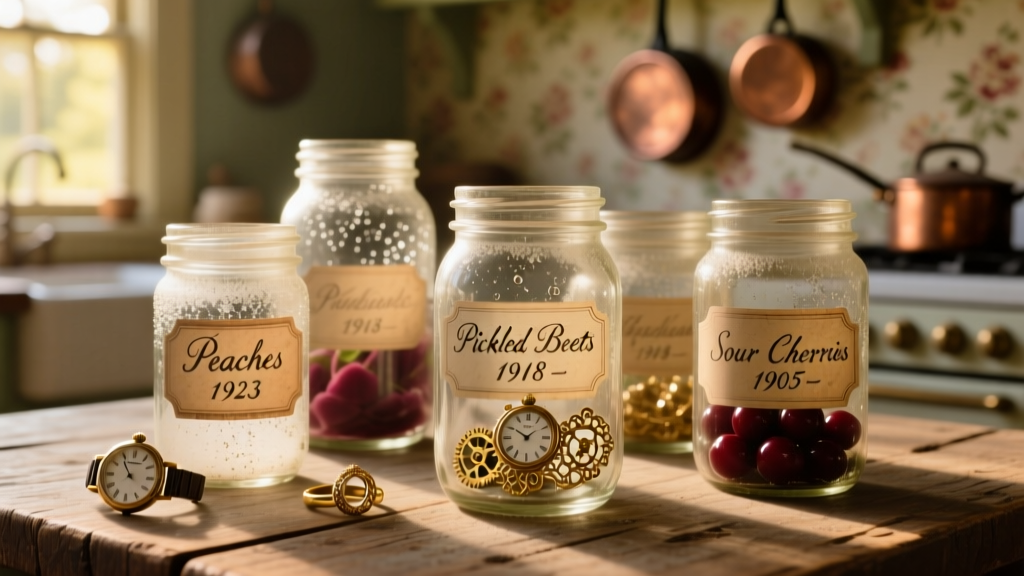
Several Old Canning Jars: Materiality, Manufacturing Marks, and Market Significance in American Domestic Antiquities

Cumby Estate Auction No. 2: A Curated Survey of Mid-Century American Luxury and Horological Rarity
Celluloid Box Jewelry: The Rare Hand-Painted 'Woman, Child, and Dog' Miniature Scene
Quimper Klate Porcelain Snuffbox: A 19th-Century Heart-Shaped Masterpiece Featuring a Boy Playing the Flute

The 1940s Toy Dog: A Rare Wooden Jointed Press-Bottom Wiggle-Sit-Jump Figure in Original Box — Collectibility, Mechanics, and Provenance

Happy WhatsitWednesday: Unpacking the Curious Charm of Mid-Century 'What-Is-It?' Jewelry and Timepieces — July 6, 2022
The Enduring Elegance of Fabric Bookmarks: History, Craftsmanship, and Collectibility

Top 5 Fathers Day Gift Ideas: Timeless, Thoughtful, and Collectible