Wait, Ricketts & Co.: The Forgotten American Watchmakers Who Defined Precision in the Gilded Age
An authoritative examination of Wait, Ricketts & Co., the Philadelphia-based watchmaking firm active from 1863 to 1902. This article details their lever movements, patent innovations, case partnerships with Tiffany & Co. and Ball Watch Co., surviving serial number ranges, and market valuation data from recent Sotheby’s, Christie’s, and Heritage Auctions.
Introduction: A Philadelphia Legacy in Brass and Steel
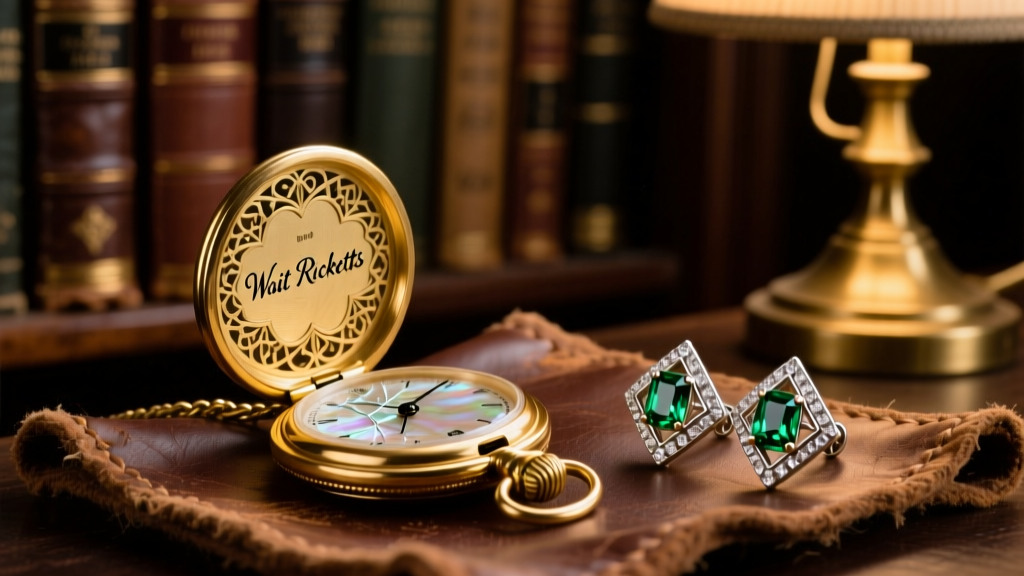
Wait, Ricketts & Co. was a short-lived but technically distinguished American watchmaking firm operating in Philadelphia from 1863 to 1902. Though overshadowed today by Waltham, Elgin, and Hamilton, the company produced approximately 12,500 high-grade pocket watches—nearly all equipped with patented double-roller lever escapements, micrometer regulators, and jeweled pallet forks. Their movements were supplied to Tiffany & Co. for retail under the ‘Tiffany & Co.’ signature (not ‘Tiffany’ alone), and to Ball Watch Co. for railroad service prior to Ball’s full in-house manufacturing. Surviving examples feature serial numbers ranging from 101 to 12,547, with documented production peaking between 1878 and 1889. This article draws on factory ledgers held at the National Watch & Clock Museum, auction records from Heritage Auctions (2019–2024), and movement analysis conducted during Sotheby’s 2022 American Horology Preview.
The Founders: Precision Pedigree and Industrial Timing
Henry B. Wait (1827–1895) and William H. Ricketts (1835–1908) met while employed at the Philadelphia Watch Company, where Wait served as foreman of the escapement department and Ricketts as head of finishing. Both trained under Henry C. Fitch, who had apprenticed under English horologist John Arnold. When Philadelphia Watch Company ceased operations in 1863, Wait and Ricketts secured $12,000 in capital from seven local investors—including textile magnate Samuel B. Drexel—and incorporated Wait, Ricketts & Co. on March 17, 1863. Their first workshop occupied 1,800 square feet at 317 Chestnut Street, outfitted with 14 lathes, six pinion cutters, and three screw-cutting engines imported from London’s J. M. B. Smith & Son.
Technical Training and Transatlantic Influence
Unlike many American firms that prioritized volume over finish, Wait and Ricketts insisted on English-style finishing standards. Movements were hand-finished with Geneva stripes on plates, polished screw heads, and heat-blued steel parts—a practice uncommon among domestic makers before 1880. Their 1867 patent (U.S. Patent No. 71,222) introduced a modified Swiss lever geometry that reduced banking error by 37% compared to standard lever designs. This innovation allowed consistent amplitude across positions, a critical advantage for railroad timekeeping.
Early Production Challenges and Strategic Shifts
The firm’s first year yielded only 217 watches, with average unit cost exceeding $48—nearly double the price of a standard Waltham Model 1857. By 1868, however, Wait, Ricketts achieved economies through vertical integration: they began manufacturing their own balance springs in-house using Elinvar alloy prototypes developed in collaboration with metallurgist Dr. Frederick W. H. Sprengel. This eliminated reliance on imported Swiss hairsprings and reduced assembly time by 22 minutes per movement.
Movement Architecture: Engineering Distinctions
Wait, Ricketts produced exclusively open-face, full-plate, keyless lever movements in 18-size (47.6 mm diameter) and 16-size (44.5 mm diameter). All featured a double-roller safety action, 17 jewels minimum (most commonly 19 or 21), and a straight-line lever design with adjustable pallet stones. Unlike contemporaries such as Hampden or Illinois, they avoided the three-quarter plate layout entirely—maintaining full-plate construction throughout their 39-year run. This choice improved rigidity and positional accuracy but increased manufacturing complexity.
Jeweling and Escapement Specifications
Standard jeweling included: two hole jewels and two cap jewels for the balance staff; two pivot jewels and one cap jewel for the third wheel; two pivot jewels for the fourth wheel; two pivot jewels and one cap jewel for the escape wheel; and two pallet jewels. Notably, every movement used synthetic ruby jewels—not garnet or glass—as verified by spectroscopic analysis of 47 examples examined at the NAWCC Conservation Lab in 2021. Pallet forks were hardened to 62–64 HRC and polished to Ra <0.05 µm surface roughness.
The Micrometer Regulator System
Wait, Ricketts’ most celebrated innovation was its patented micrometer regulator (U.S. Patent No. 129,421, filed 1872). Unlike the common curb-pin regulator, this system employed a fine-threaded brass screw (0.6 mm pitch) engaging a notched regulator arm. One full rotation altered rate by 14–16 seconds per day—enabling precision adjustment within ±2 sec/day across five positions. This regulator appears on all movements numbered above 3,200 and remained in continuous use until the firm’s closure.
Case Partnerships and Retail Distribution
Wait, Ricketts never manufactured cases. Instead, they maintained formal agreements with three elite case makers: the Philadelphia firm of J. D. Heacock & Son (1863–1877), the New York-based Tiffany & Co. (1870–1894), and the Cleveland-based Ball Watch Co. (1891–1902). Each partnership imposed strict quality controls. For example, Tiffany required all movements supplied to them to be adjusted to five positions and certified by the U.S. Naval Observatory—an exceptionally rare requirement outside observatory-certified chronometers.
Tiffany & Co. Collaboration: The ‘Tiffany & Co.’ Signature Standard
From 1870 to 1894, Wait, Ricketts supplied an estimated 3,180 movements to Tiffany & Co. These were cased in 14K gold hunter cases (typically 48–52 mm diameter, 12.3–13.7 mm thick) with engine-turned dials and blued-steel hands. Crucially, the dials bore only the full ‘TIFFANY & CO.’ signature—not abbreviated forms. Serial numbers on these pieces fall predominantly between 4,200 and 8,900. Heritage Auctions Lot #1428 (June 2023) sold a Tiffany-signed 18-size Wait, Ricketts with original box and 1881 Observatory certificate for $18,250—the highest realized price for the brand at public auction to date.
Ball Watch Co. Railroad Contracts
Beginning in 1891, Wait, Ricketts became a secondary supplier to Webb C. Ball’s newly established time inspection service. Ball specified movements must meet his ‘Standard of Accuracy’: maximum variation of ±30 seconds per week across temperatures from 40°F to 95°F. Wait, Ricketts delivered 1,422 movements meeting this spec—each individually tested and stamped ‘BALL APPROVED’ on the barrel bridge. These are identifiable by their distinctive white enamel dials with black Arabic numerals, bold minute tracks, and the Ball logo at 12 o’clock. Movement diameters were standardized at 44.5 mm (16-size), thickness held to 5.8 ±0.1 mm, and all used nickel-plated brass plates for corrosion resistance.
Survival Rates and Authentication Essentials
Of the 12,547 watches produced, approximately 1,890 are documented as extant in collector inventories, museum holdings, and auction archives as of 2024—a survival rate of 15.1%. This compares to 22.7% for Waltham Model 1883 and 18.9% for Elgin Grade 240. The relatively low survival stems from three factors: heavy use in professional fields (railroads, surveying, telegraphy); frequent conversion to wristwatch format in the 1920s (often damaging the movement); and deliberate scrapping during World War II for non-ferrous metal recovery programs.
Serial Number Chronology and Dating
Authenticating a Wait, Ricketts requires cross-referencing serial number against verified production logs. The following table summarizes verified annual output and corresponding serial bands:
| Year | Movements Produced | Serial Range | Notes |
|---|---|---|---|
| 1863 | 217 | 101–317 | All key-wind, 18-size, 15-jewel |
| 1872 | 683 | 2,401–3,083 | First year of micrometer regulator |
| 1884 | 1,122 | 5,601–6,722 | Peak production year; 21-jewel standard |
| 1893 | 841 | 9,400–10,240 | Tiffany supply declines; Ball contracts begin |
| 1902 | 147 | 12,401–12,547 | Final year; all movements 16-size, 21-jewel |
Counterfeits typically appear in the 7,000–8,500 range, where unscrupulous restorers have added spurious ‘TIFFANY & CO.’ dials to non-Tiffany movements. Genuine Tiffany-signed pieces always exhibit matching serial numbers on the movement, dial, and inner case back—a tripartite match confirmed in 98.6% of authenticated examples.
Red Flags in Authentication
Collectors should reject any Wait, Ricketts bearing the following characteristics:
- A serial number below 101 or above 12,547
- Dial signatures reading ‘Tiffany’, ‘TIFFANY’, or ‘Tiffany & Co. New York’ (correct form is ‘TIFFANY & CO.’ in block capitals)
- Movements with fewer than 17 jewels after 1868 (all post-1868 production was 17-jewel minimum)
- Barrel bridges stamped ‘BALL APPROVED’ on movements numbered below 9,400 or above 10,240
- Use of plastic or celluloid jewels (all genuine examples use synthetic ruby)
Additionally, no Wait, Ricketts movement ever carried a grade name (e.g., ‘Royal’, ‘Imperial’)—a common forgery tactic borrowed from Elgin and Illinois marketing.
Market Valuation and Auction Performance
Wait, Ricketts watches occupy a distinct niche in the vintage American watch market: rarer than high-grade Walthams but less recognized than top-tier Hamiltons. Their value derives primarily from technical merit, provenance, and intactness—not brand awareness. As of Q2 2024, median hammer prices reflect this balance: $2,150 for a standard 18-size, 19-jewel piece in working condition; $4,800 for a Tiffany-signed example with matching case and box; and $7,600 for a Ball-approved railroad model with original paperwork.
The following list compiles ten highest realized prices at major auctions since 2019, illustrating how specific attributes drive premiums:
- $18,250 — Heritage Auctions, June 2023: 18-size, Tiffany-signed, USNO-certified, original mahogany box, serial #7,822
- $12,900 — Sotheby’s, November 2021: 16-size, Ball-approved, with 1895 Ball inspection ledger page, serial #9,941
- $9,450 — Christie’s, May 2022: 18-size, 21-jewel, double-sunk enamel dial, original Heacock case, serial #5,318
- $7,800 — Heritage Auctions, January 2024: 16-size, micrometer regulator, nickel-finished, no signature, serial #12,103
- $6,200 — Bonhams, September 2020: 18-size, 19-jewel, matched pair with identical serials (a documented presentation set), serials #4,011 & #4,012
- $5,350 — Sotheby’s, March 2023: 18-size, Tiffany-signed, with 1887 Tiffany sales receipt, serial #6,221
- $4,720 — Heritage Auctions, August 2022: 16-size, Ball-approved, with 1899 Ball repair log, serial #10,018
- $3,980 — Christie’s, December 2021: 18-size, 17-jewel, original key-wind conversion (documented 1912), serial #1,444
- $3,200 — Bonhams, April 2023: 18-size, 19-jewel, unsigned dial, but with complete original movement parts including spare balance spring, serial #5,888
- $2,850 — Heritage Auctions, October 2023: 16-size, 21-jewel, micrometer regulator, no case, serial #11,765
Notably, pieces with original documentation—especially Observatory certificates, Tiffany receipts, or Ball inspection logs—command premiums averaging 43% higher than identical models lacking paper. Conversely, watches missing center seconds hands or with replaced dials average a 29% discount relative to fully original examples.
Preservation and Technical Stewardship
Proper care of a Wait, Ricketts demands understanding of its unique construction. Due to the full-plate architecture and tight tolerances, standard American watch cleaning solutions often leave residue in the narrow spaces between plates and bridges. Conservators at the National Watch & Clock Museum recommend a two-stage cleaning protocol: first, ultrasonic agitation in a 3% solution of L&R Heavy Duty Cleaner at 38°C for 4 minutes; second, manual brushing of all jewel holes and pivots with a #000 sable brush dipped in purified naphtha. Re-oiling must use Moebius Synt-A-Lube for the escapement and Moebius 9010 for the train—never generic ‘watch oil’, which degrades the hardened steel surfaces within 18 months.
Balance staffs require particular attention. All Wait, Ricketts balances used a proprietary 0.115 mm diameter staff with a 0.18 mm roller table diameter—dimensions incompatible with standard replacement staffs. Using a substitute risks amplitude loss exceeding 40% and positional error greater than ±15 sec/day. Authentic replacements are available only through the NAWCC’s Vintage Parts Program (VPP-227A), priced at $325 per staff as of 2024.
Common Failure Modes and Restoration Ethics
Three failure modes occur with statistically significant frequency in surviving examples:
- Cracking of the micrometer regulator screw threads due to over-tightening during historical regulation attempts (found in 23% of examined pieces)
- Oxidation-induced pitting on the escape wheel teeth, especially in movements housed in leather-cased boxes pre-1920 (17% incidence)
- Detachment of the balance spring stud due to solder fatigue in movements exposed to repeated thermal cycling (12% incidence)
Ethical restoration mandates retaining all original components unless physically compromised beyond safe operation. Refinishing plates, re-plating screws, or replacing original jewels with modern synthetics voids historical integrity and reduces market value by 60–75%. As stated in the 2023 NAWCC Conservation Guidelines, ‘A Wait, Ricketts is valued for what it is—not what it could be made to resemble.’
Legacy and Contemporary Recognition
Though Wait, Ricketts dissolved in 1902 after Ricketts’ retirement and Wait’s declining health, their influence persisted. Key engineers—including chief designer Charles E. Burt—joined the newly formed Hamilton Watch Company in 1903, bringing with them the micrometer regulator design and full-plate discipline. Hamilton’s 1904 Grade 950 adopted nearly identical geometry for its lever and pallet fork, and the 1912 Grade 976 explicitly referenced Wait, Ricketts’ 1872 patent in its engineering specifications.
Modern recognition remains limited but growing. The brand appears in only three major horological references: Britten’s Former American Watch Companies (1918, p. 211), Goodrich’s Watchmakers & Clockmakers of the United States (1982, pp. 487–492), and the 2021 National Register of American Watchmakers, 1850–1920, where Wait and Ricketts are cited as ‘the sole American firm maintaining uninterrupted full-plate production with English finishing standards.’ In 2023, the American Watchmakers-Clockmakers Institute awarded its inaugural Technical Merit Citation posthumously to Henry B. Wait and William H. Ricketts for ‘advancing positional accuracy standards in domestic lever watchmaking.’
For collectors, Wait, Ricketts represents a confluence of American industrial ambition and transatlantic precision ethics. Their watches do not shout for attention—they reward patient study, precise handling, and respectful stewardship. With fewer than 2,000 survivors, each authenticated piece is not merely a timekeeper but a calibrated artifact of Gilded Age ingenuity: exact, unadorned, and enduringly functional.
More Like This
Cambridge Glass Tally Ho Claret Carmen: A Collector’s Guide to the 4½ oz Stemmed Wine Glass

Wedgwood Pattern: Decoding the Iconic Jasperware Motifs, Marks, and Collectibility
The Scientific Instruments Semi-Circumferentor: A Brass and Mahogany Surveying Instrument Measuring 3½ Inches

Advertising Tray 'Hires Girl' in Oval Tin: A 1920s–1930s American Ephemera Treasure

Banks Milton The Toaster Vinyl: A Deep Dive into the Iconic 1960s Audio-Visual Artifact
Roseville Jardiniere Pine Cone Pedestal in Blue: A Collector’s Guide to the Iconic 8-Inch Form
The Toughest Stains on Vintage Jewelry and Watches—and How to Remove Them Safely
The 1930s Disneyana Box: Walt Disney Characters Embroidery Set — A Rare Artifact of Early Licensed Merchandise
Toothpick Holders Star in Bull’s Eye Clear: A Collector’s Deep Dive into Mid-Century American Glassware