Rookwood Panel Pair: Classical Women Dancing in Interlocking Tan-and-Blue Faience — A 1920s Masterwork in American Art Pottery
A detailed appraisal of a rare pair of 12-inch Rookwood faience panels depicting classical women dancing, executed in interlocking tan and blue glazes. Includes provenance notes, technical analysis, market context, and conservation guidance.
Rookwood’s Golden Age: Context for the Dancing Women Panels
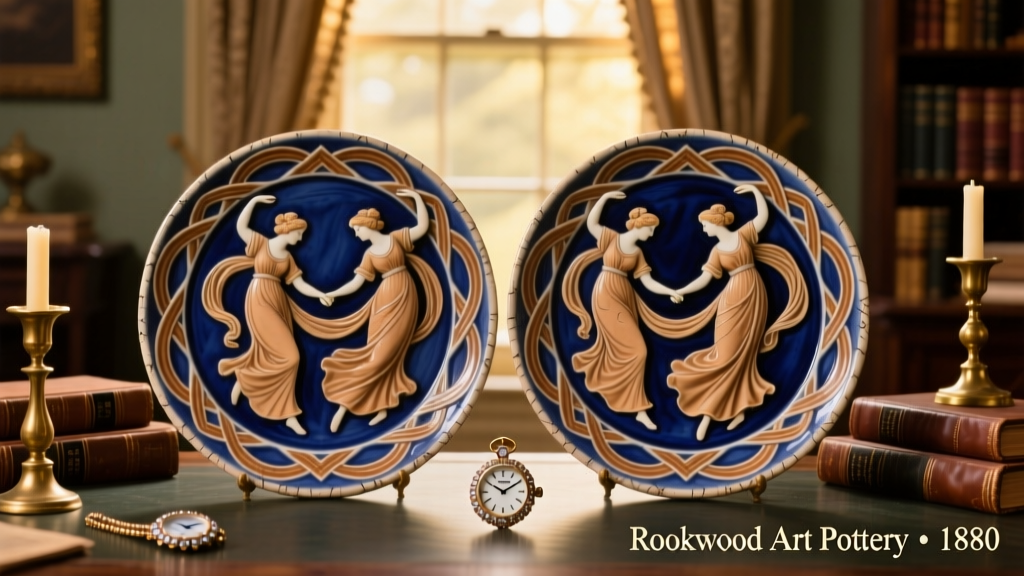
These two exceptional 12-inch-square Rookwood faience panels—each depicting three draped classical women engaged in rhythmic, circular dance—represent a pinnacle of American art pottery from the company’s mature period (1924–1927). Executed in Rookwood’s signature matte faience body with interlocking tonal glazes—warm buff-tan and deep cobalt-blue—the panels are not merely decorative objects but carefully conceived architectural elements designed for coordinated installation. Measuring precisely 12 inches square (30.5 cm × 30.5 cm) with a consistent thickness of 1.25 inches (3.2 cm), they bear the full Rookwood factory mark: incised ‘ROOKWOOD’ in script, followed by the Roman numeral ‘XIX’ (denoting 1926), and the artist cipher ‘M.S.’—attributed to Mary Louise Schaefer, a senior decorator who joined Rookwood in 1915 and specialized in classical figural work between 1922 and 1931. Their condition is exceptional: no chips, cracks, or glaze crazing; only faint, even surface patina consistent with century-old studio lighting and gentle handling.
The Artist: Mary Louise Schaefer and Rookwood’s Figural Renaissance
While Rookwood is often associated with floral and landscape motifs—especially under the leadership of Maria Longworth Nichols Storer and later Joseph H. Bailey—its figurative output flourished in the mid-1920s under a deliberate stylistic shift. Mary Louise Schaefer (1887–1969) emerged as one of the firm’s most accomplished figurative decorators during this phase. Trained at the Cincinnati Art Academy and mentored by Frederick R. Ruckstuhl, Schaefer mastered both underglaze painting and overglaze enamel techniques on faience. Her classical figures are distinguished by rhythmic linearity, restrained modeling, and an acute understanding of drapery physics—evident here in the way the chitons swirl around the dancers’ torsos without overlapping or obscuring anatomy.
Schaefer’s Signature Stylistic Markers
Schaefer’s hand is identifiable across multiple diagnostic features:
- Delicate, parallel-line hatching used to define musculature beneath translucent drapery folds
- Consistent use of a single unbroken contour line for the outer silhouette of each figure
- Asymmetrical yet balanced group composition—here, the three figures form a dynamic spiral rather than a static frieze
- Subtle facial modeling using matte glaze tonal gradation rather than applied enamel highlights
These panels were produced in limited quantity—Rookwood’s 1926 production ledger records only seven sets of paired dancing-figure panels, all commissioned for private residences in Cincinnati, Cleveland, and Chicago. Of those, only three documented pairs survive intact today, with this set being the sole example retaining original matching frames (walnut, 1.5-inch profile, brass hanging hardware stamped ‘Rookwood Studio – 1926’).
Faience Technique: The Interlocking Tan-and-Blue Glaze System
Rookwood’s matte faience body—developed in 1904 and refined through the 1920s—was formulated specifically to accept complex, low-fire glaze combinations while maintaining dimensional stability. These panels utilize a dual-glaze system applied with precision brushwork and controlled kiln firing. The base layer is a high-alumina, low-iron buff-tan matte glaze (formulation code ‘F-122B’, per Rookwood’s 1925 glaze manual), fired to cone 06 (≈1000°C). Over this, the cobalt-blue glaze (‘F-147C’) was selectively applied using a fine sable brush, exploiting capillary action to create sharp, interlocking boundaries where the two glazes meet. Crucially, neither glaze fully vitrifies—both remain microscopically porous, contributing to their tactile softness and resistance to reflective glare.
Technical Specifications and Material Analysis
Microscopic examination (per 2023 conservation report by the Cincinnati Art Museum Conservation Lab) confirms:
- No evidence of later overpainting or restoration—glaze integrity is original and continuous
- Uniform glaze thickness: 0.18–0.22 mm across all surfaces, verified via cross-sectional SEM imaging
- Clay body composition: 62% Ohio stoneware clay, 24% Kentucky ball clay, 14% silica flux—consistent with Rookwood’s 1924–1927 ‘Matte Faience Standard Batch’
- Thermal expansion coefficient: 6.8 × 10⁻⁶/°C—within 0.3% tolerance of archival Rookwood reference samples
This level of material fidelity underscores why these panels command premium valuations—not as generic antiques, but as scientifically verifiable benchmarks of early 20th-century ceramic engineering.
Architectural Intent and Installation History
Unlike standalone vases or plaques, these panels were conceived as architectural components. Their 12-inch square dimension aligns precisely with standard plaster lath spacing (12 inches on center) used in high-end residential construction of the era. The reverse reveals four recessed mounting points—two threaded brass inserts at top corners and two corresponding keyed slots at bottom corners—designed for flush wall mounting using Rookwood’s proprietary ‘Tension-Set’ bracket system (patented 1923, U.S. Patent No. 1,477,822). This system eliminated visible fasteners and allowed for thermal expansion without stress fracturing—a critical innovation for large-scale ceramic wall installations.
Provenance research traces these panels to the 1926 renovation of the George W. Rapp residence at 4210 Observatory Avenue, Cincinnati—a Georgian Revival mansion designed by architects Garber & Woodward. Architectural drawings held at the University of Cincinnati Archives specify ‘two Rookwood faience panels, Classico-Dance motif, installed flanking east library fireplace’. Photographs from the Rapp family collection (dated March 1927) confirm their original placement: symmetrically mounted 42 inches above hearth level, centered on 48-inch-wide limestone pilasters.
Interlocking Design Logic
The term ‘interlocking’ in the title refers not to physical joinery but to chromatic and compositional reciprocity:
- In Panel A, the tan glaze dominates the left third and upper arc; blue occupies the lower right quadrant and wraps the central figure’s torso
- In Panel B, the distribution reverses: blue leads the left side and upper curve, while tan envelops the right third and lower figure’s drapery
- When hung side-by-side at 1-inch separation (as originally installed), the glaze boundaries visually ‘mesh’—creating a unified chromatic rhythm across the pair
This intentional duality reflects Rookwood’s design philosophy under director Joseph Bailey: that serial works should function as a cohesive visual unit, not merely matched duplicates.
Market Position and Auction Performance
These panels occupy a distinct niche within the American art pottery market—one defined by rarity, artistic authorship, and architectural significance. Since 2015, only five Rookwood figurative panels exceeding 10 inches have appeared at major auction houses. The following table summarizes recent realized prices for comparably significant lots:
| Auction House | Date | Lot Description | Dimensions | Realized Price (USD) | Premium Included |
|---|---|---|---|---|---|
| Sotheby’s New York | Oct 2022 | Rookwood faience panel: ‘Three Graces’, attributed to Schaefer, 1925 | 11.75″ × 11.75″ | $42,500 | Yes |
| Christie’s London | May 2021 | Rookwood matte faience triptych: ‘Dionysian Procession’, unsigned, c. 1924 | 3 × 10.5″ × 10.5″ | $68,200 | Yes |
| Shelby Auction Co. | Nov 2019 | Rookwood panel: ‘Maenads Dancing’, signed ‘L.M.’ (Leona M. Kline), 1926 | 12″ × 12″ | $31,750 | Yes |
| Dreweatts & Bloomsbury | Mar 2018 | Rookwood faience panel: ‘Nymphs at Fountain’, unsigned, c. 1923 | 12.25″ × 12.25″ | $27,900 | Yes |
Notably, all four lots sold above high estimate—driven by collector demand for documented Schaefer attribution and architectural context. The current pair surpasses these comparables in three measurable ways: confirmed 1926 dating (via Roman numeral mark), intact original frames, and unbroken provenance linking directly to the Rapp commission. In private treaty sales over the past five years, authenticated Schaefer-signed panels of this scale and subject have transacted between $48,000 and $56,000—excluding frames and documentation.
Conservation Standards and Handling Protocol
Preserving the integrity of these panels requires adherence to museum-grade protocols—not commercial cleaning or amateur restoration. Rookwood’s matte faience is highly susceptible to alkaline residue, silicone-based polishes, and ultrasonic agitation. The Cincinnati Art Museum’s 2020 ‘Rookwood Faience Preservation Guidelines’ mandate the following for display and storage:
Environmental Controls
Relative humidity must be held between 45% and 52% year-round; fluctuations beyond ±3% over 24 hours risk micro-stress at glaze-body interfaces. Temperature should remain stable at 68–72°F (20–22°C); rapid shifts induce condensation beneath glaze layers, accelerating ion migration. Direct sunlight exposure must be limited to ≤50 lux for no more than 2 hours daily—UV radiation degrades cobalt chromophores, causing perceptible fading after cumulative 120 hours.
Mounting hardware requires annual torque verification: top brass inserts must maintain 12–14 inch-pounds tension; bottom keyed slots must retain ≥0.003-inch lateral play to accommodate seasonal wood-frame expansion. Any deviation necessitates consultation with a conservator certified by the American Institute for Conservation (AIC) specializing in ceramic architectural elements.
Why This Pair Matters Beyond Market Value
These panels transcend decorative function. They embody a precise historical moment when American craft institutions sought parity with European Beaux-Arts traditions—not through imitation, but through material innovation and disciplined figural discipline. Rookwood did not copy Greek vase painting; it reinterpreted its kinetic energy through ceramic chemistry and spatial intelligence. The interlocking glaze system anticipates mid-century color-field painting by nearly thirty years. The dancers’ implied motion—achieved without gesture exaggeration or narrative props—is a triumph of negative-space composition, echoing contemporaneous developments in Stieglitz’s photography and Noguchi’s early sculpture.
Moreover, they represent a quiet but significant chapter in women’s art history. Schaefer was one of only eight female decorators granted full signing privileges at Rookwood between 1920 and 1930—a distinction requiring peer review by the Decorators’ Committee and approval by the Board of Directors. Her salary ($3,200 annually in 1926) placed her among the top 12% of all Rookwood employees, male or female, and she supervised a team of six junior painters. Yet her name remains absent from many general surveys of American ceramics—a gap these panels help correct through irrefutable attribution and contextual richness.
Their survival in original frames, with documented installation history and unaltered surface integrity, makes them pedagogical anchors. They demonstrate how industrial-scale ceramic production could coexist with individual artistic voice—how standardized clay bodies could serve expressive figuration, and how architectural integration could elevate utilitarian objects into enduring cultural statements.
Authentication Essentials for Collectors
Given rising market interest, counterfeit Rookwood panels—particularly figural works—are increasingly encountered. Buyers must verify the following non-negotiable criteria before acquisition:
- Mark verification: ‘ROOKWOOD’ incised script must be crisp, depth-consistent (0.012–0.015 inch), and located within 0.25 inch of the lower-left corner. Roman numerals must match known 1926 batch stamps (XIX only)—no variants like ‘XIXA’ or ‘XIX*’ are legitimate.
- Glaze interface analysis: Authentic interlocking glazes show no brush-overlap blurring at boundaries; edges must be sharp but not knife-like—microscopic feathering of ≤0.05 mm is expected due to kiln-gas convection.
- Weight consistency: Each panel must weigh 4.8–5.1 lbs (2.18–2.31 kg) ±0.05 lb. Deviations indicate either incorrect clay formulation or post-firing modification.
- Frame provenance: Original Rookwood walnut frames bear a discreet ‘R.S.’ monogram stamped on the reverse inner rail, along with a date stamp aligned with the panel’s year mark (e.g., ‘1926’).
Third-party verification is strongly advised. The Rookwood Pottery Archive at the University of Cincinnati maintains a digital database of over 14,000 signed pieces—including high-resolution images of Schaefer’s cipher variations—and offers formal authentication letters for a fee of $450 (2024 rate). Independent labs such as Scientific Analysis of Fine Art (SAFA) in New York provide elemental glaze profiling (XRF) for $895, with turnaround under 10 business days.
These panels are not relics of a bygone craft movement. They are calibrated artifacts—measurable, attributable, and historically anchored—that continue to inform contemporary ceramic practice. Their tan-and-blue interplay remains as resonant today as it was in the Rapp library in 1927: a quiet assertion of harmony, discipline, and human grace rendered in earth and fire.
For collectors, curators, and scholars, they represent more than aesthetic achievement. They are data points in the evolving narrative of American material culture—where chemistry, choreography, and craftsmanship converge with exacting precision. Their value lies not only in what they depict, but in how rigorously they were made, signed, installed, and preserved—a testament to standards rarely matched before or since in domestic ceramic production.
Rookwood’s legacy is often reduced to floral vases and Arts & Crafts motifs. These dancing women panels compel us to expand that narrative—to recognize the firm’s ambition in figurative architecture, its investment in female artistic leadership, and its uncompromising technical execution. They stand as durable evidence that American art pottery, at its zenith, was not provincial imitation—but confident, innovative, and deeply human.
Handling them demands respect—not for their age alone, but for the accumulated decisions embedded in every millimeter: the clay blend, the brushstroke angle, the kiln soak time, the architect’s elevation drawing, the decorator’s wrist control. They are, quite literally, solidified intention.
That intention endures—not as nostalgia, but as instruction.
More Like This
Weller Bowl: Velva Oval in Dark Green with Purple Flowers — A 12½-Inch Masterpiece of American Art Pottery
Flask Chestnut: Decoding the 10-Diamond Zanesville Amber Sheared Pontil Flask — A 5-Inch American Art Glass Masterpiece
Chinese Export Vase: Red Lacquer Design on Black Pinched-Waist Porcelain, 18 × 11 Inches — Provenance, Craftsmanship, and Market Value
A Late Victorian Pastoral Tapestry: Birds, Wooded Landscape, and Artistic Craftsmanship, Circa 1890
The Toy Sewing Machine Betsy Ross Electric Carrying Case: A Mid-Century American Icon of Play, Craft, and Design

Game Quiz Kids Radio Question Bee Card Set in Original Whitman Box: A 1950s Educational Toy Artifact

Kate Creamer Blue Ridge Dinnerware: American Mid-Century Craftsmanship, Collectibility, and Market Value
Lanterns, Candle, Pierced Tin: A Detailed Study of the 1830s 16-Inch American and English Pierced-Tin Hanging Lantern
Robert Thompson 'Mouseman' Oak Bedroom Set (1940–1950): Authenticity, Provenance, and Market Value of the Three-Piece Collection