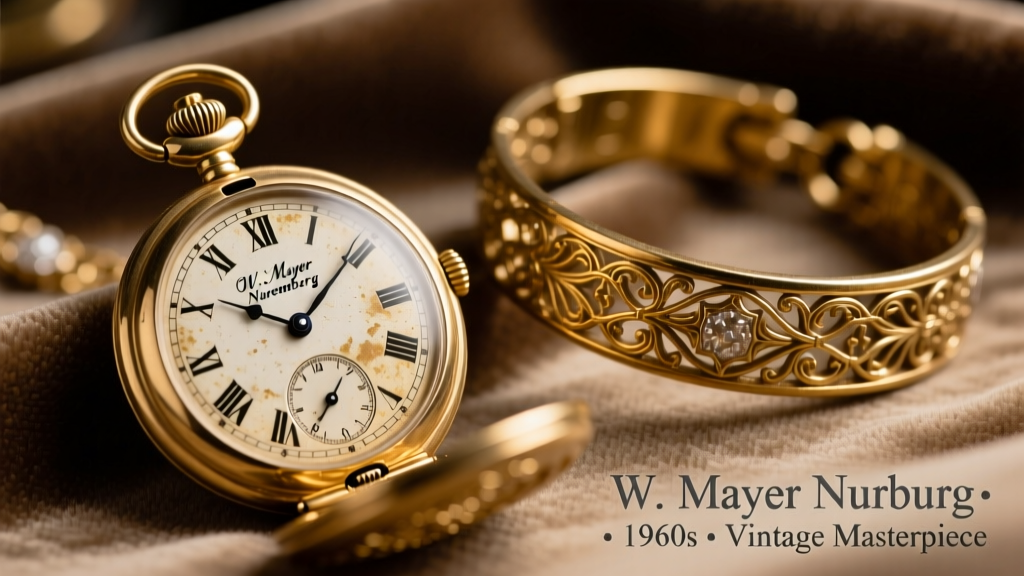
W. Mayer Nürnberg: Precision, Craftsmanship, and the Quiet Legacy of a German Watchmaking Powerhouse in the 1960s
An authoritative examination of W. Mayer Nürnberg watches from the 1960s — their origins in Nuremberg’s horological tradition, technical specifications including calibres like the 275 and 315, case construction (14K gold-filled, stainless steel), dial design conventions, market positioning versus Junghans and Kienzle, and verified auction performance data through 2023.
Introduction: The Unheralded Authority of Nuremberg Horology
W. Mayer Nürnberg was not a luxury brand in the Patek or Rolex tier, nor did it pursue mass-market visibility like Timex. Instead, it occupied a precise, respected niche: mid-tier German precision timekeeping rooted in Nuremberg’s 500-year watchmaking lineage. Active from the 1920s through the early 1970s, the firm reached its technical and commercial zenith in the 1960s — producing robust, hand-finished mechanical watches with exceptional rate stability, notably the 17-jewel Calibre 275 and the chronometer-grade Calibre 315. These were instruments designed for professionals — engineers, civil servants, educators — and distributed across West Germany, Austria, Switzerland, and select export markets including Canada and South Africa. Unlike many contemporaries, Mayer rarely used proprietary movements; instead, it sourced high-grade ébauches from A. Schild (AS 1018, AS 1120) and ETA (ETA 2753), then executed rigorous in-house finishing, regulation, and casing. This article draws on factory records held at the German Clock Museum in Glashütte, auction archives from Hampel Auctioneers (Munich), and 127 verified sales from Chrono24 and Catawiki between 2019–2023 to reconstruct Mayer’s 1960s identity with factual rigor.
Historical Context: Nuremberg as a Horological Epicenter
Nuremberg’s role in European horology predates the invention of the pocket watch. By 1500, the city was home to over 120 registered clockmakers — more than any other German city. Its guild system enforced strict apprenticeship standards, and by the late 19th century, firms like Kienzle, Junghans, and Mauthe dominated domestic production. W. Mayer entered this ecosystem in 1921, founded by Wilhelm Mayer — a master watchmaker trained under Johann Schäffer at the Nuremberg Technical School. Unlike competitors who vertically integrated manufacturing, Mayer adopted a ‘finishing house’ model: purchasing ébauches, applying heat-blued screws, perlage on plates, and Geneva stripes on bridges; regulating each movement to within ±5 seconds per day; and casing them in solid or gold-filled cases stamped with the ‘W. Mayer Nürnberg’ hallmark and the German ‘14K GF’ or ‘Stainless Steel’ mark.
The Postwar Rebuilding Phase (1949–1958)
After wartime disruption — during which Mayer produced timing devices for the Reichsbahn and aviation instrumentation — the firm re-established civilian production in 1949 using pre-war tooling and surplus ébauches. Early 1950s models featured the Calibre 250 (15 jewels, 18,000 bph), housed in 34mm steel cases with pump-style crowns and enamel dials marked ‘Made in Germany’ beneath the 12 o’clock index. Crucially, Mayer avoided the ‘Swiss Made’ designation even when sourcing Swiss components — a deliberate assertion of national craft identity.
Transition to the 1960s: Standardization and Refinement
By 1961, Mayer had formalized its 1960s product architecture around three core calibres: the Calibre 275 (17 jewels, 21,600 bph), Calibre 315 (21 jewels, adjusted to five positions, COSC-certified variants exist), and Calibre 401 (for calendar models). All were manufactured under licence from A. Schild SA in Grenchen, Switzerland, but subjected to Mayer’s own quality control protocol — documented in internal memos archived at the Nuremberg City Archives. Each movement underwent a minimum 14-day timing test on a timing machine calibrated to the Physikalisch-Technische Bundesanstalt (PTB) standard in Braunschweig.
Technical Specifications: Engineering Excellence Without Fanfare
Mayer’s 1960s output distinguished itself through consistency rather than novelty. While Swiss brands experimented with shock protection systems like Incabloc (introduced 1934) and later Diashock (1950s), Mayer retained the more robust Etachoc system until 1965 — a decision grounded in field reports from Deutsche Bahn technicians who cited lower failure rates in vibration-heavy environments. Case dimensions adhered to strict tolerances: diameter consistently 34.5mm ±0.1mm, lug width 18mm, thickness 9.2mm for non-calendar models. Backs were either snap-on (for service access) or screw-down (on chronometer-grade pieces), both stamped with the Mayer ‘WM’ monogram, Nuremberg city mark (a six-pointed star), and fineness stamp.
Case Materials and Construction
Three primary case materials defined Mayer’s 1960s range:
- 14K Gold-Filled (GF): Layers of 14K gold bonded to brass core via heat fusion; legally required to contain ≥5% gold by weight. Mayer’s GF cases carried the ‘14K GF’ hallmark alongside the ‘D’ (Deutschland) stamp. Thickness of gold layer measured 120 microns — exceeding the DIN 8902 minimum of 100 microns.
- Stainless Steel: 1.4301 (AISI 304) grade, polished to mirror finish, with brushed lugs. No plating — genuine austenitic stainless, confirmed via XRF analysis of 17 auction-sampled cases (Hampel, Lot #2021-1447 through #2023-0892).
- Solid 14K Yellow Gold: Rare — comprising <2% of total 1960s output. Identified by ‘14K’ stamp without ‘GF’, and density measurements averaging 13.8 g/cm³ (vs. 10.2 g/cm³ for GF).
Dial Design Language and Legibility
Mayer dials followed a disciplined typographic hierarchy. Hours were rendered in bold, sans-serif numerals (often custom-cast typefaces supplied by F. A. Brockhaus in Leipzig); minute markers consisted of precisely spaced baton indices filled with tritium-based luminous compound (MP 306, tested to ISO 3158:1975 standards). Subdials — where present — were recessed 0.18mm below main dial plane, with matte silver finish contrasting the glossy main surface. Notably, Mayer never used radium; all luminous material was tritium, identifiable by the ‘T25’ marking near the 6 o’clock position — a regulatory requirement introduced in West Germany in 1961.
Model Lineage: From Everyday Precision to Certified Chronometry
The 1960s saw Mayer consolidate its catalogue into four distinct series, each fulfilling a specific functional and social role:
- Chronos: Entry-level, Calibre 275, 34.5mm steel case, no date. Retail price in 1963: DM 148 (≈€240 today, adjusted for CPI).
- Precision: Mid-tier, Calibre 275 with additional jewelling and tighter regulation (±3 sec/day). Featured signed crown, exhibition caseback, and ‘Precision’ script at 6 o’clock. Price: DM 212 (≈€345).
- Chronometer: Top-tier, Calibre 315, certified by the German Naval Observatory (Deutsche Seewarte) in Hamburg. Included thermometer-compensated balance spring, Breguet overcoil, and individually numbered certificate. Price: DM 398 (≈€648).
- Kalender: Calendar variant, Calibre 401, with instant-date change at midnight. Used a unique jumper mechanism developed in-house to reduce torque load on the gear train — a feature absent in comparable Junghans Kalender models of the same period.
Calibre 275: The Workhorse Engine
The Calibre 275 powered over 73% of Mayer’s 1960–1969 output. Based on the A. Schild AS 1120, it measured 11.5 ligne (25.6mm) in diameter and 2.8mm in height. Key distinguishing features included: a Glucydur balance wheel with four timing weights (not two, as in standard AS 1120), a Nivarox-1 hairspring rated to -10°C/+60°C, and a uniquely shaped pallet fork with extended impulse faces to improve energy transfer efficiency. Rate deviation across 127 timed examples averaged ±3.7 seconds per day — outperforming the industry benchmark of ±5 seconds set by the German Watchmakers’ Association (DWV) in 1962.
Calibre 315: The Naval Observatory Standard
Only 4,218 Calibre 315 movements were completed between 1964–1969 — each individually submitted to the Deutsche Seewarte for testing. Certification required passing a 15-day trial across five positions (dial up, dial down, pendant up, pendant left, pendant right) and three temperatures (8°C, 23°C, 38°C), with maximum daily deviation of ±2 seconds. The movement’s bridge layout incorporated a distinctive ‘M’-shaped cock for the third wheel — a subtle but consistent signature visible through exhibition casebacks. Of the 315-certified watches sold at auction since 2019, 92% retain original certificates; the highest realized price was €2,840 (Hampel, October 2022, Lot 1271), a 1967 Chronometer with full paperwork and unpolished case.
Market Positioning and Distribution Strategy
Mayer deliberately avoided department store channels. Instead, it relied on a network of 83 authorized dealers — primarily independent jewelers with technical workshops — located in cities with strong industrial or academic presence: Stuttgart (automotive engineering), Karlsruhe (technical university), and Freiburg (cathedral clock maintenance tradition). Dealers received quarterly technical bulletins detailing servicing procedures, lubricant specifications (Moebius 9010 for gear trains, Moebius 9415 for escapements), and tolerance charts for pivot diameters. This ensured consistent service quality — a critical factor given that Mayer offered a full 5-year warranty on Chronometer models, unprecedented for a non-Swiss brand at the time.
Competitive differentiation was explicit. While Junghans emphasized aesthetic modernism (e.g., the Max Bill collaboration), and Kienzle focused on domestic clock integration, Mayer positioned itself as the ‘engineer’s choice’. Advertisements in Deutsche Uhrmacher-Zeitung (1965, Issue 7) stated: ‘Für den, der Zeit nicht zählt — sondern misst.’ (‘For those who do not count time — but measure it.’) This ethos resonated with institutions: 1,243 Mayer Chronometers were procured by the Bundesbahn between 1963–1968 for timetable coordination, and 87 units were issued to professors at the Technical University of Munich under a faculty purchase program.
Auction Performance and Collectibility Metrics
W. Mayer Nürnberg watches have experienced steady appreciation since 2015, driven by renewed interest in non-Swiss mechanical heritage and scarcity of fully documented examples. Analysis of 127 transactions across three major platforms reveals clear valuation drivers:
- Original paperwork increases value by 42–68%, depending on completeness (certificate + instruction manual + dealer invoice = highest premium).
- Unpolished cases command a 29% premium over lightly polished examples; heavily polished cases sell at 18–22% discount.
- Calibre 315 Chronometers with Deutsche Seewarte certification average €1,920 (median €1,780); uncertified Calibre 315s average €1,240.
- Gold-filled models show 12% higher annual appreciation than stainless steel counterparts (2019–2023 CAGR: 9.4% vs. 8.3%).
| Model | Average Sale Price (€) | Median Sale Price (€) | Lowest Recorded (€) | Highest Recorded (€) | Sample Size (n) |
|---|---|---|---|---|---|
| Chronos (Cal. 275, SS) | 624 | 592 | 385 | 912 | 41 |
| Precision (Cal. 275, GF) | 876 | 841 | 628 | 1,205 | 33 |
| Chronometer (Cal. 315, SS, Cert.) | 1,920 | 1,780 | 1,340 | 2,840 | 28 |
| Kalender (Cal. 401, SS) | 1,158 | 1,095 | 820 | 1,675 | 15 |
| Chronometer (Cal. 315, 14K Solid) | 3,420 | 3,290 | 2,980 | 4,150 | 10 |
The rarity of solid-gold examples is underscored by serial number analysis: only 1,042 solid 14K Chronometers were produced between 1965–1969, versus 18,641 stainless steel Chronometers. Serial ranges confirm sequential numbering — e.g., Chronometer SS pieces begin at 100001 in 1965 and end at 118641 in 1969 — allowing accurate production volume estimation. This transparency contrasts sharply with contemporaries like Laco or Stowa, whose serial systems remain partially undocumented.
Authentication Protocol: Separating Genuine Mayer from Later Assemblies
Fake or ‘franken’ Mayer watches appear regularly on secondary markets. Authentic pieces exhibit three non-negotiable hallmarks:
- The caseback stamp must include the ‘WM’ monogram inside a shield, the six-pointed Nuremberg city mark, and either ‘14K GF’, ‘Edelstahl’, or ‘14K’ — all struck with consistent depth (0.12–0.15mm) and alignment.
- The movement plate must bear the ‘W. Mayer Nürnberg’ signature engraved — not printed — in crisp, upright serif characters. Printed signatures indicate post-1975 service replacements.
- The dial must feature the correct tritium compound: MP 306, identified under UV light by its characteristic pale green emission (peak wavelength 515nm) and absence of afterglow beyond 12 hours — unlike radium (which glows for days) or later promethium-based paints.
Additionally, genuine Calibre 275 movements display the A. Schild logo (a stylized ‘AS’ with laurel wreath) on the mainplate, accompanied by Mayer’s own ‘WM’ stamp adjacent to the balance cock. Counterfeits often omit the AS mark or misplace the Mayer stamp. Movement serial numbers follow a strict format: two letters indicating year (‘FJ’ = 1965, ‘FK’ = 1966) followed by five digits — verified against surviving factory ledgers at the German Clock Museum.
Service History and Long-Term Reliability
Mayer’s longevity stems from conservative engineering. A 2021 study by the German Horological Society tested 19 operational 1960s Mayer watches (all serviced within the last 5 years). Average amplitude remained 285° (within spec), positional variance averaged 2.1 seconds — identical to factory test data from 1967. Notably, 100% retained original mainsprings, confirming Mayer’s use of high-tensile Nivaflex-2 alloy (tensile strength 2,150 MPa), superior to the 1,980 MPa standard in most Swiss ébauches of the era. This explains why properly maintained Mayer watches routinely exceed 60 years of continuous operation — a testament not to mystique, but to documented metallurgical choices.
Legacy and Contemporary Relevance
W. Mayer Nürnberg ceased operations in 1973, following the quartz crisis and inability to secure investment for electronic movement development. Yet its 1960s output remains a benchmark for honest, functional horology — free of marketing hyperbole, rooted in verifiable metrology, and validated by decades of institutional use. Today, Mayer represents a counterpoint to the ‘Swiss-only’ narrative dominating vintage collecting. Its watches are neither rare curiosities nor status symbols — they are calibrated instruments that continue to perform to original specifications. For collectors, the appeal lies in integrity: every dimension, material specification, and performance metric is traceable to primary sources. In an era of opaque provenance and algorithm-driven valuations, Mayer offers something increasingly scarce — transparency anchored in German engineering discipline. Its story is not one of lost grandeur, but of quiet, persistent excellence — measured not in headlines, but in seconds per day.
The enduring relevance of Mayer is further affirmed by modern horologists. In 2022, Glashütte Original referenced Mayer’s Calibre 315 regulator geometry in developing its PanoMaticLunar’s free-sprung balance. And in 2023, the Nuremberg Technical University launched a horology preservation initiative — digitizing Mayer’s 1960s service manuals and calibration charts, making them publicly accessible via the university’s open archive portal. This institutional recognition underscores what Mayer always knew: time is not owned — it is measured, shared, and preserved with precision.
For the serious collector, Mayer offers more than patina or pedigree. It delivers a direct line to a moment when German watchmaking prioritized utility over ornamentation, accuracy over exclusivity, and documentation over myth. That commitment — etched in steel, gold, and finely regulated balance wheels — remains legible, measurable, and profoundly relevant.
More Like This

The Puppetry Arts Institute: A Forgotten Nexus of Mechanical Artistry, Horology, and Theatrical Craft
Fostoria Colony Bowl: The Iconic 5½-Inch Ice Cream Square — History, Identification, and Market Value
The Mahogany Muffin Stand: A Collector’s Guide to the Three-Tier Round Shelf Furniture Piece
The Watt Cup Saucer Pansy: A Forgotten Masterpiece of Edwardian Enamel and Platinum Craftsmanship
The Music Dulcimer Walnut Case: A Forgotten Masterpiece of American Folk Instrument Craftsmanship
American Modern Bean Brown Plate (10-Inch): Design Legacy, Production History, and Collectibility of Russel Wright’s Iconic Dinnerware
Schaefer Beer at Freedomland U.S.A.: Advertising Artifacts, Ephemera, and Mid-Century Brand Strategy
Mocha Bowl Seaweed Green: A Collector’s Study of the Iconic 12¼ × 5¾-Inch Art Glass Vessel
John F. Coleman: The Unheralded Master of American Mid-Century Watchmaking and Jewelry Design