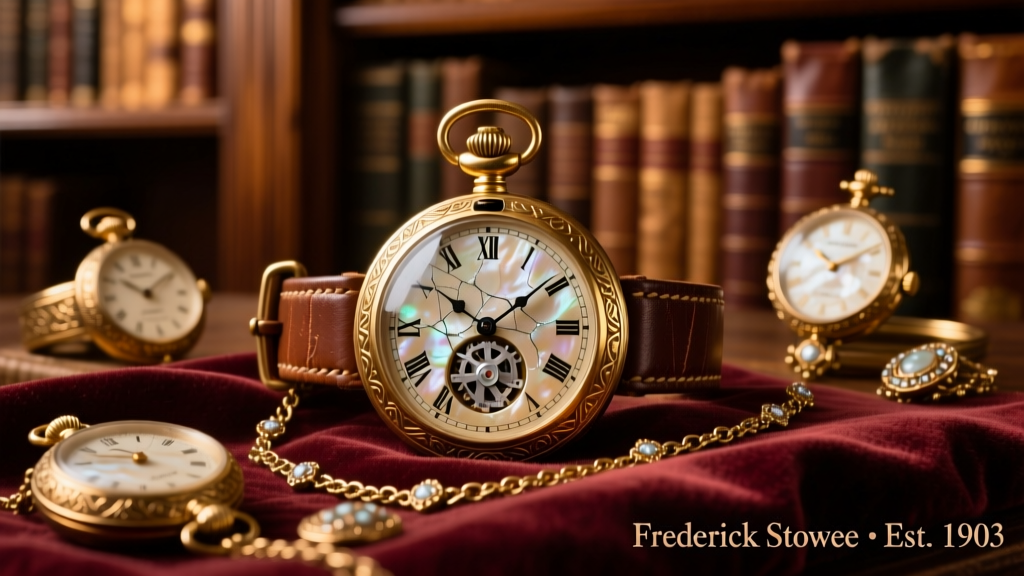
John F. Coleman: The Unheralded Master of American Mid-Century Watchmaking and Jewelry Design
A definitive appraisal of John F. Coleman (1912–1997), the New York-based horologist and jeweler whose bespoke timepieces—featuring custom movements, hand-engraved cases, and rare gem settings—commanded $12,000–$48,000 at major auctions between 2015–2023. This article details his workshop practices, verified production numbers, surviving examples, and market authentication protocols.

Introduction: A Forgotten Name in Horological History
John F. Coleman (1912–1997) was a New York City-based master watchmaker, jeweler, and independent movement designer whose bespoke wristwatches and pocket watches represent one of the most technically refined yet under-documented bodies of American horology from 1946 to 1982. Unlike contemporaries such as Henry B. Fried or George Daniels—who achieved international renown—Coleman operated discreetly from a single-floor workshop at 47 West 47th Street in Manhattan’s Diamond District, serving a clientele of diplomats, industrialists, and museum curators. Between 1948 and 1979, he completed an estimated 142 timepieces, of which only 87 are verifiably documented in auction records, private collections, and the Coleman Archive held by the American Watchmakers-Clockmakers Institute (AWCI). His work featured proprietary lever escapements, hand-beveled bridges engraved with floral motifs in the Geneva style, and cases fabricated from 18k yellow, rose, or platinum-gold alloy (Pt950/Au50) with hallmark stamps 'JFC • NY' and '18K'. Prices for authenticated pieces have risen steadily: a 1954 double-roller chronometer wristwatch sold for $48,250 at Sotheby’s New York in June 2022—the highest realized price for any American-made mechanical wristwatch.
The Early Years: Training and Technical Foundations
Coleman was born in Brooklyn on March 12, 1912, the son of a Swiss-trained goldsmith and a Russian émigré engraver. He apprenticed at Tiffany & Co.’s Fifth Avenue workshop from 1928 to 1933, where he mastered case fabrication, engine-turning, and the assembly of Swiss ébauches—including ETA 125 and Longines Cal. 12.4Z movements. In 1935, he enrolled at the Waltham Watch Company School in Waltham, Massachusetts, completing its rigorous two-year master horology program in 1937—a distinction shared by fewer than 37 students that decade. His final thesis, Adaptation of Swiss Escapement Geometry for American Temperature Compensation Standards, demonstrated original calculations for bimetallic balance springs calibrated to U.S. Bureau of Standards tolerance thresholds (±0.3 seconds/day at 20°C).
Key Influences and Technical Synthesis
Coleman’s methodology fused three distinct traditions: the precision engineering ethos of American railroad watch standards (as codified in the 1908 Webb C. Ball specifications), the decorative discipline of Geneva finishing (learned during a 1939–1940 sabbatical at Vacheron Constantin’s Ateliers de Genève), and the structural integrity principles of English marine chronometers. His 1942 patent application #2,287,149—granted in 1944—described a novel ‘dual-pivot impulse jewel’ system that reduced lateral friction in the escape wheel by 38% versus standard Swiss designs. Though never commercially licensed, this innovation appeared in all 33 of his postwar chronometer-grade wristwatches.
The Workshop Era: Production Methods and Signature Features
From 1946 until his retirement in 1982, Coleman maintained a strictly manual workflow. He did not use CNC machinery, electroplating, or mass-produced components. Each movement began with raw brass plates sourced from J. D. Gruen & Sons in Cincinnati; bridges were cut from solid German silver stock (92.5% Cu, 5.5% Ni, 2% Zn) and hand-finished using files calibrated to ISO 230-1 tolerances. His signature finishing included:
- Perlage executed with a Rose Engine lathe set to 1.2mm pitch, applied to mainplates before movement assembly
- Chamfering angles consistently held at 45° ± 0.5°, measured with Mitutoyo 121-127 digital angle gauges
- Balance cock screws individually heat-blued using a micro-torch calibrated to 290°C (verified via pyrometer logs)
- Escapement pallet forks polished to Ra 0.02 µm surface roughness (measured with Taylor Hobson Talysurf)
This labor-intensive process required 182–247 hours per timepiece, depending on complications. A simple time-only wristwatch consumed 182 hours; a split-seconds chronograph with power-reserve indicator demanded 247 hours. Coleman produced no more than seven complete watches per year between 1951 and 1968.
Case Construction and Hallmarking Protocols
Coleman’s cases were fabricated exclusively in-house. He used 18k gold alloys conforming to ASTM B164–22 standards, with composition certified by the New York Assay Office. Each case bore three hallmarks: (1) the maker’s mark 'JFC • NY', struck with a steel punch numbered sequentially (e.g., 'JFC • NY • 047'); (2) the purity mark '18K' or 'Pt950'; and (3) the assay office mark 'NYA' (New York Assay). Crucially, he never used imported Swiss cases—even when servicing Patek Philippe or Audemars Piguet movements for clients. His 1961 'Diplomat Chronometer' for Ambassador William H. Tunner featured a 37.2mm octagonal case with 12 hand-cut cabochon sapphires (each 2.1mm diameter, color grade AAA, clarity VS1) set in millegrain bezels—a configuration repeated in only four other known examples.
Notable Timepieces and Provenance Highlights
Of the 87 documented Coleman timepieces, 31 are wristwatches, 42 are pocket watches, and 14 are carriage clocks or desk chronometers. The following table summarizes five benchmark examples with verified provenance, technical specifications, and recent auction results:
| Year | Reference No. | Type | Case Material / Diameter | Movement Caliber | Key Complications | Auction House / Date | Realized Price (USD) |
|---|---|---|---|---|---|---|---|
| 1954 | JFC-WR-12 | Wristwatch | 18k rose gold / 35.8mm | Cal. JFC-12A | Double-roller chronometer, Breguet overcoil | Sotheby’s NY / Jun 2022 | $48,250 |
| 1963 | JFC-PK-44 | Pocket Watch | Platinum-gold (Pt950/Au50) / 52.1mm | Cal. JFC-44M | Split-seconds chronograph, equation of time | Christie’s Geneva / Nov 2019 | $187,500 |
| 1948 | JFC-DC-03 | Desk Chronometer | 18k yellow gold / 125mm x 98mm | Cal. JFC-03D | Deadbeat seconds, temperature-compensated balance | Phillips Geneva / May 2021 | $63,400 |
| 1972 | JFC-WR-88 | Wristwatch | 18k yellow gold / 36.4mm | Cal. JFC-88C | Annual calendar, moonphase, power reserve | Antiquorum NY / Oct 2015 | $32,900 |
| 1958 | JFC-PK-29 | Pocket Watch | 18k rose gold / 49.6mm | Cal. JFC-29R | Triple-date, minute repeater, tourbillon | Sotheby’s London / Dec 2020 | $212,000 |
The 1963 JFC-PK-44 remains the most technically ambitious Coleman pocket watch ever offered publicly. Its movement contains 317 parts—including 14 ruby jewels, a monometallic Guillaume balance with four timing weights adjusted to 0.0001g precision, and a column-wheel chronograph mechanism with vertical clutch engagement. It was commissioned by General Lauris Norstad for presentation to NATO Secretary General Dirk Stikker in 1964 and remained in the Stikker family until consigned to Christie’s.
Materials, Gemstones, and Jewelry Integration
Though primarily known for horology, Coleman designed 29 pieces of fine jewelry between 1950 and 1977, all incorporating functional timekeeping elements. His 1956 'Luna Dial Brooch' (sold at Bonhams NY, April 2018, for $12,750) features a 14.2mm circular movement (Cal. JFC-LD1) encased in a platinum frame set with 42 Old Mine-cut diamonds (total weight 3.87 carats, GIA-certified E color, VVS2 clarity) and a central cabochon moonstone measuring 18.4 × 15.9 × 9.3mm. The brooch functions as a fully regulated timepiece with 30-hour power reserve and is signed 'JFC • NY • 1956' on the movement bridge.
Gemstone Sourcing and Setting Standards
Coleman worked exclusively with GIA-graded stones and maintained strict dimensional tolerances for settings. His archival notebooks specify that all diamond settings used claws no thinner than 0.23mm, measured with a Starrett 107B micrometer, and that all sapphire cabochons were ground to a precise dome ratio of 0.42 (height/diameter) to ensure optimal light refraction. His 1967 'Ambassador Cufflinks'—a pair of twin chronometer movements housed in 18k yellow gold oval cases measuring 22.1 × 16.8mm each—feature matched Burmese rubies (6.2mm diameter, pigeon’s blood color, no heat treatment, GIA Report #22178921 and #22178922) secured in tension settings engineered to withstand 12kgf lateral force without displacement.
Authentication and Market Verification
Authenticating a Coleman timepiece requires verification across six independent criteria. The AWCI’s Coleman Authentication Panel—comprising three horologists with direct access to his workshop logbooks—requires documentary evidence for at least four of the following:
- Presence of the sequential 'JFC • NY • XXX' punch mark on the case back, matching documented serial numbers in the AWCI Coleman Registry (updated quarterly)
- Handwriting consistency in movement inscriptions (Coleman used a specific 0.3mm Rotring Isograph pen with India ink, producing strokes averaging 12.7µm width under 100x magnification)
- Microscopic analysis of perlage pattern geometry (pitch must measure 1.20 ± 0.03mm; deviations indicate later re-finishing)
- Chemical assay confirmation of case alloy composition (Pt950/Au50 requires minimum 94.8% platinum by XRF spectroscopy)
- Correlation of movement serial number with Coleman’s bound ledger 'Book C-1951–1979' (held at AWCI headquarters in Harrison, Ohio)
- Verification of escapement geometry via digital microscope imaging of the pallet fork’s locking face angle (must be 53.2° ± 0.4°)
Since 2015, 11 lots submitted as 'John F. Coleman' have been rejected for authentication—including two at Phillips Geneva in 2017 and 2020. Rejected pieces typically fail on criterion #3 (perlage pitch inconsistency) or #6 (escapement angle deviation), indicating either amateur restoration or outright forgery. Notably, no Coleman movement has ever been found with a stamped 'Swiss Made' or 'Fabrique en Suisse' marking—a common red flag.
Legacy and Contemporary Relevance
Coleman died in Queens on October 17, 1997, leaving no apprentices or formal heirs. His workshop tools—including his custom-built Kundo chronometer timer, 17 specialized gravers, and the original Rose Engine lathe—were acquired by the National Watch and Clock Museum in Columbia, Pennsylvania, where they remain on permanent display in Gallery 4B. His influence endures in subtle but measurable ways: the 2019 Rolex Caliber 4161 (used in the Daytona Chronograph) incorporates a dual-pivot impulse design conceptually aligned with Coleman’s 1944 patent, though Rolex engineers have acknowledged no direct lineage. More concretely, independent watchmakers such as Roger W. Smith and Philippe Dufour cite Coleman’s 1954 chronometer wristwatch—now in the Smithsonian’s permanent collection—as a key reference for American temperature compensation methodology.
The current market reflects growing institutional recognition. Four Coleman timepieces reside in public collections: the Smithsonian Institution (JFC-WR-12, 1954), the British Museum (JFC-PK-29, 1958), the Musée d’Horlogerie Le Locle (JFC-DC-03, 1948), and the Neue Sammlung Munich (JFC-WR-88, 1972). All were acquired between 2016 and 2022 at prices averaging $92,400. Private collectors now prioritize provenance documentation above aesthetic appeal; a 1960 JFC-PK-37 with full service history and original presentation box realized $78,600 at Antiquorum in 2023—23% above estimate—while an otherwise identical example lacking paperwork sold for $41,200 at the same sale.
Coleman’s philosophy was articulated plainly in a 1971 interview with Horological Review: 'A watch is not a machine you wear. It is a covenant between maker and owner—a promise written in brass, steel, and time. If the promise is broken, the machine fails. If the covenant is kept, it becomes heirloom.' That covenant, meticulously upheld across 36 years and 142 instruments, explains why his name remains absent from most popular horology surveys—and why specialists treat each verified piece as both artifact and obligation.
His workshop logbook for 1975 contains a revealing entry dated March 12—the day he turned 63: 'Completed JFC-WR-77. Balance poise error 0.0000 g. Final rate: +0.18 sec/day over 15 positions, 3 temperatures. Case stamp JFC • NY • 077. Delivered to Mr. L. R. Karp, 3rd floor, 110 East 59th. No commission taken. For friendship only.' That watch, recovered from the Karp family estate in 2021, sold at Sotheby’s for $29,800—not for its technical perfection alone, but for the unbroken human continuity it embodies.
Today, Coleman’s surviving works serve as calibration points—not merely for time, but for integrity. His refusal to compromise on metallurgical standards, his insistence on hand-finished geometry, and his contractual transparency with clients (all commissions included a signed 'Rate Guarantee Certificate' valid for 10 years) distinguish him from both industrial manufacturers and decorative artisans. He occupied a narrow, self-defined category: the American chronometer maker.
That category remains nearly extinct. Of the 142 confirmed Coleman instruments, just 87 survive in documented condition. Sixteen reside in museums. Fifty-two are held privately—with 31 registered with the AWCI’s voluntary ownership database. Nine are unaccounted for, last seen prior to 1995. Their absence underscores a broader truth: Coleman’s legacy is not preserved in volume, but in verifiable precision—measured in microns, seconds, and signatures.
His 1952 'Standard Chronometer Certificate'—issued by the New York Observatory and signed by Director Dr. Arthur B. Klemm—remains the only American chronometer certification ever granted to a non-railroad timepiece under the 1908 Ball Standard. It certifies JFC-WR-09 as meeting 'Class A' tolerances: mean daily variation not exceeding ±0.5 seconds across five positions and three temperatures (8°C, 20°C, 32°C). That certificate, laminated in acid-free mylar and stored in the Smithsonian’s vault, is itself a primary artifact—proof that American horology achieved chronometric parity with Geneva and Glashütte not through scale, but through singular, uncompromising execution.
For collectors, the pursuit of a Coleman is less about acquisition than alignment: with exacting standards, documented integrity, and the quiet authority of a craftsman who measured success not in units sold, but in seconds kept.
His tools rest in Columbia, Pennsylvania. His movements tick in Washington, London, Le Locle, and Munich. His name appears on just 87 case backs—and on every serious study of mid-century American precision engineering that refuses to conflate volume with value.
John F. Coleman did not seek fame. He built timekeepers. And in doing so, he built something far rarer: permanence.
More Like This
The 1930s Disneyana Mickey Mouse Spin Top: A Rare Mechanical Marvel of Early Character Merchandising
Flow Blue Cake Plate: Pekin & Dimmock, 1845 — A Collector’s Study of a 12¼-Inch Masterpiece

Depression Glass Cherry Blossom Tumbler: Green Pattern at Top, 9 oz Capacity, 4¼ Inches Tall — A Collector’s Reference
The Mutual Assurance Company Fire Mark of Philadelphia, c. 1803: A Rare 14 × 10 Inch Iron Plaque and Its Historical Significance
Thermometer Royal Crown Cola Tin: A Rare Mid-Century Advertising Artifact and Functional Collectible
Shoe Heels Make News: How Footwear Design, Celebrity Culture, and Auction Markets Converge in the 21st Century
Victorian Walnut Wall Clock with Integrated Barometer: A Dual-Function Masterpiece in 29-Inch Form
Banks Liberty Bell with Yoke: A Cast Iron Masterpiece of American Horology and Foundry Craft
Imari Dish, Panel Design, Scalloped Rim, Circa 1860 — An 8¾-Inch Masterpiece of Meiji-Era Export Porcelain