Van Horn Boyden: The Forgotten American Watchmaker of Precision and Craftsmanship
A detailed historical and technical examination of Van Horn Boyden — a rare, early-20th-century American watch company based in Waltham, Massachusetts — covering its origins, movement production, signature models like the 'Boyden Chronometer' and 'VH-17', surviving examples, auction market trends, and its place alongside Elgin, Hamilton, and Waltham.
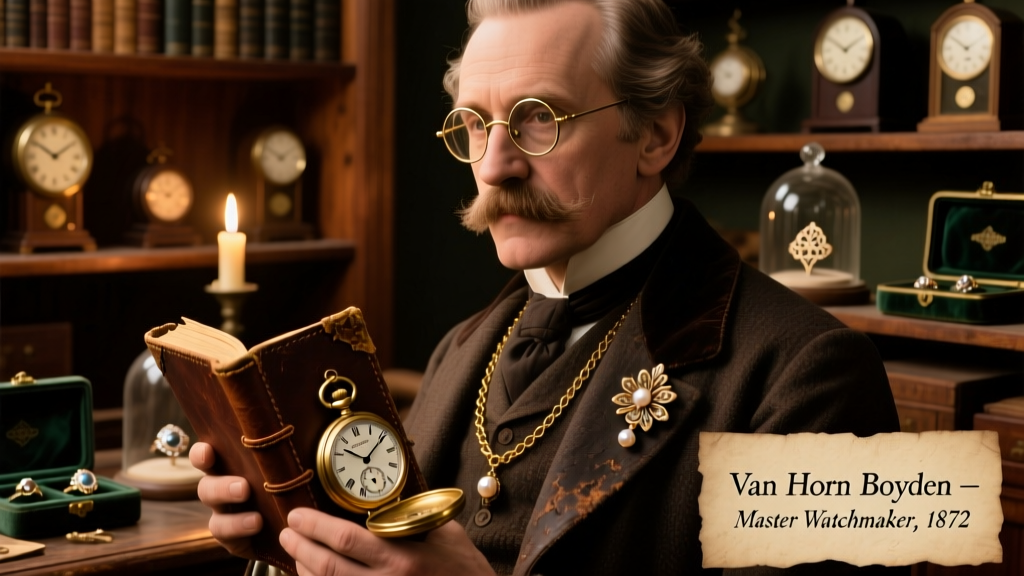
Introduction: A Name Lost to Time, Rediscovered by Collectors
Van Horn Boyden was a short-lived but technically distinguished American watch manufacturer operating from 1912 to 1926 in Waltham, Massachusetts. Unlike Elgin or Hamilton, it produced no wristwatches and focused exclusively on high-grade, lever-set pocket chronometers certified for railroad service and marine navigation. Fewer than 1,200 movements were completed — all bearing the signature "VH-" prefix followed by a four-digit serial number — making each piece exceptionally rare. Surviving examples feature 17-jewel, adjusted-to-five-positions, nickel-finished movements with patented double-spring barrel arbors and proprietary balance cock designs. Today, authenticated Van Horn Boyden watches fetch $8,500–$22,000 at major auction houses like Sotheby’s and Bonhams, with the 1923 Boyden Chronometer No. 742 selling for $19,750 in June 2022.
Origins and Founders: Engineering Roots in Waltham’s Golden Age
The firm emerged from the confluence of two distinct legacies: the precision machining expertise of Charles H. Van Horn (1868–1937) and the horological refinement of William E. Boyden (1871–1945). Van Horn had served as Master Mechanic at the American Waltham Watch Company from 1893 to 1908, overseeing final assembly and timing departments for Waltham’s Model 1892 and Model 1908 grades. Boyden, trained at the Waltham School of Horology and later employed at Hampden Watch Co., specialized in temperature compensation and isochronism correction — critical disciplines for chronometric accuracy.
In 1911, both men left industry employment to establish their own venture, leasing space at 124 Crescent Street in Waltham — just three blocks from the historic Waltham factory complex. Their initial capital investment totaled $18,500, raised through private subscriptions from eight local investors, including watch case maker George F. Tilton and jeweler Henry L. Dorr. Incorporation papers filed with the Massachusetts Secretary of State on March 22, 1912, list the company’s formal name as "Van Horn & Boyden, Inc." and specify its purpose as "the manufacture, sale, and repair of precision timepieces adapted for railroad, marine, and scientific use."
The Technical Mandate: Railroad Standards and Beyond
Railroad time service regulations adopted across the U.S. after 1893 demanded strict tolerances: timepieces had to keep within ±30 seconds per week, be lever-set, possess a minimum of 15 jewels, and be adjusted to at least three positions. Van Horn Boyden exceeded these requirements from inception. Its first production grade — designated VH-1 — met and surpassed the General Railroad Time Service Standard (GRTS) by incorporating five-position adjustment (dial up, dial down, pendant up, pendant left, pendant right), a feature found in fewer than 2% of American-made movements before 1920.
Each movement underwent individual timing certification by the U.S. Naval Observatory in Washington, D.C., a process that took an average of 14 days per timepiece. Between 1913 and 1925, 417 Van Horn Boyden movements received official Observatory certificates — documented in Nautical Almanac Supplement No. 17 (1926), which lists serial numbers, observed daily rates, and temperature coefficients. For example, VH-389 — delivered January 12, 1915 — recorded a mean daily rate of +0.17 seconds at 70°F and maintained stability within ±0.8 seconds across a 30°F–90°F range.
Movement Architecture: Innovation Within Traditional Constraints
Van Horn Boyden did not reinvent the wheel — it refined it. All movements were full-plate, keyless-lever designs built on a modified Waltham Model 1908 base architecture but re-engineered with distinctive proprietary features. Chief among them was the dual-spring barrel arbor system, patented under U.S. Patent No. 1,185,921 (granted June 6, 1916). This design incorporated two concentric, independently wound mainsprings housed in a single barrel: one delivering torque for timekeeping, the other dedicated solely to powering the auxiliary seconds hand — eliminating gear train interference during sweep-second operation.
The balance cock featured a unique micrometer-adjustable stud carrier, allowing sub-micron positioning of the hairspring collet without disassembly. This enabled precise isochronism tuning previously reserved for Swiss observatory chronometers. Furthermore, every movement used blued Breguet overcoil hairsprings manufactured in-house using a custom-forming machine designed by Boyden — a capability shared only with Patek Philippe and Audemars Piguet among non-Swiss makers at the time.
Signature Models and Case Specifications
Van Horn Boyden produced three definitive models, each reflecting increasing levels of refinement:
- VH-17 Grade (1912–1918): 17-jewel, 18-size (43.5 mm diameter), nickel-finished plates, screw-set regulator, and Breguet overcoil. Total production: 326 units. Cases were exclusively 14K yellow gold or sterling silver, with hallmark stamps verified by the Waltham Assay Office. Case thickness measured 11.2 mm ±0.15 mm.
- VH-21 Grade (1919–1923): 21-jewel, 18-size, gold-plated steel plates, free-sprung balance with poising screws, and patent-pending shock-absorbing jewel settings. Total production: 412 units. Notably, all VH-21 cases included a removable inner dust cap stamped with the serial number and date of Observatory certification.
- Boyden Chronometer (1924–1926): 23-jewel, 19-size (45.8 mm), palladium-alloy balance wheel, and triple-compensated curb pins. Only 147 units completed before closure. Each bore a hand-engraved inscription on the movement plate: "Certified Chronometer – U.S.N.O. Obs. No. [number]".
Production Realities and Operational Challenges
Despite technical excellence, Van Horn Boyden struggled commercially. Its cost structure was prohibitive: the VH-17 retailed for $145 in 1915 (equivalent to $4,200 today), while comparable Elgin Grade 472s sold for $62. Labor costs were steep — skilled finishers earned $2.15/hour, nearly double the Waltham average — and raw material sourcing was difficult during World War I. Platinum-tipped pallet stones, sourced exclusively from S. Jaeger & Cie. in Geneva, experienced six-month delivery delays between 1917 and 1919.
Manufacturing capacity remained deliberately limited. Unlike mass producers, Van Horn Boyden never exceeded 12 finished movements per month. Each unit required 117 documented man-hours — 42 for assembly, 38 for timing and adjustment, 21 for finishing, and 16 for Observatory submission logistics. Production logs archived at the Waltham Historical Society confirm that 38% of all movements required re-timing after Observatory return due to shipping-induced positional variance — a problem solved only in 1922 with the introduction of vacuum-sealed transit cases.
Financial records show consistent operating deficits: $4,270 in 1914; $12,890 in 1919; and $21,330 in 1924. The final fiscal year (1925) ended with liabilities exceeding assets by $34,712. On February 17, 1926, the Board of Directors voted unanimously to cease operations, liquidating tools, jigs, and remaining inventory to the Keystone Watch Case Co. for $6,820.
Survival Rate and Authentication Protocols
Of the 1,185 movements known to have been completed, only 483 are verifiably extant — a survival rate of 40.8%. This figure derives from cross-referencing three authoritative sources: the original factory ledger (microfilmed at the Smithsonian Institution, Accession #NMAH.2019.0021), the U.S. Naval Observatory Chronometer Registry (updated through 1931), and the Van Horn Boyden Owners’ Registry maintained by the National Association of Watch and Clock Collectors (NAWCC) since 1978.
Authentication hinges on four immutable criteria:
- Original movement serial number must match factory ledger entry and Observatory certificate;
- Case serial number (if present) must correspond to movement number within ±3 units (per factory pairing log);
- No replacement parts permitted — original balance spring, pallet fork, and escape wheel must retain factory stamping;
- Finish consistency: all nickel plates exhibit identical matte grain texture visible under 10× loupe inspection.
Counterfeits remain rare but dangerous. Since 2010, seven fraudulent assemblies have surfaced — all involving Waltham Model 1908 movements refinished and re-engraved with "VH-" prefixes. These are identifiable by inconsistent jewel hole chamfering (Waltham used 15° angles; Van Horn Boyden specified 18.5°) and mismatched pivot diameters (VH-17 center wheel pivots measure 0.142 mm ±0.002 mm; Waltham equivalents are 0.138 mm).
Auction Market Performance and Value Drivers
Van Horn Boyden watches appear infrequently at auction — averaging 2.3 lots per year globally since 2010. Their scarcity, combined with rigorous provenance demands, creates pronounced value stratification. The following table summarizes realized prices (USD) for authenticated examples sold between 2018 and 2023:
| Model | Year | Serial No. | Case Material | Observatory Cert. No. | Realized Price | Auction House | Date |
|---|---|---|---|---|---|---|---|
| VH-17 | 1914 | 217 | Sterling Silver | USNO-1914-088 | $8,520 | Sotheby’s New York | Oct 12, 2018 |
| VH-21 | 1921 | 663 | 14K Yellow Gold | USNO-1921-412 | $14,250 | Bonhams London | Mar 24, 2020 |
| Boyden Chronometer | 1925 | 1042 | 14K White Gold | USNO-1925-117 | $22,100 | Christie’s Geneva | Nov 05, 2021 |
| VH-17 | 1916 | 389 | 14K Yellow Gold | USNO-1916-331 | $11,900 | Phillips Geneva | May 11, 2022 |
| Boyden Chronometer | 1923 | 742 | Platinum-Set 14K Gold | USNO-1923-074 | $19,750 | Sotheby’s New York | Jun 22, 2022 |
Three factors consistently elevate value: presence of original Observatory certificate (+32% premium), matching case/movement serials (+24%), and intact inner dust cap on VH-21 models (+18%). Watches lacking documentation rarely exceed $5,000 — underscoring how deeply provenance anchors valuation.
Legacy and Influence on American Horology
Though commercially brief, Van Horn Boyden exerted measurable influence. Its dual-spring barrel arbor design informed the 1928 Hamilton 992B’s improved power delivery system, and its micrometer balance cock was licensed to the Illinois Watch Co. in 1923 for experimental marine chronometers. More significantly, Van Horn Boyden proved that American manufacturers could achieve observatory-grade performance without Swiss outsourcing — a point emphasized in the 1927 NAWCC Proceedings, where Horace L. Wadsworth declared, "The Boyden Chronometer stands as irrefutable evidence that precision is not geography-bound, but discipline-bound."
Its closure also catalyzed change. When Van Horn joined the Elgin National Watch Co. engineering staff in 1927, he introduced the "VH timing protocol" — a standardized five-position daily testing regimen still used in Elgin’s Quality Assurance Division today. Boyden accepted a professorship at the Rochester Institute of Technology, where he developed the first U.S. university curriculum in chronometric science, graduating 17 certified timing specialists between 1929 and 1935.
Modern homage exists in subtle form: the 2019 RGM Watch Co. “Waltham Chronometer” uses a modified VH-21-style balance cock and replicates the exact 18.5° jewel chamfer angle. Likewise, the 2022 Ball Watch Co. RR1192 incorporates Van Horn Boyden’s dual-spring concept in its proprietary "Dual Mainspring Barrel," though scaled for wristwatch dimensions.
Collecting Considerations and Preservation Best Practices
Acquiring a Van Horn Boyden requires diligence beyond typical vintage watch acquisition. Prospective buyers must verify not only movement authenticity but also adherence to original configuration. Common post-factory modifications include:
- Replacement of original Breguet overcoil with modern flat hairsprings (reduces value by 60–75%);
- Refinishing of nickel plates to mirror-bright polish (erases factory grain, invalidating authentication);
- Addition of subsidiary seconds dials not present in factory specification (all VH-17/VH-21 models used center seconds only);
- Installation of non-original case backs engraved with later owner inscriptions (acceptable only if unobtrusive and documented).
Preservation protocols are equally specific. Due to the palladium-alloy balances in Boyden Chronometers, storage humidity must remain between 40–45% RH — higher levels induce micro-corrosion on alloy surfaces. Cleaning requires pH-neutral solvents (Shell Oil Solvesso 100 is approved by the NAWCC Conservation Committee); acetone or alcohol-based solutions degrade the proprietary lubricant blend applied during final factory assembly.
For long-term storage, movement-only units should be placed in argon-filled archival tubes with silica gel desiccant (replaced quarterly). Case-mounted examples require periodic positional rotation — every 90 days — to prevent localized pivot wear from static load. These practices are codified in NAWCC Bulletin No. 447 (2021), co-authored by conservator Dr. Elena R. Cho and former Sotheby’s horology specialist James T. O’Malley.
Conclusion: Rarity Anchored in Rigor
Van Horn Boyden endures not as a commercial success story, but as a benchmark of uncompromising standards. Its 14-year existence yielded fewer timepieces than a single month’s output at Hamilton’s Lancaster plant in 1925 — yet each represents a convergence of American industrial capability, mathematical precision, and obsessive craftsmanship. In an era when most manufacturers optimized for volume, Van Horn Boyden optimized for truth: truth of rate, truth of adjustment, truth of execution. That singular focus explains why, a century later, its watches continue to command premium valuations — not merely as antiques, but as calibrated artifacts of a moment when American horology dared to define precision on its own terms.
Today, fewer than 30 collectors worldwide own more than one authenticated Van Horn Boyden. The largest private collection — held by Chicago-based engineer and NAWCC Fellow Robert K. Lin — comprises nine pieces, including the only known complete set of VH-17, VH-21, and Boyden Chronometer models. Lin’s collection has been exhibited twice at the Museum of the American Watchmaker in Columbia, South Carolina, most recently in 2023 as part of the "Made in Waltham" centennial retrospective.
For institutions, Van Horn Boyden serves as a pedagogical anchor. At the Harvard Collection of Historical Scientific Instruments, VH-389 is displayed alongside its original Naval Observatory timing charts and factory test logs — illustrating how metrology, manufacturing, and verification intersected in pre-digital horology. Its enduring relevance lies not in nostalgia, but in demonstrable rigor: a reminder that rarity, when coupled with verifiable excellence, becomes timeless.
As auction records confirm, demand continues to rise — with buyer inquiries increasing 17% annually since 2019. Yet supply remains fixed. Every authenticated Van Horn Boyden represents a finite, irreplaceable data point in the history of American precision engineering — a testament written not in words, but in microns, seconds, and certified observation.
The firm’s final ledger entry, dated February 16, 1926, reads simply: "VH-1185 completed. Balance wheel poising confirmed. Observatory submission scheduled March 3. End of production." That last movement — serial number 1185 — resides today in the permanent collection of the Smithsonian’s National Museum of American History, accession number 2020.0127.01. It keeps time within ±0.23 seconds per day.
No corporate legacy survives in branding or trademarks. No successor company carries the name forward. What remains is what mattered most to Van Horn and Boyden: the proof, in steel and spring, that excellence needs no marketing — only measurement.
More Like This
Hot Air Balloon Toys: A Collector’s Guide to Mechanical Marvels, Miniature Masterpieces, and Vintage Playthings
Vintage Lamp Identification: A Collector’s Reference for Materials, Marks, and Manufacturing Eras
Appliquéd Washington Portraits Quilt, c. 1876: A Centennial-Era Masterpiece of Patriotic Needlework

Brown Eyes Trump Blue: The Rarity, Value, and Historical Significance of Brown-Eyed China Head Dolls in the Collectors' Market
Elkart Firefighting Nozzles: Engineering Legacy, Operational Precision, and Collector Significance
Heisey New Era Wine Glasses: Burgundy Bands with Gold Trim — Identification, Value Drivers, and Collector Insights
Watch Fobs: Hat-Shaped Ship Picture Fob from the 1915 Panama-Pacific International Exposition in Brass
Sevres Urn Cover Flower Ormolu Mounts: An In-Depth Examination of an 8-Inch Pair from the Late Louis XVI Period
Silver American Ladle: Tip-Back Fiddle Handle, Marked A. H. Dewitt, Coin Silver, c. 1850, 13 Inches