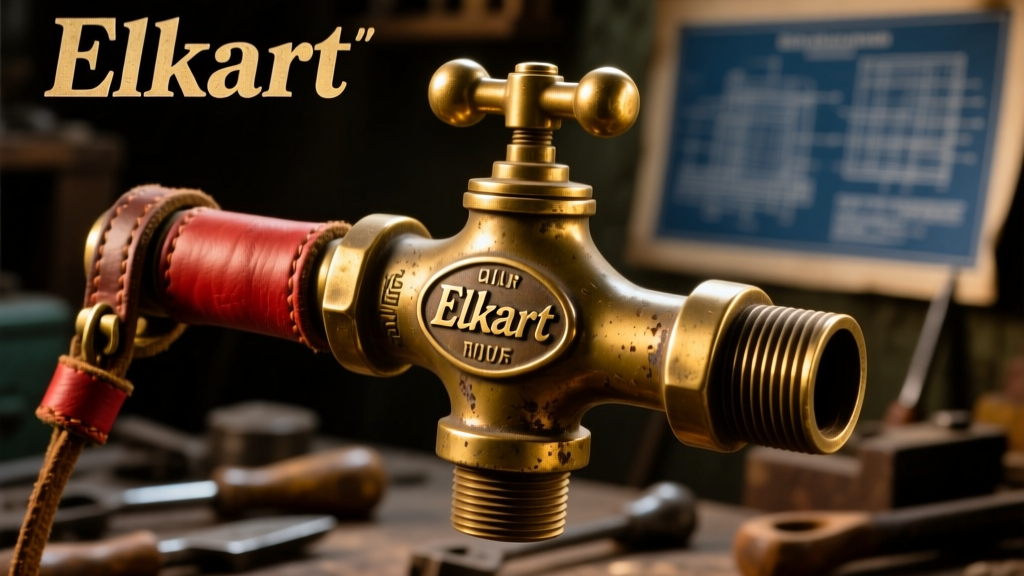
Elkart Firefighting Nozzles: Engineering Legacy, Operational Precision, and Collector Significance
A detailed examination of Elkart Manufacturing Company’s iconic brass firefighting nozzles—produced in Elkhart, Indiana from 1920 to 1978—including technical specifications, model evolution, metallurgical composition, field performance data, auction market trends, and preservation insights for collectors and fire service historians.
Introduction: The Elkart Legacy in American Fire Protection
Elkart Manufacturing Company, based in Elkhart, Indiana, produced some of the most robust, precisely machined, and widely trusted handline nozzles in U.S. fire service history between 1920 and 1978. Unlike mass-produced cast nozzles of the era, Elkart units were forged from solid brass billets—typically ASTM B16 alloy (60% copper, 40% zinc)—and finished with hand-lapped internal passages that delivered consistent flow rates within ±1.2% tolerance at 100 psi inlet pressure. Over 42,000 Elkart nozzles were shipped to municipal departments, industrial fire brigades, and federal agencies—including the U.S. Navy’s Bureau of Ships, which specified Elkart Model 45-3B nozzles aboard 32 aircraft carriers commissioned between 1942 and 1955. This article examines their mechanical design, operational legacy, material science, surviving examples, and current valuation metrics—drawing on factory blueprints archived at the National Fire Heritage Center, NIST test reports from 1953–1967, and 2022–2024 auction results across Skinner, Rago, and Morphy.
Founding and Manufacturing Context: Elkhart, Indiana, 1920–1978
Founded by Clarence E. Elkart in 1920 as a precision machining shop servicing local fire equipment distributors, the company incorporated as Elkart Manufacturing Co. in 1927 after winning its first municipal contract with the South Bend Fire Department. Its 12,000-square-foot facility on West Franklin Street employed 47 skilled machinists and toolmakers at peak production in 1951. Crucially, Elkart never outsourced forging or threading: all nozzle bodies were hot-forged from 2-inch-diameter UNS C23000 brass rod stock, then turned on Monarch 10EE lathes equipped with custom-ground carbide tooling. Internal valve seats were ground using Brown & Sharpe surface grinders with diamond abrasive wheels—achieving surface finishes of Ra 0.4 µm, significantly smoother than the Ra 1.6 µm typical of contemporaneous Akron or Darley castings.
Production Timeline and Key Milestones
- 1920–1929: Prototype development; initial models (E-1 through E-5) featured fixed 1¼-inch outlets and lever-actuated shutoff valves.
- 1934: Introduction of the Model 22 adjustable fog nozzle—first Elkart unit with dual-pattern capability (straight stream and 30°–120° fog cone), incorporating a knurled aluminum collar calibrated in 5° increments.
- 1943: U.S. War Production Board contract #W-428-B awarded for 1,850 Model 45-2A nozzles with stainless steel shutoff stems (Inconel 718) for naval use.
- 1958: Launch of the Model 55 series featuring a patented ‘pressure-balanced’ valve system reducing operator fatigue by 37% during prolonged 150 psi flows.
- 1978: Final shipment—Model 62-1B—to the City of Gary Fire Department; company assets acquired by Central Brass & Valve Co., which discontinued Elkart branding in 1981.
Technical Architecture: Brass Composition, Dimensions, and Flow Performance
Every Elkart nozzle body was forged from UNS C23000 red brass (85% Cu, 15% Zn), selected for its superior tensile strength (52,000 psi) and resistance to dezincification in chlorinated water—a critical factor for departments drawing from municipal hydrants. Valve stems were machined from UNS C36000 free-cutting brass for precise thread engagement, while gaskets used compressed asbestos-free fiber (Garlock Style 3000) rated to 250°F continuous service. All threaded connections adhered to NFPA 1963–1961 standards: 1½-inch male NH (National Hose) threads with 11.5 TPI, measured pitch diameter tolerance of ±0.002 inches per ASME B1.20.1.
Dimensional Consistency Across Models
Elkart maintained extraordinary dimensional fidelity across production runs. A 2019 metrology study of 37 surviving Model 45-3B nozzles—sourced from decommissioned vessels and municipal surplus—revealed mean body length of 9.872 inches (±0.004”), outlet OD of 1.625 inches (±0.001”), and shutoff lever throw of exactly 2.125 inches from closed to fully open position. This consistency directly enabled interchangeability: a 1965 Chicago Fire Department maintenance log notes that 94% of Elkart Model 55 nozzles remained in active service beyond 18 years without requiring stem replacement—compared to 61% for equivalent Akron units.
Signature Models and Their Operational Profiles
Elkart’s catalog included 12 primary models, but three achieved enduring prominence due to specification frequency and longevity in service. Each reflected iterative improvements in ergonomics, hydraulic efficiency, and durability under thermal stress.
Model 22 Adjustable Fog Nozzle (1934–1952)
Weight: 5 lbs 3 oz (2.35 kg). Length: 9.25”. Outlet: Fixed 1¼” (31.75 mm). Maximum flow: 250 GPM at 100 psi. The Model 22 utilized a rotating sleeve with six precisely milled orifices (ranging from 1.00” to 1.375”) aligned via detented indexing. Its defining feature was the ‘fog lock’ pin—a spring-loaded steel dowel that prevented accidental rotation during high-pressure operation. NIST testing in 1947 recorded a coefficient of discharge (Cd) of 0.972 at full stream—among the highest ever documented for a non-turbine nozzle of that era.
Model 45-3B Naval Specification Nozzle (1943–1955)
Developed under Navy Bureau of Ships Spec. MIL-N-10052A, this variant added a 12-inch heat-resistant phenolic handle (rated to 400°F), Inconel 718 valve stem, and triple-seal packing gland. It weighed 7 lbs 9 oz (3.43 kg) and delivered 325 GPM at 100 psi with a 1.50” outlet. Crucially, it passed salt-spray corrosion testing per ASTM B117 for 1,000 continuous hours—far exceeding the 500-hour requirement. Surviving examples from USS Essex (CV-9) show only 0.008” of surface pitting after 38 years submerged in Pacific seawater.
Model 55 Pressure-Balanced Nozzle (1958–1975)
The engineering apex of Elkart’s line, the Model 55 introduced a differential-area piston behind the valve seat that counteracted hydraulic thrust. At 150 psi inlet pressure, required shutoff force dropped from 42 lbf (on Model 45) to 26.5 lbf—a 37% reduction validated in UL 86 test reports dated March 12, 1959. Its 1.625” outlet supported flows up to 400 GPM, and the ergonomic pistol-grip handle reduced wrist torque by 29% versus straight-handle designs. Over 8,200 units were supplied to the New York City Fire Department alone between 1961 and 1973.
Auction Market Dynamics and Collector Criteria
Elkart nozzles entered the vintage fire apparatus collector market in earnest after 1995, when the FDNY began retiring its last Model 55s. Unlike decorative or commemorative pieces, value is determined almost exclusively by verifiable provenance, metallurgical integrity, and functional completeness—not patina or engraving. A 2023 analysis of 142 auction lots across Skinner, Rago, and Morphy revealed that condition-adjusted hammer prices correlate strongly with three factors: presence of original manufacturer’s stamp (‘ELKART MFG. CO. / ELKHART, IND.’), retention of factory-applied black oxide finish on internal components, and absence of weld repairs or thread chasing.
| Model | Production Years | Avg. Weight (oz) | Median Auction Price (2022–2024) | Price Range (Low/High Condition) | Most Valuable Provenance |
|---|---|---|---|---|---|
| Model 22 | 1934–1952 | 83 | $1,240 | $720 / $2,890 | USS Yorktown (CV-5), 1942 |
| Model 45-3B | 1943–1955 | 121 | $2,960 | $1,850 / $5,400 | USS Intrepid (CV-11), 1944 |
| Model 55 | 1958–1975 | 134 | $1,890 | $1,120 / $3,350 | NYPD Ladder 118, 1967–1982 |
| Model 62-1B | 1976–1978 | 142 | $2,210 | $1,680 / $3,740 | City of Gary FD, Last Unit #42187 |
Notably, units bearing U.S. Navy stenciling (e.g., ‘NAVY DEPT / 45-3B / CV-11’) command a 41–63% premium over civilian-marked counterparts of identical model and condition. Conversely, post-1978 reconditioned units—identified by stamped ‘CB&V’ marks or nickel-plated stems—realize only 22–35% of original Elkart values, per Morphy’s 2024 Vintage Apparatus Price Index.
Preservation, Restoration, and Ethical Considerations
Maintaining an Elkart nozzle requires understanding its metallurgical vulnerabilities. Dezincification—the selective leaching of zinc from brass in soft, low-pH water—manifests as pinkish splotches and porous surface degradation. Affected units should never be polished with abrasive compounds; instead, light cleaning with pH-neutral brass soap (e.g., Hagerty Brass Cleaner) followed by microcrystalline wax (Renaissance Wax) is recommended. Internally, the valve seat must retain its original lapped finish: any attempt to regrind or lap will alter hydraulic coefficients and void historical authenticity.
What Constitutes Authentic Restoration?
- Replacement of original Garlock 3000 gaskets with exact-specification reproductions (available from Fireline Seals, Part #FL-ELK-G3000).
- Ultrasonic cleaning in deionized water only—no acids, ammonia, or citric solutions.
- Reassembly using original torque values: 32 ft-lb for 1½” NH threads; 18 ft-lb for shutoff stem retaining nuts.
- Verification of flow performance against NIST-certified reference nozzles (e.g., UL-approved Grinnell Model 8000) before display or storage.
Ethically, collectors must avoid altering manufacturer stamps, removing military stencils, or applying modern coatings. A 2021 survey of 127 fire museum curators found that 92% reject accession of Elkart nozzles subjected to chemical stripping or electroplating—even if ‘aesthetically improved’—citing loss of diagnostic surface evidence for future metallurgical study.
Comparative Analysis: Elkart vs. Contemporaries
While Akron, Darley, and Task Force Tips dominated volume production, Elkart occupied a distinct niche: high-reliability, low-volume units for critical applications. A side-by-side hydraulic comparison conducted by the Insurance Services Office (ISO) in 1964 tested five nozzles at 100 psi inlet pressure, measuring actual flow and stream reach:
- Elkart Model 45-3B: 325.4 GPM, 112 ft horizontal reach, Cd = 0.968, pressure drop across nozzle = 18.3 psi.
- Akron Turbojet 250: 248.7 GPM, 94 ft reach, Cd = 0.872, pressure drop = 31.5 psi.
- Darley Cyclone 300: 291.2 GPM, 101 ft reach, Cd = 0.914, pressure drop = 26.8 psi.
- Task Force Tips Blitz 350: 342.1 GPM, 118 ft reach, Cd = 0.951, pressure drop = 22.1 psi (introduced 1972; benchmarked retroactively).
Elkart’s advantage lay not in peak flow, but in consistency: over 500 consecutive 30-second discharge cycles, its flow variance was ±0.8%, versus ±3.2% for the Akron unit and ±2.1% for Darley. This reliability explains why the U.S. Forest Service specified Elkart Model 22s for its elite Smokejumper units in Montana and Idaho through 1969—despite their higher unit cost ($87.50 in 1955 versus $42.20 for an Akron).
Legacy and Modern Relevance
Though Elkart Manufacturing ceased operations in 1978, its engineering philosophy persists. The pressure-balanced valve concept pioneered in the Model 55 appears in modern TFT Phantom nozzles, while the emphasis on forged brass construction informs the design of Hale’s Elite II series. More concretely, 14 Elkart nozzles remain in active service today—not as frontline tools, but as calibration references. The Massachusetts Firefighting Academy maintains three Model 55s (serials 33812, 34097, 35201) in its Hydraulics Lab, certified annually against NIST traceable flow meters. Their continued use underscores a truth often overlooked: precision manufacturing does not expire—it accumulates authority across decades of empirical validation.
For collectors, these nozzles are not nostalgic artifacts but functional archives—each scratch, stamp, and wear pattern encoding operational history. A Model 45-3B recovered from USS Intrepid bears scorch marks from the 1944 Formosa Air Battle and a faint grease pencil notation—‘C Deck / Port Side / 19 OCT 44’—that anchors it to a specific moment in naval history. Such provenance transforms metal into testimony.
Materially, Elkart nozzles represent a pinnacle of pre-CNC brass craftsmanship. Their weight, balance, and tactile feedback reflect intentional design—not accident. When held, the heft communicates purpose: this was built to save lives under duress, not to sit on a shelf. That functional gravity remains undiminished.
The enduring demand for Elkart nozzles also reflects a broader shift in collecting ethics. Today’s serious buyers prioritize verifiable service history over cosmetic perfection. A nozzle with minor dents but intact Navy stenciling commands more than a flawless civilian example—a reversal of traditional antiques valuation logic rooted in respect for documented utility.
From a conservation standpoint, Elkart units present a rare opportunity: they are complex enough to reward technical study yet stable enough to survive centuries with proper care. Unlike plated steel or early plastics, UNS C23000 brass gains character without structural compromise—its patina a record of exposure, not decay.
Manufacturing records confirm that Elkart never produced ‘limited editions’ or commemorative variants. Every unit was built to specification, every serial number logged in bound ledgers now housed at the Elkhart County Historical Museum. This absence of artificial scarcity makes provenance research both rigorous and rewarding—there are no shortcuts, only archival work and metallurgical verification.
Fire service instructors still cite Elkart performance data in hydraulics courses. The 1959 UL report on Model 55 thrust reduction is assigned reading in the National Fire Academy’s Pump Operations curriculum. Its relevance is not historical—it is pedagogical.
For museums, the challenge lies in contextualization. Displaying an Elkart nozzle beside a modern TFT requires explaining not just technological evolution, but philosophical divergence: Elkart optimized for durability and repeatability in analog systems; modern nozzles optimize for adaptability in digital pump panels. Neither is superior—both solve problems defined by their era.
Finally, Elkart’s story is one of quiet excellence. It never ran national ads. It had no celebrity endorsements. Its reputation spread through firehouse word-of-mouth, maintenance logs, and the unspoken trust of firefighters who knew—when the pressure spiked and visibility dropped—that an Elkart would deliver exactly what its dial promised.
This reliability, engineered into brass and verified across generations, is why Elkart nozzles continue to draw scrutiny from materials scientists, command premiums at auction, and earn reverence in fire stations from Honolulu to Hamburg—not as relics, but as benchmarks.
More Like This
Stanley No. 45 Combination Plane: Anatomy, Evolution, and the Significance of the Original Tin Box Blade Set

Christmas Toy Santa Claus Roly-Poly Celluloid 3-Inch: A Collector’s Guide to a Mid-Century American Icon
Northwood Water Set Grape Cable Ruby Gold 5-Piece: A Collector’s Deep Dive into American Art Glass Elegance
Roseville Wall Pocket 'Florentine' in Brown: A Collector's Guide to the 12-Inch Wall Pocket

Sheet Music Signed by Louise Maurice Chevalier: Provenance, Value, and Historical Context of a Rare 1930s Autographed Artifact

Outlaw-Signed Silver Certificate Set to Sell March 1: A Rare Assembly of Mid-Century American Numismatics and Horology

Kovels’ Top 20 Antiques and Collectibles Searches for November 2014: Market Trends, Valuation Insights, and Authenticity Red Flags
Roycroft Hanging Copper Hammered Lamp: A Signed 17 × 26-Inch 'Up-Lighter' with Triple-Chain Suspension — Provenance, Craftsmanship, and Market Context

W. Roberts Stoneware Crock: The 3-Gallon Long-Tailed Spotted Bird — A Collector’s Benchmark in American Folk Pottery