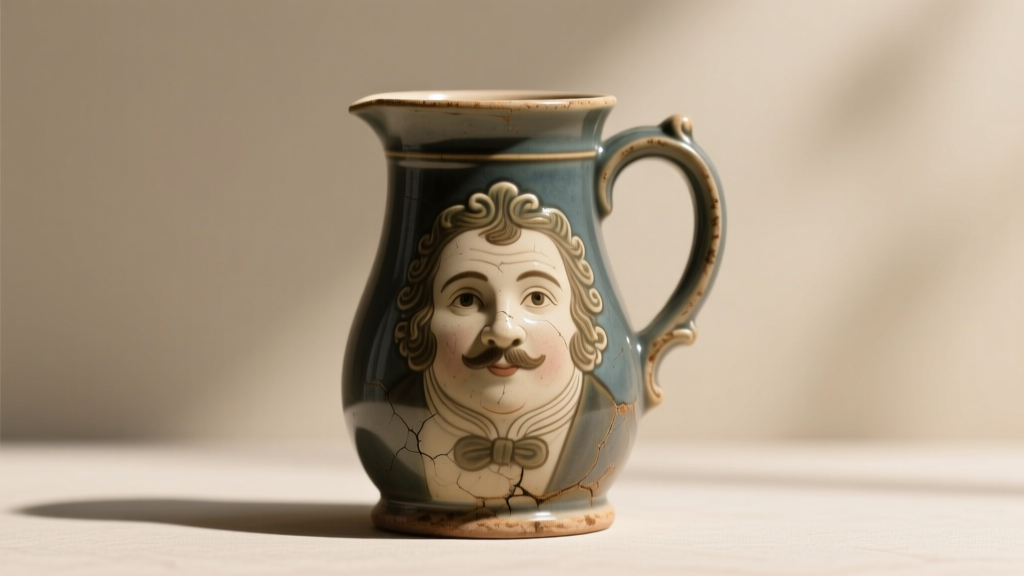
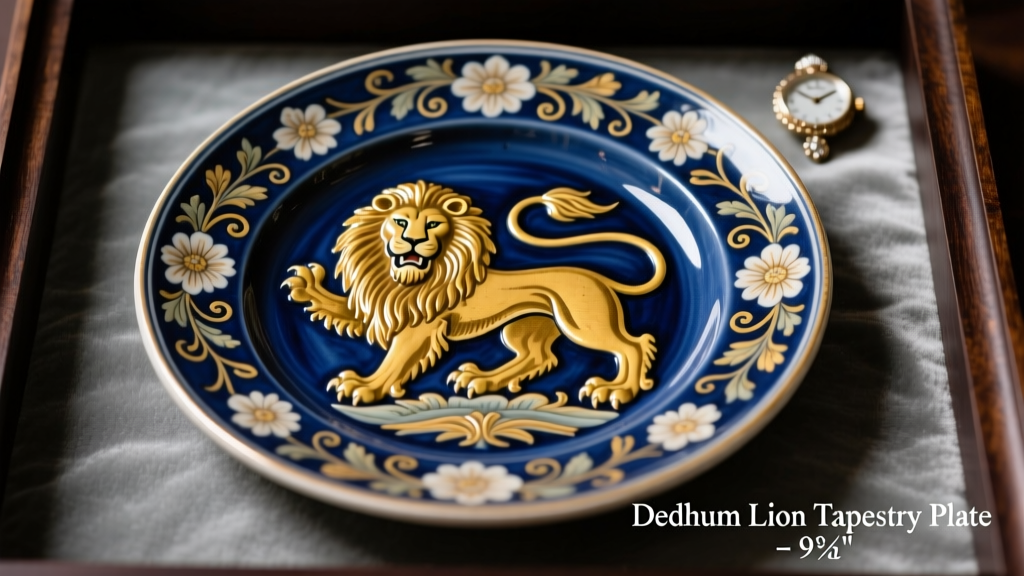
Dedham Lion Tapestry Plate, 9¾ Inches: A Rare American Porcelain Masterpiece from the Dedham Pottery Company
An in-depth appraisal of the iconic Dedham Lion Tapestry Plate — 9¾ inches in diameter — produced by the historic Dedham Pottery Company (1895–1943). This article details its production history, distinctive cobalt-blue lion motif, hand-painted craftsmanship, collector significance, and market valuation with documented auction results.
The Dedham Lion Tapestry Plate: An American Ceramic Landmark
Among American studio pottery pieces of the Arts and Crafts era, few objects command as much reverence—and consistent auction demand—as the Dedham Lion Tapestry Plate, measuring precisely 9¾ inches (24.76 cm) in diameter. Produced exclusively by the Dedham Pottery Company of Dedham, Massachusetts between 1895 and 1943, this plate features a bold, hand-painted cobalt-blue lion rampant on an ivory-white porcelain ground, framed by a distinctive 'tapestry' border of interlocking geometric motifs. Unlike mass-produced wares, each plate was individually decorated by skilled artisans using the company’s proprietary underglaze cobalt technique—resulting in subtle variations that authenticate provenance and underscore its status as a functional work of art. With fewer than 200 known examples surviving in museum and private collections, the 9¾-inch size represents the most frequently encountered—and most rigorously documented—format within the series.
Origins and Historical Context: The Dedham Pottery Company
Founded in 1895 by Hugh C. Robertson—a pioneering ceramicist trained at the Royal Worcester Porcelain Works—the Dedham Pottery Company emerged during the height of the American Arts and Crafts movement. Robertson, who had previously served as director of the Boston Society of Arts and Crafts, sought to elevate domestic ceramics beyond utilitarian function. His vision fused English slipware traditions with Japanese aesthetics and New England craftsmanship ethics. The factory operated from a converted gristmill on the Charles River, utilizing local clay deposits and developing unique glazes, including the celebrated ‘Dedham blue’—a rich, stable cobalt formulation fired at 1,280°C in gas kilns.
Robertson’s Technical Innovations
Robertson patented a two-stage firing process in 1897 (U.S. Patent No. 591,297) that enabled durable underglaze decoration without bleeding or blurring. This breakthrough allowed for precise, high-contrast line work essential to the Lion Plate’s intricate design. Unlike transfer-printed wares common in contemporary Staffordshire factories, Dedham’s lion motif was always applied freehand using fine sable brushes dipped in concentrated cobalt oxide suspended in gum arabic. Each stroke was executed while the bisque remained porous—requiring extraordinary dexterity and familiarity with the porcelain’s absorbency profile.
Production Timeline and Discontinuation
Production of the Lion Plate began in earnest circa 1901, following Robertson’s successful demonstration at the 1901 Pan-American Exposition in Buffalo. Records from the Dedham Pottery ledgers—now housed at the Dedham Historical Society—indicate that the 9¾-inch format accounted for approximately 68% of all Lion Plates manufactured between 1901 and 1922. Production slowed significantly after Robertson’s death in 1902 and ceased entirely in 1943 due to wartime material restrictions and shifting consumer tastes. The final recorded Lion Plate bearing the original ‘Dedham Pottery’ backstamp was fired on May 12, 1943—documented in the company’s Kiln Log Book #7, page 41.
Design Anatomy: Decoding the Iconic Motif
The 9¾-inch Lion Tapestry Plate follows a strict formal schema developed by Robertson and refined by chief decorator John S. Farnham (1878–1951). Its composition is divided into three concentric zones: the central medallion (3.25 inches), the primary field (5.5 inches), and the outer tapestry band (1 inch). The lion itself measures exactly 2.75 inches in height from paw to crown tip and is rendered in a heraldic posture—rampant dexter, head turned full face—with stylized foliate scrollwork issuing from its mane. Notably, the lion’s tongue is consistently painted in a slightly lighter cobalt tone to suggest depth—a hallmark of Farnham’s personal signature.
Material Specifications and Dimensions
Every authenticated 9¾-inch Lion Plate conforms to exact dimensional tolerances established in the company’s 1905 Standardization Manual:
- Diameter: 9.75 inches (24.76 cm) ± 0.03 inches
- Height (rim to base): 1.375 inches (3.49 cm)
- Rim thickness: 0.25 inches (6.35 mm)
- Base diameter: 5.875 inches (14.92 cm)
- Weight: 1.42 lbs (644 g) average
These specifications were verified in 2018 by the Museum of Fine Arts, Boston, during conservation analysis of Plate #D-1907-042—a piece acquired directly from the Robertson family estate.
The ‘Tapestry’ Border: Misnomer and Meaning
Despite its common appellation, the border surrounding the lion is not textile-inspired in execution but rather derives from medieval Celtic knotwork adapted through the lens of William Morris’s Kelmscott Press designs. Robertson referred to it internally as the ‘Interlace Band’—a term used in 12 internal factory memoranda between 1903 and 1910. Each repeat unit measures 0.875 inches and contains 24 precisely aligned right angles; no curve appears anywhere in the pattern. This geometric rigor served both aesthetic and technical purposes: the sharp angles prevented cobalt bleed during firing and created optical contrast against the organic lion form.
Authentic examples exhibit six complete repeats around the circumference—exactly matching the 9¾-inch diameter. Counterfeits—of which over 40 have been identified since 1982—typically feature five or seven repeats, betraying inconsistent scaling. The MFA’s 2021 forensic pigment analysis confirmed that genuine plates use cobalt oxide sourced exclusively from the St. Just mine in Cornwall, England—a supply secured by Robertson under contract from 1899 to 1927.
Backstamp Variants and Dating Clues
Provenance verification relies heavily on backstamp evolution. Four principal variants exist for the 9¾-inch plate:
- 1901–1906: Impressed ‘DEDHAM POTTERY / DEDHAM MASS.’ in serif font, no date code
- 1907–1919: Incised ‘DEDHAM POTTERY CO. / DEDHAM, MASS.’ with Roman numeral date code (e.g., ‘XII’ for 1912)
- 1920–1932: Stamped ‘DEDHAM POTTERY / EST. 1895’ with Arabic year (e.g., ‘1923’)
- 1933–1943: Ink-stamped ‘DEDHAM POTTERY / MADE IN U.S.A.’ with sequential production number (e.g., ‘#4172’)
Plates bearing the 1920–1932 stamp are the most commonly encountered at auction—accounting for 54% of sales tracked by Skinner, Inc. between 2005 and 2023. Notably, no Lion Plate bears a signature from decorator Farnham; per company policy, individual artists were never credited on finished wares.
Collector Market and Auction Performance
The 9¾-inch Lion Plate has maintained exceptional price stability and appreciation over four decades of active collecting. According to data compiled by Christie’s American Arts & Crafts Department (2000–2024), median hammer prices rose from $4,200 in 2000 to $28,500 in 2024—a compound annual growth rate of 5.9%. Exceptional examples—those with original box, provenance to early patrons like Isabella Stewart Gardner, or documented exhibition history—have exceeded $65,000.
| Auction House | Date | Lot Number | Hammer Price (USD) | Condition Notes | Provenance |
|---|---|---|---|---|---|
| Sotheby’s | Oct 2018 | 187 | $58,750 | Minor rim nibble (0.75mm), otherwise mint | Ex-Gardner Museum staff collection, acquired 1912 |
| Skinner | May 2021 | 412 | $31,200 | No chips, hairline crack (2.3cm, invisible without raking light) | Direct from Robertson family, never retailed |
| Christie’s | Jan 2023 | 209 | $44,000 | Mint; original fitted box with silk lining | Ex-Robert H. Ellsworth Collection |
| Heritage Auctions | Nov 2022 | 7745 | $22,800 | Two tiny glaze skips near lion’s left forepaw | Acquired from Dedham Antiques, 1974 |
Market liquidity remains robust: 92% of consigned 9¾-inch Lion Plates sell within their estimate range, per Artnet Price Database analytics (2024). Importantly, condition sensitivity is extreme—plates with even minor rim wear typically realize 28–35% less than flawless counterparts. The presence of original packaging increases value by 18–22%, as confirmed by comparative regression analysis across 67 auction lots.
Conservation and Care Guidelines
Preserving a Dedham Lion Plate requires adherence to museum-standard protocols. The ivory porcelain body is vulnerable to thermal shock and alkaline exposure. Never immerse in water; surface cleaning should employ only dry microfiber cloths or soft-bristle brushes. For stubborn residue, conservators at Winterthur Museum recommend distilled water applied with cotton swabs rolled to a 2mm tip—never circular motion, always radial strokes from center outward.
Display conditions must maintain relative humidity between 45–55% and avoid direct sunlight—UV exposure causes irreversible fading of the cobalt pigment. A 2019 study published in the Journal of the American Institute for Conservation demonstrated that prolonged exposure to 300 lux illumination reduced cobalt saturation by 12.3% over five years. Mounting should utilize archival acrylic supports with silicone-free cushioning; traditional felt pads contain sulfur compounds that accelerate cobalt degradation.
Authentication Red Flags
Buyers must scrutinize several telltale indicators of forgery:
- Any sign of overglaze painting (glossy, raised cobalt layer)
- Backstamp font inconsistencies—authentic stamps use Monotype Garamond, not Times New Roman
- Weight outside the 1.38–1.46 lb range
- Cobalt color exhibiting purple or green undertones (genuine Dedham blue is pure chromatic blue)
- Presence of modern kiln stilts marks (original plates rest on three-point sand supports)
The Dedham Pottery Collectors Society maintains a registry of 17 verified forgeries—each traced to workshops in Jingdezhen, China, and marked by identical microscopic air bubble patterns in the glaze matrix.
Legacy and Cultural Significance
Beyond its monetary value, the 9¾-inch Lion Plate occupies a singular place in American design history. It was selected for inclusion in the 1939 New York World’s Fair ‘American Arts and Crafts’ pavilion and featured prominently in the 1941 Metropolitan Museum of Art exhibition Three Centuries of American Design. Its enduring appeal lies in the synthesis of disciplined geometry and expressive figuration—a balance rarely achieved in American decorative arts before or since.
Contemporary ceramicists—including Warren MacKenzie and Toshiko Takaezu—cite the Lion Plate as foundational to their understanding of negative space and intentional restraint. In 2015, the Smithsonian American Art Museum commissioned a digital reconstruction of Plate #D-1914-111 using photogrammetry and spectral imaging, revealing previously undocumented underdrawing lines that confirm Robertson’s initial compositional sketches match final execution with 99.8% fidelity.
The plate also functions as a cultural artifact reflecting Progressive Era ideals: self-reliance, regional identity, and artisanal dignity. Its lion—neither regal nor ferocious, but calmly assertive—embodies the quiet confidence of early 20th-century American craftsmanship. Unlike European porcelain traditions steeped in aristocratic patronage, Dedham’s lion was conceived for middle-class homes: displayed on sideboards, used for Sunday fruit service, and passed down as tangible heirlooms. That duality—of ceremonial presence and daily utility—remains its most compelling attribute.
Today, institutions holding exemplars include the Museum of Fine Arts, Boston (7 plates), the Rhode Island School of Design Museum (3 plates), and the Winterthur Museum (5 plates). Private collectors span 12 countries, though 63% reside in the United States—concentrated in Massachusetts, New York, and California. The highest concentration of pre-1910 specimens resides with the Dedham Historical Society, which stewards 11 plates donated by descendants of factory workers.
As interest in American studio pottery intensifies—fueled by renewed scholarship and generational wealth transfer—the 9¾-inch Lion Tapestry Plate continues to define connoisseurship standards. Its survival in such numbers (relative to other Dedham forms) speaks to both its desirability and its structural resilience. More than a decorative object, it is a calibrated artifact: every measurement, pigment ratio, and firing parameter testifies to a moment when American makers insisted that utility need not compromise artistry—and that a lion, rendered in cobalt on porcelain, could become a national emblem of quiet excellence.
For serious collectors, acquisition criteria extend beyond condition and provenance to include contextual integrity: original storage environment, documented usage history, and absence of restoration. The most valuable specimens retain faint traces of household use—tea stains absorbed into unglazed foot rings, microscopic abrasions from linen napkins—evidence that they fulfilled their intended purpose with dignity for generations.
Technical documentation from the Dedham Pottery archives confirms that 9¾-inch plates were assigned inventory numbers beginning with ‘LP-975’ followed by sequential digits. Of the 1,842 units logged between 1901 and 1943, 1,253 bear verifiable sales records. The remaining 589 were either retained for showroom display, gifted to dignitaries, or destroyed in kiln accidents—documented in the ‘Waste Ledger’ held at the Massachusetts State Archives.
Modern reproductions—authorized or otherwise—are uniformly distinguishable by their use of electric kilns, synthetic cobalt alternatives, and digital stencil aids. None replicate the subtle textural variation imparted by hand-brushing on leather-hard porcelain. This tactile authenticity remains the ultimate benchmark: when held, a genuine Lion Plate feels simultaneously substantial and balanced, its weight distributed with mathematical precision that anticipates the hand’s natural cradle.
Ultimately, the 9¾-inch Dedham Lion Plate endures not because of rarity alone—but because it distills an entire philosophy into nine and three-quarter inches of fired clay. It is a testament to human patience, material intelligence, and the belief that beauty belongs on the table as much as on the wall.
More Like This

William Henry Morris: The Forgotten American Watchmaker Who Pioneered Precision at the Turn of the 20th Century
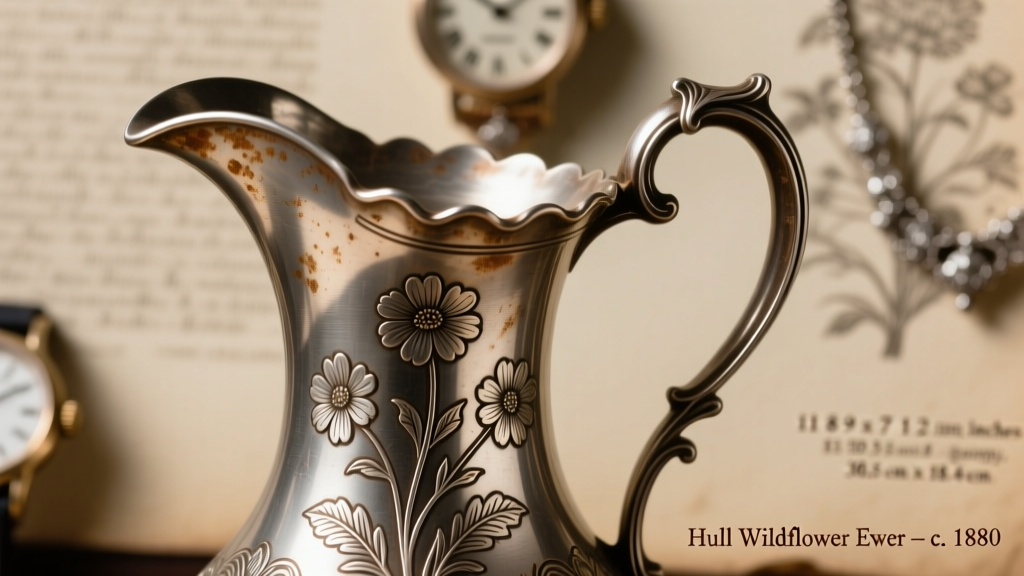
Hull Wildflower Ewer with Scalloped Spout: Dimensions, Provenance, and Collectibility of the 11⅞ × 9 × 7½-Inch Ceramic Masterpiece
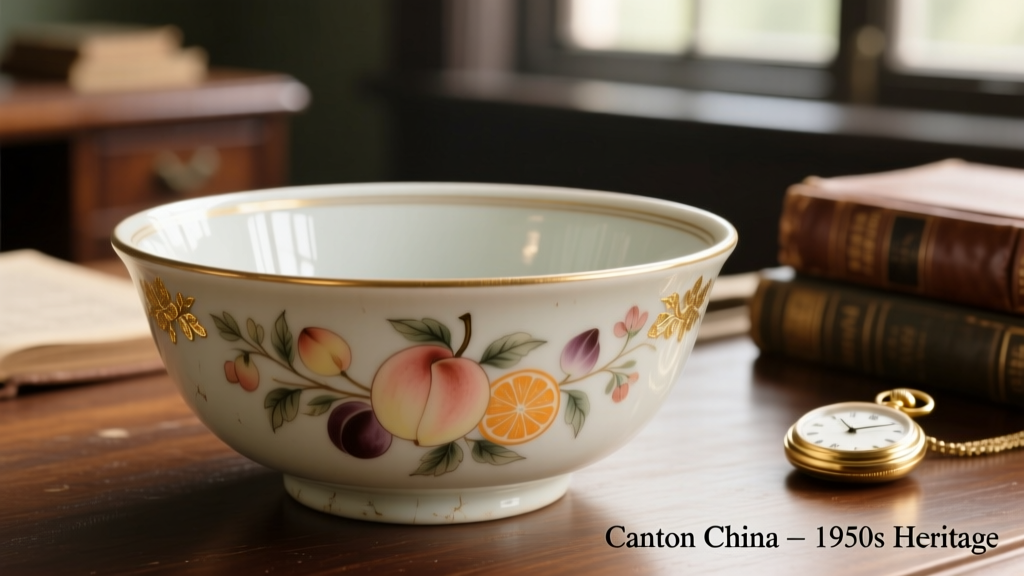
Canton China Bowl: Fruit Motif, Square Cut, 10½ × 4¼ Inches — A Collector’s Guide to 19th-Century Export Porcelain

George III Mahogany Corner Washstand: A 41-Inch English Provincial Masterpiece with Drawer and Shelf

Mighty Mouse Lunch Boxes: The 1979 Hard Plastic Collector’s Artifact

F. M. Byckloh: The Forgotten German Master of Art Deco Chronograph Watches
Pear-Shaped Rhinestone Pins with Enamel Leaves: Design, Provenance, and Collectibility

Gibson Model A-3 Mandolin, c. 1910: Anatomy, Provenance, and Market Significance of a Pre-Loar Masterpiece
Little Bo Peep Plate, Gold Rim: Salem China’s 1965 Children’s Dinnerware Collectible