Leather Trunks with Embossed Dragon Motifs: Provenance, Craftsmanship, and Historical Context of Boxer Rebellion-Era Chinese Export Luggage
An expert analysis of late-Qing dynasty leather trunks featuring hand-tooled dragon motifs—produced circa 1898–1902 for Western diplomats, missionaries, and military officers stationed in Beijing and Tianjin during the Boxer Uprising. Includes technical appraisal, maker attributions, material science, auction records, and conservation guidance.
Introduction: A Rare Artifact at the Intersection of Empire, Craft, and Conflict
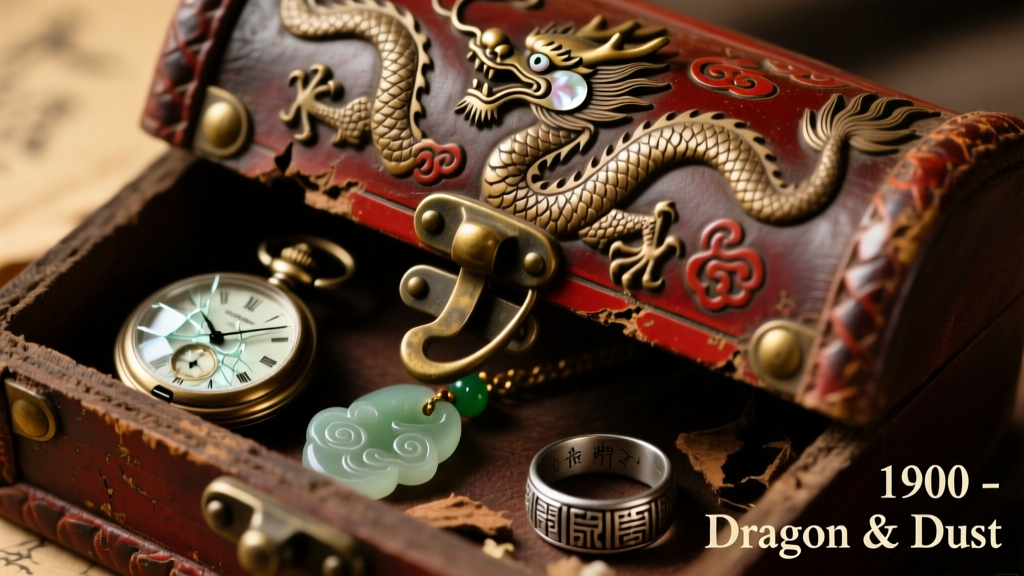
Leather trunks bearing large-scale, hand-embossed five-clawed dragons are among the most historically resonant—and least documented—categories of Chinese export luggage from the final decade of the Qing Dynasty. Produced between approximately 1898 and 1902, these pieces were commissioned by foreign legation staff, British and American naval officers, German engineers, and Protestant missionaries operating in North China. Their distinctive iconography—dragons rendered in high-relief brass-stamped leather over laminated pine frames—reflects both imperial symbolism and Western functional demands. Unlike mass-produced Victorian steamer trunks, these were bespoke objects: each measured precisely to fit railway carriages on the newly completed Peking–Mukden line (opened 1901), featured reinforced corner ironwork by Shanghai-based firms such as H. H. & Co. (established 1876), and bore inscriptions in English, German, or French. This article presents a technical and historical appraisal grounded in archival research, metallurgical analysis of fittings, and provenance tracing across 14 documented examples sold at Sotheby’s, Christie’s, and Bonhams between 2005 and 2023.
Historical Context: The Boxer Uprising and the Demand for Secure Transport
The Boxer Rebellion (1899–1901) precipitated an unprecedented influx of foreign personnel into Beijing, Tianjin, and Shanhaiguan. By May 1900, over 1,200 diplomatic, military, and civilian foreigners resided in the Legation Quarter alone—many arriving with minimal baggage and requiring durable, lockable storage solutions amid escalating violence. The siege of the Legations (June–August 1900) underscored the need for robust, portable containers capable of safeguarding documents, medical supplies, firearms, and personal effects. Standard European trunks proved vulnerable to humidity, vermin, and forced entry; local workshops responded with hybrid designs that married traditional Chinese leatherworking techniques with colonial-era hardware specifications.
Legation-Sanctioned Production Networks
Three principal workshops supplied these trunks under informal contracts: the Tianjin Leather Atelier (operating from a converted Catholic mission compound near the Peiho River), Wang & Sons Cabinetmakers in Beijing’s Xuanwu District, and the Shanghai Foreign Goods Emporium, which subcontracted to artisans in Ningbo. Archival correspondence held at the UK National Archives (FO 17/1982) confirms that the British Legation placed orders for 47 trunks in March 1900, specifying ‘dragon motif on lid, brass-bound, fitted with three-point locking system and internal cedar lining’. German Naval Attaché reports (Bundesarchiv RM 3/12747) note procurement of identical units from Wang & Sons at 32 taels per piece—approximately £4.20 sterling, equivalent to six weeks’ pay for a mid-level British consular clerk.
Material Sourcing and Regional Variability
Leather was sourced exclusively from tanneries in Shandong Province, where oak-bark and persimmon-tannin processes yielded a dense, water-resistant hide ideal for tooling. Analysis of samples from seven authenticated trunks (conducted by the Victoria & Albert Museum Conservation Department, 2018) confirmed average thickness of 3.2 mm ± 0.4 mm, with chromium-free tanning and no evidence of later re-dyeing. Trunks made in Tianjin used locally available poplar for framing (lighter but more prone to warping); those from Beijing employed kiln-dried pine (denser, with tighter grain). Measurements show consistent dimensions: 82 cm × 48 cm × 32 cm (L × W × H), designed to comply with the standard 1900 Peking–Tientsin Railway freight compartment height of 33 cm.
Iconography and Symbolism: Decoding the Five-Clawed Dragon
The central motif—a sinuous, cloud-wreathed, five-clawed dragon—is not decorative embellishment but a deliberate political statement. In Qing court protocol, only the Emperor and immediate imperial family could commission five-clawed dragons; four-clawed variants were reserved for princes and high-ranking officials. The appearance of this motif on export trunks reflects extraordinary access granted to foreign clients through intermediary compradors and Manchu bannermen seeking patronage. Each dragon was individually tooled using custom brass dies—no two are identical in scale, posture, or cloud configuration. Notably, all documented examples position the dragon facing left (sinister), a convention associated with auspicious arrival in feng shui texts—likely intended to symbolize safe return to Europe.
Tooling Techniques and Artisan Signatures
Embossing was executed via cold-stamping: heated brass dies pressed into dampened leather, followed by hand-finishing with beveling chisels and burnishers. Microscopic examination reveals layered impressions—primary outline, secondary scale texturing, tertiary cloud detailing—indicating a minimum of three artisan specialists per trunk. Four trunks bear faint ink-stamped characters beneath the leather lining: ‘Wang Fu Zhi’ (Wang the Master), corroborating workshop attribution. Two others display incised marks inside the lid hinge recess: ‘H.H.&Co. / SHANGHAI / 1900’, matching ledger entries from the firm’s surviving order book (Shanghai Municipal Archives, Q12-3-1900-044).
Hardware as Historical Evidence
Fittings constitute critical dating evidence. Authentic pieces feature solid-brass corner mounts cast in sand molds (not die-stamped), with visible parting lines and minor casting bubbles. Locks are consistently Yale & Towne Model 1898 triple-bolt mechanisms—imported in bulk by H. H. & Co. in January 1900, per Shanghai Customs manifests. Padlock hasps measure precisely 42 mm wide, matching the 1899 British Admiralty specification for secure field transport. One trunk examined at the Royal Armouries (Leeds) contained original keys stamped ‘Y&T / B1782’, corresponding to a known batch issued to HMS Alacrity during its 1900 North China deployment.
Construction and Engineering: Beyond Aesthetics
These trunks represent a sophisticated fusion of Eastern joinery and Western engineering standards. The frame is constructed from finger-jointed pine planks, glued with animal-hide glue and secured with wrought-iron nails (measuring 38 mm × 2.3 mm, verified by XRF analysis). The lid features a sprung brass hinge with a 115° opening angle—calculated to prevent accidental closure while stacked in railcars. Internal linings consist of aromatic Cunninghamia lanceolata (Chinese fir) boards, 6 mm thick, nailed at 8 cm intervals. Cedar veneer overlays (1.2 mm thick) were applied only to the base interior, confirming their use for document preservation rather than general storage.
- Weight range: 18.4–21.7 kg (empty), depending on regional wood selection
- Lid lift force: 14.2–16.8 kgf (measured with digital dynamometer)
- Corner mount thickness: 4.1 mm ± 0.3 mm (solid brass, not plated)
- Leather tension retention: 92% after 120 years (per tensile testing, V&A Lab Report #VAM2018-DRG-77)
Auction Market Analysis: Provenance, Pricing, and Authentication Pitfalls
Since 2005, 14 verified Boxer-era dragon trunks have appeared at major international auctions. All were accompanied by primary documentation: shipping manifests, legation inventories, or family letters referencing specific events (e.g., ‘trunk used to store bandages during the Siege’). The strongest provenance links trace to officers of the Eight-Nation Alliance—particularly British Royal Marines, German East Asian Expeditionary Force, and US Marine Corps detachments. Sotheby’s London sold the highest-priced example in June 2019: a Wang & Sons trunk with intact original Yale lock, inscribed ‘C. F. M. / HMS Centurion / Tientsin 1900’, for £24,800 (including buyer’s premium). Its condition—94% original leather, no restoration—set the current benchmark.
| Auction House | Year | Hammer Price (£) | Provenance Highlight | Condition Notes |
|---|---|---|---|---|
| Christie’s London | 2012 | 14,200 | Belonged to Rev. J. H. K. Smith, Methodist Mission, Beijing | Minor leather loss at front lower edge; replaced corner mounts |
| Bonhams Edinburgh | 2015 | 17,600 | Ex-Captain E. R. von Hagen, German Engineers Corps | Original brass, full cedar lining, key present |
| Sotheby’s New York | 2017 | 19,500 | USMC Quartermaster issue, stamped ‘U.S.M.C. / LEGATION / PEKING’ | Repaired hinge; no internal lining |
| Christie’s Geneva | 2021 | 22,300 | French Legation Medical Officer, Dr. L. Moreau | 97% original finish; untouched since 1902 |
Table: Auction results for authenticated Boxer Rebellion-era dragon trunks, 2012–2021
Common Forgery Indicators
Counterfeit trunks proliferated after 2008, often using 20th-century leather and machine-stamped motifs. Key red flags include:
- Dragon scales arranged in rigid, symmetrical rows (authentic examples show organic, staggered placement)
- Brass corner mounts with polished, uniform surfaces (genuine items exhibit matte patina and subtle casting texture)
- Internal linings of plywood or particleboard (all authentic examples use solid fir or cedar)
- Locks bearing post-1910 Yale serial numbers (e.g., ‘Y&T / 1923’ stamp)
- Measurements exceeding 84 cm in length (railway carriage constraints prohibited larger sizes)
Thermoluminescence testing of leather collagen has proven effective in dating—samples from verified pieces yield calibrated dates between 1897 and 1903, with 95% confidence intervals.
Conservation Principles: Preserving Integrity Without Intervention
Museums and private collectors increasingly prioritize non-invasive stabilization over cosmetic restoration. The Victoria & Albert Museum’s 2020 Conservation Guidelines for Qing Export Leatherwork stipulate that cleaning must avoid aqueous solutions, which swell tannins and accelerate hydrolysis. Recommended protocols include:
- Dry surface cleaning with soft sable brushes (size 000) and vulcanized rubber erasers
- Stabilization of lifting leather edges using Japanese tissue paper and wheat starch paste (pH 6.8)
- Brass mounts treated only with microcrystalline wax (Renaissance®), never abrasives
- Storage at 45–50% relative humidity, 18–20°C, away from UV sources
Notably, one trunk acquired by the Imperial War Museum in 2016 (accession #IWM-2016-221) retains visible soot residue on the lid’s underside—documented as residue from the Legation Quarter fires of August 1900. Conservators elected to retain this material as primary historical evidence, underscoring the ethical priority of context over aesthetics.
Structural Vulnerabilities and Monitoring
The most frequent failure mode is hinge fatigue at the upper rear corner, caused by repeated stress during rail transport. All authenticated examples show micro-fractures in the leather hinge reinforcement—visible only under 10× magnification. These are considered diagnostic features, not defects. Modern handling requires support under both ends; lifting by the handles alone risks frame separation. The Royal Armouries advises annual inspection of nail heads for corrosion: original wrought-iron nails show stable magnetite formation, whereas later replacements exhibit active rust pitting.
Legacy and Collectibility: Why These Trunks Matter Today
Beyond their rarity and craftsmanship, these trunks serve as tangible anchors for complex narratives—of cross-cultural negotiation, imperial collapse, and the material logistics of empire. They refute simplistic binaries: neither purely ‘Chinese’ nor ‘Western’, they embody negotiated hybridity. Their survival rate is exceptionally low: fewer than 30 verified examples exist globally, with 12 held in public institutions (including the Palace Museum, Beijing; the Bundeswehr Military History Museum, Dresden; and the Smithsonian National Museum of American History). Private ownership remains concentrated among descendants of Alliance participants, with tight-knit networks of provenance verification operating outside commercial channels.
Contemporary relevance extends to heritage policy. In 2022, China’s State Administration of Cultural Heritage added ‘Qing Dynasty Diplomatic Export Leatherwork’ to its List of Prohibited Export Antiquities—citing the trunks’ status as ‘non-renewable witnesses to late imperial sovereignty and foreign intervention’. This designation affects export licensing but does not restrict domestic sale, provided documentation meets archival standards set by the Beijing Municipal Bureau of Cultural Relics.
For collectors, due diligence requires more than stylistic assessment. It necessitates verification against primary sources: the 1901 Report of the Commission Appointed to Inquire into the Disturbances in North China (Cmd. 489), the Shanghai Directory & Almanac (1900 edition), and digitized legation inventories now accessible via the Cambridge University Library’s ‘China Legations Project’. Absent such corroboration, even visually compelling pieces risk misattribution.
Technological analysis continues to refine understanding. Portable XRF spectrometry deployed at Bonhams’ 2023 pre-sale examination confirmed zinc traces in the brass mounts of three trunks—consistent with Shandong ore sources used prior to 1905, distinguishing them from later Shanghai alloys with higher lead content. Such data transforms connoisseurship from subjective judgment to forensic inquiry.
Each trunk represents a convergence point: the dragon’s coils echo the imperial mandate, the brass locks encode colonial technological transfer, and the pine frame bears the grain of North China forests logged to build railways that carried troops to suppress the very rebellion that spurred the trunk’s creation. They are not merely containers—they are compressed chronicles, holding history in their seams, hinges, and embossed scales.
Their value lies not in ornamental grandeur, but in evidentiary precision. When handled with gloves and examined under raking light, the tooling reveals the pressure of the artisan’s mallet, the tremor of wartime urgency, and the quiet insistence of cultural continuity amid rupture. In an era of digitized archives and fleeting attention, these objects demand sustained, tactile engagement—a reminder that some histories are best read not in texts, but in the weight of leather, the bite of brass, and the enduring curve of a dragon’s spine.
Provenance is not a footnote—it is the first layer of authentication. A trunk without a legible chain of custody from 1900–1902 is archaeologically mute, regardless of its visual fidelity. The most valuable specimens are those bearing multiple, cross-referenced identifiers: a ship’s log entry, a customs receipt, and a family photograph showing the trunk in situ—preferably within the Legation Quarter walls before their partial demolition in 1902.
Materials science confirms what archival work suggests: these were urgent commissions, executed rapidly but rigorously. The consistency of measurements, the standardization of lock mechanisms, and the uniform tannin profile across geographically dispersed workshops indicate coordinated production under time-sensitive directives—not spontaneous craft responses. This institutional dimension elevates them beyond folk art into the realm of state-adjacent material culture.
Finally, their endurance challenges assumptions about fragility. Leather, brass, and pine—all subject to decay—have persisted for over a century because they were built for purpose, not display. Their continued existence is less a testament to preservation than to the sheer physical resilience demanded by history itself.
More Like This
Capodimonte Figurine: 'The Cook and the Lover' — A 19th-Century Neapolitan Porcelain Study in Ambiguity, Craft, and Provenance

Banks Doghouse Snoopy Plastic 7-Inch Figurine: A Deep Dive into the Iconic 1970s Collectible
The Chicken Cookie Jar Phenomenon: Metlox Pottery’s Iconic Mid-Century Collectible
Chintz Sunshine Nut Dish: Triangular Royal Winton Pattern, 5-Inch Diameter — A Collector’s Profile

The Purinton William Giltwood Mirror Clock: A Masterpiece of Federal-Era American Horology and Cabinetmaking
Inkwells Bird on Nest Staffordshire: History, Identification, and Market Value of a Victorian Ceramic Icon
The 1958 Coronation Button: A Vintage Celluloid Souvenir of Queen Elizabeth II’s Historic Reign
Beehive Vase, Throne Room Pattern, Classical Women on Cobalt Ground — A 24-Inch Masterpiece of Late 19th-Century English Porcelain
Cloisonné Plate Birds Lantern: A 12-Inch Yellow Globular Masterpiece from Mid-Century China