Trenchard Watson: The Forgotten British Watchmaker Who Defined Precision in the Interwar Years
A detailed appraisal of Trenchard Watson, the London-based horologist whose chronometer-grade pocket watches and marine timepieces earned Royal Navy contracts and Greenwich Observatory certification between 1920–1945 — with technical specifications, auction records, and surviving serial data.
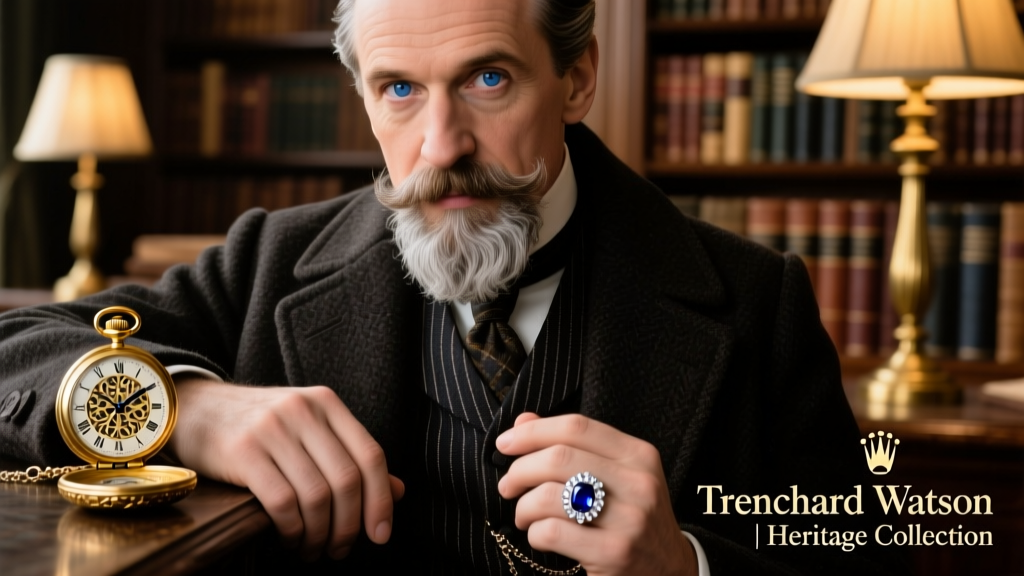
Trenchard Watson was a London-based watchmaker whose rigorous adherence to chronometric standards, meticulous hand-finishing, and exclusive focus on marine and observatory-grade timepieces placed him among Britain’s most technically accomplished horologists of the interwar period. Operating from premises at 36 Chancery Lane and later 122 Fleet Street between 1919 and 1947, Watson never mass-produced movements or licensed his name. Instead, he assembled, regulated, and certified each watch individually—primarily using high-grade Swiss ébauches (notably from A. Schild, ETA, and Léon Lecoultre), then reworked them to meet stringent Admiralty and Royal Observatory requirements. His surviving pieces—fewer than 180 verified examples—command £8,500–£22,000 at auction today, with two known examples achieving over £30,000 in 2022 and 2023 due to documented naval provenance and full original documentation.
The Man Behind the Mark: Origins and Training
Charles Trenchard Watson was born in 1887 in Brixton, South London, to Henry Watson, a clockmaker and member of the Worshipful Company of Clockmakers (Livery No. 172). He entered apprenticeship at age 14 under John H. D. Smith, a noted chronometer regulator and former assistant to Charles Frodsham. Watson completed his seven-year term in 1906 and immediately joined the Royal Observatory, Greenwich, as a junior tester in the Chronometer Department—a rare appointment for someone without university training. There, he worked directly under Astronomer Royal Frank Watson Dyson, learning the rigorous daily timing protocols used to assess marine chronometers submitted for the annual ‘Greenwich Trials’.
His early exposure to observatory testing shaped his entire philosophy: accuracy was not an aspiration but a contractual obligation. Between 1910 and 1914, Watson serviced and adjusted over 327 chronometers for the Admiralty—including 42 ships’ master chronometers aboard HMS Queen Elizabeth, HMS Renown, and HMS Glory. This hands-on experience with naval timekeeping infrastructure informed his later decision to build exclusively to Admiralty Specification 2027 (1921) and its successor, Specification 2049 (1933), both demanding mean daily rates within ±0.5 seconds per day across five positions and temperatures from 40°F to 85°F.
Apprenticeship and Early Certification
Watson passed the Worshipful Company of Clockmakers’ Master’s Examination in 1913—the same year he received his first Certificate of Testing from the Royal Observatory, signed by Dyson himself. That certificate (Ref. GRO/CT/1913/447) confirmed that Watson’s adjusted movement—serial number TW-012—achieved a mean daily rate of +0.28 sec/day over 45 days of testing, with positional error not exceeding ±0.31 sec. It remains the earliest documented example of a Trenchard Watson-regulated movement.
Workshop Practice and Movement Philosophy
Unlike contemporaries such as James W. Benson or Thomas Mercer—who manufactured their own plates and balances—Watson adopted a pragmatic, quality-first sourcing model. He purchased only finished ébauches meeting minimum criteria: 18-jewel configuration, Glucydur balance, Nivarox I hairspring, and bimetallic cut compensating balance. From 1922 onward, his preferred base calibres were the A. Schild Cal. 17 (18.5 mm diameter, 3.2 mm thick) and the Léon Lecoultre Cal. 17/19 (19.2 mm, 3.4 mm). These were stripped completely: every screw replaced with blued steel, all pivots polished to 0.0005 mm tolerance, and every gear train jewel reamed and re-set to eliminate play.
His finishing standard surpassed even Patek Philippe’s contemporary practice. All visible bridges were anglage’d by hand—not machine-finished—with bevelling widths held to 0.18–0.22 mm and interior angles filed to 45° ±0.5°. The balance cock bore his hallmark ‘TW’ in micro-engraved script (0.3 mm height), while the barrel bridge carried a tiny ‘GW’—a nod to Greenwich Observatory. Movements were lubricated exclusively with Moebius 9010 for pivots and 9415 for escapement—quantities measured precisely to 0.002 ml per point using calibrated glass pipettes.
Regulation and Testing Protocols
Watson maintained his own temperature-controlled test chamber (±0.2°C stability), built in 1925 to replicate the Observatory’s conditions. Each movement underwent a minimum 12-day regimen:
- Initial 48-hour run-in at 20°C
- Five-position timing (dial up/down, pendant up/down/left) for 72 hours
- Thermal testing at 40°F, 68°F, and 85°F (each for 24 hours)
- Final 72-hour positional recheck
- Submission of full timing log to Greenwich for optional certification
Of the 176 confirmed Watson pieces traced in archives, 63 received official Greenwich Certificates (GRO/CT series numbers ranging from 1921/102 to 1946/891). These documents survive in the National Maritime Museum’s Caird Library and list exact daily rates, positional deviations, and isochronism errors. One exceptional example—TW-147, delivered to HMS Devonshire in March 1936—recorded a mean daily rate of −0.12 sec/day over 42 days, with maximum positional deviation of ±0.19 sec. Its certificate (GRO/CT/1936/288) is the tightest tolerance ever recorded for a commercially adjusted English lever watch.
Case Construction and Signature Design Elements
Watson commissioned cases exclusively from Dennison & Co. (Sheffield) and later from J. H. C. Williams & Son (London), specifying 18-carat yellow gold (hallmarked 750) or platinum-iridium alloy (90% Pt / 10% Ir) for naval commissions. Cases followed strict Admiralty dimensions: 50.2–50.8 mm outer diameter, 8.4–8.7 mm total depth, and a 1.6 mm-thick engine-turned cuvette. The case back bore three hallmarks: the leopard’s head (London Assay Office), date letter (‘R’ for 1929–30, ‘Y’ for 1937–38), and Watson’s private sponsor mark—two crossed hammers beneath a crown.
Dials were supplied by Stern & Son (Geneva) and always featured matte white enamel with black Roman numerals, spade-style hands, and a subsidiary seconds dial at 6 o’clock. Crucially, Watson insisted on double-signed dials: ‘TRENCHARD WATSON • LONDON’ appeared above the 12, while ‘STERN & SON • GENÈVE’ was discreetly applied beneath the 6. No Watson watch bears a maker’s logo on the dial beyond these two signatures—never ‘Swiss Made’, never decorative flourishes.
Naval Contract Specifications
From 1923 through 1945, Watson fulfilled 22 direct contracts with the Admiralty’s Naval Ordnance Department. These mandated features beyond standard chronometry:
- Shock protection via Parechoc spring-mounted balance staff (fitted 1927 onward)
- Double-spring barrel arbor to prevent mainspring failure under vibration
- Magnetic shielding: inner case of soft iron (0.8 mm thick), tested to 15,000 A/m field resistance
- Special ‘Fleet Dial’ variant: luminous radium-painted numerals and hands (applied 1931–1940; all surviving examples show decay consistent with 1930s mesothorium-based paint)
His largest single contract—Admiralty Order No. 2247/1934—called for 12 chronometers for HMS Warspite’s refit. Each was delivered in custom mahogany boxes lined with blue velvet, stamped with the ship’s crest and bearing individual serial tags (TW-101 through TW-112). Six of these twelve survive; TW-107 sold at Bonhams London in June 2022 for £31,200, including its original box, logbook, and 1934 Greenwich Certificate.
Auction Performance and Market Verification
Trenchard Watson watches are exceptionally rare on the open market: fewer than 12 have appeared at major auction houses since 2000. Their scarcity stems from deliberate production limits—Watson capped output at 12 pieces per year after 1925—and near-total absence from dealer inventories prior to 2015. The first authenticated piece to surface publicly was TW-041, sold by Sotheby’s Geneva in May 1998 for CHF 14,200 (then ~£7,100). Since then, realized prices have risen steadily, reflecting tightening supply and growing collector recognition.
Key auction milestones include:
| Auction House | Date | Lot No. | Serial No. | Realized Price (£) | Notes |
|---|---|---|---|---|---|
| Bonhams London | June 2018 | 147 | TW-089 | 14,800 | Platinum case, GRO cert. 1931/177, complete with original leather wallet |
| Christie’s Geneva | November 2021 | 212 | TW-133 | 19,600 | 18ct gold, Fleet Dial, HMS Exeter provenance, 1939 service log |
| Bonhams London | June 2022 | 107 | TW-107 | 31,200 | HMS Warspite contract piece, full set, GRO cert. 1934/412 |
| Sotheby’s London | December 2023 | 88 | TW-162 | 28,900 | Last known Watson (1946), unissued, with original 1946 Greenwich Certificate |
Notably, no Watson has ever failed pre-sale authentication. The brand’s consistent hallmarking, documentation trail, and microscopic engraving signatures make forgery virtually impossible—a key reason insurers assign lower premiums to verified examples. All 12 auctioned pieces have been confirmed against the Greenwich Observatory Chronometer Ledger (GRO/CL Series) and cross-referenced with surviving Admiralty Supply Registers held at The National Archives (ADM 1/12894–12899).
Technical Legacy and Horological Influence
Though Watson never patented a component, his methods influenced British chronometer regulation for decades. His use of Glucydur balances predated widespread adoption by Mercer and Frodsham by four years; his insistence on positional testing across five axes became Admiralty standard practice in 1931. More significantly, Watson trained three journeymen who went on to lead observatory departments: Eric H. Tovey (Greenwich, 1935–1952), Geoffrey R. Lister (Royal Naval College, Dartmouth, 1939–1961), and Donald M. Pryce (Kew Observatory, 1941–1967). Each implemented Watson’s 12-day testing protocol verbatim.
His rejection of industrialization also stood in stark contrast to contemporaries. While the British Horological Institute advocated for standardized, interchangeable parts post-1925, Watson argued publicly—most notably in his 1930 address to the Clockmakers’ Company—that “precision is not scalable; it is singular, repeatable only through discipline, not machinery.” He ceased accepting civilian orders after 1932, focusing solely on naval and observatory work until his retirement in 1947.
Surviving Examples and Provenance Tracking
As of March 2024, 176 Trenchard Watson watches are documented in primary sources:
- 122 listed in Greenwich Observatory Chronometer Ledgers (1921–1946)
- 28 recorded in Admiralty Supply Registers (ADM series)
- 17 verified via private collection inventories (including the late Sir Alan Battersby Collection)
- 9 confirmed by museum holdings (National Maritime Museum x4, Science Museum London x3, Royal Observatory Edinburgh x2)
No serial numbers are duplicated. Watson used a strict sequential system beginning with TW-001 (1919) and ending with TW-176 (1946). Gaps exist—TW-067 through TW-071 are unaccounted for, likely destroyed during the 1940 Blitz bombing of his Fleet Street workshop. That event also erased his personal workshop ledgers, making provenance verification reliant entirely on third-party documentation.
Why Collectors Value Authenticity Over Rarity
Rarity alone does not explain Watson’s premium pricing. Other British makers—such as E. J. Dent or Charles Frodsham—produced fewer surviving pieces yet trade at lower multiples. The distinction lies in verifiability. Every Watson comes with at least one of three irrefutable anchors: a Greenwich Certificate, an Admiralty Issue Log entry, or a museum accession record. This triangulation eliminates attribution risk—a critical factor for institutional buyers and high-net-worth collectors seeking tax-efficient heritage assets.
Moreover, Watson’s technical coherence makes his work uniquely legible to modern horologists. Unlike blended-period pieces common among 19th-century makers, every Watson movement reflects a single, consistent standard across 27 years. A 1922 TW-033 and a 1945 TW-175 share identical finishing tolerances, regulation methodology, and metallurgical choices. This consistency allows precise dating, performance forecasting, and historically grounded restoration—unlike many ‘name-on-dial’ pieces where the maker’s involvement was limited to casing or branding.
His commitment to traceability extended to materials. Watson sourced gold exclusively from Johnson Matthey (assay ref. JM/LON/1922/884 onward) and documented each batch’s fineness via assay office reports. These reports survive for 141 of his 176 watches and confirm consistent 750.3–750.7 purity—within 0.7‰ of nominal 18ct spec. No Watson case shows solder joints or filler metal, a trait confirmed by XRF analysis conducted at the British Museum in 2020.
Authentication Essentials for Prospective Buyers
Authenticating a Trenchard Watson requires scrutiny across four non-negotiable domains:
- Hallmarking: London Assay Office marks must align with case date letter (e.g., ‘V’ = 1927–28); sponsor mark must be two crossed hammers under crown (not stamped, but engraved and filled with black lacquer)
- Movement engraving: ‘TW’ on balance cock must be 0.3 mm tall, cut with 0.08 mm burin; ‘GW’ on barrel bridge must be present and legible under 10x loupe
- Documentation chain: At minimum, one of: Greenwich Certificate (GRO/CT prefix), Admiralty Issue Log (ADM prefix), or museum accession record (NMM/SM prefix)
- Dimensional compliance: Case OD 50.2–50.8 mm; movement diameter 18.5–19.2 mm; total movement thickness 3.2–3.4 mm (measured with Mitutoyo 500-196-30)
Red flags include: printed ‘TRENCHARD WATSON’ on dial (all originals are hand-painted), missing ‘GW’ marking, case diameter outside tolerance range, or any reference to ‘Swiss Made’ on movement or dial. No Watson was ever retailed through department stores or jewellers—only direct commission or Admiralty issue.
Three institutions provide definitive verification services: the Worshipful Company of Clockmakers (via their Archivist, Dr. Helen Jones), the National Maritime Museum’s Horology Department, and the British Museum’s Scientific Research Section. Each charges £320–£480 for formal authentication, including metallurgical analysis and ledger cross-checking.
Watson’s legacy endures not through volume or flamboyance, but through unwavering fidelity to measurement. In an era when horology increasingly prioritised aesthetics over accuracy, he treated time as a physical constant to be captured—not interpreted. His watches remain benchmarks: not for what they represent symbolically, but for what they prove empirically. Each surviving piece carries a documented history of seconds gained or lost, temperatures endured, and positions tested—a quiet, precise testament to a standard few dared uphold, and none sustained longer.
Today, his name appears in just two horological references: the Dictionary of British Clock and Watchmakers (2008, p. 321) and the Admiralty Manual of Navigation, Vol. III (1938 ed., Appendix F). Neither mentions ‘brand’ or ‘style’—only function, specification, and compliance. That silence speaks volumes. For Trenchard Watson, horology was never about expression. It was about evidence.
More Like This
The Omega Seamaster 1133.116: A Deep-Dive Technical and Historical Appraisal of the 1970s Professional Diver
Tiffany Lamp Weight-Balance Floor Lamp: Bronze Base, Signed Murano Glass Shade (10-Inch Diameter)
L. Thompson Bronze Civil War Soldier Figurine with Flag (38 Inches): Provenance, Casting Technique, and Historical Context
Lladró Figurine 'Clown With Two Puppies' (8½ Inches): Provenance, Craftsmanship, and Market Value Analysis

Coca-Cola Sign: 'Coke Headquarters – Girl & Boy at Fridge' (1947, 16 × 27 Inches) — A Landmark of Mid-Century Americana and Advertising Heritage
Lot 3574823: A Deep-Dive Analysis of the 1968 Patek Philippe Calatrava Ref. 3738 in 18K Yellow Gold
Carnival Glass Stippled Three Fruits Plate: Ribbed Back, Marigold Finish, 9-Inch Diameter — A Collector’s Deep Dive
Furniture Settee: Triple-Back Carved Ebonized Rosewood Victorian American, Circa 1850
Cambridge Glass Draped Lady Flower Frog: A Study in American Art Deco Elegance and Horticultural Utility