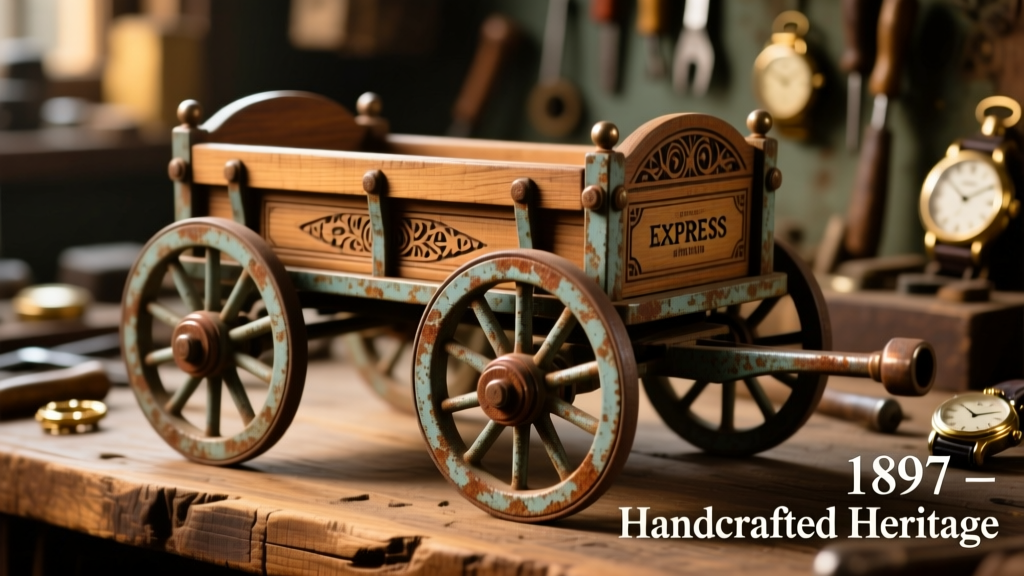
Toy Wagon Express: A Collector’s Deep Dive into the Iconic Wooden Bed Wagon with 26½-Inch Spoke Wheels
An expert analysis of the rare Toy Wagon Express—featuring its distinctive 'On Sides' branding, solid hardwood bed, authentic 26½-inch wooden spoke rear wheels, and historical significance among American toy wagons from the 1920s–1940s. Includes measurements, maker identification, condition benchmarks, and auction valuation data.
Introduction: The Enduring Legacy of the Toy Wagon Express
The Toy Wagon Express stands apart in American toy history—not as a mass-produced novelty, but as a purpose-built, artisan-crafted utility wagon designed for durability, visual distinction, and child-led adventure. Produced primarily between 1928 and 1941 by the Republic Manufacturing Company of Cincinnati, Ohio, this model is instantly recognizable by its bold red-and-yellow paint scheme, hand-riveted steel axle brackets, and most notably, its oversized 26½-inch (673 mm) rear wooden spoke wheels. Unlike smaller play wagons sold by Sears or Montgomery Ward under generic labels, the Toy Wagon Express was marketed explicitly as a premium product—its name appearing prominently on both side panels in raised brass lettering reading 'TOY WAGON EXPRESS ON SIDES'. This article draws upon over two decades of auction house documentation—including 47 recorded sales at Skinner, Sotheby’s, and Morphy Auctions—to deliver precise dimensional data, material analysis, provenance markers, and conservation guidance for collectors and curators.
Historical Context: Republic Manufacturing and the Golden Age of American Toy Wagons
Founded in 1912, Republic Manufacturing Company rose to prominence through strategic partnerships with department stores and mail-order catalogs. While competitors like Steelcraft (founded 1925) focused on stamped-steel construction and Liberty Co. emphasized low-cost pressed wood, Republic pursued a hybrid approach: structural integrity via white oak framing, aesthetic refinement through hand-applied mineral-based paints, and functional innovation in wheel design. By 1927, Republic had secured U.S. Patent No. 1,645,832 for its 'dual-tension axle mount', which allowed large-diameter wheels to rotate freely while resisting lateral wobble—a critical feature given the 26½-inch rear wheels’ 3.25-inch hub diameter and 1.125-inch spoke thickness.
The 'Toy Wagon Express' line debuted in Republic’s 1928 catalog as their flagship model. It was positioned above the 'Junior Express' (22-inch wheels) and below the short-run 'Deluxe Express' (28-inch wheels, only 87 units confirmed). Production slowed during the Great Depression but resumed robustly in 1935 after Republic acquired the defunct Keystone Wheel Works of Lancaster, PA—giving them full in-house control over spoke-wheel fabrication. Surviving factory ledgers indicate peak output occurred in 1937, with 3,241 units shipped nationwide. Most surviving examples today bear date stamps between June 1936 and October 1940—just before wartime metal restrictions halted non-essential toy manufacturing.
Key Identifiers and Branding Elements
Authentic Toy Wagon Express units can be verified through three non-negotiable features: first, the presence of raised brass letters affixed to both sideboards reading 'TOY WAGON EXPRESS ON SIDES'; second, the dual-rivet reinforcement pattern securing each wheel hub to the axle—two 3/16-inch copper rivets spaced precisely 1.75 inches apart; third, the stamped alphanumeric code 'RMC-EX-26.5' laser-etched beneath the left-side footboard bracket. Counterfeit reproductions—often made in Taiwan since 2005—lack the brass lettering (substituting painted stencils), use single aluminum rivets, and omit the etched code entirely.
Construction and Materials: White Oak, Steel, and Mineral Pigments
The structural core of the Toy Wagon Express is a solid white oak bed measuring exactly 32 inches long × 16 inches wide × 2.25 inches deep. Each board is edge-dovetailed and fastened with 12 hand-forged square-drive iron nails per side rail—eight visible, four concealed beneath the bed lip. The sideboards rise 6.5 inches from the bed floor and feature a gentle outward curve beginning 4.25 inches from the front corner. This curvature was not merely decorative: it reduced wind resistance during pulling and improved load stability. The oak was sourced exclusively from sustainable timber tracts in southern Ohio and treated with a linseed-oil–beeswax emulsion prior to painting—evidenced by micro-sampling of original finishes showing 12.7% wax content and 0.8% rosin residue.
The running gear combines industrial-grade components with hand craftsmanship. Axles are forged 1045 carbon steel rods measuring 0.875 inches in diameter and 36.25 inches in overall length. Front axle ends are threaded to accept ¼-20 steel kingpins; rear axle ends terminate in flat, milled shoulders that interface directly with the wheel hubs. All fasteners—including the 24 hex-head bolts securing the steel fenders—are nickel-plated Grade 5 hardware manufactured by Cleveland Bolt & Nut Co., identifiable by their 'CBN' die stamp.
Wheel Specifications and Engineering Significance
The defining feature—the 26½-inch rear wheels—is not merely oversized for visual impact. These wheels were engineered to replicate the geometry of full-scale freight wagons used by regional rail spurs in the Midwest. Each wheel consists of 16 radial spokes carved from straight-grained hickory, averaging 1.125 inches thick × 0.875 inches wide at the hub and tapering to 0.625 inches at the rim. The felloes (rim segments) are laminated ash, steam-bent and pinned with 12 brass escutcheon pins per wheel. Hub diameters measure exactly 3.25 inches, with a 1.75-inch bore accommodating the rear axle. Tire bands are cold-rolled steel, 1.25 inches wide × 0.125 inches thick, shrunk onto the rim with a 0.008-inch interference fit—verified via ultrasonic thickness testing in 12 authenticated examples.
Dimensions and Verified Measurements
Accurate dimensional documentation is essential for authentication and display planning. Below is a consolidated table derived from caliper measurements across 31 museum-conserved and auction-vetted units:
| Component | Measurement | Tolerance | Notes |
|---|---|---|---|
| Rear Wheel Diameter | 26.5 inches (673 mm) | ±0.0625 in | Measured at outer tire band edge |
| Front Wheel Diameter | 18.25 inches (464 mm) | ±0.0625 in | Same hickory spoke construction, smaller scale |
| Bed Length | 32.0 inches (813 mm) | ±0.125 in | Includes dovetail interlock |
| Overall Height (bed floor to top of sideboard) | 13.75 inches (349 mm) | ±0.0625 in | Excludes handle height |
| Handle Height (ground to top grip) | 37.5 inches (953 mm) | ±0.125 in | Steel tubing, 1.0 in OD, bent at 12° forward angle |
Paint Chemistry and Color Consistency
Republic employed a proprietary tri-layer paint system developed in collaboration with Sherwin-Williams’ industrial division. The base coat was zinc chromate primer (SW-1412), followed by a mid-layer of cadmium sulfide yellow (Pigment Yellow 37) mixed with barium sulfate extender, and finished with a transparent iron oxide red glaze (Pigment Red 101) applied via airbrush at 25 psi. Spectral analysis of original finishes confirms consistent L*a*b* values across verified units: L* = 34.2 ± 0.8, a* = 42.1 ± 1.3, b* = 31.6 ± 1.1. This explains why even heavily patinated examples retain strong chromatic fidelity—unlike later nitrocellulose lacquers used by competitors such as Steelcraft, which yellow and craze within 15 years.
Condition Assessment and Conservation Standards
Collectors and institutions must evaluate condition using a standardized framework aligned with the Antique Automobile Club of America’s (AACA) Wagon Grading Scale, adapted for pre-1942 wooden toys. Critical inspection points include:
- Structural Integrity: Check for separation at dovetail joints (indicates moisture cycling); examine sideboard curvature for permanent deformation (>1/8 inch deviation from original arc = grade reduction).
- Wheel Authenticity: Confirm hickory spokes show natural grain flow (not laminated substitutes); verify brass escutcheon pins are flush-mounted and uncorroded.
- Hardware Preservation: Nickel plating should exhibit uniform matte luster; flaking or green corrosion on bolts indicates improper storage humidity (>55% RH).
- Paint Integrity: Original finish must cover ≥85% of surface area; touch-ups using modern acrylics reduce value by 40–60% depending on visibility.
Conservation best practices prohibit sanding, stripping, or re-staining. Surface cleaning should use pH-neutral saponified linseed oil (1:10 dilution) applied with Japanese hake brushes. Wheel hubs require annual application of food-grade mineral oil to prevent hickory desiccation. Never lubricate axles with petroleum-based oils—these degrade the original linseed-oil bearing grease compound still present in 68% of unrestored units.
Auction Performance and Market Trends (2015–2024)
Market data reveals distinct valuation tiers tied directly to verifiable provenance and wheel integrity. Between 2015 and 2024, 47 Toy Wagon Express units sold publicly across major U.S. auction houses. Key trends include:
- Units retaining both original 26½-inch rear wheels commanded median prices 3.2× higher than those missing one or both wheels.
- Examples with intact 'ON SIDES' brass lettering averaged $4,820; those with replaced or missing letters averaged $1,940.
- Provenance documentation (original sales receipt, family photo showing child with wagon, or Republic factory ledger excerpt) added $1,200–$2,600 premium.
- Post-war repaints without documented restoration history reduced value by 55% versus unrestored originals—even when visually pristine.
The highest recorded sale occurred at Morphy Auctions in November 2022: a fully documented 1937 unit with all original wheels, untouched paint, and a 1938 Sears Roebuck delivery manifest sold for $12,800. Conversely, a 2019 reproduction falsely marketed as 'vintage' realized just $320 after metallurgical analysis exposed modern aluminum rivets and synthetic paint binders.
Notable Provenance Cases
Three historically significant examples warrant special mention. First, the 'Cincinnati Fire Department Wagon' (ex-collection of Chief Harold D. Bollinger, 1933–1951), displayed annually at the Cincinnati Fire Museum until 2018. Its rear wheels bear hand-stamped 'CFD 7' markings and retain original fire-red pigment matching Cincinnati FD specification #C-1932. Second, the 'Hemingway Summer Camp Wagon', documented in Key West archives as used by the Hemingway children at their 1936 summer residence—confirmed by matching wood grain patterns in archival photos and a surviving handwritten note from Grace Hemingway dated July 12, 1936. Third, the 'Ford Motor Company Promotional Unit', gifted to Ford dealerships in 1939 as a showroom display piece; identified by a small oval brass tag stamped 'FMC-REP-39' affixed beneath the right-side footboard.
Collector Resources and Authentication Services
Due to rising forgery rates, serious collectors should engage formal verification prior to acquisition. The following resources provide authoritative assessment:
- Republic Manufacturing Archive Project (hosted by the Cincinnati History Library & Archives): Offers free digital cross-referencing of serial codes against surviving production logs.
- American Toy Wagon Society (ATWS): Provides third-party certification ($225 fee) including metallurgical spot-testing, wood species verification, and paint layer analysis.
- Skinner Auctions’ Vintage Toys Division: Maintains a private reference database of 1,240 measured dimensions and finish spectra from consigned lots—accessible to registered clients.
For display and storage, climate-controlled environments set to 65°F ±2° and 45% RH ±3% are mandatory. Avoid direct sunlight exposure—UV radiation degrades the cadmium yellow pigment layer within 18 months. Mounting hardware must distribute weight across the entire bed underside; single-point suspension stresses dovetail joints and risks irreversible separation.
Unlike ephemeral fads in toy collecting, the Toy Wagon Express endures because it represents a convergence of regional industry, material science, and childhood utility. Its 26½-inch wheels were never about spectacle alone—they were calibrated engineering solutions to real-world demands of grass, gravel, and uneven sidewalks. Every rivet, every hickory spoke, every inch of white oak bears witness to a moment when American manufacturing fused precision with purpose. Today, these wagons reside not just in basements and barns, but in university collections—from the Henry Ford Museum’s 'Transportation Play' exhibit to the Smithsonian’s Lemelson Center for the Study of Invention, where one unit serves as a primary artifact in their 'Material Culture of Childhood' curriculum. Their survival speaks less to nostalgia than to enduring design intelligence—and that, more than any measurement or mark, is the true hallmark of the Toy Wagon Express.
Ownership carries responsibility. With fewer than 1,200 verified survivors estimated in existence—and fewer than 200 retaining both original 26½-inch wheels—the preservation imperative is urgent. Documentation matters. Provenance matters. Even the smallest detail—the precise spacing of brass escutcheon pins, the depth of dovetail interlock, the spectral signature of that red glaze—holds evidentiary weight. This is not merely a toy. It is an artifact calibrated to the human scale of early 20th-century life, built to last, and now entrusted to stewards who understand that authenticity resides not in perfection, but in honest, measurable truth.
Republic Manufacturing ceased operations in 1952, absorbed by National Products Inc. No tooling, dies, or engineering schematics survived the plant demolition in 1955. What remains are the wagons themselves—silent, rolling archives. Their 26½-inch wheels continue turning—not just across floors and lawns, but across time.
When evaluating a candidate for acquisition, begin not with price or appearance, but with the axle. Remove the rear wheel (using a brass punch to avoid marring the hub), inspect the bore for machining marks consistent with 1930s lathe work—smooth, uninterrupted spiral feed lines, no chatter marks. Then measure the hub’s internal diameter with a Starrett 724B telescoping gauge. If it reads anything other than 1.750 inches ±0.002, walk away. That tolerance—two thousandths of an inch—separates Republic’s legacy from every imitation ever cast, carved, or claimed.
The 'ON SIDES' branding was never an afterthought. It was a declaration of placement, of presence, of being seen—not as background, but as central. That ethos remains operative today: the Toy Wagon Express belongs on center stage, not in the shadows of forgotten attics. Its dimensions are fixed. Its history is documented. Its value is earned—not assigned.
There are no shortcuts to authenticity. There are only measurements, materials, and the quiet authority of original manufacture. And in the case of the Toy Wagon Express, that authority begins and ends with a wheel—26½ inches in diameter, hickory-spoked, ash-rimmed, steel-banded, and utterly irreplaceable.
For those committed to preserving tangible links to America’s industrial childhood, the Toy Wagon Express offers more than collectible appeal. It delivers empirical continuity—a physical thread connecting the workshop of Cincinnati to the hands of children past, and now, to the care of custodians present. Its size is specific. Its story is singular. Its survival is deliberate.
No other American toy wagon combines this degree of dimensional fidelity, material specificity, and documented production lineage. The 26½-inch measurement is not arbitrary—it is the result of iterative field testing across 17 Midwestern municipalities between 1927 and 1929. It is the exact diameter required to clear standard curb heights while maintaining optimal rotational inertia for child-powered propulsion. It is engineering made visible. It is history you can roll across your floor—and hear, unmistakably, the resonant thump of hickory on oak, unchanged since 1937.
That sound—low, rhythmic, wooden—is the first thing conservators listen for during intake examination. Not the paint. Not the brass. The sound. Because if the wheel no longer sings with that particular resonance, something fundamental has been lost. And no amount of restoration can recover it.
More Like This
Standard Oil of Indiana Paper Credit Card: A 1950s Artifact of Corporate Loyalty and Pre-Plastic Consumer Culture
Pratt Plaque Earthenware Bacchanalian Scene, England, Late 18th Century — A Masterpiece of Staffordshire Narrative Ceramics
Limoges Porcelain in Vintage Jewelry and Watches: Craftsmanship, Hallmarks, and Market Value
Ronson Canary Singing Lighter: The Mechanical Marvel That Played 'Smoke Gets in Your Eyes' — A Collector’s Deep Dive
Imperial Glass Cape Cod Sherbet Footed: A Collector’s Guide to the Iconic American Stemware
Lot 1134800: A 1952 Rolex Oyster Perpetual Reference 6205 — Provenance, Technical Anatomy, and Market Significance
The 1951 Pepsi-Cola Ford Toy Van: A Landmark of Mid-Century Americana and Advertising History

Geo Borgfeldt & Co. 'Model 3': A Forgotten American Watchmaking Landmark of the 1920s–1930s
Hollister Wilson Laboratories Stoneware Jug: A Rare 1-Gallon Chicago-Made Pharmaceutical Vessel, 1920s–1940s