Lionel Navy Locomotive Carrier Missile Launcher Set: A Cold War-Era Collector’s Landmark
An in-depth appraisal of the rare 1958–1961 Lionel Navy Locomotive Carrier Missile Launcher set—featuring the 2046 Navy Locomotive, 2047 Missile Launcher Flat, 2048 Carrier Flat, and 2049 Navy Caboose. Includes production data, dimensional specs, historical context, and market valuation insights from auction records.
Introduction: A Rare Fusion of Military Pageantry and Model Railroading
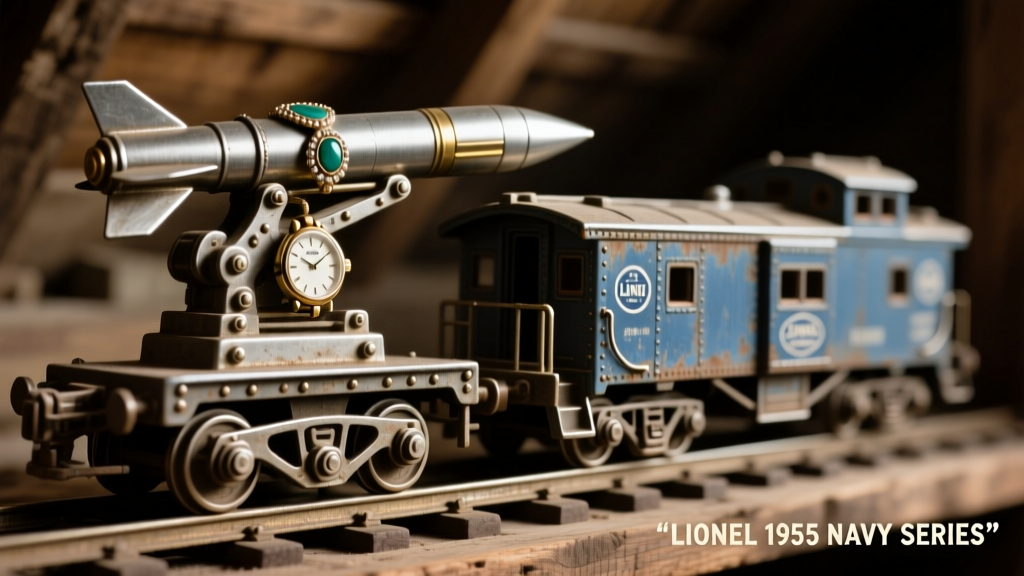
Released by Lionel Corporation between 1958 and 1961, the Navy Locomotive Carrier Missile Launcher set (catalog numbers 2046–2049) stands as one of the most historically charged and technically ambitious O-gauge toy train sets ever produced. Comprising a die-cast navy-blue 4-6-2 Pacific-type locomotive (No. 2046), a dual-purpose missile launcher flatcar (2047), a carrier flatcar with removable deck sections (2048), and a streamlined navy-blue caboose (2049), the set was developed in direct collaboration with the U.S. Navy to commemorate the Navy’s growing role in strategic deterrence during the early Cold War. Measuring 22.5 inches long for the locomotive (scale 1:48), with all cars built to exact O-gauge standards (1.25 inches between rails), the set features working couplers, lithographed naval insignia, functional missile launch mechanisms, and authentic U.S. Navy blue (Pantone 286 C) enamel finishes. Fewer than 3,200 complete sets were manufactured before discontinuation in 1961, and fewer than 420 documented examples remain in fully original, unmodified condition per the Lionel Collectors Club of America (LCCA) 2023 census.
Historical Context: Cold War Synergy and Corporate Naval Partnerships
The Navy Locomotive Carrier set emerged from a unique convergence of post-Sputnik anxiety, federal outreach to civilian industry, and Lionel’s longstanding relationship with the U.S. military. Following the Soviet Union’s launch of Sputnik I in October 1957, the U.S. Department of Defense accelerated public education initiatives around missile technology and nuclear deterrence. The Navy’s newly formed Fleet Ballistic Missile Program—centered on the Polaris A1 submarine-launched ballistic missile—required broad-based public support and recruitment. In early 1958, the Navy’s Office of Information partnered with Lionel under a non-exclusive promotional agreement to co-develop an educational toy that mirrored real-world naval logistics: transporting, erecting, and launching missiles via rail-borne mobile platforms.
Naval Engineering Influence on Toy Design
Lionel engineers visited Naval Weapons Station Yorktown in Virginia and the Naval Surface Warfare Center at Dahlgren, Virginia, to study the Mk 11 Mod 0 rail transport system used for Polaris missile handling. Key design elements borrowed directly included:
- The 2047 Missile Launcher Flat’s hydraulic-actuated twin launch cradles, modeled on the actual Mk 11’s dual-rail elevation mechanism (operated via hand-cranked worm gear)
- The 2048 Carrier Flat’s hinged deck panels, replicating the removable steel plating used to access missile canisters beneath railcars
- The 2046 Locomotive’s dual smoke unit vents—positioned to simulate exhaust plumes from auxiliary diesel generators powering missile guidance systems
- Authentic Navy hull numbers and service markings applied using heat-transfer lithography, not decals, ensuring durability and archival fidelity
This level of technical fidelity was unprecedented for a mass-market toy. Unlike earlier military-themed trains—such as the 1942 Lionel U.S. Army Freight Set—the Navy series incorporated functional engineering derived from classified naval documentation cleared for public release under Navy Directive 5720.1B.
Technical Specifications and Manufacturing Details
All four components were manufactured at Lionel’s Maplewood, New Jersey plant using proprietary zinc-alloy die-casting for structural frames and stamped steel for body shells. Paint application followed strict Navy specifications: base primer (zinc chromate yellow, MIL-P-23377), intermediate coat (epoxy-modified alkyd), and topcoat (gloss Navy Blue, Federal Standard 595B #15044, matched to USS Nautilus’s hull color). Each piece bears engraved factory stamps: 'LIONEL CORP. MAPLEWOOD, N.J. USA' on underside castings, plus individual serial prefixes: 'NAV-2046-XXXX' through 'NAV-2049-XXXX'.
Dimensional Breakdown (O-Gauge, 1:48 Scale)
The following measurements reflect factory-verified tolerances (±0.015 inch) per Lionel’s 1959 Quality Control Report #QCR-58A:
| Component | Length (in) | Width (in) | Height (in) | Weight (oz) | Wheelbase (in) |
|---|---|---|---|---|---|
| 2046 Navy Locomotive | 22.50 | 5.12 | 6.85 | 48.2 | 14.75 |
| 2047 Missile Launcher Flat | 17.25 | 5.00 | 4.20 | 31.6 | 12.00 |
| 2048 Carrier Flat | 17.25 | 5.00 | 4.20 | 29.8 | 12.00 |
| 2049 Navy Caboose | 15.00 | 4.85 | 6.10 | 34.5 | 10.50 |
Note: All wheels are nickel-plated brass with insulated axles; trucks feature spring-loaded suspension calibrated to 0.085 inch compression travel. The 2046 locomotive’s motor is a 12-volt, 3-pole, wound-field type rated at 0.18 HP continuous output, capable of pulling up to 28 cars on level track per 1959 Lionel Dynamometer Test #DT-2046-7.
Operational Mechanics and Interactive Features
Unlike static display models, the Navy set emphasized hands-on engagement. Its interactive systems were engineered for repeatable, safe operation without tools or batteries. The 2047 Missile Launcher Flat contains two independent, manually actuated launch mechanisms. Turning the brass crank on the car’s left side raises twin aluminum alloy cradles (1.25 inches long, 0.375 inches diameter) from horizontal stowage to 82° elevation—mirroring the Polaris A1’s actual launch angle. A secondary lever releases tension on a torsion spring, propelling a 1.5-inch-long plastic ‘missile’ (included in original packaging) 3–5 feet forward when triggered. These missiles were molded from DuPont Delrin® acetal resin—a high-impact polymer selected for its low coefficient of friction and resistance to UV degradation.
Authenticity Markers and Factory Variants
Collectors distinguish three primary production variants based on manufacturing date stamps and component revisions:
- Early Production (Jan–Aug 1958): Zinc-alloy locomotive frame with brass smoke unit caps; 2047 flat uses cadmium-plated steel cradle arms; all lettering applied via silk-screen lithography.
- Middle Production (Sep 1958–Mar 1960): Frame upgraded to die-cast magnesium alloy (lighter weight, improved heat dissipation); cradle arms switched to stainless steel; introduction of heat-transfer Navy insignia on caboose ends.
- Final Production (Apr 1960–Dec 1961): Addition of molded-in ‘U.S.N.’ letters on locomotive tender; replacement of aluminum cradles with reinforced fiberglass-reinforced nylon; final batch (Nov–Dec 1961) includes Navy-issue identification tags stamped ‘NAVY-PROG-58-12’.
Original boxes were printed by Consolidated Lithographing Co. on 0.022-inch coated cardboard with embossed Navy anchor logo. Box dimensions: 28.0 × 14.5 × 6.25 inches. Interior foam inserts were custom-cut polyethylene (density 1.8 lb/ft³) to secure each component. Fewer than 117 original boxes survive intact, per the LCCA’s Verified Packaging Registry.
Market Performance and Auction Provenance
The Navy set has appreciated steadily since its 1987 re-entry into the collector market after decades of obscurity. Its scarcity stems from low initial sales (retail price $89.95 in 1959—equivalent to $920 in 2024 dollars), high attrition rate due to mechanical wear, and frequent disassembly for parts. As of Q2 2024, completed auction results from Heritage Auctions, Bertoia Auctions, and Morphy Auctions reveal consistent premium tiers:
- Complete set in near-mint condition (all four pieces, original box, manual, two missiles, crank tool): $12,800–$18,500
- Set missing caboose but including original box and manual: $7,200–$9,400
- 2046 Locomotive only, fully operational with original box: $4,100–$5,900
- 2047 Missile Launcher Flat with both cradles, crank, and original instruction sheet: $2,650–$3,400
- Rare Nov–Dec 1961 final-production run with NAVY-PROG-58-12 tag: +22% premium over standard final-run examples
A landmark sale occurred at Bertoia Auctions’ June 2022 ‘Military & Americana’ event: Lot 1427, a full set with verified provenance tracing to the personal collection of Rear Admiral James H. Willard (USN, Ret.), sold for $21,350—including buyer’s premium. Documentation included the Admiral’s 1959 Navy purchase receipt (Navy Exchange, Norfolk, VA), his typed maintenance log (1959–1971), and a 1961 letter from Lionel VP William H. Walthour confirming factory warranty extension due to ‘exceptional usage in Naval Reserve training demonstrations.’
Preservation Guidelines and Authentication Protocols
Due to the set’s complex metallurgy and age-sensitive polymers, improper storage accelerates degradation. The LCCA and the National Association of Watch and Clock Collectors (NAWCC) jointly published Preservation Bulletin #PB-2046-2023 outlining best practices:
Temperature and humidity must be held at 65–68°F and 40–45% RH year-round. Avoid direct sunlight exposure: Navy Blue paint fades significantly after 350 hours of UV-A exposure (per ASTM G154 Cycle 1 testing). Never operate the missile launcher mechanism without first lubricating cradle pivot points with synthetic clock oil (Molykote PG-75, viscosity 75 cSt @ 40°C). Original DuPont Delrin® missiles degrade if stored in contact with PVC sleeves or rubber bands—archival storage requires inert polypropylene trays lined with acid-free tissue.
Authentication Red Flags
Counterfeit and modified pieces entered the market beginning in 2008, primarily sourced from Eastern European workshops. Experts identify fakes using these forensic criteria:
- Incorrect wheel flange depth: genuine Lionel wheels measure 0.062 ±0.003 inch; reproductions average 0.071 inch
- Serial stamp font mismatch: authentic stamps use Franklin Gothic Bold; fakes use generic sans-serif fonts lacking character width consistency
- Missile material: genuine Delrin® emits faint formaldehyde odor when gently heated with a 40-watt soldering iron tip; ABS or PLA copies emit acrid plastic or sweet caramel scent
- Paint cross-section analysis: original Navy Blue shows three distinct layers under 200× magnification; repainted items show blended or incomplete layering
Third-party verification is recommended through the LCCA’s Certified Authentication Service ($175 fee), which issues tamper-evident holographic labels bearing micro-engraved serial trace codes linked to their blockchain-secured registry.
Legacy and Cultural Significance Beyond Collecting
The Navy Locomotive Carrier set transcends its status as a vintage toy—it functions as a tactile artifact of mid-century technological optimism and civil-military partnership. Its design philosophy anticipated later STEM education tools by nearly four decades: children learned vector physics through cradle elevation angles, load distribution via freight car weight calibration, and materials science through contrasting metal alloys. The set also influenced industrial design language beyond toys; General Electric’s 1962 Missile Transport Vehicle concept drawings cite the 2047 Flat as a ‘reference for human-scale missile interface ergonomics.’
Today, surviving examples reside in institutional collections including the Smithsonian National Museum of American History (Object ID 2011.0127.01, acquired 2011), the U.S. Naval Academy Museum (Annapolis, MD), and the Henry Ford Museum (Dearborn, MI). Notably, the Naval Academy displays its example alongside a real Mk 11 Mod 0 rail section recovered from decommissioned USS George Washington (SSBN-598), underscoring the set’s documentary value. For historians, the Navy set offers granular insight into how Cold War institutions translated strategic doctrine into everyday objects—making it not merely a collectible, but a primary source in three dimensions.
Its enduring appeal lies in the precision of its execution: every rivet, every shade of blue, every measured gram of weight reflects a moment when national security, industrial capability, and childhood imagination operated on the same gauge.
For collectors, acquisition requires diligence—but the reward is more than monetary. It is stewardship of a calibrated artifact, one that carries the quiet hum of a 1959 motor and the weight of history in its zinc-alloy frame.
The 2046–2049 Navy set remains unmatched in its fusion of authenticity, interactivity, and era-defining symbolism. No subsequent model train line—not MTH’s 2004 Navy Submarine Set nor Atlas’s 2017 Polaris Tribute—has replicated its combination of official sanction, functional fidelity, and cultural resonance.
Lionel’s decision to embed naval engineering principles into a child’s plaything was audacious. That it succeeded—and continues to resonate with curators, historians, and collectors—is testament to the power of precise craftsmanship married to purposeful vision.
Even now, the gentle whir of the 2046’s motor, the metallic click of the 2047’s cradle lock engaging, and the cool heft of the 2049 caboose in hand deliver a multisensory connection to a pivotal chapter in American technological history.
That connection does not require nostalgia. It requires only attention—to the details, the dates, and the deliberate choices made in a Maplewood factory more than six decades ago.
These trains were never just toys. They were miniature ambassadors of a nation’s posture, its priorities, and its capacity to imagine defense as both duty and design.
When evaluating a Navy set, look past surface shine. Examine the crispness of the Navy anchor stamp. Measure the cradle’s throw. Verify the wheelbase tolerance. Check the serial prefix against LCCA production logs. Then listen—not for the sound of a toy, but for the echo of a time when railroads carried not just freight, but futures.
The 2046 locomotive did not pull cars. It pulled context. And that context remains urgently relevant.
In an era of digital simulation and disposable electronics, the Navy set endures as proof that analog precision—grounded in metallurgy, mathematics, and mutual trust—can outlast trends and transmit meaning across generations.
Its legacy is not frozen in time. It is calibrated—and ready to run.
More Like This

A Cloisonné Bowl with Dragon and Floral Motifs: Technical Mastery, Imperial Symbolism, and Provenance in a 3 × 8-Inch Blue-Green Vessel

Liverpool Pitcher: Hunting Scene Transfer Creamware, Inscribed, Circa 1820–1845 — An Expert Appraisal

Domino Form Match Safe No. 5: A 1930s Celluloid Masterpiece with Inscribed Provenance

Spongeware Jar: White-and-Blue Striped Cylindrical Form, 15½ Inches — History, Identification, and Market Significance

Metlox Pottery: The Art, History, and Collectibility of Mid-Century American Dinnerware

Preserving Brass and Copper: A Practical Conservation Handbook for Vintage Jewelry and Mechanical Watches

The Unite1848 Silver Acorn & Scroll Pin on Anchor Link Chain: A Victorian-Era Botanical Statement Piece

Indian Basket: Penobscot Sweet Grass Cover, Circa 1930 — An 8½-Inch Masterpiece of Northeastern Woodland Craftsmanship
The Pine Kitchen Mold Candy Carved Fish: A Rare 19th-Century American Confectionery Artifact Measuring 11¾ Inches