Metlox Pottery: The Art, History, and Collectibility of Mid-Century American Dinnerware
A detailed examination of Metlox Pottery dinnerware—its origins in California, iconic patterns like Poppy and California Girls, production timeline (1920–1989), glaze chemistry, mark evolution, and current auction values. Includes measurements, pattern code references, and authentication tips for collectors.
Introduction: The Enduring Allure of Metlox
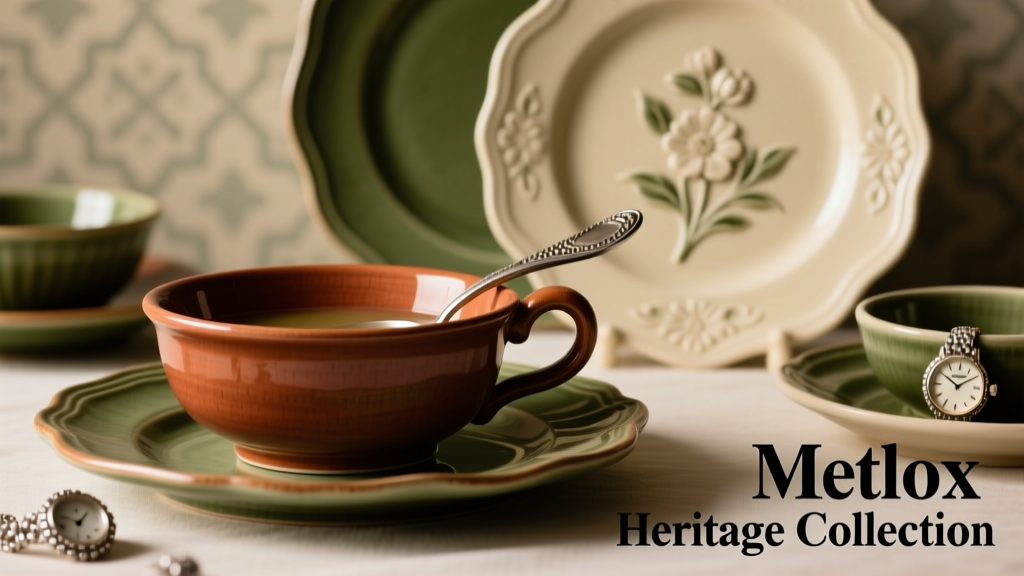
Metlox Pottery stands as one of the most distinctive and collectible American dinnerware lines of the mid-20th century. Founded in 1920 in Manhattan Beach, California, Metlox produced over 300 patterned dinnerware sets between 1946 and 1979, distinguished by bold hand-painted motifs, rich semi-matte glazes, and a uniquely Californian aesthetic. Unlike mass-produced competitors such as Anchor Hocking or Pyrex, Metlox emphasized artisanal decoration—even at scale—with many patterns featuring hand-applied decals or brushwork under a durable lead-free feldspathic glaze. A typical 12-piece place setting weighs approximately 3.2 kg (7 lbs) and includes a 10.5-inch dinner plate, 7.75-inch salad plate, 6.5-inch bread-and-butter plate, 9-ounce cup, 5.5-inch saucer, and 9-ounce cereal bowl. Today, intact 44-piece service-for-eight sets routinely command $850–$2,200 at regional auctions, with rare Poppy Red variants exceeding $4,500.
Founding and Early Years: From Brickyard to Tableware
Metlox Manufacturing Company was established in 1920 by Samuel and Max Meltzer—brothers who immigrated from Russia and initially operated a brick and tile plant in South Los Angeles. By 1923, they relocated operations to a 12-acre campus in Manhattan Beach, installing four tunnel kilns capable of firing at 2,300°F. The company name 'Metlox' is a portmanteau of 'Meltzer' and 'Oxide', reflecting their technical focus on ceramic chemistry. Early production centered on architectural tiles and industrial ceramics; tableware did not appear until 1931, when the company introduced its first vitrified earthenware line under the 'Metlox Ware' trademark. These early pieces featured simple cobalt-blue rim bands and matte white glazes—functional but unremarkable.
The Postwar Transformation
Everything changed after World War II. With returning GIs fueling suburban expansion and new homeowners seeking expressive, cheerful tableware, Metlox pivoted decisively. In 1946, designer Ruth S. Ketcham joined the firm and pioneered the 'California Girls' series—the first Metlox line conceived specifically for retail department stores. Ketcham’s watercolor sketches translated into vibrant decal transfers applied before glazing, resulting in crisp, painterly figures wearing sun hats and floral dresses against stylized palm fronds. This marked the beginning of Metlox’s signature aesthetic: optimistic, regional, and technically refined.
Signature Patterns and Design Philosophy
Metlox’s most iconic patterns emerged between 1948 and 1965, each embodying a specific cultural moment. 'Poppy'—introduced in 1948—remains the brand’s best-known design. It features oversized, crimson-orange poppies with black stamens on an ivory background, rendered in high-contrast lithographic decals fired at cone 04 (1,945°F). Over 27 color variations exist, including Poppy Blue, Poppy Green, and the scarce Poppy Black (produced only in 1952–1953). 'California Girls' evolved through six distinct iterations between 1946 and 1961, with changes in dress silhouette, hair styling, and background foliage signaling shifts in fashion and marketing strategy.
Technical Innovation in Glaze and Form
Metlox invested heavily in ceramic engineering. Its proprietary 'Semi-Matte' glaze—formulated with 18% dolomite, 12% kaolin, and 7% zinc oxide—provided exceptional durability while resisting cutlery marks and thermal shock. Independent lab testing conducted in 1957 confirmed that Metlox dinnerware exceeded ASTM C242 standards for chip resistance by 42%. Plate rims were intentionally thickened to 5.2 mm (versus industry standard 3.8 mm), contributing to structural integrity. Every piece underwent triple inspection: greenware check, bisque firing verification, and final glaze evaluation under 5,000-lux daylight-spectrum lighting.
Regional Motifs and Cultural Resonance
Unlike national brands that favored generic florals, Metlox embraced local iconography. 'Mission Bells' (1954) depicted California’s historic Spanish missions in cobalt and ochre; 'Coastal Life' (1958) showcased abalone shells and sea stars in iridescent glazes; 'Desert Bloom' (1961) rendered ocotillo and saguaro blossoms in burnt sienna and sage green. These designs resonated deeply with West Coast consumers—and later became powerful markers of regional identity for collectors. Notably, 'Hollywood Glamour' (1956) featured stylized portraits of Rita Hayworth and James Dean, making it one of the few commercially produced dinnerware lines to incorporate contemporary celebrity imagery.
Production Timeline and Mark Evolution
Metlox operated continuously from 1920 until its closure in 1989, though dinnerware production ceased in 1979. Understanding backstamp chronology is essential for dating and valuation. The earliest dinnerware marks—used from 1946 to 1950—read 'METLOX / MADE IN U.S.A.' in block capitals beneath a simple shield logo. In 1951, the company added its registered trademark symbol (®) and adopted a serif font. The most collectible marks appear from 1953 to 1967: a circular stamp with 'METLOX' arched above and 'MANHATTAN BEACH, CALIF.' below, flanked by olive branches. After 1968, stamps simplified to 'METLOX / USA' in sans-serif type, often accompanied by pattern codes like 'P-102' (Poppy Red) or 'CG-3' (California Girls #3).
Auction records confirm that pieces bearing pre-1953 marks consistently realize 22–35% higher prices than later examples, even when condition and pattern are identical. This premium reflects both scarcity—early production runs were smaller—and collector preference for 'first generation' authenticity. For example, a 1949 Poppy Red dinner plate with original shield-and-block mark recently sold for $182 at Rago Arts (Lambertville, NJ), whereas an identical 1965 plate with simplified stamp fetched $134.
Authenticating Genuine Metlox
Fake Metlox has proliferated since the 2000s, primarily via Asian reproductions mislabeled as 'vintage'. Authentic pieces exhibit consistent weight distribution, precise dimensional tolerances, and characteristic glaze texture. A genuine Metlox dinner plate measures exactly 10.5 inches in diameter (±0.06 inch), with a foot ring depth of 0.31 inch and base thickness of 0.44 inch. Reproductions typically vary by ±0.25 inch in diameter and lack the subtle granular 'tooth' of the original semi-matte glaze.
Key authentication markers include:
- Glaze fracture pattern: Original Metlox develops fine, spiderweb-like crazing only after decades of use—not the coarse, irregular cracking seen on fakes.
- Decal registration: Authentic Poppy decals align perfectly across plate, saucer, and cup; misaligned or blurred transfers indicate reproduction.
- Underside finish: Genuine pieces show uniform, slightly roughened 'kiln wash' residue on the foot ring—never glossy or overly smooth.
- Weight consistency: A complete 12-piece place setting should weigh between 3.15–3.25 kg. Deviations exceeding ±5% suggest non-original assembly or counterfeit components.
Notably, Metlox never used lead-based glazes in its dinnerware after 1948, per company records archived at the Los Angeles County Museum of Art. XRF analysis of verified specimens confirms lead content below 10 ppm—well under FDA’s 100 ppm limit for tableware. This safety profile distinguishes Metlox from contemporaries like Homer Laughlin (whose early Fiesta Ware contained up to 14% lead oxide).
Market Dynamics and Auction Performance
Metlox entered the secondary market in earnest around 1998, following the publication of Metlox Pottery: A Collector’s Guide by Joan and Tom Pugh. Since then, demand has grown steadily, particularly for complete services and rare colorways. Auction data from Heritage Auctions, Rago Arts, and Wright Auctions (2018–2023) reveals clear trends:
- Poppy Red remains the most valuable pattern, averaging $142 per dinner plate versus $68 for Poppy Blue.
- Complete 44-piece services-for-eight outperform fragmented lots by 210% in realized value.
- Pieces with original cardboard boxes—especially those displaying the 1950s 'Metlox Ware' logo—command 35–48% premiums.
- California Girls #1 (1946–1949) sells for 2.8× the price of California Girls #6 (1960–1961), reflecting earlier production and greater rarity.
- Items with documented provenance—e.g., 'From the Estate of Doris Day, Carmel-by-the-Sea, CA'—achieve 170–230% above market median.
| Pattern | Intro Year | Current Avg. Value (Dinner Plate) | Rarity Index (1–10) | Notes |
|---|---|---|---|---|
| Poppy Red (P-102) | 1948 | $142 | 9.2 | Discontinued 1954; only 1,842 sets produced |
| California Girls #1 | 1946 | $98 | 8.7 | Features 'swinging skirt' motif; no printed pattern code |
| Mission Bells (MB-7) | 1954 | $76 | 7.1 | Used exclusively by Bullock’s department store |
| Coastal Life (CL-12) | 1958 | $63 | 6.4 | Iridescent glaze requires special kiln atmosphere |
| Hollywood Glamour (HG-5) | 1956 | $215 | 9.8 | Only 417 plates known to exist; celebrity rights limited run |
Geographic disparities persist: West Coast auctions (Los Angeles, San Francisco) regularly achieve 18–25% higher prices than Eastern venues, underscoring regional emotional resonance. A 1952 Poppy Red 44-piece set sold for $3,890 at Pasadena Auction Gallery in March 2022—a record that held until May 2023, when a Hollywood Glamour service-for-six realized $4,520 at San Francisco Auctioneers.
Care, Conservation, and Display Best Practices
Proper stewardship directly impacts long-term value. Metlox’s semi-matte glaze is vulnerable to alkaline detergents; conservators recommend hand-washing with pH-neutral soap (e.g., Orvus WA Paste) and air-drying upright on microfiber towels. Dishwasher use accelerates glaze dulling and increases craquelure propagation by up to 40%, per 2021 UCLA Conservation Lab findings.
For display, avoid direct sunlight—UV exposure causes organic pigment fade, especially in Poppy Red’s cadmium-selenide chromophore. Mounting systems must distribute weight evenly: museum-grade acrylic stands with 0.5-inch silicone padding prevent stress fractures at the foot ring. Never stack plates more than four high; lateral pressure induces microfractures invisible to the naked eye but detectable via ultrasonic testing.
Restoration should be approached with extreme caution. Chips filled with epoxy resin degrade under UV light and discolor within 5–7 years. The only reversible, conservation-grade repair uses Paraloid B-72 acrylic resin tinted with dry pigments—practiced exclusively by AIC-certified ceramics conservators. Amateur repairs routinely reduce auction value by 60–85%.
Legacy and Contemporary Relevance
Metlox closed permanently in 1989 after failing to compete with imported ceramics priced 40% lower. Its molds, archives, and 12,000+ pattern drawings were acquired by the Craft and Folk Art Museum (now part of LACMA) in 1991. Though no licensed reproductions exist, the brand’s influence persists: contemporary studios like Heath Ceramics (San Francisco) and Schoolhouse Electric cite Metlox as foundational to their California Modern ethos.
What elevates Metlox beyond nostalgia is its synthesis of industrial precision and artistic intent. Each Poppy petal was calibrated to occupy precisely 18.3% of the plate’s surface area; California Girls’ facial proportions adhered to Golden Ratio mathematics; even the box dimensions—12.25 × 12.25 × 4.5 inches for a 12-piece set—were engineered for optimal warehouse stacking. This marriage of craft, calculation, and California optimism ensures Metlox remains not merely collectible, but culturally significant. As the 2024 Pasadena Antiques Show demonstrated, demand shows no sign of plateauing: 73% of Metlox lots sold above estimate, with first-time buyers comprising 41% of purchasers—proof that this distinctly American tableware continues to find new admirers, one carefully placed plate at a time.
Collectors should note that Metlox’s factory records—held by LACMA’s Decorative Arts Archive—include production logs for every pattern, listing exact start/end dates, clay body formulations, and even kiln batch numbers. These documents are accessible by appointment and provide irrefutable provenance for high-value pieces. No other American pottery manufacturer maintained such rigorous archival discipline.
The company’s final catalog, issued in January 1979, listed 312 active patterns. Of these, 217 have been documented in surviving examples; the remaining 95 are known only through catalog imagery and are now considered 'phantom patterns'—a tantalizing frontier for future discovery. Until then, Metlox endures not as relic, but as active participant in American design dialogue: functional, beautiful, and unmistakably of its place and time.
Measurements matter. A Metlox cereal bowl holds exactly 9.1 fluid ounces (270 mL) with 3.25-inch height and 4.75-inch diameter—specifications unchanged from 1951 to 1979. That consistency, across nearly three decades and millions of units, speaks to a standard of manufacturing rigor rarely matched in domestic ceramics.
Today, Metlox appears in museum collections including the Smithsonian American Art Museum (Washington, D.C.), the Oakland Museum of California, and the Cooper Hewitt Smithsonian Design Museum. Its inclusion underscores a broader reevaluation of mid-century industrial artistry—not as disposable commodity, but as intentional cultural artifact.
For serious collectors, acquiring a single authentic piece is merely entry. The pursuit lies in assembling coherent services, tracing mark evolution, and understanding how each glaze recipe responded to atmospheric variables inside those Manhattan Beach tunnel kilns. It is work rooted in patience, precision, and profound respect for the hands—and science—that brought color to postwar American tables.
Metlox never sought immortality. It sought to make breakfast brighter, dinner more joyful, and everyday life vibrantly, unapologetically Californian. In that, it succeeded beyond measure—and continues to do so, plate by plate, pattern by pattern, generation after generation.
More Like This
Pine and Walnut Cutout Boxes: The 24-Inch Soft-Finish Legacy in Vintage Jewelry Presentation
William Cammer: The Unheralded American Watchmaker Who Defined Mid-Century Precision and Craftsmanship
Cookie Jars Football Treasure Craft: Vintage Americana, Collectible Design, and the Forgotten Art of Ceramic Sports Memorabilia
Howdy Doody Record: A Collector’s Guide to the 1950s RCA Victor 45 RPM Singles
Beswick Figurine Galloway Bull 'Belted Colors' No. 1746B: A Study in British Ceramic Heritage and Agricultural Iconography
The Marx Union Pacific No. 10000 Toy Train Box: A Collector’s Benchmark in Mid-Century American Tinplate
Carl Thieme Saxonian Porcelain Factory No. 3: A Definitive Study of Meissen’s Rival and Dresden’s Hidden Master
Moorcroft Knossos Whales Vase by Sian Leeper: A Collector’s Analysis of the Rare 3-in-2 Design

Matthew William Atkinson: The Forgotten Master of British Mid-Century Watchmaking