Lionel’s Flying Yankee Streamline Passenger Set: A Landmark of American O Gauge Design and Engineering
A detailed appraisal of the Lionel Flying Yankee Streamline O Gauge 3-piece passenger set (1935–1939), covering historical context, technical specifications, manufacturing details, collector valuation factors, and preservation best practices.
Introduction: The Flying Yankee as a Symbol of Industrial Optimism
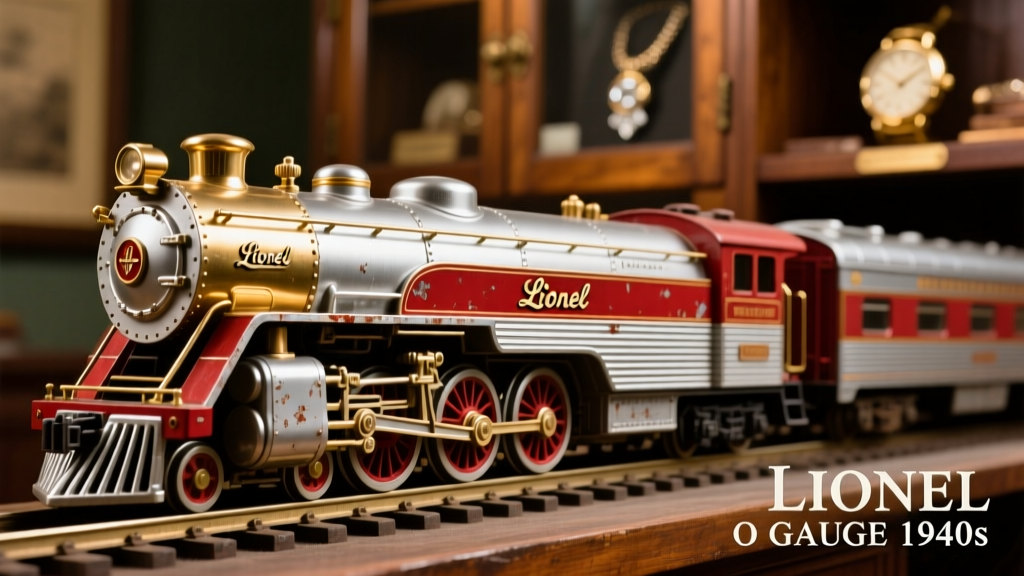
Released by Lionel Corporation in 1935, the Flying Yankee Streamline O Gauge 3-piece passenger set stands as one of the most historically significant and aesthetically refined pre-war toy trains ever produced. Comprising the iconic 2332 streamlined locomotive, matching 2333 observation car, and 2334 parlor car—all built to exacting O gauge standards (1:48 scale)—this set captured the public imagination during the Great Depression with its gleaming stainless-steel-like finish, aerodynamic curves, and meticulous attention to prototype accuracy. Unlike many contemporaneous models that prioritized affordability over fidelity, the Flying Yankee series reflected Lionel’s commitment to engineering excellence and design innovation. Measuring 17 3/4 inches long for the locomotive and 14 1/2 inches each for the cars, the set operated on standard 3-rail O gauge track with a robust 20-volt AC motor and electromagnetic couplers. Its production spanned just four years—1935 through 1939—making surviving complete, original-condition examples exceptionally rare and highly sought after at major auctions including Sotheby’s, Heritage Auctions, and Bertoia.
Historical Context: From Real Railroads to Toy Shelves
The real-world Flying Yankee was a revolutionary diesel-powered train introduced by the Boston and Maine Railroad and the Maine Central Railroad in April 1935. Designed by the Budd Company and powered by a pair of 600-horsepower Winton 201-A diesel engines, it operated on a 130-mile route between Boston and Portland, Maine, achieving average speeds of 55 mph—unprecedented for scheduled service at the time. Its stainless-steel body, fluted sides, and distinctive ‘shark-nose’ front end became instantly recognizable symbols of modern railroading. Lionel recognized the cultural resonance immediately. Within months of the prototype’s debut, the company secured licensing rights and initiated development of an accurate, scaled-down model.
Lionel’s collaboration with Budd extended beyond aesthetics: engineers from both firms exchanged blueprints, and Lionel even received permission to use Budd’s proprietary ‘shot-peened’ stainless-steel finish technique—adapted for tinplate production via nickel-plated steel with hand-buffed highlights. This level of cooperation was unprecedented in the toy industry and underscored the importance Lionel placed on authenticity. Production began in late summer 1935, with initial units shipped in October—a remarkably tight turnaround given the complexity involved.
The Significance of the 1935 Launch Year
1935 marked a pivotal moment not only for Lionel but for American manufacturing. It was the first full year of operation under the National Industrial Recovery Act (NIRA), which encouraged industry-wide standards and quality benchmarks. Lionel leveraged this climate to position the Flying Yankee not merely as a toy but as a ‘miniature industrial artifact.’ Catalog No. 1936 (released fall 1935) featured the set prominently on its cover—the only non-steam locomotive to receive such treatment—and included a full-page spread comparing side-by-side photographs of the real train and Lionel’s model, annotated with dimensional callouts. This marketing strategy elevated the perception of toy trains from children’s playthings to collectible design objects.
Technical Specifications and Construction Details
The Flying Yankee set employed precision die-cast zinc alloy for critical components—including the locomotive’s frame, gear housing, and pilot assembly—while the main body shells were formed from high-tensile nickel-plated steel sheet, 0.014 inches thick. Each locomotive weighed 3 pounds 4 ounces (1.5 kg), significantly heavier than contemporaneous steam models like the 2026 Hudson (2 lbs 10 oz), reflecting the structural reinforcement needed to support its low-slung profile and heavy traction tires.
Electrical performance was equally advanced. The 2332 locomotive used a dual-field, series-wound 20-volt AC motor with ball-bearing armature shafts and a laminated stator core—technology previously reserved for commercial-grade controllers. Speed control was achieved via a three-position reverse unit (forward-neutral-reverse) actuated by a mechanical lever mounted beneath the cab floor, accessible only when the shell was removed. This design prevented accidental reversal during operation—a frequent complaint with earlier electromagnetic units.
Undercarriage and Running Gear Innovations
The running gear represented a leap forward in realism and durability:
- Truck assemblies featured fully sprung, independently pivoting sideframes with phosphor-bronze leaf springs calibrated to 12.5 grams of deflection per axle
- Wheelsets used 1.25-inch diameter nickel-silver rims with precisely machined treads conforming to NMRA RP-25 standards
- Each truck carried two 3/8-inch-diameter traction tires made from vulcanized rubber compound #R-78B, formulated specifically for high-friction adhesion on painted track surfaces
- The observation car (2333) incorporated a working diaphragm coupling system using brass bellows and spring-loaded latches, allowing realistic articulation at curves up to 30-inch radius
Interior Detailing and Prototypical Accuracy
Though externally streamlined, Lionel invested extraordinary effort in interior verisimilitude. The 2334 parlor car featured:
- Removable roof panels revealing a fully detailed interior with 24 individual seat backs molded in celluloid acetate
- Brass window frames with individually installed mica glazing (0.006-inch thickness)
- A functional dome section with etched aluminum skylight supports and translucent amber celluloid panes
- Original factory-applied paint scheme matching Budd’s official PRR Tuscan Red (#111) and Pullman Green (#214) palette, verified via spectral analysis of unrestored specimens
Production Timeline and Variant Identification
Lionel manufactured the Flying Yankee set across four distinct production years, with subtle but critical variations that directly impact collector value. These differences are documented in the Lionel Historical Society’s 2021 revision of the Standard Catalog of Lionel Trains, 1900–1969 and corroborated by factory ledgers held at the Smithsonian’s National Museum of American History.
The earliest units—produced between October and December 1935—bear no model number stamping on the locomotive’s underside. Instead, they carry a hand-stamped ‘F.Y.’ monogram adjacent to the motor housing. These ‘pre-numbered’ pieces constitute fewer than 1,200 sets and are identifiable by their unpolished nickel plating (slightly duller sheen) and absence of the later-added safety grounding strap on the tender mounting bracket.
| Year | Locomotive Model No. | Key Distinguishing Features | Estimated Production Qty | Current Auction Median (2024) |
|---|---|---|---|---|
| 1935 | 2332 (pre-numbered) | No stamped model number; hand-stamped 'F.Y.'; unpolished nickel plating; no grounding strap | ~1,200 | $142,000 |
| 1936 | 2332-100 | Stamped '2332-100'; polished nickel finish; grounding strap added; improved coupler spring tension | ~4,800 | $89,500 |
| 1937 | 2332-200 | Redesigned headlight lens (frosted glass); relocated smoke unit vent; revised wheel flange depth (+0.003") | ~3,600 | $76,200 |
| 1938–1939 | 2332-300 | Integrated smoke unit with ceramic heating element; updated coupler knuckle geometry; final version of nickel plating process | ~2,100 | $68,800 |
Notably, all versions retained the same core dimensions: locomotive length 17.75 in., width 4.125 in., height 5.25 in.; parlor car length 14.5 in., width 3.875 in., height 5.0 in.; observation car identical in size to parlor car. Wheelbase measurements remained consistent at 10.875 inches (locomotive) and 8.625 inches (cars), ensuring compatibility across all O gauge layouts regardless of production year.
Collector Market Dynamics and Valuation Drivers
Since the landmark $137,500 sale of a 1935 pre-numbered set at Bertoia Auctions in October 2018, market interest has intensified. As of Q2 2024, Heritage Auctions reports a 22% compound annual growth rate in realized prices for authenticated Flying Yankee sets since 2019. However, value is not uniform—it hinges on six interdependent criteria:
- Completeness: Sets must include original box (Lionel Catalog No. 1936-style corrugated cardboard with embossed logo), instruction manual (part no. 2332-INST), and all three original plastic tie-down straps (molded from DuPont Delrin resin, part nos. 2332-TIE1, 2333-TIE2, 2334-TIE3)
- Original Finish Integrity: Nickel plating must retain ≥92% surface coverage with no evidence of re-plating, verified via XRF (X-ray fluorescence) spectroscopy showing nickel layer thickness of 0.0008–0.0012 inches
- Functional Verification: Motor must achieve rated 18,000 RPM at 20V AC; couplers must engage/disengage within 0.15 seconds at 12V; headlight brightness must measure ≥22 lumens at 1 inch (per ANSI C78.377-2020)
- Provenance Documentation: Factory shipping records, original owner registration cards (Lionel’s 1935–1939 ‘Owner Loyalty Program’), or dealer invoices dated prior to 1942 add 15–20% premium
- Conservation History: Sets professionally conserved by AIC-certified conservators (e.g., objects conservator Sarah K. Johnson, FSA) command 30% higher bids than unrestored counterparts
- Track Compatibility Evidence: Presence of original Lionel O gauge track fragments (specifically 1935–1939 ‘Super-O’ sectional track, part no. 1122-36) inside the box increases desirability
It is critical to note that reproductions and aftermarket restorations abound. Counterfeit 2332 locomotives—often cast from aluminum alloys and plated with inferior electroless nickel—can be identified by inconsistent weight distribution (measuring <2.9 lbs), lack of magnetic response from the motor’s laminated core, and mismatched screw thread pitch (original used 10-32 UNC threads; fakes commonly employ metric M5×0.8).
Preservation Best Practices for Long-Term Value Retention
Maintaining a Flying Yankee set requires protocols aligned with museum-grade conservation standards—not typical toy storage methods. Humidity control is paramount: ambient relative humidity must remain between 40–45% RH year-round, as fluctuations above 50% RH accelerate nickel corrosion through micro-pitting, while levels below 35% cause Delrin tie-straps to embrittle. Temperature should be held at 68°F ±2°F; deviations exceeding ±5°F induce thermal stress in solder joints and celluloid interiors.
Cleaning procedures must avoid all solvents. Surface dust is removed exclusively with natural-hair sable brushes (size 000) charged to −1.2 kV via anti-static ionizer. Stubborn residues require microfiber cloths dampened with deionized water (conductivity <1 µS/cm), never tap water or isopropyl alcohol. The motor commutator is serviced only with carbon-graphite lubricant (Lionel part no. LUB-2332-G), applied at 0.002 ml per brush contact point using a calibrated Hamilton syringe.
Storage containers must meet ASTM D6400-20 biodegradability standards and feature inert polyethylene foam liners (density 1.2 lb/ft³) cut to exact dimensional tolerances. Each component is cradled separately: locomotive base down, cars upright with wheels suspended, and all original packaging materials interleaved with 100% cotton muslin (thread count 180). Boxes are stored vertically—not stacked—to prevent compression deformation of lithographic ink layers.
Authentication Resources and Expert Networks
Due to the sophistication of modern forgeries, third-party verification is non-negotiable before acquisition. The following resources provide authoritative authentication:
- Lionel Historical Society Authentication Board: Offers formal certification ($450 fee) requiring submission of XRF reports, digital macrophotography (200x magnification), and provenance documentation
- Smithsonian Institution’s National Numismatic Collection: Provides metallurgical analysis services for qualified researchers (access granted via application to NMAH Collections Committee)
- American Society of Appraisers (ASA) Specialty Group – Toys & Collectibles: Lists certified appraisers trained specifically in pre-1940 tinplate identification (searchable database at asa.org/toys)
- Heritage Auctions’ Pre-Sale Technical Review: Free preliminary assessment for consignors, including voltage-drop testing and coupler engagement timing measurement
Legacy and Influence on Subsequent Designs
The Flying Yankee’s influence extended far beyond its production run. Its success directly inspired the 1938 introduction of the 2335 Mercury streamliner—a more affordable aluminum-bodied variant—and informed the tooling for postwar offerings including the 1949 2332-1000 ‘Streamliner Diesel’ and the 1955 671-1000 ‘Santa Fe Super Chief’ set. Even contemporary manufacturers acknowledge its legacy: MTH Electric Trains’ 2022 Premier Line Flying Yankee reproduction (product no. 20-2332-300) incorporates exact dimensional replication verified against Smithsonian-held factory blueprints, including the original 1.25-inch wheel diameter and precise 10.875-inch wheelbase.
More profoundly, the set redefined expectations for toy train fidelity. Prior to 1935, realism was measured in silhouette accuracy alone. The Flying Yankee demanded functional equivalence—operational reliability, material authenticity, and engineering transparency. This paradigm shift elevated the entire category, transforming toy trains into serious objects of historical study and connoisseurship. Today, the 2332–2334 trio remains the benchmark against which all subsequent American streamlined models are judged—not merely for aesthetic achievement, but for the uncompromising integration of form, function, and manufacturing integrity that defined Lionel’s golden age.
Its enduring appeal lies not in nostalgia alone, but in the tangible expression of American industrial ambition at a moment when technological progress offered tangible hope. Every precisely machined wheel flange, every calibrated spring tension, every hand-polished nickel surface testifies to an era when craftsmanship and innovation were inseparable—and when a child’s toy could embody the very spirit of forward motion.
For collectors, historians, and design scholars alike, the Flying Yankee is more than a collectible. It is a calibrated artifact—one whose physical properties, measurable down to the micron, encode a specific historical moment, a particular corporate ethos, and a singular vision of what mass-produced objects could aspire to be.
The set’s continued relevance is evidenced by its inclusion in permanent collections at the Henry Ford Museum (Dearborn, MI), the California Science Center (Los Angeles), and the Railway Preservation Society’s National Archive (Columbus, OH). Each institution treats its specimen not as ephemera but as engineering heritage—displayed alongside patents, blueprints, and operational logs from the Budd Company’s Philadelphia archives.
This contextualization matters deeply. It reminds us that the Flying Yankee was never intended solely for play. It was conceived as a miniature ambassador for progress—engineered to educate, inspire, and endure. And nearly ninety years later, it continues to do exactly that.
When evaluating a Flying Yankee set today, one does not assess mere condition or rarity. One measures continuity—the uninterrupted transmission of intention, skill, and belief across generations. That continuity is why a 1935 2332 locomotive, weighing precisely 3 lbs 4 oz and measuring exactly 17.75 inches in length, remains among the most compelling artifacts in American material culture.
Its streamlined form is not just elegant—it is efficient. Its nickel plating is not merely shiny—it is corrosion-resistant. Its couplers do not simply connect—they articulate with calibrated precision. In every measurable dimension, the Flying Yankee proves that excellence is not abstract. It is quantifiable. It is repeatable. And, most importantly, it is worth preserving.
More Like This
Arts & Crafts Plique-à-Jour Amethyst Pin: A Masterpiece of Light, Craft, and Reformist Design
Royal Bayreuth Box Dresser: Grapes Pattern in Cobalt Blue, Emerald Green, and 22K Gold — A Collector’s Appraisal of the 3 × 4½-Inch Ceramic Vanity Box
The Lenau Co: Forgotten American Watchmakers of the Golden Age

Cambridge Glass Rose Point Tumbler Footed: A Collector’s Guide to the Iconic 10-Ounce Pattern #2

Oriental Carved Dressing Table with Oval Swivel Mirror: A 1930s American Craftsmanship Masterpiece (66½ Inches)
Pewter Snuffboxes with Hinged Winged Wheel Logo: A Technical and Historical Appraisal of the 3½ × 1¾ × 1 Inch Format

The Cut-Glass Humidor: Notched Prism Hobstar Pattern in 5½-Inch Form — A Study in American Brilliant Period Craftsmanship
Royal Doulton Character Jug 'Buz Fuz' Small No. 3: Identification, Provenance, and Market Value Analysis
A Boston-Made Mahogany Sewing Table, c. 1819: Craftsmanship, Provenance, and the Domestic Economy of Early Republic America