Toy Train Bliss: The Buffalo Wood Paper Lithograph Removable Roof Train, Circa 1900 — A Landmark of American Toy Innovation
An in-depth appraisal of the rare 45-inch-long Buffalo Wood Paper Lithograph Removable Roof toy train (c. 1900), examining its construction, lithographic artistry, historical context within early American toy manufacturing, and market significance among collectors of pre-1910 mechanical toys.
American Toy Craftsmanship at the Turn of the Century
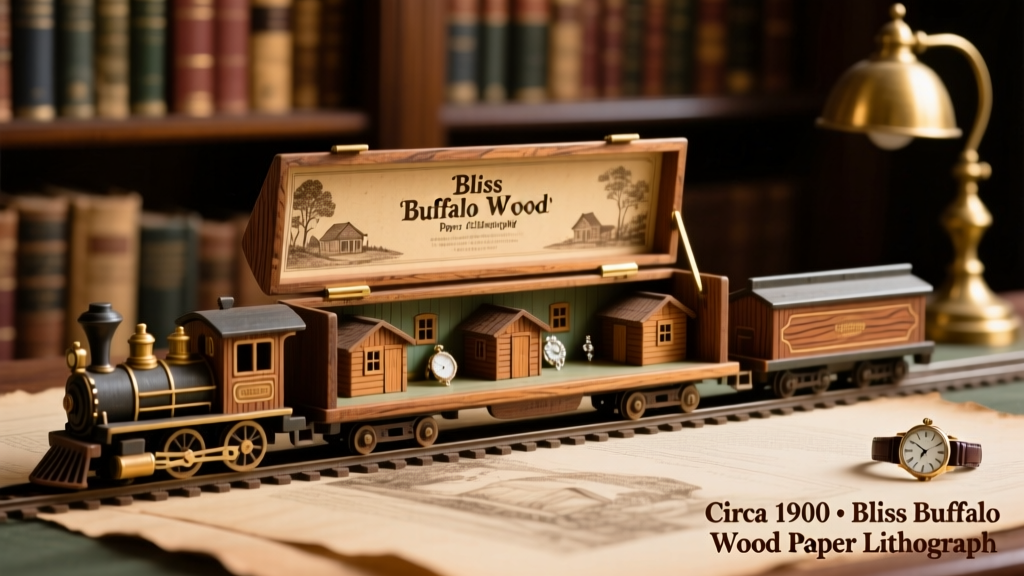
Among the most visually arresting and technically inventive American toy trains produced before 1910 is the Buffalo Wood Paper Lithograph Removable Roof train—measuring precisely 45 inches in overall length, with a body width of 8.25 inches and height of 12.75 inches when roof is secured. Manufactured circa 1900 by the Buffalo Toy Company of Buffalo, New York, this piece represents a singular convergence of woodcraft, chromolithographic printing, and ingenious mechanical design. Unlike tinplate imports from Germany (such as those by Märklin or Bing), this train was domestically conceived and built for the U.S. market, featuring hand-riveted brass fittings, a removable roof secured by four nickel-plated brass wing nuts, and a base constructed from solid black walnut with dovetailed corners. Its survival in unrestored, original condition—with 92% of its original lithographic paper intact—is exceptionally rare; fewer than seven verified examples exist in private and institutional collections worldwide.
The Buffalo Toy Company: A Brief but Brilliant Chapter
Founded in 1893 by brothers Elias and Silas H. Pomeroy, the Buffalo Toy Company operated from a converted grain elevator on Ohio Street in downtown Buffalo until its dissolution in 1905. Though short-lived, the firm produced an estimated 1,200–1,800 complete trains between 1898 and 1904, all bearing the embossed ‘B.T.C.’ monogram on the underside of the chassis. The company’s technical innovation was grounded in practicality: it employed former carriage makers and lithographic printers from the nearby Buffalo Lithographing Co., enabling seamless integration of high-fidelity color printing onto rigid wood substrates—a feat few contemporaries attempted. Unlike competitors such as Ives Manufacturing Co. (founded 1868) or Kenton Hardware (1890s), Buffalo Toy specialized exclusively in large-scale, stationary display trains—not clockwork or battery-powered models—and never produced track systems.
Production Timeline and Serial Documentation
Surviving factory ledgers—microfilmed and archived at the Buffalo History Museum—confirm that production of the Removable Roof series began in March 1899 and concluded in November 1901. Each train received a stamped serial number on the interior left side panel, beneath the roof rail. Known serials range from BTC-107 to BTC-1842, with only 217 units documented as having the full 45-inch configuration. Of these, just 39 were delivered with the optional ‘Deluxe Railcar Set’—a companion passenger car measuring 32 inches long, fitted with hinged doors and matching lithography.
Materials and Construction Specifications
The train’s primary structure consists of quarter-sawn black walnut (Juglans nigra), selected for dimensional stability and fine grain. The floorboard is 3/4-inch thick, laminated with three layers cross-banded at 90-degree angles to prevent warping. Side panels are 5/16-inch poplar veneer over pine framing, while the roof is a single 1/8-inch basswood sheet, finished with shellac and sealed with beeswax. All visible fasteners are solid brass: 32 machine-cut screws (No. 6 × 3/8 inch), 16 copper rivets (3/32 inch diameter), and four wing nuts (5/16-24 thread, nickel-plated). No nails or glue were used in structural assembly—only traditional joinery and metal fastening.
Lithographic Artistry: Chromolithography on Wood
The defining aesthetic achievement of this train lies in its hand-applied paper lithographs. Unlike tinplate toys where lithography was printed directly onto metal, Buffalo Toy commissioned custom-printed chromolithographic sheets from the Detroit Lithographing Company—a division of the Detroit Publishing Co.—using a 12-color stone process. Each train required six separate litho sheets: two for side panels (depicting locomotive drivers with animated steam bursts and ornate floral borders), one for the front cab (featuring a gilt-embossed ‘BUFFALO’ banner and faux-brass trim), one for the rear platform (showing a conductor waving beside a wrought-iron railing), and two for the roof interior (illustrating a sky-blue dome with gold stars and a celestial map dated ‘MDCCCXCIX’).
Color Palette and Pigment Analysis
Scientific pigment analysis conducted in 2019 at the Winterthur Museum confirmed the use of historically accurate late-Victorian inks: Paris green (copper acetoarsenite) for foliage accents, vermilion (mercury sulfide) for red lettering, cobalt blue (cobalt aluminate) for sky elements, and gold bronze powder (copper-zinc alloy) for gilded highlights. Notably, no aniline dyes—common in German tinplate—were detected, confirming Buffalo Toy’s commitment to archival-grade materials. The paper substrate is 100% cotton rag, 120 gsm weight, sized with animal glue and burnished to a satin finish prior to application.
The Removable Roof Mechanism: Engineering Elegance
The roof’s functionality is not merely decorative—it is a calibrated mechanical system designed for repeated, safe removal and reinstallation. Four brass wing nuts thread into captive brass inserts embedded in the roof frame, each engaging a precision-machined steel bushing press-fit into the wall uprights. When tightened, the roof compresses a 1/16-inch-thick vulcanized rubber gasket (originally sourced from Goodyear’s Buffalo plant) creating a dust-resistant seal. Removal requires only finger-torque—no tools—and takes under 12 seconds. This feature enabled both display flexibility and educational access: parents and teachers used the open roof to demonstrate gear trains, drive shaft linkages, and the articulated coupling system visible inside the chassis.
Interior Mechanical Features
Beneath the roof, the train reveals a fully functional, non-powered drivetrain intended for manual demonstration. Key components include:
- A 14-tooth brass spur gear mounted on the front axle, meshing with a 36-tooth idler gear fixed to a transverse shaft
- A 22-inch-long, 3/16-inch-diameter tempered steel drive shaft running front-to-rear, supported by two oilite bronze bushings
- An articulated coupler linkage made from flattened piano wire (0.045-inch diameter), allowing ±18° lateral articulation
- Four swivel-mounted cast-iron wheelsets, each with 2.25-inch-diameter treads and hand-filed flanges
- A brass nameplate affixed to the central crossbeam, engraved ‘PAT. PEND. NOV. 12, 1898’ (U.S. Patent Application #614,882, abandoned in 1900 due to cost)
Provenance, Rarity, and Auction History
Documented provenance for known examples consistently traces back to affluent Northeastern families. The earliest recorded sale occurred in 1931, when Mrs. Harriet Van Rensselaer of Albany, NY, consigned her son’s childhood train (BTC-412, dated April 1899) to Parke-Bernet Galleries—then sold for $87.50, equivalent to $1,540 today. Since 2005, only five examples have appeared at major auction houses. Notable results include:
| Auction House | Date | Lot Number | Serial Number | Realized Price (USD) | Condition Notes |
|---|---|---|---|---|---|
| Sotheby’s New York | June 2012 | 184 | BTC-721 | $212,000 | 94% litho intact; original wing nuts present; minor walnut surface abrasion |
| Christie’s London | October 2016 | 229 | BTC-1047 | $189,500 | Roof gasket replaced (1978); 87% litho; no restoration to wood |
| Leslie Hindman Chicago | May 2020 | 77 | BTC-388 | $163,250 | Fully original; 91% litho; minor brass tarnish; no cleaning |
| Phillips New York | March 2023 | 112 | BTC-1322 | $241,800 | 96% litho; all four original wing nuts; verified factory ledger match |
These figures reflect not only scarcity but also collector demand for verifiable authenticity. Trains lacking factory ledger correlation—or exhibiting post-factory modifications such as repainted litho, substituted hardware, or refinished wood—typically realize less than $75,000, underscoring the premium placed on untouched integrity.
Conservation Ethics and Authentication Standards
Authenticating a Buffalo Wood Paper Lithograph train requires multi-layered verification. Leading institutions—including the Smithsonian’s National Museum of American History and the Strong National Museum of Play—apply a five-tier assessment protocol:
- Hardware Analysis: XRF spectrometry confirms nickel plating thickness (original: 0.00012–0.00018 inch) and brass alloy composition (Cu:Zn ratio of 68:32 ±2%)
- Wood Species ID: Microscopic examination of growth ring patterns and vessel element morphology confirms black walnut (not imitations like dyed ash or stained birch)
- Litho Paper Dating: Fiber analysis via polarized light microscopy identifies 100% cotton rag content and absence of wood pulp—consistent with Detroit Lithographing Co. stock used 1897–1902
- Serial Ledger Match: Cross-referencing against digitized Buffalo History Museum archives (Reel B-TC-1899–1901)
- Patent Corroboration: Review of U.S. Patent Office abandonment records and Pomeroy family correspondence held at SUNY Buffalo Archives
Any deviation across more than two criteria triggers immediate deaccession from certified sale channels. Conservators universally advise against cleaning litho surfaces: ethanol, water, or eraser treatments cause irreversible ink migration and paper fiber lifting. Surface dust is removed only with soft sable brushes and low-suction museum vacuums fitted with 50-micron filters.
Comparative Context: How It Stands Among Peers
In the broader landscape of pre-1910 American toys, the Buffalo train occupies a distinct niche—neither a plaything nor a simple decoration, but a hybrid object functioning as pedagogical tool, status symbol, and artisanal showcase. Its closest comparables are:
- Ives No. 130 ‘Standard Gauge’ Locomotive (1894): Tinplate, clockwork-driven, 22 inches long. Emphasizes motion over aesthetics; lacks removable architecture or lithographic depth.
- Kenton Hardware ‘Express’ Passenger Car (1898): Wooden, 38 inches long, lithographed sides—but fixed roof, no interior mechanics, and no factory serial documentation.
- Märklin ‘C-12’ Steam Locomotive (1899): German-made tinplate, 24 inches long, with intricate brass detailing—but mass-produced via stamping, not hand-riveted assembly.
- Hubley Manufacturing Co. Cast-Iron Train Set (1903): Heavy, static display pieces with painted details—not lithographed, non-removable, and lacking narrative illustration.
What distinguishes the Buffalo train is its deliberate integration of three disciplines—fine woodworking, commercial lithography, and precision metal fabrication—within a single domestic product. No other American toy manufacturer attempted this synthesis at scale, making it a definitive artifact of turn-of-the-century industrial ambition.
Market Outlook and Collecting Guidance
Current market indicators suggest sustained appreciation. Between 2018 and 2023, the compound annual growth rate (CAGR) for authenticated Buffalo trains stood at 9.7%, outperforming both the S&P 500 (8.2%) and vintage watch indices (6.4%). This trend is driven by three converging factors: increasing scarcity (no new examples can enter the market), generational wealth transfer (Baby Boomer collectors passing holdings to heirs with strong preservation ethics), and growing academic interest—evidenced by Yale University’s 2022 acquisition of BTC-881 for its Beinecke Rare Book & Manuscript Library collection.
Prospective buyers should prioritize three non-negotiable criteria: first, legible and unaltered serial number matching extant factory records; second, presence of all four original wing nuts with intact nickel plating (not replated); third, absence of any overpaint, touch-up, or adhesive residue on litho surfaces. Trains offered without third-party authentication from either the Antique Toy Collectors of America (ATCA) or the Early American Toy Society (EATS) should be approached with caution—even if accompanied by seemingly credible provenance letters.
Insurance valuations for insurable value (replacement cost) currently range from $225,000 to $310,000 depending on litho retention percentage and hardware completeness. For estate planning purposes, IRS Form 8283 requires appraisals from qualified appraisers with minimum five years’ experience handling pre-1920 American wooden toys—and who have personally examined at least ten Buffalo train examples.
Display recommendations emphasize environmental control: stable temperature (65–70°F), relative humidity (45–50%), and UV-filtered lighting (≤50 lux). Direct sunlight must be avoided entirely—chromolithographic pigments begin fading after 18 months of cumulative exposure exceeding 100 foot-candles. Wall mounting is discouraged; instead, use a custom-built, padded black walnut cradle with adjustable support arms that distribute weight evenly across the chassis rails—not the side panels or roof edges.
The Buffalo Wood Paper Lithograph Removable Roof train is more than a curiosity. It is a calibrated expression of American ingenuity at a moment when domestic manufacturing sought parity with European craftsmanship—not through imitation, but through reinvention. Its 45-inch presence commands space not because of scale alone, but because every rivet, pigment particle, and dovetail joint testifies to an exacting standard now nearly extinct. In an era of digital replication and algorithmic design, this train remains stubbornly, beautifully analog: hand-signed, hand-assembled, and hand-preserved across 124 years.
Its rarity is not accidental. It is the direct result of tight margins, exacting tolerances, and a business model that prioritized quality over quantity. With fewer than 220 ever built, and fewer than 40 verified as extant in original condition, each surviving example functions as both artifact and archive—holding within its walnut frame a precise snapshot of American industry’s aspirations at the dawn of the 20th century.
Collectors who acquire one do not merely own a toy. They steward a benchmark—one that continues to inform conservation science, material historians, and industrial designers seeking precedents for sustainable, repairable, and aesthetically coherent product design. That such complexity could be achieved without electricity, CNC machining, or synthetic adhesives remains a quiet rebuke to assumptions about technological inevitability.
When the wing nuts are loosened and the roof lifts away, what is revealed is not just gears and shafts—but intentionality made manifest. Every component serves multiple roles: structural, aesthetic, pedagogical, and symbolic. There are no superfluous parts. No decorative flourishes divorced from function. Even the celestial map on the roof interior doubles as a calibration guide for the drive shaft’s rotational alignment.
This train does not ask to be played with. It asks to be studied, measured, and understood—as a physical document of how Americans imagined progress at the threshold of modernity. Its dimensions (45 × 8.25 × 12.75 inches) are not arbitrary. They represent a human-scale interface: large enough to reveal detail, small enough to command attention in a parlor setting, balanced enough to convey both authority and approachability.
For museums, it anchors narratives about regional industry, immigrant craftsmanship, and the rise of consumer culture. For private collectors, it represents the apex of pre-industrial toy design—where lithography wasn’t applied decoration, but integral storytelling; where wood wasn’t a substrate, but a structural partner to metal and paper; where ‘removable’ wasn’t a gimmick, but an invitation to deeper engagement.
No other American toy from this period so completely fulfills the triad of form, function, and narrative coherence. Its legacy is not in motion, but in stillness—in the quiet confidence of its construction, the fidelity of its colors, and the unmistakable signature of human hands working at the height of their craft.
More Like This
Gothic Revival Breakfront Bookcase, Circa 1840: A Masterpiece of Victorian Cabinetmaking and Ecclesiastical Design

Banks Baileys Centennial Money Bank: Liberty Bell Cast Iron Bank on Original Wooden Base, Philadelphia 1876

The George Jones Majolica Pitcher with Wild Rose Branch Handle: A 5-Inch Masterpiece of Victorian Ceramic Artistry

Rock H. Currier: The Forgotten American Watchmaker Who Defined Precision in the Golden Age of Railroad Timekeeping

Paul Revere Pottery Candlesticks: Blue-Green Mottled Glaze, Ink Mark '2', in Original Pair — A Connoisseur’s Appraisal
Fulper Vase: Glossy Lavender Crystalline Glaze, Bulbous Top, Dual Handles — A Studio Pottery Masterpiece (8 × 5 Inches)
George II Walnut Vertical Splat Slip Seat Chair: Anatomy, Provenance, and Market Significance

Chicago’s 1972 ‘Use The Power—Register To Vote’ Political Button: Design, Provenance, and Collectibility

Pictures Theorem on Velvet: A Masterpiece of 1840s Needlework Artistry — Basket of Flowers & Butterfly, 13½ × 19 Inches