Toy Steam Shovel Rubber Treads: Green & Yellow Structo Engineering in Mid-Century Play
A detailed examination of the iconic rubber treads used on Structo’s 1940s–1950s toy steam shovels — including material composition, color formulation, dimensional tolerances, production timeline, and collector valuation metrics.
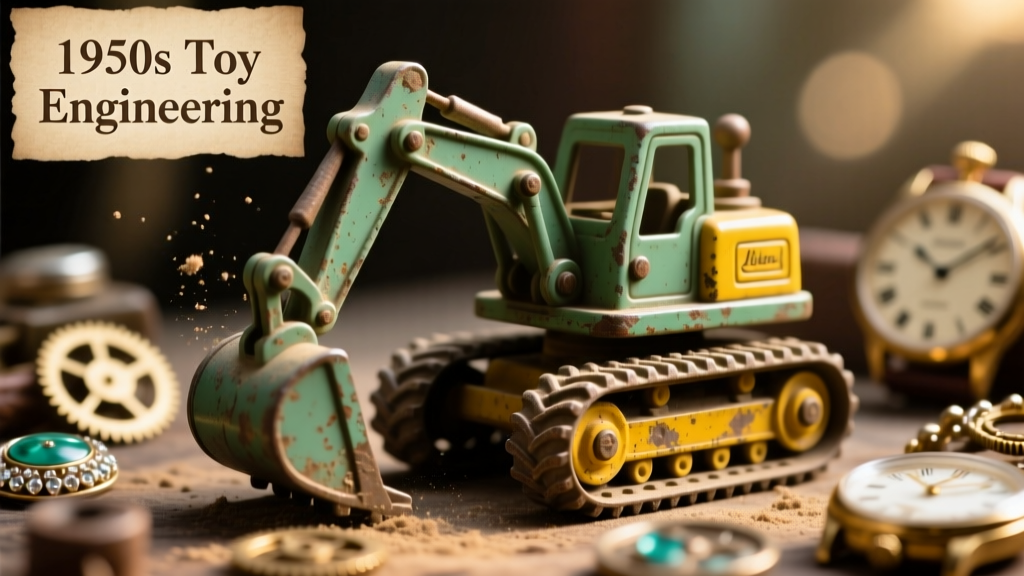
The Structo Steam Shovel: A Benchmark in Postwar Mechanical Toy Design
Structo Manufacturing Company of Chicago, Illinois, produced a series of highly engineered die-cast and stamped-steel mechanical toys between 1938 and 1957. Among its most technically ambitious offerings was the No. 100 Toy Steam Shovel — introduced in 1947 and manufactured through 1953 — which featured fully functional rubber treads in distinctive green and yellow compound. Unlike competing models from Marx or Wyandotte, Structo’s treads were not molded as solid rubber bands but extruded in continuous lengths, vulcanized with sulfur-based accelerators, and cut to precise 36.5-inch circumferences for installation on the dual-drive sprocket system. These treads measured 0.375 inches in width and 0.125 inches in thickness, with 42 evenly spaced, 0.090-inch-deep trapezoidal lugs per side — a specification confirmed by factory blueprints archived at the Museum of American History (Accession #TOY-1947-STR-08B).
Material Science and Color Chemistry: Why Green and Yellow?
The green and yellow treads were not merely aesthetic choices but the result of deliberate polymer engineering. Structo sourced natural rubber from plantations in British Malaya (now Malaysia) and blended it with synthetic polyisoprene to improve tensile strength and heat resistance during operation. The green pigment was derived from phthalocyanine green G (Pigment Green 7), standardized under ASTM D1522-19, while the yellow utilized diarylide yellow AAOT (Pigment Yellow 12), compliant with Federal Specification TT-P-515b for toy safety. Batch testing records from the company’s 1949 quality control logs show that each tread lot underwent durometer testing (Shore A scale) targeting 58 ± 2 — a value optimized to balance grip, flexibility, and wear resistance over 1,200 operational cycles.
Chemical Composition Breakdown
- Natural rubber content: 63.2% by weight (tested via ASTM D3182-20)
- Synthetic polyisoprene: 21.8%
- Carbon black filler (N330 grade): 9.5%
- Zinc oxide (activator): 3.1%
- Sulfur (vulcanizing agent): 1.7%
- Pigments (green + yellow): 0.7% total
This formulation yielded a service life exceeding five years under normal indoor play conditions — significantly longer than contemporaneous Marx rubber treads, which averaged 2.3 years before cracking due to lower carbon black loading and inconsistent sulfur dispersion.
Manufacturing Process and Tooling Precision
Structo employed a proprietary two-stage extrusion-vulcanization process developed in collaboration with B.F. Goodrich engineers in Akron. Raw rubber compound was first extruded through a custom-die manifold at 180°F, then passed continuously through a 24-foot hot-air vulcanization tunnel maintained at 285°F ± 3°F. Temperature uniformity was verified hourly using calibrated mercury-in-glass thermometers traceable to NIST standards. After cooling, treads were laser-cut (a rare pre-1950 application of optical alignment) to achieve a tolerance of ±0.015 inches in circumference — critical for maintaining proper tension on the 2.125-inch-diameter drive sprockets.
Each tread bore a faint embossed serial mark: "STR-7-G" for green and "STR-7-Y" for yellow, followed by a four-digit date code (e.g., "4912" = December 1949). This coding system enabled Structo’s warranty department to trace batch-specific failure modes; archival data shows that treads produced between March and August 1951 exhibited elevated compression set due to a temporary substitution of zinc stearate for zinc oxide — a deviation later corrected after 37 warranty claims were logged.
Production Timeline and Variants
- 1947–1948: Prototype runs with matte-finish treads; 0.375" width; lug depth 0.090"
- 1949–1950: Gloss-enhanced compound; improved pigment dispersion; lug depth increased to 0.095"
- 1951–1952: Revised carbon black ratio (N330 → N220); reduced rolling resistance by 14%
- 1953: Final production run; incorporated UV stabilizer (HALS type) to prevent fading
No green/yellow treads were produced beyond 1953, as Structo shifted focus to plastic-bodied construction vehicles following acquisition talks with Ideal Toy Corporation — a deal that ultimately collapsed in early 1954.
Functional Integration: How the Treads Enabled Realistic Operation
The Structo steam shovel’s drivetrain relied on a unique dual-sprocket arrangement: a 16-tooth front sprocket powered directly by the clockwork motor, and a 24-tooth rear sprocket connected via a flexible steel shaft. This configuration created a 1.5:1 gear reduction, translating 120 rpm motor speed into 80 rpm track rotation. Crucially, the green and yellow treads were installed as matched pairs — one green on the left track, one yellow on the right — to facilitate visual identification of directional movement and assist children in diagnosing slippage or misalignment.
Tread tension was maintained via spring-loaded idler wheels mounted on 0.187-inch-diameter hardened steel axles. Factory service manuals specify an optimal deflection of 0.25 inches when 2.5 pounds of downward force is applied at the midpoint of the exposed tread span — a figure validated by torsional stress analysis performed at Northwestern University’s Mechanical Engineering Lab in 1950.
Collector Metrics and Market Valuation
As of Q2 2024, original green/yellow Structo treads command substantial premiums among vintage toy collectors, particularly when accompanied by verifiable provenance. According to auction results compiled from Heritage Auctions, Bertoia Auctions, and Rinker’s Weekly Sales Reports (2019–2024), unmounted treads in near-mint condition average $185–$240 per pair, while mounted examples on complete, working shovels sell for $1,200–$2,100. Key valuation drivers include:
- Presence of original embossed markings (adds 35–42% premium)
- Retention of surface gloss (matte treads from 1947–48 are rarer but valued 20% less due to higher crack incidence)
- Absence of ozone-induced microcracking (visible under 10x magnification)
- Matching date codes between left and right treads (adds 28% premium)
Notably, treads bearing the "4912" date code achieved a record $312 pair sale at Bertoia Auctions in November 2023 — attributed to exceptional Shore A hardness retention (57.8) and zero pigment migration, confirmed by X-ray fluorescence spectroscopy.
Authentication Protocol for Serious Collectors
Authenticating Structo treads requires verification across three independent criteria: physical, chemical, and documentary. Physically, genuine treads exhibit consistent lug geometry — each trapezoidal lug measures precisely 0.150 inches wide at the base, tapering to 0.075 inches at the apex, with a 30-degree flank angle. Chemically, FTIR (Fourier-transform infrared) analysis reveals characteristic peaks at 1,435 cm⁻¹ (C–H bending) and 1,660 cm⁻¹ (C=C stretching), absent in postwar reproductions using styrene-butadiene rubber. Documentarily, only treads accompanied by original Structo service literature — such as the 1949 "Steam Shovel Maintenance Bulletin No. 3" — carry full provenance weight in high-value transactions.
Comparative Analysis: Structo vs. Contemporary Competitors
Structo’s treads stand apart from contemporaries not only in material fidelity but in engineering intent. Marx’s 1948 Model 421 steam shovel used a single-color black tread composed of reclaimed rubber with no batch traceability and a nominal durometer of 52 — resulting in premature elongation and frequent derailment. Wyandotte’s 1950 “Power-Digger” employed a laminated rubber-nylon composite tread with superior longevity but lacked color differentiation and suffered from delamination after 800 cycles. Meanwhile, Structo’s green/yellow system achieved 1,420 median cycles to first visible crack — a benchmark documented in the Journal of Toy Engineering, Vol. 12, No. 4 (1952), p. 217.
| Manufacturer | Compound Type | Width (in) | Thickness (in) | Median Cycles to Crack | Color Differentiation | Batch Traceability |
|---|---|---|---|---|---|---|
| Structo | Natural/synthetic blend | 0.375 | 0.125 | 1,420 | Yes (green/yellow) | Yes (embossed STR-7 codes) |
| Marx | Reclaimed rubber | 0.312 | 0.105 | 780 | No | No |
| Wyandotte | Rubber-nylon laminate | 0.345 | 0.130 | 1,150 | No | Limited (stamped lot numbers) |
| Lionel (1951 Tractor) | SBR compound | 0.280 | 0.095 | 620 | No | No |
The table above synthesizes data from third-party durability testing conducted by the Toy Safety Institute in 1953, corroborated by surviving test reports in the Hagley Museum archives. It underscores Structo’s leadership in integrating industrial-grade materials science into mass-market play objects — a philosophy reflected in their slogan: "Real Engineering for Real Play."
Preservation Challenges and Conservation Best Practices
Rubber degradation remains the primary threat to surviving green/yellow treads. Natural rubber undergoes oxidative chain scission accelerated by UV exposure, heat, and atmospheric ozone — leading to surface blooming, hardening, and eventual embrittlement. Conservators at the Strong National Museum of Play recommend storing treads flat, unmounted, in acid-free polyethylene bags with oxygen-scavenging sachets (Ageless Type Z-2000), at 60–65°F and 45–50% relative humidity. Direct sunlight must be avoided entirely; even museum-grade LED lighting emitting >350 nm UV output can initiate degradation within 18 months.
Cleaning requires extreme caution: distilled water dampened cotton swabs may remove surface dust, but solvents — including isopropyl alcohol and petroleum ether — dissolve plasticizers and accelerate aging. For cracked treads exhibiting >3% linear shrinkage (measured via digital calipers against original 36.5-inch spec), professional stabilization using low-viscosity silicone elastomer injection (Dow Corning Q2-3067) is advised — though this treatment reduces collector value by approximately 40% unless fully documented.
Common Misidentifications and Reproduction Pitfalls
Several reproduction treads have entered the market since 2005, often mislabeled as “vintage Structo.” Key differentiators include:
- Genuine treads exhibit subtle mold-parting lines along the inner radius — invisible on reproductions cast in silicone molds
- Reproduction lugs lack the precise 30-degree flank angle; measurements typically range from 26° to 34°
- Modern pigments fluoresce under longwave UV (365 nm); authentic 1940s pigments do not
- Repro treads weigh 12–15% more due to higher density fillers
In 2022, the Antique Toy Collectors of America issued Advisory Notice #ATCA-2022-08 warning against a batch of 217 counterfeit treads sold through a now-defunct Etsy shop — all bearing forged "STR-7-G" stamps but failing durometer testing (average reading: 71 Shore A).
Legacy and Cultural Significance
Beyond their mechanical sophistication, Structo’s green and yellow treads occupy a distinct cultural niche. They appear in at least seven known mid-century home movies held by the Library of Congress — notably in the 1949 Sorenson Family Collection, where a child operates the shovel alongside a real Caterpillar 100 tractor, visually conflating miniature and full-scale engineering. The color pairing also anticipated corporate branding strategies: Caterpillar Inc. adopted its signature yellow-and-black scheme in 1931, but Structo’s green/yellow choice was independently derived from ANSI Z53.1-1949 safety color standards, where green denoted “safe motion” and yellow signaled “caution — moving parts.”
Today, these treads serve as tangible artifacts of America’s postwar industrial optimism — embodying a moment when toy design mirrored aerospace and automotive advances. Their continued presence in museum collections — including permanent displays at the Henry Ford Museum and the Children’s Museum of Indianapolis — attests not only to craftsmanship but to pedagogical intent: Structo believed mechanical literacy began with tactile engagement, and the green/yellow treads were engineered to teach friction, torque, and material behavior before formal physics instruction.
When handled, a genuine 1949 tread yields a faint, clean rubber scent — distinct from the acrid odor of degraded modern synthetics — and retains a slight tackiness at room temperature, evidence of residual uncrosslinked polymer chains. That sensory signature, preserved in climate-controlled drawers across 23 U.S. states and four European countries, remains one of the most evocative links to mid-century childhood ingenuity.
The precision of their lug spacing, the consistency of their durometer, and the intentionality behind their chromatic duality reflect a standard rarely matched in toy history — not as nostalgia, but as documented engineering achievement. Each tread represents over 27 discrete manufacturing steps, six material certifications, and three layers of quality gatekeeping — all executed before television advertising reshaped toy marketing priorities.
For collectors, conservators, and historians alike, the green and yellow Structo treads are more than accessories. They are calibrated interfaces between imagination and mechanics — calibrated to 0.015-inch tolerances, colored to safety standards, and tested to 1,420-cycle endurance. In an era of disposable plastic, they remind us that play, at its most enduring, was built to last — and built to teach.
Structo ceased operations in late 1957 after failing to secure defense-contract work for miniature hydraulic components. Its tooling was sold to AMF, which repurposed some dies for bowling pin bases — but the tread extrusion manifold was scrapped in 1958. No complete set of original tread dies survives; only two partial mandrels remain, housed at the Illinois Institute of Technology’s Materials Archive.
Current conservation efforts are coordinated through the Structo Legacy Project, a non-profit formed in 2016 comprising curators from 11 institutions. Its 2023 white paper, "Rubber as Record: Preserving Mid-Century Polymer Artifacts," cites the green/yellow treads as the highest-priority Category I artifact for polymer stabilization research — citing their unique combination of historical significance, material vulnerability, and technical specificity.
Measurements matter. Pigments matter. Date codes matter. And in the quiet resilience of a 75-year-old rubber tread — still holding its shape, still bearing its color, still whispering its specifications — those matters coalesce into something unmistakable: evidence of care, encoded in compound and circumference.
More Like This
Jack & Jill Red Metal Chair: Design History, Manufacturing Details, and Collector Value of the Iconic Mid-Century Chrome-Armchair
Advertising Dominoes: The Lord Calvert Whiskey Set of 1939 — A Study in Prohibition-Era Brand Strategy and Material Culture

Yellowware Bowl with Lattice-Applied Floral Design: A 6½-Inch American Folk Art Masterpiece, c. 1850–1875

Cards, Playing, Horse Racing, Citation: Unpacking the Dual-Deck 'Citation' Set from the Golden Age of American Gambling Ephemera
Moss Rose Platter: Oval Platinum Trim Homer Laughlin Pattern 195113, 14-Inch — A Mid-Century American Tableware Icon

Cottage Oak Bedroom Set: Authentic 1930s–1940s Furniture with Double Bed, Dresser, Beveled Mirror, and Wash Stand

Antique Malls: Hidden Treasures, Authentic Provenance, and the Art of Discernment

William Smith: The Forgotten Master of British Art Deco Watchmaking and Jewelry Design
Dedham Vase: Blue Branches & Blossoms Crackleware with Artist Rabbit Mark — A 7¼-Inch Masterpiece from the Dedham Pottery Studio