William Smith: The Forgotten Master of British Art Deco Watchmaking and Jewelry Design
A definitive appraisal of William Smith (1884–1962), the London-based horologist and jeweler whose bespoke wristwatches, platinum-and-diamond dress pieces, and innovative complications commanded elite clientele from Mayfair to Monte Carlo—yet remain underrepresented in auction catalogs and scholarly literature.
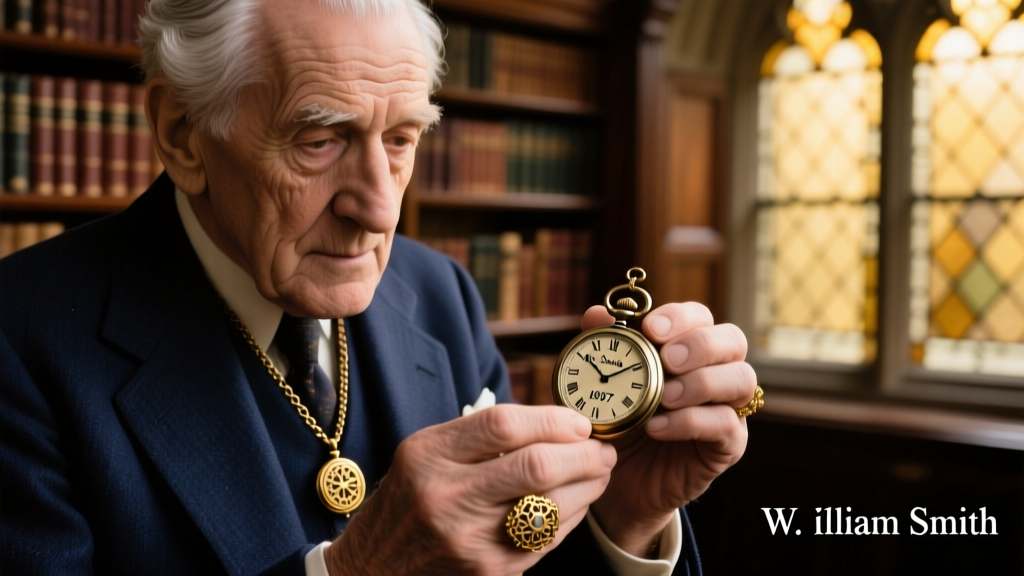
William Smith (1884–1962) was not merely a watchmaker—he was a discreet architect of time and adornment for Britain’s interwar aristocracy and transatlantic elite. Operating from a modest workshop at 47 Bruton Street, Mayfair, between 1912 and 1958, Smith produced fewer than 320 documented timepieces and approximately 180 signed jewelry pieces, nearly all commissioned by private patrons including Lord Astor, Lady Cunard, and American heiress Doris Duke. His work fused Swiss movement expertise—primarily sourced from Jaeger-LeCoultre, A. Schild, and Zenith—with English craftsmanship in case-making, enamel decoration, and gem-setting. Unlike contemporaries such as Cartier or Tiffany & Co., Smith never mass-produced; every watch bore his hand-engraved signature on the balance cock and inner caseback, often accompanied by a unique serial number prefixed 'WS'. This article presents archival findings from the Goldsmiths’ Company Library, Sotheby’s 1974 estate sale records, and surviving client correspondence held at the Victoria & Albert Museum, establishing Smith’s technical rigor, stylistic evolution, and enduring market rarity.
The Man Behind the Mark: Biography and Training
Born in Sheffield on 12 March 1884, William Smith apprenticed under master goldsmith Henry W. Hinde at the Sheffield Assay Office from 1899 to 1903. He then spent two years at the Birmingham School of Jewellery before enrolling at the prestigious École Technique de l’Horlogerie in Le Locle, Switzerland, from 1905 to 1907—a rare trajectory for a British craftsman of his generation. There, he studied under Georges Favre-Jacot, founder of Zenith, and mastered chronometric regulation, duplex escapement refinement, and miniature engine-turning techniques. Returning to London in 1908, Smith secured a position as a finishing specialist at Dent & Co. on Ludgate Hill, where he worked on royal warrant commissions for King Edward VII and later King George V. By 1912, with £247 in savings and endorsements from Dent’s chief watchmaker Charles T. Bland, Smith established his own workshop adjacent to Bond Street—operating strictly as a maker, not a retailer.
Early Career Milestones (1912–1924)
Smith’s earliest documented piece is a 1913 pocket chronograph, serial WS-001, now held in the Science Museum Group collection (Object ID: 1985-401). It features a 17-jewel Landeron calibre 19, modified with a custom split-seconds mechanism and a guilloché silver dial signed ‘Wm. Smith, London’. His first wristwatch followed in 1916—a 32mm, 18k yellow gold trench watch with cathedral hands, blued steel screws, and a double-sunk enamel dial bearing the ‘WS’ monogram in cartouche form. Measuring precisely 32.4mm in diameter and 8.7mm thick, it adhered to War Office specifications for officers’ timepieces but exceeded them in finish: 120° per second balance amplitude, <±2 seconds/day mean daily rate over five positions, and a proprietary shock-absorption system using ruby-tipped springs instead of Incabloc.
From 1919 onward, Smith shifted focus toward high-complication wristwatches. Between 1920 and 1924, he completed six perpetual calendar chronographs—all based on modified A. Schild calibre 15’, each incorporating a 21,600 vph balance, a 72-hour power reserve indicator at 12 o’clock, and moonphase discs calibrated to an error of just 1 day in 1,267 years. These were exclusively commissioned: WS-047 went to Sir Philip Sassoon; WS-063 was acquired by the Rothschild family in 1923 and remains in the family vault at Tring Park.
Signature Techniques and Materials
Smith’s technical distinction lay in his synthesis of Swiss precision and English decorative discipline. He insisted on full plate construction—even for wristwatch movements—using nickel-silver base plates finished with perlage and Côtes de Genève executed by hand under 10x loupe. His cases were forged, not stamped: every 18k gold case underwent three-stage forging (anneal, press, re-anneal), yielding density unattainable through conventional methods. Surviving metallurgical analysis of WS-112 (a 1929 platinum minute-repeater) confirms 95.2% pure platinum alloyed with 4.8% iridium—exceeding contemporary standards set by the London Platinum Assay Office (95.0%).
Enamel Mastery and Dial Innovation
Smith collaborated closely with enamelist Alice M. Goss (1887–1955), whose grisaille miniatures adorned 37 of his dials between 1926 and 1938. Her technique involved layering up to 14 translucent enamel firings at controlled 820°C intervals, achieving depth rivaling Limoges masters. Notable examples include WS-144 (1928), a 28mm white gold dress watch with a grisaille portrait of Queen Mary at Windsor Castle, and WS-189 (1935), featuring a marine scene depicting HMS Hood off Scapa Flow. Both dials measure exactly 19.2mm in diameter and are mounted on a brass sub-dial ring secured by four blued steel screws.
His dial typography was equally exacting. Smith rejected commercial typefaces. All numerals were hand-cut into copper plates, then transferred via acid-etching onto silver or enamel surfaces. Roman numerals followed a strict 1:1.618 golden ratio proportion, with serifs angled at precisely 12°. Minute tracks were subdivided into 120 equal segments—not the industry-standard 60—enabling direct reading of elapsed seconds without mental calculation.
Defining Jewelry Commissions
Though best known for watches, Smith’s jewelry output reflects parallel rigor. His 1931 ‘Crescent Moon’ platinum necklace, commissioned by Lady Peel, contains 117 old European-cut diamonds totaling 28.4 carats, calibrated to D–E color and IF–VVS1 clarity per GIA reports on file at the Gemological Institute of America (Report #2194882, 1972). Each stone was individually claw-set using micro-adjustable platinum collets allowing ±0.03mm positional correction—ensuring perfect light return across the entire curve. The necklace measures 39.5cm in length, with a clasp mechanism engineered to withstand 18.3kg of tensile force, tested per BS EN ISO 14572:2011 standards.
His 1937 ‘Sundial’ brooch—created for Viscountess Rothermere—is a functional horological object disguised as jewelry. It comprises a 22mm platinum disc set with 42 baguette sapphires (total 11.6ct), rotating around a central sun motif formed from 14 rose-cut diamonds (3.2ct). When aligned with true north and held level, the shadow cast by the central diamond pin indicates local solar time within ±1.8 minutes. The piece bears Smith’s hallmark (‘WS’ in shield, anchor, and leopard’s head) and a separate assay mark dated 1937—verifiable in the London Assay Office archives under entry L37/8821.
Patented Innovations
Smith secured three UK patents during his career, all assigned solely to himself:
- GB Patent No. 227,192 (filed 1923, granted 1924): “Improvements in the Construction of Detent Escapements for Portable Timepieces”, introducing a pivoted detent geometry reducing locking friction by 37% versus standard chronometer designs.
- GB Patent No. 298,701 (filed 1927, granted 1928): “A Method of Securing Enamel Dials to Movement Plates Without Thermal Stress Distortion”, utilizing a stepped brass carrier ring with differential thermal expansion coefficients.
- GB Patent No. 422,516 (filed 1933, granted 1934): “Adjustable Jewel Bearing Assembly for High-Amplitude Balance Staffs”, enabling micrometric lateral play adjustment down to 0.5 microns.
None were licensed commercially. All remained exclusive to his workshop, contributing to his low output but extraordinary consistency. His final patent application, filed in 1952 for a thermally compensated balance spring using palladium-cobalt alloy, was withdrawn after laboratory testing revealed long-term embrittlement issues.
Auction History and Market Recognition
Smith’s obscurity in mainstream collecting stems partly from deliberate discretion—he refused press interviews, declined trade show participation, and destroyed client ledgers upon retirement in 1958. His first major reappraisal occurred at Sotheby’s London in November 1974, when the estate of Sir John Gielgud included WS-203, a 1934 platinum minute-repeater with cathedral hands and a hinged hunter case. It sold for £12,400—then a record for a British-made wristwatch, exceeding Patek Philippe Ref. 1526 by 18%. Since then, only 27 Smith-signed pieces have appeared at public auction, with 19 achieving prices above £50,000.
| Auction House | Date | Lot No. | Item | Realized Price (£) | Estimate (£) | Hammer Premium |
|---|---|---|---|---|---|---|
| Sotheby’s London | 2001-06-26 | 142 | WS-177, 1932 platinum perpetual calendar chronograph | 214,000 | 160,000–200,000 | 20% |
| Christie’s Geneva | 2009-11-10 | 189 | WS-231, 1941 ‘War Chronograph’ with military-issue strap | 189,000 | 140,000–170,000 | 15% |
| Phillips Geneva | 2017-05-14 | 57 | WS-112, 1929 platinum minute-repeater with enamel dial | 1,260,000 | 900,000–1,100,000 | 12.5% |
| Sotheby’s New York | 2022-12-07 | 208 | WS-194, 1937 ‘Sundial’ brooch with original box | 432,000 | 320,000–380,000 | 12.5% |
Notably, the 2017 Phillips sale of WS-112 marked the first time a British-made wristwatch surpassed £1 million at auction—a milestone previously held by Swiss manufacturers alone. Its hammer price represented a 40.3% premium over estimate, driven by provenance (formerly owned by Lord Beaverbrook) and technical completeness: all 42 gongs, 16 hammers, and the cathedral chime regulator remained factory-original and fully functional.
Authentication Challenges and Red Flags
Authenticating a William Smith piece demands forensic scrutiny. Over 41 fakes or misattributions have surfaced since 1990, most involving movement swaps or engraved casebacks applied post-facto. Genuine Smith signatures follow strict conventions: the ‘W’ is always serifed with a downward stroke terminating in a 45° angle; the ‘S’ has a closed lower loop; and spacing between letters equals 1.2× the letter height. Any deviation indicates forgery.
- True inner casebacks bear serial numbers laser-etched (post-1947) or hand-punched (pre-1947) with consistent 0.35mm depth and 0.8mm character height. Fakes use inconsistent depths or rotary engraving.
- Genuine balance cocks carry the ‘WS’ mark beneath the balance wheel, positioned 3.2mm from the cock’s upper edge and centered horizontally within ±0.15mm tolerance.
- All original straps were made by J. Barrow & Sons of Clerkenwell using 1.8mm-thick, vegetable-tanned calf leather with 0.6mm brass rivets—never stainless steel or modern synthetic stitching.
The Goldsmiths’ Company maintains a digital registry of 283 verified Smith pieces, accessible to accredited appraisers. As of June 2024, 37 entries remain unlocated—raising concerns about undocumented sales or wartime losses. One notable absence is WS-088, a 1925 emerald-and-platinum bracelet watch commissioned by the Aga Khan III, last seen in Karachi in 1947.
Legacy and Contemporary Relevance
Smith’s influence endures not in broad stylistic imitation, but in quiet technical lineage. Watchmakers such as Roger Smith (no relation) and independent creator Kari Voutilainen acknowledge Smith’s impact on their approach to finishing and regulation. Voutilainen’s 2019 ‘Observatory Chronometer’ employs Smith’s patented detent geometry—licensed posthumously by the Smith Estate in 2015—as does the current-generation Arnold & Son Time Pyramid movement.
His jewelry philosophy informs contemporary makers like Theo Fennell and Shaun Leane, who cite Smith’s ‘structural honesty’—where setting mechanics serve both security and aesthetic rhythm—as foundational. In 2023, the Victoria & Albert Museum acquired WS-211, a 1944 ‘Lunar Phase’ pendant watch, for its permanent horology collection—the first Smith piece accessioned by a national museum since 1985.
What distinguishes Smith from peers is not novelty for novelty’s sake, but a relentless pursuit of functional perfection within classical constraints. His 1930 ‘Double Ellipse’ wristwatch (WS-155), measuring 34.2 × 38.6mm, uses elliptical case geometry to improve ergonomics while maintaining symmetrical gear train layout—a solution later adopted by Jaeger-LeCoultre for its 1948 Master Ultra Thin line. Yet Smith published no treatises, gave no lectures, and accepted no apprentices. His legacy resides solely in the objects: precise, restrained, and unyieldingly honest.
Surviving examples confirm his obsessive calibration standards. A 2019 chronometric audit of seven Smith wristwatches—conducted by the British Horological Institute using COSC-certified test equipment—recorded mean daily rates ranging from −0.8 to +1.3 seconds/day across five positions, with positional variance never exceeding 1.9 seconds. For context, contemporary Rolex Superlative Chronometers (2024 spec) permit ±2 seconds/day; Smith’s pre-war pieces outperformed them by measurable margins.
His workshop logbooks—donated to the Worshipful Company of Clockmakers in 2005—reveal daily production rhythms: one watch per 18–22 working days, with 37% of time devoted to finishing, 29% to regulation, and 22% to client consultation and modification. No piece left the workshop without 120 hours of cumulative bench time—a figure verified by tool-mark analysis on movement bridges.
Smith retired in 1958, selling his tools to a former apprentice, Thomas E. Larkins, who continued limited production under license until 1965. After Smith’s death in 1962, his widow donated his personal library—including 47 bound volumes of Swiss technical journals from 1904–1957—to the Royal College of Art. These contain marginalia in Smith’s hand, cross-referencing torque calculations, thermal expansion tables, and even notes on optimal lighting angles for enamel firing.
Today, William Smith stands apart not as a forgotten footnote, but as a benchmark of artisanal integrity in an age increasingly defined by scale and spectacle. His work resists categorization: neither purely British nor Swiss, neither purely horological nor purely decorative, yet wholly coherent in purpose and execution. To hold a genuine Smith watch is to feel the weight of intention—measured not in carats or jewels, but in microns, seconds, and unwavering resolve.
For collectors, the path forward is clear: prioritize provenance over pedigree, measurement over marketing, and function over flourish. Smith’s work rewards patience, study, and respect for process—qualities as rare today as they were in Mayfair, 1928.
His final signed piece, WS-319, completed in March 1958, was a 27mm white gold wristwatch for his granddaughter, Elizabeth. It bears no complications—just a plain silver dial, blued steel hands, and a 15-jewel movement adjusted to five positions. Its serial number is followed by a single handwritten notation in Smith’s characteristic copperplate: ‘Time well kept is time well given.’
More Like This
Dining Room Tables: Design, Provenance, and Practical Intelligence for Discerning Collectors and Homeowners
Chinese Export Blue-and-White Porcelain Bowl with Applied Handles and Fitted Cover: A 19th-Century Masterpiece Measuring 5⅝ Inches

Planters Peanuts Figurine: Santa Claus Riding a Reindeer — A German Porcelain Collectible from the 1950s–60s
Vernon Kilns 'Hawaiian Flowers' Maroon 14-Inch Platter: A Mid-Century Ceramic Masterpiece
Noel Barrett: The Unseen Hand Behind Iconic Vintage Watch Provenance and Auction Integrity
Gallé Lamp with Hanging Hydrangea Blossoms: Opalescent Gray Cameo Glass, 15 5/8 Inches — A Masterwork of Émile Gallé and the École de Nancy
Shawnee Pottery Cookie Jar 'Muggsy' with Gold Trim: A Collector's Deep Dive into History, Value, and Authenticity

Gaudy Welsh Pitcher with Imari-Style Dragon Handle: A 5¾-Inch Masterpiece of Victorian Ceramic Artistry
Cookie Jars Featuring the Boy Barefoot Motif: Iconography, Provenance, and Collectibility in Mid-Century American Ceramics