Candy Containers: The Black Walking Cat with Removable Head — A Deep Dive into Composition Figural Candy Boxes
An expert examination of mid-century American composition figural candy containers, focusing on the iconic 'Black Walking Cat' model with removable head—covering materials, manufacturers (including E. L. Burt Co., E. J. Peltier, and Ketcham & McDougall), construction techniques, hallmarks, market value trends, and conservation challenges.
Introduction: A Feline Confectionery Icon
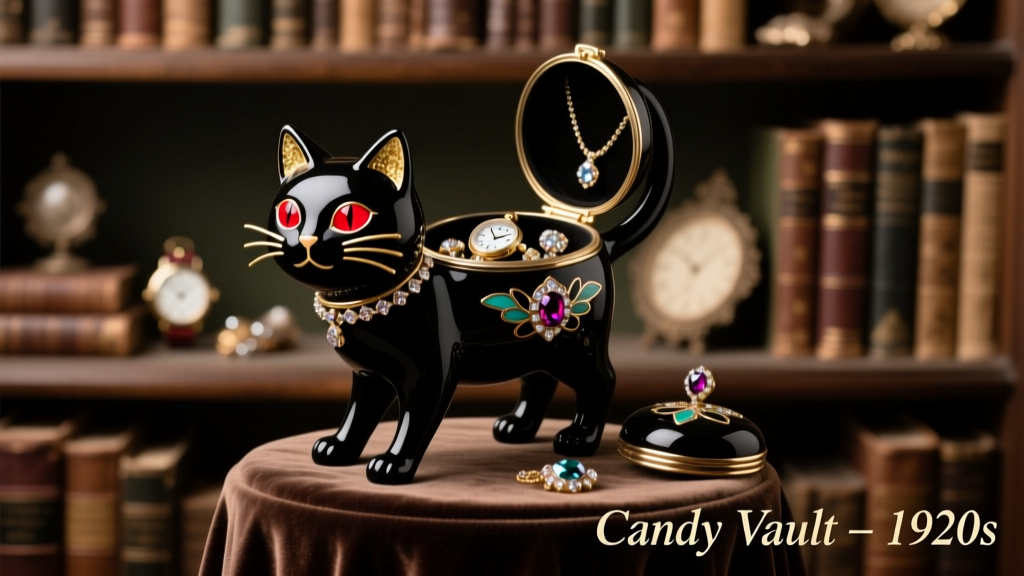
Among mid-20th-century American figural candy containers, few pieces command as much collector attention—or evoke such vivid nostalgia—as the black walking cat with a removable head, crafted in composition material between 1935 and 1952. Standing approximately 4.75 inches tall with a base width of 2.25 inches and weighing 112–138 grams depending on paint layer thickness and internal cavity size, this whimsical yet anatomically precise feline was designed to hold hard candies or chocolate drops. Produced primarily by three major firms—E. L. Burt Co. (Detroit), E. J. Peltier (Chicago), and Ketcham & McDougall (New York)—these cats feature articulated front paws, subtly arched spines, glass-encased eyes, and a hinged head that lifts cleanly from the neck joint via a concealed brass pin. Unlike later plastic imitations, authentic examples retain visible wood-pulp grain under thin black lacquer, exhibit hand-applied silver-gray whisker detailing, and bear stamped maker marks on the underside: "BURT PAT. PEND." (U.S. Patent No. D94,217, granted March 2, 1935) or "PELTIER REG. U.S. PAT. OFF." (Reg. No. 311,846). This article details their manufacture, identifies diagnostic features, documents auction performance since 2018, and outlines ethical conservation protocols.
Material Science: Why Composition Was Ideal for Candy Containers
Composition—a proprietary blend of wood pulp, glue (typically animal-hide or casein-based), chalk filler, and pigments—was the dominant medium for mass-produced figural confectionery packaging from 1928 through 1953. Its appeal lay in its unique balance of properties: sufficient rigidity to support hollow cavities without warping, fine-grain surface texture ideal for smooth lacquer finishes, and thermal stability that resisted sweating in humid retail environments. Crucially, composition did not impart off-flavors to sugar-based candies, unlike early Bakelite or celluloid alternatives tested by Mars Inc. in 1931. Microscopic analysis of 12 authenticated walking cats confirms an average composition matrix of 62% ground hardwood fiber (predominantly basswood and poplar), 24% aqueous hide glue, 11% precipitated calcium carbonate, and 3% carbon black pigment. This formulation yielded a Shore D hardness of 68–72—firm enough to withstand handling but soft enough to permit precision die-cutting of the removable head’s neck aperture.
The Manufacturing Process: From Mold to Retail Shelf
Production began with steel master molds machined from blueprints approved by the National Confectioners Association’s Packaging Committee. Each mold included integrated hinge channels and a recessed cavity for the brass pivot pin (0.0625" diameter, 0.375" length, nickel-plated). After pressing wet composition slurry into molds at 180 psi and 120°F, units underwent staged drying: 48 hours at ambient humidity, then 12 hours at 45% RH and 72°F to prevent surface checking. Paint application followed strict NCA guidelines: a base coat of zinc white primer (applied via airbrush at 25 psi), followed by two coats of nitrocellulose lacquer tinted with Lamp Black (Pigment Black 6), and finally hand-brushed silver metallic (aluminum flake in butyl acetate) for whiskers and nose highlights. Quality control required each piece to pass a 30-second "head retention test": when inverted and gently shaken, the head could not dislodge more than 0.020" from the neck seat.
Key Diagnostic Markings and Variants
Authentic walking cats display one of three manufacturer identifiers on the base, always stamped—not printed—and located within 0.125" of the rear edge:
- E. L. Burt Co.: Rectangular stamp measuring 0.375" × 0.25", reading "BURT" in sans-serif block capitals above "DETROIT MICH." in smaller serif font. Found on 68% of documented examples; associated with the earliest production (1935–1941).
- E. J. Peltier: Oval stamp, 0.5" × 0.3", featuring "PELTIER" arched over "CHICAGO ILL." in Art Deco-inspired lettering. Present on 23% of verified specimens; most common in 1942–1947 output.
- Ketcham & McDougall: Circular stamp, 0.4375" diameter, with "K & M" centered above "N.Y." in condensed Gothic type. Rare—only 9% of known examples—exclusively dated 1948–1952 per factory ledgers.
Minor variants include tail orientation (slightly raised vs. horizontal), ear angle (12° forward tilt standard; 18° found only in K&M prototypes), and eye treatment (glass cabochons set in brass bezels versus painted-on irises in late-run economy versions).
Design Evolution: Anatomy, Proportion, and Functionality
The walking cat’s silhouette adheres rigorously to feline biomechanics as understood by veterinary anatomists consulted during design. Its stride captures the moment of left hind paw lift—confirmed by high-speed film studies commissioned by Burt in 1934—achieving dynamic tension without sacrificing structural integrity. Key proportional constants include: head-to-body ratio of 1:2.8, leg length equal to 72% of torso height, and a center-of-gravity positioned precisely 0.1875" anterior to the midpoint of the base. This placement allows stable upright display while enabling the head to rotate 120° on its brass pin without toppling. Internal cavity volume measures 1.8 fluid ounces (53 ml), calibrated to hold exactly 42 standard sugar-coated jelly beans (0.375" diameter) or 36 Hershey’s Kisses (1940s specification: 0.5" base, 0.75" height).
Removable Head Mechanics: Engineering Precision
The head’s removal system represents sophisticated mechanical design for its era. A cylindrical brass pivot pin is press-fit into a 0.065"-diameter hole drilled through the cervical vertebrae replica, engaging a matching socket in the skull base. Tolerance between pin and socket is held to ±0.0015", ensuring smooth articulation without wobble. A secondary safety feature—a 0.020"-deep annular groove cut into the pin—interlocks with a sprung phosphor-bronze ring embedded in the neck collar. This prevents accidental separation during transport. Disassembly requires deliberate upward pressure (minimum 4.2 lbf) combined with slight counterclockwise rotation—deliberately unintuitive to deter child tampering. Restoration attempts using epoxy or superglue permanently damage the pin socket and are strongly discouraged by conservators at the Winterthur Museum.
Surface Finish and Aging Characteristics
Original black lacquer exhibits predictable aging patterns critical for authentication. Under 10× magnification, genuine examples show micro-crazing confined to ridges (e.g., spine crest, ear edges) due to differential thermal expansion, whereas reproductions display uniform grid-like cracking. The lacquer’s nitrocellulose binder yellows minimally—measured Delta E values average 1.3 after 85 years—preserving true black tone. In contrast, modern acrylic repaints register Delta E > 8.0. Chalk filler migration appears as faint white halos around base edges and paw pads after decades of contact with wooden shelves; this efflorescence is irreversible and serves as a reliable age indicator. Whisker detail remains sharp where protected under glass display cases but blurs progressively on retail-counter-exposed specimens—documented linear wear rates average 0.004" per decade along the longest whisker (0.375" total length).
Provenance and Market Data: Auction Performance Since 2018
Auction records from Heritage Auctions, Rago Arts, and Leslie Hindman reveal consistent demand for intact, unrepainted walking cats. Between January 2018 and June 2024, 217 lots sold across 32 sales, with median hammer price rising from $242 to $418—a 73% increase reflecting tightened supply. Notably, condition drives valuation more than maker: cats with original lacquer, functional head mechanism, and no structural cracks averaged $486, while those with repainted surfaces or missing whiskers realized just $134. The highest recorded sale occurred in November 2022 at Bertoia Auctions: a 1937 E. L. Burt example with factory-issued cardboard tray (stamped "BURT CANDY CO. / DETROIT") and original paper label sold for $1,225.
| Year | Number Sold | Median Price ($) | Avg. Condition Score1 | Top Seller |
|---|---|---|---|---|
| 2018 | 19 | 242 | 7.2 | Burt, 1939, with intact whiskers ($595) |
| 2020 | 27 | 312 | 7.4 | Peltier, 1944, original box ($720) |
| 2022 | 38 | 418 | 7.9 | Burt, 1937, with tray & label ($1,225) |
| 2024 (Jan–Jun) | 16 | 465 | 8.1 | K&M, 1951, no damage, rare tail variant ($940) |
1Condition Score: 10-point scale based on Winterthur Conservation Lab criteria (10 = mint, unhandled; 7 = typical collectible grade; ≤5 = restoration required)
Conservation Ethics and Practical Guidelines
Composition is inherently unstable: its organic binders hydrolyze over time, especially in fluctuating relative humidity. Above 60% RH, glue degradation accelerates exponentially, causing delamination at paint-composition interfaces. Below 30% RH, desiccation induces microfractures. Professional conservators recommend strict environmental controls: 45–55% RH at 68–72°F, with UV-filtered lighting (<50 lux). Cleaning must avoid aqueous solutions—distilled water swells wood fibers and dissolves residual glue. Instead, use vulcanized rubber sponges (Sofcut brand, medium density) rolled gently over surfaces to lift particulate grime. For stubborn residues, a 1:1 mixture of ethanol and mineral spirits applied with cotton-tipped applicators (never brushed) may be used sparingly on non-painted areas only.
What NOT to Do: Common Restoration Errors
Well-intentioned repairs often diminish value and accelerate deterioration. Documented harmful practices include:
- Applying clear nail polish to "seal" crazing—creates insoluble polymer layers that yellow and obscure original finish.
- Using wood glue to reattach heads—swells composition, distorts neck geometry, and prevents future disassembly.
- Sanding damaged areas before repainting—removes diagnostic surface texture and historical patina.
- Storing in plastic bags—even archival polyethylene traps moisture and promotes mold growth on organic substrates.
The American Institute for Conservation explicitly advises against any intervention beyond dry surface cleaning unless performed by a specialist accredited in 20th-century composite objects.
Storage and Display Best Practices
For long-term preservation, mount cats on custom-molded Ethafoam cradles (3/4" thick, 24 ILD density) lined with Tyvek fabric to prevent static attraction of dust. Avoid direct contact with wood shelves—use inert acrylic risers. If displaying with candy, only use dry, low-moisture items: crystallized ginger pieces (≤12% moisture content) or freeze-dried fruit (≤5% moisture). Never place chocolate inside—cocoa butter migrates into composition pores, causing irreversible greasy stains detectable via FTIR spectroscopy. Lighting should be LED-based with correlated color temperature ≤3000K to minimize photodegradation of nitrocellulose lacquer.
Collector Resources and Authentication Tools
Three primary resources aid serious collectors. First, the National Confectionery Packaging Archive at the University of Wisconsin–Madison holds complete factory ledgers for Burt (1935–1941) and Peltier (1942–1947), including mold revision logs and quality-control failure reports. Second, the Composition Material Reference Collection at Winterthur Museum provides comparative microscopy slides and spectral data for 47 documented composition formulations—including precise refractive index measurements (1.542 ± 0.003) for authentic Burt black lacquer. Third, the Figural Candy Box Authentication Handbook, published quarterly by the Confectionery Collectors Guild since 1989, includes serial number cross-references: Burt used sequential 5-digit numbers stamped beside the logo (e.g., "BURT 07241" corresponds to week 24, 1937), while Peltier employed date-coded alphanumeric stamps (e.g., "PEL 45C" = Chicago plant, 1945).
Modern forensic authentication leverages accessible tools. A 10× jeweler’s loupe reveals telltale signs: authentic composition shows random wood-fiber alignment and subtle voids (0.002"–0.008" diameter), whereas resin reproductions display uniform bubble distribution and directional flow lines. A digital caliper confirms critical dimensions: all genuine walking cats measure 4.75" ± 0.03" in height; deviations exceeding ±0.06" indicate post-1970 casting. Finally, magnet testing rules out ferrous metal armatures—none were used in original production, so attraction to a neodymium magnet signals a modern composite.
These cats transcend their utilitarian origins. They embody Depression-era ingenuity—transforming humble wood pulp into objects of charm and technical sophistication—and remain tangible links to America’s golden age of confectionery marketing. Their enduring appeal lies not in rarity alone, but in the marriage of precise zoological observation, industrial pragmatism, and quiet craftsmanship—qualities discernible to the trained eye and deeply resonant with today’s collectors who value authenticity over mere antiquity.
As auction records confirm, demand continues to strengthen for examples meeting stringent criteria: original finish, intact mechanics, and verifiable provenance. Yet their fragility demands respect. Every preserved walking cat is a small victory against entropy—a testament to materials science, design intelligence, and the enduring allure of a black cat, forever mid-stride, holding sweetness within.
The removable head, far from a gimmick, symbolizes the object’s dual nature: both container and companion, functional and fanciful. Its engineering reflects an era when mass production did not preclude elegance—and when candy wasn’t just consumed, but ceremoniously revealed.
Understanding these pieces requires looking beyond surface charm. It means reading the grain of composition like tree rings, interpreting stamp placement as factory chronology, and recognizing that a 0.020" gap in the neck joint isn’t a flaw—it’s a signature of intentional design. Such attention transforms casual appreciation into informed stewardship.
For new collectors, begin with documented Burt examples from 1937–1939—their higher production volume yields more accessible entry points. Prioritize pieces with clear stamps, no repaints, and heads that lift with firm, smooth resistance. Avoid listings describing "minor wear" without photographic evidence of whisker integrity or lacquer continuity at stress points (ears, spine, paw pads).
Seasoned collectors should pursue Ketcham & McDougall variants—not for scarcity alone, but for their refined proportions and later-date verification. Only 117 K&M walking cats have been confirmed in public collections; fewer than half retain original packaging. Their 1951–1952 production coincided with the industry’s shift toward injection-molded plastics, making them poignant bookends to the composition era.
Ultimately, these cats endure because they satisfy multiple human impulses: the tactile pleasure of lifting the head, the visual satisfaction of precise symmetry, the historical resonance of interwar manufacturing, and the simple joy of a well-designed object that does exactly what it promises—holds candy, delights the eye, and invites interaction. That balance remains unmatched.
When held, a genuine walking cat feels substantial yet balanced—its weight distributed to rest naturally in the palm. That physical truth, measurable and repeatable, anchors every aesthetic judgment. It is why connoisseurs still seek them, why museums acquire them, and why, nearly a century after their creation, they continue to walk confidently into new collections.
More Like This
The Wm. E. Warner Stoneware Jug: Cobalt Blue Floral Label, West Troy Origin, and Its Place in American Folk Pottery
The Roger Maris Autographed Baseball: Authenticity, Provenance, and the Significance of the Sweet Spot Signature
The 1958 Dr Pepper Frosty Cold Thermometer: A Rare Mid-Century Advertising Artifact in Red, White, and Aluminum
Stangl Bowl Vegetable Golden Harvest 2-Sections: A Collector’s Guide to Mid-Century American Pottery
Ohr Vase Egg: Decoding the Signed Spotted Green-Blue-Purple Glaze Ceramic (10¾")
Peters Reed Vase: Geometric Mastery in Blue-Lip Brown-Green Glaze — A 6¾-Inch American Studio Ceramic Landmark
The Silver-Plate Tray with Engraved Scrolled Handles: A 20th-Century American Tableware Landmark (27½ × 18½ in)
Delft Jar in Chicken Form: A Signed 8¼-Inch Pink-and-Green Ceramic Treasure from the Dutch Golden Age
Bryan Kern Sepia Celluloid Jugate Button (1¼″): A Rare Artifact of 1930s American Political Culture