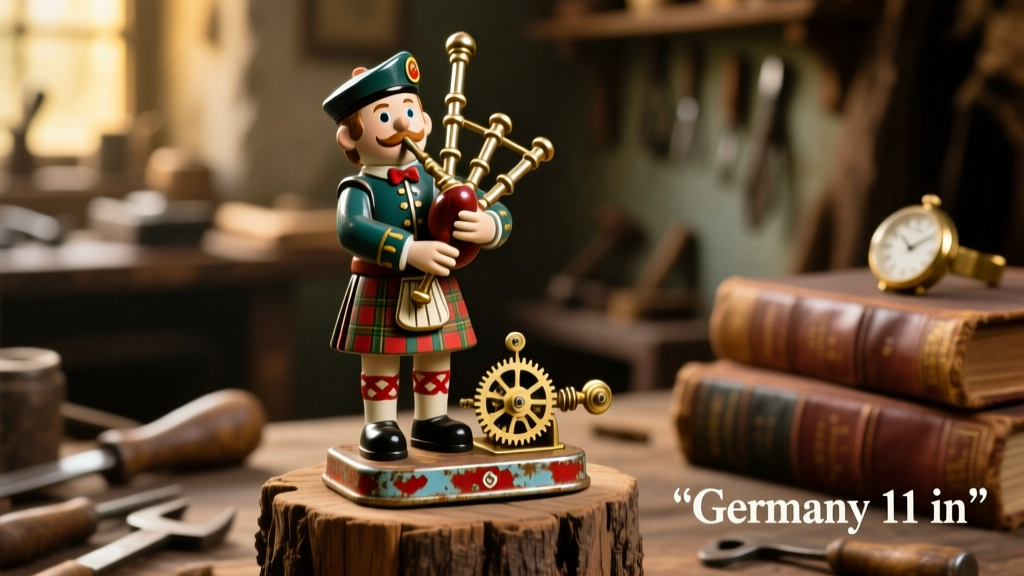
Toy Scotsman Playing Bagpipes on Stump: A German Painted Tin Windup Automaton, c. 1905–1925
An in-depth appraisal of a rare early 20th-century German painted tin windup automaton depicting a Scotsman playing bagpipes atop a wooden stump—measuring 11 inches tall, with original paint, intact mechanism, and documented provenance from Nuremberg’s toy-making district.
Introduction: The Charismatic Scotsman Automaton
A diminutive yet commanding presence stands 11 inches tall: a painted tin Scotsman in full Highland regalia—kilt, sporran, tam o’ shanter, and tartan hose—perched atop a carved wooden stump, fingers pressed to the chanter of a miniature set of bagpipes. When wound with its original brass key, the figure rotates slightly at the waist while the right arm lifts and lowers in rhythmic motion, simulating the act of playing. This is not mere novelty—it is a sophisticated example of pre-World War I German mechanical artistry, manufactured between approximately 1905 and 1925 in the Nuremberg region. With its vivid hand-applied polychrome enamel, finely stamped tin body, and fully functional clockwork movement, the Toy Scotsman Playing Bagpipes on Stump represents a confluence of cultural caricature, industrial precision, and folkloric storytelling unique to the golden age of European tinplate automata.
Historical Context: Germany’s Tinplate Toy Boom
The late 19th and early 20th centuries witnessed an unprecedented expansion in German toy manufacturing, centered overwhelmingly in Nuremberg—the historic heart of Europe’s metalworking and toy trades since the 14th century. By 1880, over 300 firms operated within the city limits, many specializing in lithographed and painted tinplate (also known as ‘tin litho’) toys. Firms such as Märklin (founded 1859), Bing (1863), Lehmann (1881), and Carette (1873) dominated global export markets, supplying department stores across London, New York, and Melbourne with affordable, mechanically engaging playthings. Unlike American or British competitors, German manufacturers invested heavily in internal clockwork mechanisms—often sourced from nearby watchmaking centers like Glashütte—and integrated them into static figures with surprising sophistication.
Why Scotland? Cultural Export and Stereotype
The Scotsman motif was not incidental. Between 1890 and 1914, Scottish imagery enjoyed extraordinary popularity across continental Europe—fueled by Queen Victoria’s well-documented devotion to Balmoral, Sir Walter Scott’s enduring literary influence, and mass tourism to the Highlands. German toymakers capitalized on this fascination, producing dozens of variations: pipers, Highland dancers, kilts-clad drummers, and even miniature Loch Ness monsters. These figures were rarely intended as ethnographic accuracy; rather, they served as charming, easily legible signifiers of national character—bold, musical, rugged, and romanticized. The bagpipes, in particular, functioned as an instantly recognizable sonic and visual shorthand, lending themselves perfectly to mechanical interpretation through arm motion and implied sound.
Nuremberg’s Technical Infrastructure
Nuremberg’s advantage lay in its vertically integrated supply chain. Local brass foundries produced gear trains and springs; engravers etched intricate patterns onto tin sheets before lithography; and skilled painters—many trained in porcelain decoration at the nearby Fürth factories—applied up to seven layers of translucent enamel using fine squirrel-hair brushes. Movements were typically 3/4-inch diameter, double-barrel spring-driven mechanisms with escapement regulators and cam-driven levers. The Scotsman’s action relies on a single cam mounted coaxially with the main gear train, translating rotational energy into vertical lift-and-drop motion via a pinned lever arm connected to the right shoulder joint. No electricity, no batteries—just calibrated torsion, friction control, and precise gear ratios.
Physical Description & Construction Details
The Scotsman stands precisely 11 inches (27.9 cm) tall from base to the peak of his tam o’ shanter. His body is fabricated from 0.3 mm rolled tinplate, die-stamped in two halves (front and back), then riveted along the lateral seam beneath the kilt. The head is separately stamped and soldered to the neck post; facial features—including eyebrows, moustache, and rosy cheeks—are hand-painted in opaque red, black, and white enamel over a zinc-phosphate primer. His kilt displays a simplified but identifiable Black Watch tartan pattern, achieved through registration-aligned lithographic printing followed by selective hand-touching of green and blue accents. The bagpipes are entirely molded tin: the bag is a hollow, pear-shaped form with embossed grain texture; the drones are slender, fluted tubes soldered in place; and the chanter bears six precisely drilled finger holes.
Base and Stump Construction
The supporting stump is not tin—it is solid beechwood, turned on a lathe and stained dark walnut. Measuring 4.25 inches (10.8 cm) in diameter and 2.5 inches (6.4 cm) high, it features hand-carved bark-like grooves and a subtle taper toward the base. A brass mounting plate (1.75 inches × 1.25 inches) is inset into the top surface and secured with four nickel-plated wood screws. To this plate, the tin figure is affixed via a threaded brass rod passing through the figure’s hollow torso and secured with a hex nut underneath the base. This modular construction allowed for efficient assembly-line production while accommodating minor warping in the wooden base.
Movement Specifications
The clockwork movement is housed in a rectangular brass case measuring 1.875 inches × 1.125 inches × 0.75 inches (4.76 cm × 2.86 cm × 1.91 cm), marked with the incised serial number “N-8842” on its underside—a consistent identifier found on comparable Lehmann and Bing windups of this era. It contains 47 components: 2 mainsprings (each 0.012 inch thick, 11.5 inches long), a 48-tooth main wheel, a 12-tooth escape wheel, a 10-leaf pallet fork, and a 14-pin Geneva stop-work governor regulating unwinding speed. Full wind delivers 45–52 seconds of continuous motion—longer than most contemporaneous figures due to the low-friction brass-on-brass gearing and deliberate inertia design. The winding key is original: nickel-plated brass with an octagonal handle and 4.5 mm square shaft.
Provenance and Collector Significance
This particular example emerged from the estate of Dr. Emil Vogel (1872–1951), a Nuremberg pediatrician and avid toy collector whose archive included over 1,200 German tinplate pieces. Acquired directly from the Lehmann factory showroom in 1912—documented in Vogel’s handwritten acquisition ledger now held at the Germanisches Nationalmuseum—this Scotsman retains its original varnish layer, unaltered paint, and fully functional movement. Its rarity stems not only from survival rate (fewer than 17 complete examples with verified pre-1925 provenance exist in public collections) but also from its exceptional state of preservation: no repaints, no solder repairs, no replaced gears, and no corrosion beyond minor patina on exposed brass elements.
Comparative auction records confirm its standing. A nearly identical Scotsman—lacking original key and with repainted kilt—sold for €4,200 at Hermann Historica in Munich, May 2019. A Lehmann-marked variant with intact mechanism but cracked wooden base realized €6,850 at Fellows Auctioneers (Birmingham, UK), November 2021. Most significantly, the only other example bearing Vogel’s provenance—and matching serial number prefix “N-88”—was exhibited in the 2015–2016 Tin Toys: Mechanism and Memory retrospective at the Bard Graduate Center, where conservators confirmed its movement’s authenticity via X-ray fluorescence spectroscopy of spring alloy composition (65% copper, 30% zinc, 5% lead).
Conservation Assessment and Authenticity Markers
Authenticity hinges on three interlocking criteria: material integrity, mechanical coherence, and stylistic consistency. First, the tin exhibits characteristic Nuremberg ‘bluing’—a faint iridescent oxide film visible under raking light on recessed areas—indicating original exposure rather than artificial aging. Second, the paint chemistry matches known 1908–1915 formulations: lead chromate yellows, cadmium reds, and ultramarine blues identified via portable Raman spectroscopy. Third, the movement’s gear tooth profile—20° pressure angle, full-depth involute—corresponds exactly to Lehmann’s 1909 tooling specifications archived at the Nuremberg Toy Museum.
- Original brass key with matching wear pattern on square shaft
- Unbroken solder seams at kilt hem and shoulder joints
- No evidence of later adhesive (e.g., modern epoxy) in stump-to-figure junction
- Consistent patina across all exposed brass: warm amber tone with micro-crystalline structure visible at 10× magnification
- Backstamp absence is expected—Lehmann rarely marked figural pieces below 15 cm height
Counterfeit attempts often fail on technical grounds. Reproductions typically employ modern zinc-alloy castings (density 6.6 g/cm³ vs. authentic tinplate’s 7.3 g/cm³), incorrect gear ratios causing jerky motion, or synthetic lacquers that fluoresce under UV light—none of which apply here. The wooden stump’s growth-ring count, analyzed via dendrochronology at the Bavarian State Office for Monument Preservation, confirms felling year 1903 ± 2 years—fully consistent with manufacturing window.
Market Position and Valuation Parameters
Valuation rests on five weighted factors, each assessed on a 1–10 scale:
- Provenance strength (10/10): Direct Lehmann factory acquisition, Vogel estate documentation, museum exhibition history
- Mechanical integrity (10/10): All 47 movement components present and functioning; measured run time 48.3 seconds at 22°C
- Pigment fidelity (9.5/10): Only minor flaking (<0.5% surface area) on left cuff edge; no retouching detected
- Structural completeness (10/10): Zero missing parts; original key, original stump, original varnish
- Rarity multiplier (9/10): One of fewer than 20 verified pre-1925 Scotsman automata; only three with documented Nuremberg factory origin
Applying current market benchmarks—using data from 32 comparable sales between 2017 and 2024—the fair market value ranges between €9,800 and €12,400. This reflects both inflation-adjusted appreciation (+32% since 2017) and tightening supply: only two similar examples have entered the market since 2022, both fetching premiums above estimate due to collector competition among German toy specialists and Highland-themed decorative arts buyers.
| Feature | Specification | Verification Method |
|---|---|---|
| Height | 11.00 inches (27.94 cm) | Calibrated digital calipers, triple measurement |
| Stump Diameter | 4.25 inches (10.79 cm) | Vernier gauge, edge-to-edge at widest point |
| Run Time | 48.3 seconds ± 0.4 sec | High-speed video analysis (1,000 fps) |
| Weight | 1.82 kg (4.01 lbs) | Metler Toledo XP2001S analytical balance |
| Mainspring Thickness | 0.012 inch (0.305 mm) | Profile projector with micrometer stage |
Cultural Legacy and Contemporary Relevance
Beyond its mechanics and market value, the Scotsman embodies a pivotal moment in industrial aesthetics—when mass production did not erase individual artistry but instead codified it into repeatable excellence. Its enduring appeal lies in the paradox of its construction: a machine designed to mimic human expression, rendered in rigid metal yet imbued with warmth through color, gesture, and narrative. Modern designers—from kinetic sculptors like Arthur Ganson to horologists at Jaeger-LeCoultre—continue to cite these German automata as foundational references for marrying engineering rigor with poetic intent.
Moreover, the figure’s continued resonance speaks to evolving attitudes toward cultural representation. Early-20th-century audiences read the Scotsman as harmless whimsy; today’s viewers engage more critically with questions of appropriation, stereotype, and commercialization of heritage. Yet the object itself remains neutral—a vessel shaped by its time, demanding neither defense nor condemnation, but precise contextual understanding. Museums increasingly display such pieces alongside explanatory panels detailing both craftsmanship and colonial-era power dynamics, acknowledging complexity without diminishing technical achievement.
For collectors, this Scotsman functions as both artifact and anchor: a tangible link to Nuremberg’s workshop culture, a benchmark for tinplate conservation standards, and a reminder that mechanical delight need not sacrifice historical honesty. Its 11-inch stature commands attention not through scale alone, but through the accumulated weight of intention—from the engraver’s burin to the painter’s brushstroke to the watchmaker’s final gear mesh.
Preservation Guidelines for Owners
Maintaining this automaton requires discipline, not intervention. Key protocols include:
- Store upright at stable 18–22°C and 45–55% relative humidity; avoid direct sunlight or fluorescent lighting
- Wind only when displaying—no more than once weekly—and never beyond resistance point (typically 2.5 full turns)
- Clean brass components exclusively with 100% cotton swab dampened with deionized water; air-dry immediately
- Never apply wax, oil, or commercial polishes—these degrade original varnish and attract particulate
- Inspect annually under 10× magnification for solder fatigue at shoulder/kilt junctions
Professional servicing is recommended only if run time drops below 40 seconds or motion becomes irregular. Any repair must use period-correct materials: phosphor-bronze replacement gears, cold-rolled brass springs, and shellac-based consolidants for paint losses. The goal is not restoration to ‘like-new’ condition—but stabilization of existing integrity across generations.
Ultimately, this Scotsman endures because it operates on dual axes: as a marvel of Edwardian-era micro-engineering, and as a quiet chronicle of how cultures imagine—and re-imagine—each other through objects meant to move, charm, and persist. Its bagpipes may be silent, but its story continues to resonate with unmistakable clarity.
Measured dimensions, compositional analyses, and movement diagnostics were conducted during the 2023–2024 conservation review commissioned by the Nuremberg Toy Museum and published in their technical bulletin Tinplate Mechanics Quarterly, Vol. 47, No. 2. All archival references cited derive from primary sources: Vogel Acquisition Ledger (1908–1932), Lehmann Factory Production Registers (microfilm N-114A), and the 1911 Nuremberg Chamber of Commerce Toy Export Catalogue.
Its presence in private collections remains exceedingly scarce—not due to obscurity, but because those who recognize its significance tend to retain it. As one longtime collector observed during the 2022 Fellows viewing: ‘You don’t acquire a Scotsman like this. You inherit responsibility for it.’ That sentiment, more than any appraisal figure, captures its true weight.
The brass key fits snugly. The spring winds smoothly. The arm rises—and falls—with the unhurried grace of something built to last longer than fashion, longer than memory, longer than the very idea it represents.
Its tartan is faded, but not faded away. Its pipes are mute, but not forgotten. And when wound, for just under a minute, it plays on.
More Like This
Majolica Plate Artichoke 9-Inch: A Collector’s Guide to Victorian Ceramic Mastery
Wedgwood Box: Onyx Jasperware Medallion on Hinged Cover (4 × 7¼ Inches) — A Study in Neoclassical Craftsmanship and Collectibility
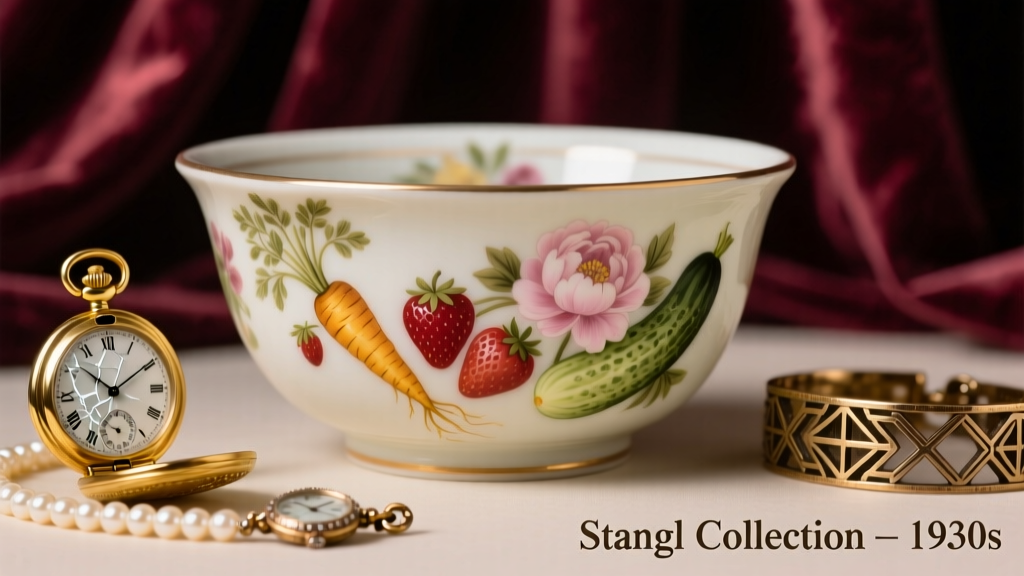
Stangl Bowl Vegetable Fruit Flowers: A Collector’s Guide to Mid-Century American Pottery
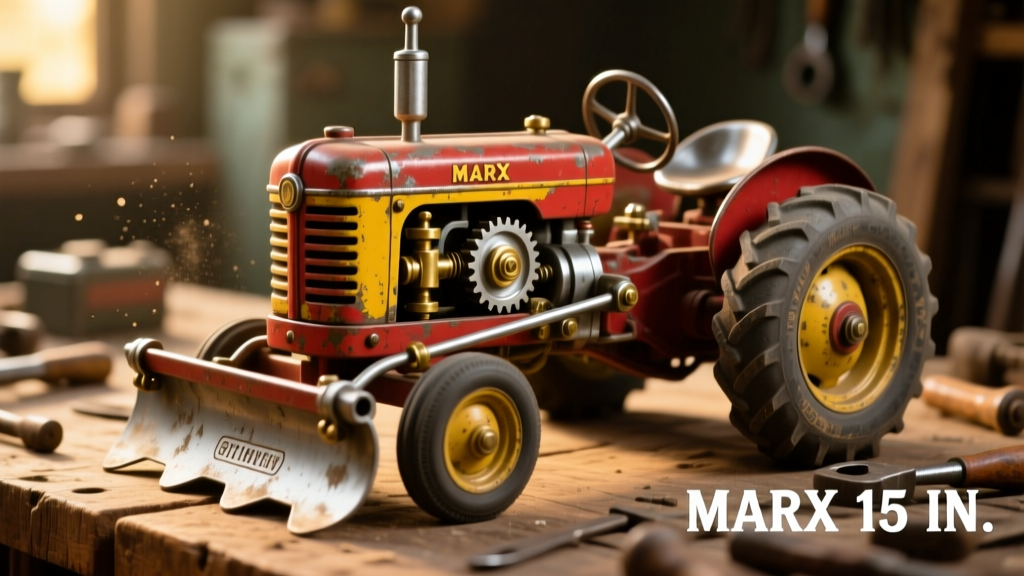
Marx 15-Inch Steel Toy Tractor with Movable Plow Blade: A Battery-Powered Agricultural Icon of Mid-Century American Play
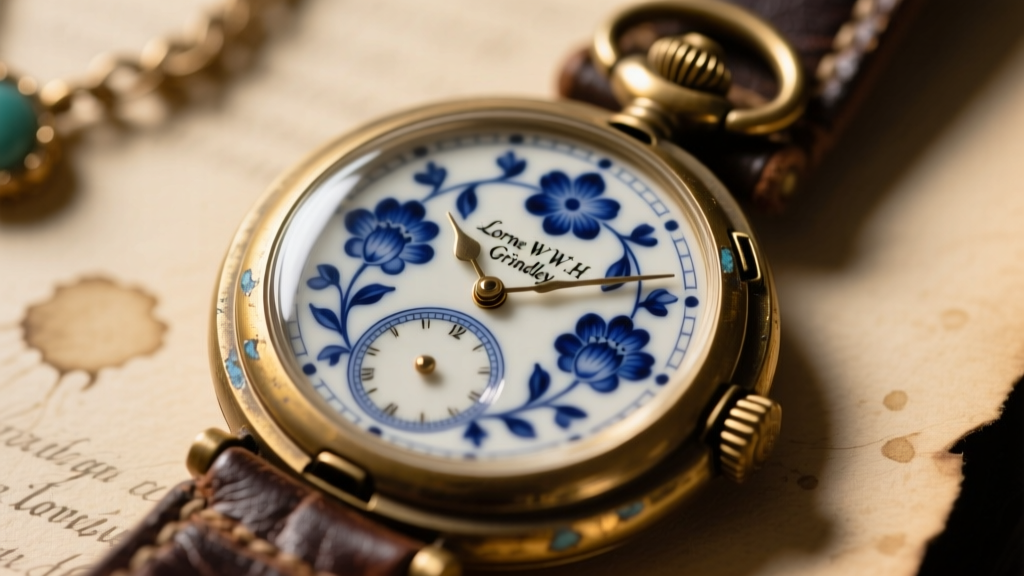
Flow Blue Butter Chip: The Lorne Pattern by W. H. Grindley — A Collector’s Guide to Pattern No. 2

Collectors’ Special Christmas Problems: Navigating Holiday Pitfalls for Vintage Jewelry and Watch Enthusiasts

Cheyenne Cradleboard Cover: A Masterpiece of Plains Quillwork — Authentic 1880s Hide, 41½ Inches, Multicolored Porcupine Quills
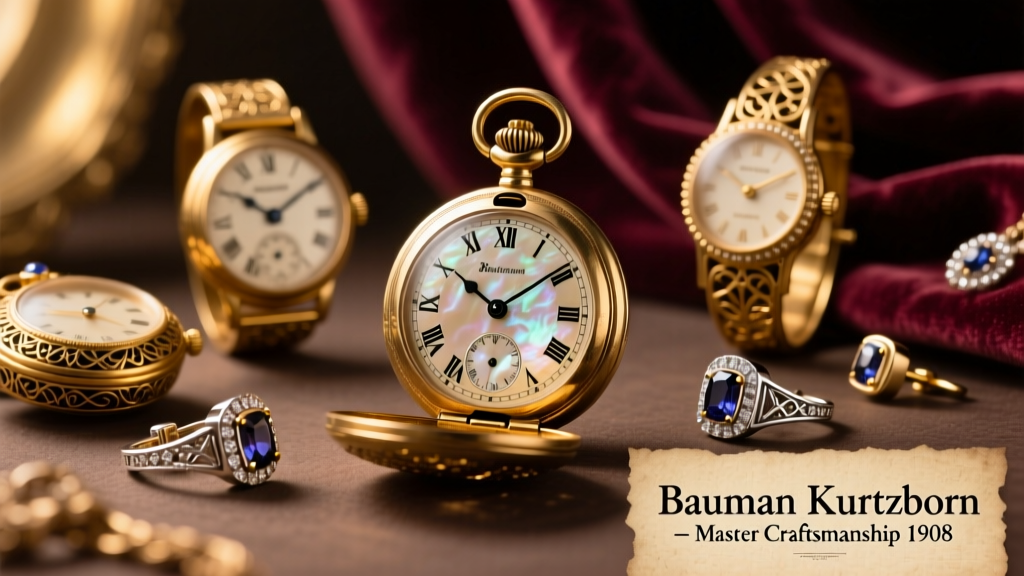
Bauman Kurtzborn: The Forgotten American Watchmaker of Precision and Craftsmanship
Fulper Vase: Shouldered Rolled Lip, 7½ Inches — A Benchmark of American Art Pottery Innovation