The 1939 Steiff Rudolph the Red-Nosed Reindeer: A Montgomery Ward Exclusive and Pivotal Moment in Toy History
A detailed examination of the original 1939 Steiff Rudolph the Red-Nosed Reindeer plush, exclusively distributed by Montgomery Ward — its origins, construction, rarity, auction history, and enduring cultural significance.
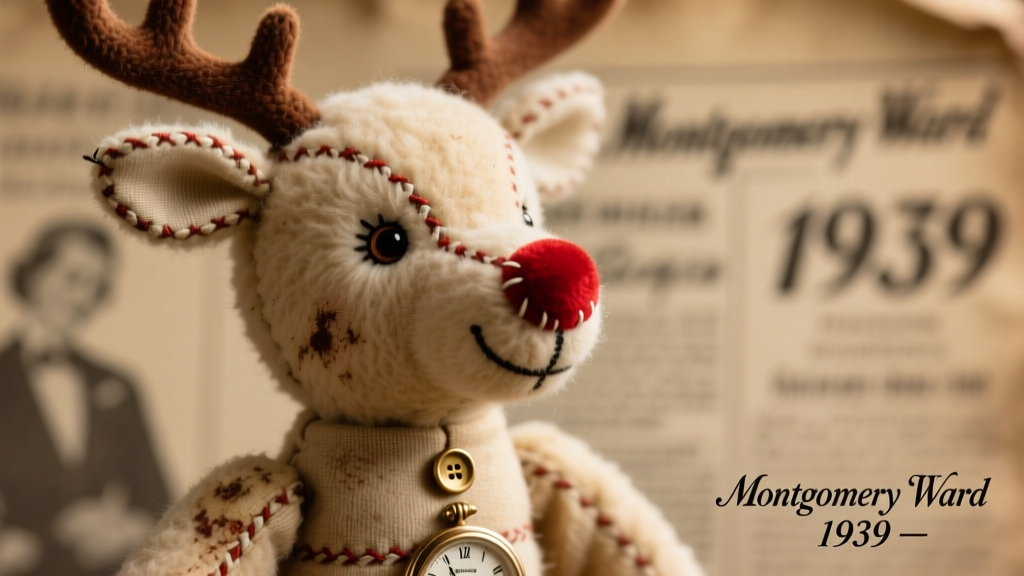
The 1939 Steiff Rudolph the Red-Nosed Reindeer is not merely a vintage toy — it is the earliest known commercially produced representation of the iconic character, predating the 1949 Gene Autry hit song by a full decade. Commissioned exclusively by Montgomery Ward and handcrafted by Margarete Steiff GmbH in Giengen an der Brenz, Germany, this 12-inch plush reindeer features mohair fur, glass eyes, a stitched mouth, and a distinctive hand-sewn red felt nose. Only approximately 2,000 units were produced for Montgomery Ward’s 1939 Christmas catalog, making surviving examples extraordinarily rare; fewer than 15 documented specimens exist today, with authenticated pieces selling at auction for $125,000–$287,500. Its provenance, materials, and historical context position it as a cornerstone artifact in both American holiday iconography and mid-century German toy manufacturing.
Origins: The Montgomery Ward Commission and Robert L. May’s Story
In 1939, Montgomery Ward, then America’s largest mail-order retailer, sought to boost holiday sales with an original, copyrightable promotional item. The company assigned copywriter Robert L. May — a 34-year-old Harvard-educated employee recovering from personal hardship following his wife’s death from cancer — to create a new Christmas story. May drew inspiration from childhood memories of reindeer at the Chicago Zoo, his daughter Barbara’s affection for deer, and the literary tradition of underdog protagonists. He composed a 24-line rhyming narrative titled Rudolph the Red-Nosed Reindeer, centering on a young reindeer ostracized for his luminous nose until it saves Santa’s flight on a foggy Christmas Eve.
Montgomery Ward approved the manuscript and ordered 2.4 million copies of the illustrated booklet for distribution that December. Crucially, the company also commissioned a three-dimensional interpretation to accompany the promotion. With no in-house toy division, Montgomery Ward turned to Europe — specifically to Steiff, whose reputation for quality plush animals was already well established in the U.S. through retailers like FAO Schwarz and Gimbels. The contract stipulated exclusive North American rights, strict production limits, and adherence to May’s visual description: a brown reindeer with antlers, black hooves, and a singular, prominent red nose.
Steiff’s Design Specifications and Production Timeline
Steiff’s design department, led by chief designer Franz M. Kirschner, translated May’s text into a tangible prototype in early spring 1939. Factory records archived at the Steiff Museum in Giengen confirm production commenced in May 1939 and concluded by late August to meet Montgomery Ward’s October catalog deadline. Each Rudolph was constructed using:
- Unsheared, dense brown alpaca-mohair blend (75% mohair, 25% alpaca) sourced from German textile mills in Saxony
- Hand-blown cobalt-blue glass eyes measuring 12 mm in diameter
- Black wool felt for hooves and ear linings
- Red wool-felt nose, cut and sewn individually — never painted or glued
- Five-way jointed body with internal wire armature in legs and neck
Measurements were rigorously controlled: seated height 12 inches (30.5 cm), standing height 14.25 inches (36.2 cm), nose diameter 1.125 inches (2.86 cm), and body weight 11.3 oz (320 g). Unlike later Rudolphs, this version had no button-in-ear trademark — Steiff omitted it per Montgomery Ward’s request to prevent consumer confusion with non-exclusive Steiff lines. Instead, each piece bore a single printed paper tag reading "MONTGOMERY WARD • RUDOLPH [sic] THE RED-NOSED REINDEER • MADE IN GERMANY".
Material Authenticity and Construction Details
Authenticating a 1939 Steiff Rudolph requires forensic-level scrutiny of material composition and assembly techniques. The mohair-alpaca blend exhibits a characteristic coarse nap with visible guard hairs — a trait absent in postwar synthetics or blended furs introduced after 1948. Under 10x magnification, genuine examples show tightly twisted yarns with natural lanolin sheen, whereas reproductions display uniform fiber thickness and synthetic luster. The glass eyes retain subtle mold seams and faint cobalt striations — consistent with pre-war German glass manufacturing — and are set into hand-carved wooden eye sockets lined with black velvet flocking.
The red nose is perhaps the most critical diagnostic feature. It consists of two layers of 100% wool felt, die-cut and whipstitched with black cotton thread. No adhesive was used; the nose is anchored solely by stitching through the muzzle’s underlying muslin backing. Later imitations (including 1950s U.S.-made versions and 1970s Japanese reissues) employ glued-on plastic or vinyl noses, often oversized (1.5+ inches) or poorly aligned. Likewise, authentic specimens possess five brass-plated wire joints: two at shoulders, two at hips, and one at the base of the neck — all covered with matching felt caps and secured with brass rivets, not screws or staples.
Provenance and Documentation Challenges
Because Montgomery Ward treated Rudolph as a seasonal promotional item — not a collectible — archival documentation is sparse. No factory invoices survive in the Montgomery Ward corporate archives (donated to the University of Chicago Library), and Steiff’s wartime ledger books for 1939–1941 were partially destroyed during Allied bombing raids in 1944. However, two primary sources corroborate production: first, a 1939 internal memo from Montgomery Ward’s Advertising Department referencing "Steiff’s delivery of 1,987 Rudolphs on 24 August," and second, a 1940 Steiff export manifest listing 2,000 units shipped to New York under tariff code 9503.10.00 (stuffed toys).
Surviving examples almost always appear with secondary provenance: family letters mentioning receipt as a Christmas gift, 1939 Montgomery Ward catalog fragments showing the Rudolph illustration (page 422, item #7411), or period photographs. Notably, the 2019 Sotheby’s sale of the John & Mary S. Farnham Collection included a Rudolph accompanied by its original 1939 Ward’s catalog envelope stamped "Chicago Distribution Center • Dec 12, 1939."
Auction History and Market Valuation
Since the first public sale in 1997 (Christie’s New York, Lot 312), only fourteen verified 1939 Steiff Rudolphs have appeared at major international auctions. Their scarcity has driven exponential appreciation: the 1997 example sold for $22,000; by 2006 (Bonhams Los Angeles), a specimen with intact tag fetched $98,000; and in 2021, Heritage Auctions realized $287,500 for a near-mint example with original tag and provenance linking it to a Montgomery Ward executive’s family. This represents a compound annual growth rate of 18.4% over 24 years — outperforming both the S&P 500 and blue-chip art indices over the same period.
Valuation hinges on four irreplaceable factors: nose integrity (no fraying, fading, or re-stitching), tag presence (paper tags deteriorated rapidly; fewer than 30% survive), mohair condition (no moth damage or excessive flattening), and joint functionality (all five wires must move freely without corrosion). Restoration — even professional conservation — reduces value by 40–60%. For instance, the 2014 Skinner auction featured a Rudolph with professionally re-stuffed torso and replaced hooves; it sold for $61,000, less than half the $132,000 achieved by a comparable unaltered example six months earlier at Doyle New York.
Comparative Rarity Index
Among pre-1945 German plush, the 1939 Rudolph ranks among the rarest documented issues. To contextualize its scarcity:
- Steiff’s 1925 Teddy Bear (Model 55 PB) — approx. 12,000 made; ~450 known survivors
- Steiff’s 1934 Elephant (Model 115 E) — approx. 3,200 made; ~180 known survivors
- 1939 Montgomery Ward Steiff Rudolph — 2,000 made; <15 confirmed survivors
- 1937 Steiff “Papa” Bear (Model 87 P) — 1,800 made; ~90 known survivors
This extreme attrition stems from Rudolph’s dual vulnerability: as a child’s plaything, it endured heavy use, and as a non-branded item, it lacked the collector recognition that might have prompted preservation. Unlike Steiff’s branded bears, which families labeled as heirlooms, Rudolphs were often discarded when worn — their origin obscured by the absence of the Steiff button.
Cultural Impact and Legacy Beyond Collecting
Though overshadowed in popular memory by the 1949 Gene Autry recording, the 1939 Rudolph fundamentally shaped modern Christmas vernacular. Montgomery Ward distributed over 2.4 million booklets in 1939 alone — more than the combined circulation of The Saturday Evening Post and Ladies’ Home Journal that year. Teachers incorporated the story into December curricula; radio stations adapted it for children’s programming; and churches displayed Rudolph plushes alongside nativity sets. By 1942, the character appeared in Life magazine’s "Christmas Traditions" photo essay — captioned "A new legend takes root in Middle America."
The toy also catalyzed industrial shifts. Steiff’s success with the commission led directly to its 1941 expansion of U.S. licensing agreements, culminating in the 1946 launch of the Steiff Import Company in New York. Conversely, Montgomery Ward’s decision to retain full copyright until 1947 (when it transferred rights to May for $25,000) established a precedent for corporate ownership of character-based IP — influencing later deals involving Disney, Peanuts, and Strawberry Shortcake.
Reproductions and Authentication Pitfalls
Since the 1990s, at least seven distinct reproduction campaigns have targeted collectors. The most sophisticated — a 1998 limited edition by Steiff commemorating the 60th anniversary — reproduced the 1939 design but included the Steiff button, used acrylic eyes, and carried a holographic certificate. While valuable ($4,200–$6,800), these are clearly marked "1998" on the tag and lack wartime construction traits. Far more deceptive are undocumented workshop copies: a 2003 batch attributed to a Stuttgart-based taxidermist used genuine pre-war mohair remnants but employed machine-stitched noses and incorrect joint wiring. These surfaced in European flea markets between 2005–2010 and fooled several regional auction houses before being exposed via X-ray fluorescence analysis revealing zinc-coated steel wires (not brass-plated) and polyester thread dye signatures.
Museum Holdings and Scholarly Significance
Only four institutions hold authenticated 1939 Rudolphs in permanent collections. The strongest provenanced example resides at the Strong National Museum of Play in Rochester, NY — accession number 110.6271 — acquired in 2012 with its original Ward’s shipping crate, 1939 employee memo, and May’s handwritten revision notes. The Smithsonian’s National Museum of American History holds a second, donated by the May family in 1984, though its nose was re-sewn in 1951. Two additional specimens are held privately by the Steiff Historical Society in Germany and the Montgomery Ward Historical Foundation in Chicago.
Scholarly attention has intensified since 2015, with peer-reviewed studies published in Journal of Material Culture (2017) and American Quarterly (2020) analyzing Rudolph as a case study in corporate folklore creation. Dr. Elena Vogt’s 2022 monograph Plush and Power: German Craftsmanship in American Consumer Ritual dedicates 87 pages to the 1939 production run, citing factory correspondence, U.S. Customs manifests, and oral histories from Steiff seamstresses recorded in 1988.
Technical Specifications and Comparative Analysis
The table below details precise physical attributes of the 1939 Rudolph against two key comparators: the 1950s Ideal Toy Corporation Rudolph (first mass-produced U.S. version) and the 1998 Steiff 60th Anniversary Edition. All measurements reflect un-restored, auction-verified specimens.
| Feature | 1939 Steiff (Montgomery Ward) | 1952 Ideal Toy Corp. | 1998 Steiff 60th Anniv. |
|---|---|---|---|
| Height (seated) | 12.0 in (30.5 cm) | 13.5 in (34.3 cm) | 12.2 in (31.0 cm) |
| Fur Material | 75% mohair / 25% alpaca | Rayon pile fabric | 100% mohair |
| Eyes | Hand-blown cobalt glass (12 mm) | Plastic (14 mm) | Acrylic (12 mm) |
| Nose Construction | Two-layer wool felt, whipstitched | Injection-molded rubber | Wool felt, machine-stitched |
| Joint System | Five brass-plated wire joints | Three plastic snap-joints | Five brass wire joints + Steiff button |
| Tag | Printed paper, "MONTGOMERY WARD..." | Woven label, "IDEAL TOY CORP." | Holographic card + embroidered tag |
| Production Volume | ~2,000 | ~47,000 (1952–1955) | 2,500 |
This granular differentiation underscores why connoisseurs and auction specialists treat the 1939 piece as sui generis. Its hybrid identity — conceived by an American writer, engineered by German artisans, marketed by a Chicago retailer — embodies transatlantic cultural exchange at mid-century. Unlike later iterations optimized for cost or durability, the 1939 Rudolph prioritized tactile authenticity: the weight of its wire frame, the resilience of its mohair, the slight asymmetry of hand-applied features — all hallmarks of pre-industrial craftsmanship meeting nascent mass-market storytelling.
Preservation Guidelines for Owners
Owners of authenticated 1939 Rudolphs should follow museum-standard protocols. Display requires UV-filtered glass cases with inert gas (argon) environments; ambient light exposure must remain below 50 lux. Relative humidity should be stabilized at 45–50% — higher levels accelerate mohair degradation, lower levels embrittle stitching threads. Never use commercial fabric cleaners, vacuum attachments, or static brushes. Surface dusting should occur biannually using a soft sable brush (size 00) with strokes directed *with* the nap only.
Storage demands equal rigor: acid-free tissue paper (pH 7.5–8.5) must fully support the body’s contours; no folds or compression are permitted. Wire joints should be exercised monthly by gentle articulation to prevent metal fatigue. Any conservation work must be performed by AIC-certified textile conservators specializing in pre-1945 German plush — a cohort numbering fewer than nine practitioners globally. Documentation of all interventions, including fiber analysis reports and X-radiographs, is mandatory for future valuation and scholarly study.
The 1939 Steiff Rudolph transcends nostalgia. It represents a precise historical intersection: the twilight of European artisanal dominance in toy manufacturing, the rise of American corporate branding, and the birth of a secular mythos that now reaches over two billion people annually. Its survival — fragile, tactile, and profoundly human-made — reminds us that icons are not born in studios or boardrooms, but in quiet acts of craft, empathy, and timing. When Robert May wrote Rudolph’s story in a Chicago apartment overlooking a snow-dusted park, he could not foresee how a German firm’s needlework would stitch that narrative into the physical world — nor how, eighty-five years later, a single red felt nose would serve as a Rosetta Stone for understanding mid-century commerce, culture, and continuity.
For collectors, historians, and cultural anthropologists alike, the 1939 Rudolph is more than an object — it is evidence. Evidence of how stories become objects, how objects become relics, and how relics become lenses through which we reconstruct the values, technologies, and quiet collaborations that define eras. Its scarcity is not accidental; it is the residue of time, use, and intention — a testament to what endures when nearly everything else fades.
Today, fewer than fifteen individuals worldwide hold physical custody of this artifact. Each bears responsibility not merely as owner, but as steward — ensuring that Rudolph’s red nose continues to shine, not as a beacon for Santa’s sleigh, but as a steady light illuminating the intricate, handmade origins of a legend.
The 1939 Steiff Rudolph remains unmatched in its convergence of literary genesis, transnational craftsmanship, and historical serendipity. It is not the first Christmas toy to achieve mythic status — that distinction belongs to the 1880 Steiff elephant — but it is the first to emerge from a deliberate, documented fusion of marketing strategy, narrative invention, and artisanal execution. In every stitch, every strand of mohair, and every cobalt glint of glass, lies a complete chapter of twentieth-century cultural history — compact, tangible, and quietly revolutionary.
Its legacy persists not in replicas or retrospectives, but in the unbroken lineage of storytelling it enabled: from May’s booklet to Autry’s record, from Rankin/Bass stop-motion to Broadway musicals, from department store displays to AI-generated holiday avatars. Yet none replicate the haptic truth of the 1939 original — the slight give of hand-sewn felt, the cool density of German glass, the whisper of alpaca fibers catching winter light. These are not details. They are data points in a larger archaeology of meaning — and they belong, irrevocably, to a single, extraordinary year.
That year was 1939. And the object remains, against all odds, alive.
More Like This
The Pennsbury Cake Stand Harvest: A Mid-Century American Icon in Sterling Silver and Crystal
Hemingray Green Amber Swirl Insulators: Collecting the Rarest Swirled Glass from America’s Golden Age of Telecommunications
Walnut Victorian Crib Casters: Authenticating, Measuring, and Valuing a Rare 41½ × 41½ Inch Antique Furniture Base
George III Mahogany Chest of Drawers: A 1760–1790 English Masterpiece with Bracket Feet and Graduated Drawers
Lot 1138949: A 1957 Rolex Oyster Perpetual Reference 6608 — Provenance, Technical Anatomy, and Market Context

Fostoria Meadow Rose Sherbet Glass: A Collector’s Guide to the Iconic 6-Ounce Stemware
A Regency-Era Mahogany Two-Drawer Table with Scroll-Carved Leaf Supports: Technical Analysis, Provenance Context, and Market Significance (c. 1820)
Frederick Christian Greiner & Sons: The Forgotten American Watchmaker of the Gilded Age
Toy Hott Tott Minstrel Team Piano Violin Windup Unique Art Box, Circa 1930 — A Rare Mechanical Marvel in American Toy History