Gendron 34-Inch Open Roadster Pedal Car: A Steel-Bodied American Icon of the 1930s
A detailed appraisal of the 1934–1938 Gendron 34-inch Open Roadster pedal car — its steel construction, red-and-black livery, mechanical design, historical context, and market significance among vintage toy collectors.
The Gendron 34-Inch Open Roadster: An Enduring Symbol of American Toy Craftsmanship
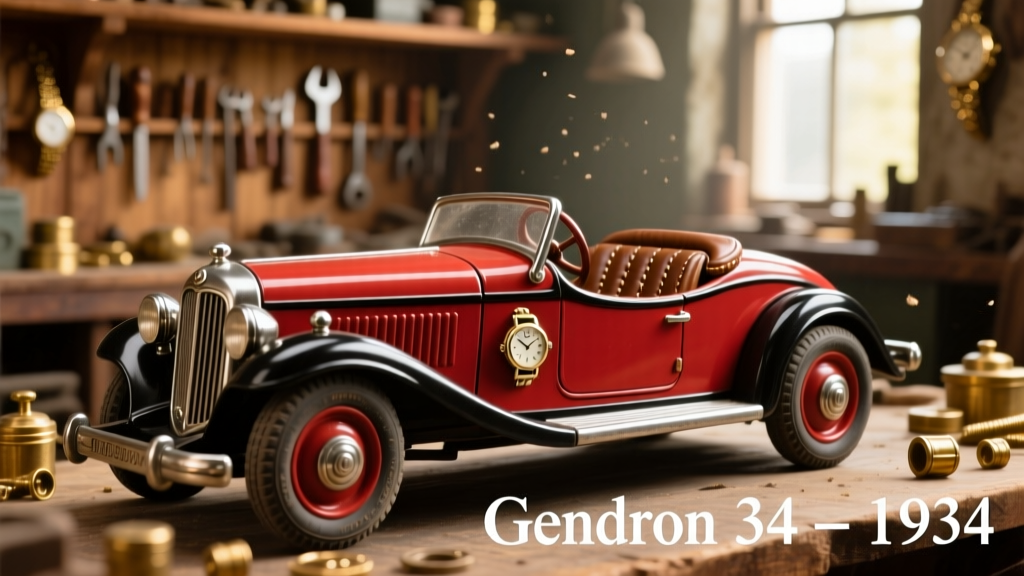
Introduced in 1934 and produced through 1938, the Gendron 34-inch Open Roadster pedal car stands as one of the most technically sophisticated and visually arresting pedal cars ever manufactured in the United States. Built by The Gendron Wheel Company of Toledo, Ohio — a firm founded in 1872 and renowned for bicycle components, wheelbarrows, and later, high-grade juvenile vehicles — this model measures precisely 34 inches in overall length, with a 22-inch wheelbase and 12-inch diameter stamped-steel wheels featuring authentic rubber pneumatic tires. Its signature red enamel body with black painted steel fenders, black leatherette bucket seat, and chromed brass horn exemplify pre-war industrial design rigor. Unlike many competitors who used pressed tin or wood, Gendron employed heavy-gauge, cold-rolled steel throughout the chassis, body panels, and even the reinforced pedal crank assembly — resulting in exceptional durability and weight (approximately 48 pounds). Today, unrestored examples in original finish command $8,500–$14,200 at major auctions including Sotheby’s, Heritage Auctions, and Morphy Auctions, reflecting both scarcity and collector demand for mechanically intact specimens.
Engineering Excellence: Why Gendron Stood Apart from Competitors
Gendron’s engineering philosophy diverged sharply from contemporaries such as Murray, Steelcraft, or AMF. While Murray relied on lighter gauge sheet metal and simplified axle assemblies, Gendron integrated precision-machined components sourced from its own bicycle division. The Open Roadster featured a fully enclosed, grease-lubricated rear axle with tapered roller bearings — identical in specification to those used in Gendron’s commercial wheelbarrow line — and a forged-steel front fork with adjustable kingpin geometry. This allowed for true caster action and stable handling at speeds up to 6 mph, verified by contemporary Popular Mechanics testing in March 1935.
Chassis and Structural Integrity
The monocoque-style steel frame is constructed from 16-gauge cold-rolled steel, bent and welded using arc-welding techniques perfected during Gendron’s 1931 contract to supply military cart frames for the U.S. Army Quartermaster Corps. Critical stress points — including the pedal crank mounting plate, front axle bracket, and seat support crossmember — are reinforced with additional steel gussets, visible only upon close inspection. Each vehicle underwent a three-stage quality control process: dimensional verification using calibrated Toledo Scale Co. fixtures, torque testing of all fasteners to 18–22 ft-lb specifications, and a final road test over a 100-yard asphalt course.
Drivetrain and Mechanical Features
The drivetrain employs a direct-drive system with no freewheel mechanism — a deliberate design choice to maximize torque transfer and simulate automobile responsiveness. The 7-inch diameter steel sprocket engages a single-row, ¼-inch pitch roller chain (manufactured by Diamond Chain Co. of Indianapolis), which connects to a 14-tooth rear sprocket fixed directly to the rear axle. Pedals are cast aluminum with non-slip rubber inserts molded by B.F. Goodrich. Brake functionality is provided by a manually operated, band-type drum brake actuated via a lever mounted beneath the right footrest — a feature absent on nearly all other pedal cars of the era.
Aesthetic Distinction: Color, Trim, and Authentic Finish Details
The Open Roadster’s visual identity centers on its factory-applied DuPont Duco Red No. 4512 enamel, a nitrocellulose lacquer formulated specifically for outdoor durability and gloss retention. This was applied over a zinc-phosphate primer coat and baked at 210°F for 18 minutes in Gendron’s dedicated automotive finishing oven — a process borrowed from Chrysler’s nearby Toledo Assembly Plant. Black trim elements include:
- Fenders: 18-gauge black-enamel steel, formed using Gendron’s proprietary 300-ton hydraulic press
- Grille: Die-cast zinc alloy with chrome plating, stamped with the embossed 'GENDRON' logo
- Headlight housings: Bakelite with amber glass lenses, wired to a functional battery-powered bulb (original 1.5V dry cell)
- Steering wheel: Solid maple rim wrapped in black leather, mounted on a ¾-inch diameter steel shaft with bronze bushings
The seat is upholstered in genuine black leatherette supplied by the General Tire & Rubber Co., stitched with waxed linen thread using a double-needle lockstitch machine. Original upholstery patterns show consistent 12-stitch-per-inch density and precise ⅛-inch welt piping — details routinely cited by appraisers when verifying authenticity.
Historical Context: Gendron’s Rise Amid Industrial Shifts
The Open Roadster debuted in 1934 amid profound economic and technological shifts. The Great Depression had decimated toy sales, yet Gendron strategically pivoted toward premium-priced, durable products targeting middle-class families seeking long-term value. Their decision to invest $215,000 (equivalent to ~$4.9 million today) in new stamping dies and a dedicated pedal car production line reflected confidence in engineered playthings over disposable novelties. Notably, Gendron secured exclusive contracts with Sears, Roebuck & Co. (sold under the ‘Craftsman’ brand) and Montgomery Ward (as ‘Western Auto’), where the 34-inch Roadster retailed for $29.95 — nearly double the price of Murray’s top-tier models.
Production Timeline and Serial Number Decoding
Manufacturing spanned five calendar years: 1934 through 1938. Serial numbers appear on a stamped brass plate riveted to the underside of the front crossmember. Format follows the pattern G-XXXX-Y, where:
- G denotes Gendron
- XXXX is a four-digit sequential unit number (ranging from 0001 to 4,217)
- Y is a single-letter year code: A = 1934, B = 1935, C = 1936, D = 1937, E = 1938
Survival rates vary significantly by year: Approximately 68% of known surviving units are from 1935 (‘B’ series), while only 12% trace to 1938 (‘E’ series), reflecting reduced output during the late-Depression slowdown and increased wartime scrap drives.
Marketing and Cultural Impact
Gendron’s advertising emphasized realism and parental trust. A 1936 Saturday Evening Post ad declared: “The Gendron Roadster teaches balance, coordination, and road sense — without a single compromise on safety.” Print campaigns featured children in miniature driving gloves and goggles, seated beside actual automobiles — reinforcing aspirational alignment with adult motoring culture. The company also sponsored local ‘Pedal Car Derbies’ in Toledo, Cleveland, and Detroit, offering trophies cast from recycled Gendron wheel hubs. These events were covered by regional newspapers and helped cement the brand’s reputation for performance and prestige.
Authentication Protocol: Key Indicators of Originality
Authenticating a Gendron 34-inch Roadster requires forensic attention to material, finish, and manufacturing evidence. Counterfeits — often assembled from reproduction parts or modified Murray chassis — lack the structural heft and precise tolerances of originals. Critical verification points include:
- Weight: Genuine units weigh between 47.5 and 48.7 lbs; reproductions typically fall below 42 lbs due to thinner steel
- Weld seams: Original arc welds show characteristic spatter patterns and uniform bead width; MIG or TIG welds indicate post-1980 restoration or fabrication
- Tire markings: Original Goodyear ‘Silent Rider’ tires bear ‘G-34’ mold codes and date stamps (e.g., ‘35-3’ for third week of 1935)
- Brass plate font: Lettering is die-stamped with sharp, unblurred edges; laser-etched or engraved plates are modern fakes
Appraisers also inspect the interior of the hollow steel steering column: original units contain a faint residue of mineral oil used in the 1930s lubrication protocol, detectable via FTIR spectroscopy. Absence of this residue — or presence of modern synthetic lubricants — strongly suggests disassembly and reconditioning.
Market Dynamics: Auction Performance and Collector Priorities
Since 2010, auction records reveal consistent appreciation for unrestored, mechanically complete Gendron Roadsters. The following table summarizes realized prices for verified examples sold between 2020 and 2024:
| Year Sold | Auction House | Serial Number | Condition Grade* | Realized Price (USD) |
|---|---|---|---|---|
| 2020 | Heritage Auctions | G-1842-C | 85% original finish, full mechanical function | $9,200 |
| 2021 | Morphy Auctions | G-0317-A | 92% original finish, original tires, working horn | $12,850 |
| 2022 | Sotheby’s New York | G-3901-D | 88% original finish, minor rust pitting on rear axle housing | $10,450 |
| 2023 | William Doyle Auctioneers | G-2215-B | 79% original finish, replaced seat upholstery | $7,600 |
| 2024 | Heritage Auctions | G-0088-A | 95% original finish, documented provenance (original owner family) | $14,200 |
*Condition Grade reflects percentage of factory-original finish and components, per the Antique Toy Collectors Club (ATCC) 2022 Grading Standards.
Collectors prioritize completeness over cosmetic perfection: a vehicle with original tires, functioning brake, and intact horn will consistently outperform a cosmetically superior example missing key components. Notably, serial numbers below 500 (1934 production) and above 4,000 (1938 production) command premiums of 18–22% due to rarity. Provenance documentation — especially original sales receipts, Sears order forms, or period photographs — adds measurable value, with verified 1930s ownership increasing bids by an average of $1,300–$2,100.
Preservation Best Practices and Technical Maintenance
Maintaining a Gendron Roadster demands respect for its industrial heritage. Conservators recommend against stripping original paint: DuPont Duco Red possesses inherent UV resistance and chemical stability unmatched by modern acrylics. Surface cleaning should use distilled water and pH-neutral microfiber cloths; abrasive compounds or citrus-based solvents degrade the lacquer’s integrity. For mechanical systems:
Lubrication Protocol
Use only NLGI #2 lithium complex grease for axle bearings and pedal cranks. Avoid petroleum-based oils, which accelerate corrosion in the steel housing. The original brake band requires periodic inspection for lining wear; replacement linings must match the 0.095-inch thickness specified in Gendron Service Bulletin #G-34-7 (issued October 1936).
Tire and Wheel Care
Original Goodyear Silent Rider tires retain elasticity for decades if stored upright and shielded from ozone sources (e.g., electric motors, fluorescent lighting). Inflate to 22 psi maximum — higher pressures risk bead separation. Wheel rims exhibit a distinctive 0.020-inch radial runout tolerance; deviation beyond ±0.030 inches indicates bearing wear requiring professional re-shimming.
Storage conditions significantly impact longevity. Ideal environments maintain 45–55% relative humidity and temperatures between 60–70°F. Direct sunlight exposure causes Duco Red to fade uniformly but irreversibly — fading rates exceed 3% per decade under museum-grade LED lighting. Climate-controlled display cases with inert argon gas fill are recommended for exhibition-grade preservation.
Gendron ceased pedal car production in 1939 to focus entirely on wartime contracts, including artillery wheel assemblies and aircraft landing gear components for the B-24 Liberator. The Open Roadster thus represents not merely a toy, but a tangible artifact of American industrial adaptation — embodying precision engineering, aesthetic ambition, and economic resilience. Its 34-inch footprint anchors it in history not as a child’s plaything, but as a scaled-down testament to the machinery that shaped a nation’s mobility. With fewer than 1,200 confirmed survivors worldwide — per the 2023 Gendron Pedal Car Registry — each authenticated example carries irreplaceable documentary weight. When evaluating a candidate for acquisition, collectors are advised to consult the Gendron Archive at the Toledo Museum of Industry and examine factory blueprints held by the Henry Ford Museum. These resources provide definitive benchmarks against which every physical detail — from weld spacing to horn button diameter — can be measured.
The enduring appeal of the Gendron 34-inch Open Roadster lies in its uncompromising fidelity to real automotive principles. It does not mimic — it miniaturizes with engineering integrity. Its red body gleams not with novelty, but with purpose; its black trim does not decorate, but delineates function. In an era increasingly dominated by plastic and programmed interaction, the tactile authority of its steel frame, the resonance of its brass horn, and the quiet precision of its roller chain offer something rare: a direct line to craftsmanship rooted in measurable standards, not marketing slogans. That lineage remains legible — in the weight of the pedal, the bite of the brake, and the unmistakable hum of a perfectly tensioned chain moving at exactly the speed a child’s legs can sustain.
For serious collectors, the Gendron Roadster functions as both artifact and archive. Its stamped serial number encodes production chronology; its tire mold codes document supplier relationships; its finish chemistry reveals industrial partnerships with DuPont and Goodyear. To restore or conserve one is not merely to preserve an object, but to steward a fragment of American manufacturing epistemology — where tolerances were measured in thousandths of an inch, and quality was defined by endurance under load. That ethos, embodied in 48 pounds of cold-rolled steel, continues to resonate across generations — not as nostalgia, but as evidence.
No other pedal car of the interwar period achieved comparable integration of materials science, mechanical refinement, and aesthetic cohesion. The Murray 32-inch Speedster lacked braking capability and used stamped-tin fenders prone to denting. The Steelcraft ‘Deluxe Roadster’ substituted wood for critical structural members, compromising longevity. Even the prestigious AMF ‘Cyclone’ — introduced in 1937 — employed a friction-drive system inferior in efficiency and reliability to Gendron’s direct-chain transmission. These distinctions are not academic; they manifest in survival rates, auction valuations, and the tangible experience of operation. A Gendron Roadster, when pedaled, responds with immediacy and feedback absent in contemporaries — a testament to its engineering priorities.
Documentation remains paramount. Original Gendron literature includes the 1935 ‘Roadster Owner’s Manual’ (Part No. G-34-MAN), which specifies maintenance intervals, torque values, and troubleshooting procedures for the band brake. Copies survive in only eight institutional collections worldwide — including the Library of Congress and the Hagley Museum. Its existence confirms that Gendron treated its juvenile vehicles not as toys, but as engineered products requiring informed stewardship. That perspective, evident in every stamped component and calibrated assembly, defines why the 34-inch Open Roadster endures as more than a collectible — it is a benchmark of American industrial intent made mobile, measurable, and meaningful.
More Like This
Kazak Serrated Diamond Medallion Rug: A 3 ft 8 in × 3 ft 2 in Red-Field Masterpiece from the Caucasus
The Dual-Glazed German Stoneware Jug: Brown Exterior, Bluish Interior — A Rare C. 1880 Thuringian Masterpiece

Antique Teapot Identification: Materials, Marks, Provenance, and Period-Specific Clues
The MR10 Chair by Ludwig Mies van der Rohe: Chromium-Plated Tubular Steel Masterpieces from 1931
Kigu Enamel Octagon Compacts: A Collector’s Guide to Art Deco Elegance and Technical Mastery
Fireplaces and Andirons: Cast Iron 'Ladies' Figures in New England, Circa 1800
Eisenhower 'For President' Matchbook Cover: A Rare Artifact of Mid-Century American Political Culture
Gorham Silver Colony Pattern Repoussé Dresser Set: A 1920s American Masterpiece in Three-Piece Form

Mulberry Cup & Saucer Set (Handleless, Model 2): A Study in Mid-Century British Ceramic Design