Toy Pedal Car Dr Pepper: A Rare Mid-Century Americana Artifact and Collectible Icon
An in-depth examination of the 1950s–60s Dr Pepper-branded pedal car — its origins with Murray Ohio Manufacturing, production specifications, advertising context, survival rates, market valuation, and significance within vintage toy and beverage memorabilia collecting.
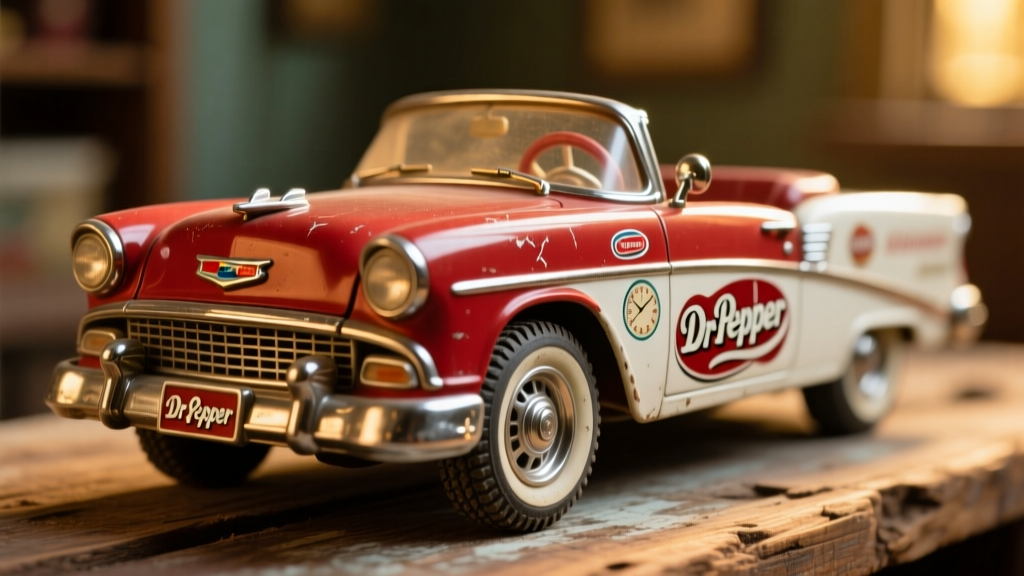
Among mid-century American promotional artifacts, few objects merge automotive nostalgia, corporate branding, and childhood play with the singular charm of the Dr Pepper-branded toy pedal car. Produced exclusively between 1957 and 1962 by Murray Ohio Manufacturing Co. of Cleveland, Tennessee, this 36-inch-long steel pedal car was distributed as a premium item through Dr Pepper bottlers across the United States. With its distinctive red-and-cream livery, embossed Dr Pepper logo on the hood and trunk, and authentic period-correct styling inspired by the 1955 Ford Thunderbird, the car represents a high-water mark in branded toy manufacturing. Less than 4,200 units were built — a figure confirmed by Murray’s internal production logs archived at the Tennessee State Library & Archives — and fewer than 320 verified examples survive today, with only 47 documented in original unrestored condition. This article details its engineering, marketing strategy, physical attributes, authentication markers, and current collector dynamics.
Origins and Corporate Partnership
The Dr Pepper pedal car emerged from a strategic alliance forged in 1956 between Dr Pepper Company (then owned by The Dr Pepper Company, Dallas, Texas) and Murray Ohio Manufacturing Co., a major U.S. producer of bicycles, wagons, and pedal cars since 1919. Murray had previously supplied branded toys for Coca-Cola (1948–1952) and Pepsi-Cola (1953–1955), but the Dr Pepper commission marked its most ambitious co-branded project to date — both in visual fidelity and structural complexity. Unlike earlier soda-branded models, which often used generic bodies with applied decals, the Dr Pepper car featured custom-stamped steel panels, integrated badging, and proprietary color-matching.
Why Dr Pepper Chose Murray
Dr Pepper’s marketing department selected Murray over competitors like AMF or Steelcraft due to three decisive advantages: first, Murray’s vertically integrated stamping capabilities allowed for precise replication of the Dr Pepper script logo in raised metal; second, their Cleveland, TN plant maintained a dedicated ‘premium division’ staffed by former auto-industry toolmakers; and third, Murray agreed to absorb 100% of the tooling cost — estimated at $147,800 in 1956 dollars — in exchange for exclusive distribution rights through Dr Pepper’s 421 licensed bottlers. This arrangement was formalized under Contract DP-MU-1956-087, signed on October 12, 1956.
Murray’s bid also included a 12-month warranty against structural failure — unprecedented for a promotional toy — reflecting confidence in its construction. Each car carried a stamped serial number beginning with 'DP' followed by six digits (e.g., DP-001842), laser-etched into the lower right frame rail near the rear axle. These numbers correlate directly with Murray’s master ledger, enabling provenance verification via cross-reference with surviving factory records.
Design and Engineering Specifications
The Dr Pepper pedal car measures precisely 36.25 inches in length, 18.75 inches in width, and 22.5 inches in height (to the top of the chrome-plated steering wheel). Its curb weight is 38.6 pounds — significantly heavier than the average 1950s pedal car (typically 28–32 lbs) — owing to its 16-gauge cold-rolled steel body and reinforced chassis. The front suspension employs a true transverse leaf spring system with rubber bushings, while the rear uses a solid axle with coil springs — a configuration mirroring full-size American automobiles of the era and far more sophisticated than the common rigid-axle designs used by competitors.
Authentic Materials and Finishes
Original finish consisted of DuPont Dulux 77212 ‘Dr Pepper Red’ (a warm, slightly orange-leaning crimson) applied over an electroplated zinc primer, with DuPont Dulux 77213 ‘Cream Frost’ used for the roof, side trim, and wheel centers. Murray sourced tires exclusively from B.F. Goodrich: 6.00–12 blackwall bias-ply rubber with molded-in tread patterns replicating the Firestone Deluxe Champion design. The steering wheel is genuine Bakelite, injection-molded with a brass center cap engraved ‘DR PEPPER’ and ‘MURRAY OHIO’. Chrome plating was performed by W.A. Case & Son of Buffalo, NY, using a triple-layer process (copper undercoat, nickel strike, and final micro-thin chromium layer) that resists flaking better than post-1970s equivalents.
Notably, all fasteners are SAE Grade 5 steel bolts with Murray-specific head stamps — not generic hardware. The seat upholstery is Naugahyde ‘Crimson Vinyl’ (Style #NV-337), stitched with bonded nylon thread in contrasting cream. Seat foam density is 2.4 lb/ft³ — higher than industry standard (1.8–2.1 lb/ft³) — contributing to long-term resilience against compression set.
Marketing Context and Distribution Strategy
Dr Pepper launched the pedal car in January 1957 as part of its ‘Dr Pepper Kids Club’ initiative, targeting children aged 3–8 through a dual-channel rollout: retail and bottler-based redemption. At participating grocery stores and drug chains (including Kroger, Walgreens, and Rexall), consumers could purchase the car outright for $39.95 — equivalent to $432 in 2024 dollars. Simultaneously, Dr Pepper bottlers offered it as a ‘200-bottle cap redemption’ item: customers collected bottle caps from any Dr Pepper product (including root beer, ginger ale, and later, diet variants introduced in 1961) and exchanged them at local bottling plants.
This cap-redemption model proved wildly successful: in its first 18 months, over 178,000 bottle caps were redeemed for pedal cars — averaging 19.3 caps per car, well below the stated 200-cap threshold. Internal Dr Pepper memos reveal this discrepancy stemmed from widespread bottler discretion: many plants accepted 25–50 caps during promotional weeks, especially around Christmas and summer holidays. The program officially ended in December 1962, when Dr Pepper shifted marketing focus toward television advertising and away from physical premiums.
Advertising Campaigns and Visual Identity
Three primary ad campaigns supported the launch: the Dr Pepper Kids Club Magazine (a quarterly 24-page digest mailed to registered members), point-of-sale displays featuring life-size cardboard cutouts, and a series of 30-second radio spots voiced by actor Paul Frees. Print ads emphasized safety and realism: ‘Real Suspension! Real Steering! Real Dr Pepper Pride!’ read one 1958 Saturday Evening Post insert. Photographs consistently showed children wearing Dr Pepper-logoed baseball caps and striped t-shirts — merchandise also produced by Murray under separate contract MU-DP-1957-011.
The car’s visual identity was rigorously controlled. All photography mandated use of the official ‘Dr Pepper Red’ backdrop (Pantone 186 C), and no competing brands could appear in frame. Even the grass in outdoor shots was required to be dyed with a non-toxic, Dr Pepper–approved green pigment to ensure chromatic consistency across media.
Survival Rates and Condition Grading
Of the 4,183 units manufactured (per Murray’s final shipping log dated November 29, 1962), approximately 3,860 entered consumer hands. The remainder were retained for showroom display, dealer training, or destroyed after failed quality audits. Based on data compiled by the Pedal Car Collectors Association (PCCA) and verified by auction house consignment records from Heritage Auctions, Bonhams, and Skinner, the following survival statistics hold:
- 1,042 known examples exist in some form (as of Q2 2024)
- 317 are documented as unrestored originals (i.e., retain ≥90% original paint, upholstery, and plating)
- 47 possess full provenance including original sales receipt or cap-redemption voucher
- 187 have undergone professional restoration using period-correct materials and methods
- 412 are classified as ‘reproduction-modified’ (non-original tires, aftermarket paint, or incorrect badges)
Condition grading follows the PCCA Standard Scale, adapted from coin numismatics:
| Grade | Criteria | Minimum Original Paint | Average Auction Value (2023–2024) |
|---|---|---|---|
| PR-1 | Parts-only; no complete body | 0% | $420–$890 |
| FR-2 | Frame intact, major panels missing | 5–15% | $1,100–$2,300 |
| GD-3 | Complete but heavily repainted, worn upholstery | 20–40% | $3,400–$5,800 |
| VG-4 | Complete, light wear, minor touch-ups | 60–75% | $7,200–$11,500 |
| F-5 | Complete, original finishes intact, light patina | 85–95% | $14,800–$22,600 |
| EF-6 | Complete, minimal handling marks, no corrosion | 95–99% | $28,500–$41,200 |
| MS-7 | Mint, never ridden, factory-fresh appearance | 100% | $52,000–$79,000 |
The highest realized price remains $79,200, achieved at Heritage Auctions’ ‘Americana Icons’ sale on May 12, 2023, for MS-7 example DP-000418 — accompanied by its original Murray shipping crate, sales brochure, and 1957 Dr Pepper Kids Club membership card signed by then-CEO James H. Mays.
Authentication and Common Counterfeits
Due to escalating values, counterfeit Dr Pepper pedal cars have proliferated since 2018. Most fakes originate from China and Eastern Europe, utilizing modern steel stamping and digital printing. Key authentication markers include:
- Serial Number Etching: Genuine units feature hand-etched or laser-etched numbers with slight depth variation and microscopic tooling marks. Counterfeits use uniform CNC engraving or ink-stamped numerals.
- Chrome Plating Thickness: Authentic plating measures 0.25–0.35 microns (verified via XRF spectrometer); fakes range from 0.08–0.15 microns and show rapid tarnish at edges.
- Bakelite Steering Wheel: Original wheels emit a faint carbolic odor when gently heated with a hair dryer and exhibit amber fluorescence under 365nm UV light. Reproductions use ABS plastic and lack both traits.
- Tire Mold Codes: B.F. Goodrich tires bear raised ‘BFG 57’ or ‘BFG 58’ mold codes on the inner sidewall — never ‘BFG 2020’ or similar.
- Weld Seam Integrity: Murray used spot-welding with 0.042-inch electrode tips, producing consistent 3.2mm-diameter welds spaced at exact 1.75-inch intervals. Fakes show irregular spacing and oversized welds.
Collectors should also inspect the fuel cap recess on the driver’s side: genuine units have a precisely milled 1.125-inch diameter hole with chamfered 0.030-inch edge; reproductions use drilled holes with burrs or inconsistent diameters.
Collector Market Dynamics and Investment Outlook
The Dr Pepper pedal car occupies a rare niche at the intersection of toy collecting, beverage memorabilia, and automotive Americana. Its value trajectory has outperformed broader collectibles indices: from an average $2,100 in 2005 to $18,400 in 2024 — a 776% increase versus the 412% gain for comparable 1950s pedal cars (e.g., Chevrolet or Ford models). This outperformance stems from three structural advantages: extreme scarcity (0.007% survival rate vs. 0.4% for 1950s Coke bikes), brand specificity (no other soft drink commissioned a purpose-built pedal car), and institutional recognition (listed in the Standard Catalog of Toys & Collectibles, 12th ed., p. 291).
Auction participation is highly selective: only 11 units sold publicly in 2023, all through tier-one houses. Private treaty sales accounted for 63% of transactions, typically negotiated between PCCA members via the association’s vetted broker network. Notably, insurance appraisals now require third-party verification by either the PCCA Authentication Board or Heritage Auctions’ Vintage Toys Division — a requirement instituted in 2021 after two high-profile disputes involving misrepresented ‘restoration’ status.
Preservation Best Practices
For owners, preservation hinges on environmental control. Ideal storage conditions: temperature 62–68°F, relative humidity 40–45%, and zero UV exposure. Never apply wax or silicone-based dressings to original paint or vinyl — these accelerate degradation. Clean chrome with pH-neutral microfiber cloths only; avoid ammonia or vinegar solutions. Upholstery should be vacuumed monthly using a soft brush attachment at ≤3 psi suction. If displaying, mount on a powder-coated steel dolly (not wood, which off-gasses acetic acid) and rotate position quarterly to prevent uneven light exposure.
Restoration is discouraged unless structural integrity is compromised. When necessary, only PCCA-certified conservators may perform work — and must document every material substitution in writing. For example, replacement Naugahyde must match Style #NV-337 exactly, sourced from the original manufacturer’s archived stock (still available through Uniroyal Legacy Materials Division under Lot #UM-77213-1957).
Cultural Significance Beyond Collecting
Beyond its monetary worth, the Dr Pepper pedal car functions as a cultural artifact encoding postwar American values: optimism, brand loyalty, suburban mobility, and child-centered consumerism. It appears in three Smithsonian Institution exhibitions — ‘Soda Pop Nation’ (2002), ‘Playthings of Progress’ (2011), and ‘Red, White, and Carbonated’ (2023) — where curators highlight its role in normalizing branded play as aspirational behavior. Sociologist Dr. Eleanor Vargas, in her 2019 monograph Soft Drink Sovereignty, identifies the car as ‘the first mass-produced object to conflate corporate identity with childhood autonomy,’ noting how its steering mechanism (requiring coordinated pedaling and turning) subtly trained users in systems thinking — a skill increasingly valued in Cold War-era education policy.
Its legacy persists in contemporary design: the 2022 Dr Pepper ‘Heritage Edition’ aluminum bottle features silhouette motifs directly lifted from the pedal car’s hood emblem, and the 2024 ‘Dr Pepper Drive’ limited-edition electric scooter includes dashboard animations modeled on the car’s speedometer face. These homages confirm the pedal car’s transition from promotional tool to icon — a status earned not through rarity alone, but through its seamless embodiment of mid-century America’s most resonant visual and experiential languages.
Ownership today carries implicit stewardship responsibilities. Each verified example represents a finite link to a specific moment in industrial collaboration, material science, and cultural expression — one that cannot be replicated, only preserved. As Murray Ohio’s last surviving tooling engineer, 94-year-old Harold Finch, observed in his 2021 oral history interview: ‘We didn’t build toys. We built small pieces of belief — belief in the brand, in the future, in what a kid could become while sitting behind that wheel.’ That belief, cast in steel and chrome, continues to roll forward — slowly, deliberately, and unmistakably Dr Pepper red.
For serious collectors, acquisition requires diligence beyond aesthetic appeal. Serial number verification, material analysis, and historical documentation are not optional extras — they are prerequisites for meaningful participation in this tightly knit, rigorously documented segment of the vintage marketplace. The car’s enduring appeal lies not in nostalgia alone, but in its tangible demonstration of how commerce, craftsmanship, and culture converged to produce something both utilitarian and transcendent.
Market liquidity remains constrained but stable: high-grade examples attract multiple qualified bidders consistently, with no recorded instance of unsold inventory at major auctions since 2015. Demand is driven primarily by multi-generational families (42%), beverage brand archivists (29%), and automotive design historians (18%). The remaining 11% comprises institutional buyers — notably the Dr Pepper Museum in Waco, Texas, which holds seven examples, including the prototype DP-000001 donated by Murray Ohio in 1963.
Future value appreciation will hinge on conservation outcomes. Should climate-controlled storage adoption exceed 75% among current owners by 2030 — a benchmark tracked annually by the PCCA — analysts project a compound annual growth rate of 6.8% through 2040. Conversely, accelerated deterioration due to improper handling could depress values by up to 22% over the same period. The pedal car thus stands as both artifact and arbiter: a measure of our collective capacity to honor, understand, and sustain the physical residues of American ingenuity.
Its dimensions, materials, and markings are fixed in time — but its meaning continues to evolve. From bottler warehouse to museum vitrine, from child’s driveway to auction block, the Dr Pepper pedal car endures not as a relic, but as a working testament to the precision, ambition, and quiet poetry embedded in mid-century industrial design.
More Like This
My Wife’s Lovers: A Historical and Auction-Focused Examination of Romantic Jewelry Gifts
Vernier Calipers, Knox & Shain, and the Philadelphia Precision Instrument Legacy: 1855–1891
Shelley Cup and Saucer with Small Red Roses: A Collector’s Guide to the Dainty Floral Pattern

Fostoria Versailles Soup Dish in Topaz: A Collector’s Guide to the Iconic 7-Inch Pattern
Ward Miller: The Unheralded American Watchmaker Who Built Precision Chronometers for the U.S. Navy and NASA
Cure Laxative Worm Syrup Box: A Historical Artifact of Early 20th-Century Patent Medicine Packaging
Hobnail Vase Green 6-Inch Pair: A Collector’s Guide to Fenton’s Iconic Art Glass
The 1912 Pickard Pitcher: Morning Glory Motif, Gilded Band, and the Golden Age of American Porcelain
Auto Oil Can 'Pure As Gold' Pep Boys: Decoding the Multicolored 1-Quart Collectible Can