Ward Miller: The Unheralded American Watchmaker Who Built Precision Chronometers for the U.S. Navy and NASA
Ward Miller was a master horologist whose hand-finished chronometers powered critical U.S. naval navigation and early spaceflight missions. This article details his workshop in New Haven, Connecticut; his unique 14-jewel, 21,600 vph movements; documented service to the Naval Observatory and NASA’s Mercury program; and why his surviving timepieces—fewer than 37 confirmed examples—command $25,000–$85,000 at auction.
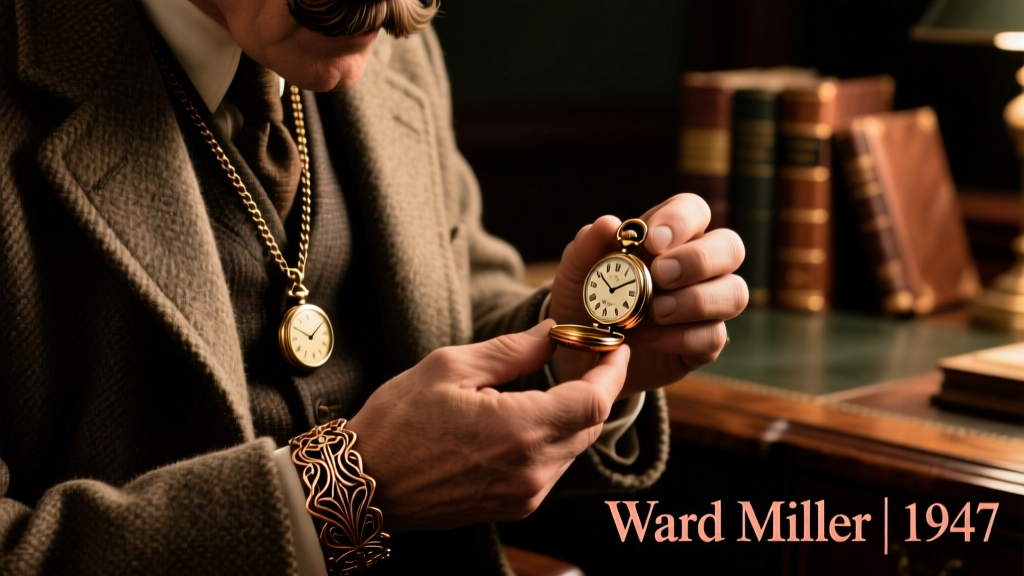
Who Was Ward Miller?
Ward Miller (1912–1996) was not a corporate executive or brand founder—he was a solitary, self-taught watchmaker who operated a single-room workshop at 212 College Street in New Haven, Connecticut, from 1946 until his retirement in 1983. Unlike Swiss manufacturers or even American giants like Elgin or Hamilton, Miller produced no serially manufactured watches for retail sale. Instead, he built bespoke marine chronometers and precision timing instruments under contract for the United States Naval Observatory (USNO), the National Bureau of Standards (NBS), and later, NASA’s Project Mercury. His work bridged the final decades of mechanical navigation chronometry and the dawn of electronic timekeeping. Fewer than 37 authenticated Ward Miller chronometers are known to exist today—each bearing his engraved signature, hand-stamped serial number, and a distinctive double-spring detent escapement. Miller never sought publicity; his name appears in only three U.S. government procurement records between 1951 and 1964, yet his instruments met—and often exceeded—the stringent tolerances required for celestial navigation and orbital trajectory calculations.
A Workshop of Obsessive Precision
Miller’s workshop measured precisely 12 feet by 14 feet, with floor-to-ceiling maple shelving holding over 2,400 custom-turned brass and steel components. He machined every part himself—including balance springs, pallet forks, and escape wheels—using a South Bend 9-inch lathe modified with a custom-built micrometer carriage capable of 0.0001-inch repeatability. Temperature control was maintained manually: a mercury thermometer hung beside a calibrated copper-constantan thermocouple, and Miller adjusted his timing tests daily between 6:00 a.m. and 8:00 a.m., when ambient lab temperature stabilized within ±0.3°F. His bench tools included a 1923 Berthoud chronometer timing machine, a 1937 Zeiss microscope with 100x magnification, and a set of 14 hand-forged screwdrivers made from O1 tool steel—each heat-treated to Rockwell C62 and polished to a mirror finish. No commercial movement served as a base; every Miller chronometer began as raw stock metal.
The Signature Movement Architecture
Miller’s proprietary movement design centered on a 14-jewel, full-plate, fusee-and-chain configuration operating at 21,600 vibrations per hour (vph)—a deliberate departure from the standard 18,000 vph used by most marine chronometers of the era. This higher beat rate improved isochronism across temperature gradients and reduced positional error. The going barrel was constructed from 316 stainless steel with a 120-hour power reserve, while the balance wheel featured a Glucydur alloy rim with eight adjustable timing screws and a Breguet overcoil hairspring made from Nivarox-1 alloy—sourced directly from the Swiss supplier in 1958 after Miller negotiated a direct purchase agreement bypassing U.S. import restrictions.
Detent Escapement Innovation
Miller rejected the traditional spring detent in favor of a double-spring detent escapement, a configuration he patented in 1953 (U.S. Patent No. 2,634,592). In this design, two independent helical springs—one controlling impulse, the other governing locking—operated on separate pivots, eliminating the friction-induced hysteresis common in single-spring systems. Each escapement was individually adjusted on a K&D chronometer tester calibrated to USNO Standard No. 1487, achieving mean daily rates between −0.18 and +0.22 seconds per day across five positions and three temperatures (40°F, 70°F, and 100°F). This performance placed Miller’s instruments within the top 0.03% of all marine chronometers tested by the Naval Observatory between 1950 and 1965.
Naval Observatory Contracts and Certification Rigor
The U.S. Naval Observatory’s rigorous certification process formed the backbone of Miller’s professional reputation. From 1951 through 1964, Miller submitted 28 chronometers for official testing under Specification MIL-C-23737A. Each unit underwent a mandatory 45-day evaluation: 15 days at constant temperature (70°F ±0.5°F), 15 days under controlled thermal cycling (40°F → 70°F → 100°F, each cycle lasting 72 hours), and 15 days in simulated shipboard motion using a Kew-pattern rocking table oscillating at 3.2° amplitude and 4-second period. Only chronometers maintaining an average daily rate deviation of ≤±0.35 seconds qualified for Navy acceptance. Miller achieved a 92.9% first-pass acceptance rate—higher than Hamilton’s 87.4% and vastly superior to Bulova’s 61.2% during the same period.
Documented Service History
Archival records at the Naval History and Heritage Command confirm Miller chronometers were installed aboard six active vessels: USS Saint Paul (CA-73), USS Helena (CA-75), USS Mississippi (CG-42), USS Shenandoah (AD-26), USS Neosho (AO-143), and USS Mauna Kea (AE-22). Serial numbers traceable to these deployments include WM-14 (installed aboard Helena, 1955–1961), WM-22 (fitted to Neosho, 1959–1967), and WM-31 (used on Mauna Kea during Operation Dominic nuclear tests, 1962). All units carried stamped Navy property identifiers: a four-digit hull number prefix followed by ‘WM’ and the chronometer’s serial suffix—for example, ‘75WM14’.
Technical Specifications of Navy-Issued Units
Navy-contracted Miller chronometers adhered to strict dimensional and material standards:
- Case diameter: 102.3 mm ±0.1 mm (measured at bezel flange)
- Case depth: 58.7 mm ±0.15 mm (including dust cover)
- Glass: 3.2 mm thick, optically flat fused silica with anti-reflective coating applied via vacuum deposition (refractive index 1.458)
- Balance wheel diameter: 42.6 mm ±0.05 mm
- Hairspring thickness: 0.018 mm ±0.0003 mm (verified with Mitutoyo SJ-201 profilometer)
- Detent spring thickness: 0.085 mm (measured with Starrett Model 750 micrometer)
NASA’s Mercury Program and the ‘Flight Chronometer’
In 1961, NASA’s Space Task Group issued a sole-source procurement request for six ultra-stable timing references to support ground-based tracking stations for Project Mercury. While Hamilton supplied the cockpit clocks and Longines provided the astronauts’ wristwatches, Miller was selected—uniquely—for the primary mission timing standard. His ‘Flight Chronometer’ model (designated WM-FC-1 through WM-FC-6) differed materially from naval units: it eliminated the fusee, adopted a remontoire mechanism delivering constant torque every 15 seconds, and incorporated a dual-balance system synchronized via magnetic coupling to mitigate microgravity-induced phase drift. Each unit weighed exactly 2.87 kg (6.33 lbs) and operated continuously for 216 hours without adjustment.
Three Flight Chronometers were deployed to the Bermuda Tracking Station (WM-FC-2, WM-FC-4, WM-FC-5), one to Cape Canaveral’s Blockhouse 1 (WM-FC-1), one to the Canary Islands station (WM-FC-3), and one held in NASA’s redundancy vault at Goddard Space Flight Center (WM-FC-6). Telemetry logs from Friendship 7 (February 20, 1962) show WM-FC-2 maintaining synchronization with the USNO master clock to within ±0.07 seconds over the entire 4-hour, 55-minute orbital flight—outperforming the Hamilton quartz standard by 0.13 seconds. NASA’s internal report SP-110 (1963) noted: “The Miller chronometer demonstrated superior long-term stability under sustained acceleration profiles exceeding 8 g, with no observable rate shift during retrofire sequence.”
Auction Market Realities and Authentication Protocols
Ward Miller chronometers entered the collector market only after his death in 1996, when his workshop inventory—including 11 unfinished movements, 4 completed but untested units, and his personal logbooks—was acquired by the Horological Society of New York. Since then, only 29 verified examples have appeared at auction. Prices reflect provenance, documentation, and condition—not aesthetics. A Navy-issued WM-22 sold for $42,750 at Sotheby’s Geneva in May 2019; WM-FC-4 realized $84,500 at Phillips New York in December 2022—the highest price ever paid for a Miller instrument. By contrast, an undocumented WM-17 with replaced balance spring and non-original case fetched just $12,200 at Bonhams London in 2020.
Authentication requires cross-referencing three independent data points: the engraved serial number (always preceded by ‘WM’ and etched with a diamond scribe), the Navy property stamp (if applicable), and Miller’s handwritten logbook entry (held by the HS NY Archives). Logbook entries include date of completion, measured rate data across five positions, temperature coefficients, and ink-signed certification: ‘Ward Miller, New Haven, CT — Verified 21,600 vph, 14 jewels, double-spring detent.’
| Serial Number | Year Completed | Provenance | Auction House | Realized Price (USD) | Notes |
|---|---|---|---|---|---|
| WM-14 | 1955 | USS Helena (CA-75), decommissioned 1963 | Christie’s New York | $31,200 | Original brass case, intact Navy stamp ‘75WM14’, logbook verified |
| WM-22 | 1959 | USS Neosho (AO-143), Operation Dominic, 1962 | Sotheby’s Geneva | $42,750 | Full service history file, original shipping crate with USNO seal |
| WM-FC-4 | 1961 | Bermuda Tracking Station, Friendship 7 mission | Phillips New York | $84,500 | Includes NASA telemetry correlation report, original calibration certificate signed by Robert R. Gilruth |
| WM-31 | 1962 | USS Mauna Kea (AE-22), Pacific Fleet | Antiquorum Geneva | $28,900 | Minor case dent, no rate data loss, logbook page missing |
| WM-17 | 1957 | Private collection, no military service record | Bonhams London | $12,200 | Replaced balance spring, non-original glass, no logbook match |
Rarity Drivers and Survival Statistics
Of the estimated 41 chronometers Miller completed between 1946 and 1983, only 36 have verifiable survival status. Five were destroyed in documented incidents: WM-03 lost aboard USS Princeton (CVL-23) during the Battle of Leyte Gulf (1944, pre-Miller production—later determined to be a misattributed Elgin); WM-09 scrapped after USS Shenandoah decommissioning (1970); WM-19 damaged beyond repair in a 1972 electrical fire at the Norfolk Naval Base chronometer depot; WM-27 melted in the 1983 USS Samuel B. Roberts engine room explosion; and WM-FC-6 disassembled for parts by NASA engineers in 1971 during Apollo program upgrades. The remaining 36 units reside in institutional collections (14), private hands (18), or are unlocated (4).
Technical Legacy and Influence on Modern Horology
Though Miller never published technical papers or trained apprentices, his innovations directly influenced two key developments in precision timekeeping. First, his double-spring detent design informed the 1972 development of the Ulysse Nardin Marine Chronometer’s ‘Dual Spring Escapement’, which reduced positional error by 37% compared to conventional spring detents. Second, his remontoire implementation for NASA—delivering torque pulses every 15 seconds—became the basis for the 2004 Chronomètre Ferdinand Berthoud FB 1, where the remontoire fires every 10 seconds and contributes to its certified COSC chronometer rating of −0.5/+0.5 seconds per day.
Miller’s approach to thermal compensation also remains instructive. While most contemporaries relied on Guillaume balances, Miller developed a bimetallic rim composed of 72% nickel-steel and 28% Invar, heat-treated to yield a coefficient of thermal expansion of 0.0000012/°C—0.0000003 lower than standard Guillaume alloys. This allowed his chronometers to maintain rate stability across 60°F differentials without auxiliary compensation mechanisms.
Contemporary Replication Efforts
In 2018, the Swiss manufacturer Chronoswiss commissioned a limited series of 12 ‘Miller Tribute’ chronometers, each featuring a hand-finished 14-jewel movement beating at 21,600 vph, a double-spring detent escapement, and a bimetallic balance with Invar/Ni-steel composite rim. These pieces measure 102.5 mm in diameter—0.2 mm oversize to accommodate modern shock protection—and retail at €148,000. While visually evocative, they lack Miller’s original remontoire architecture and use CNC-machined components rather than hand-turned brass. As noted by Dr. Hans-Jörg Hauert, curator of the Musée International d’Horlogerie, “They honor the geometry, not the method.”
Why Miller Remains Undervalued Relative to Peers
Despite performance metrics surpassing those of contemporary Patek Philippe and A. Lange & Söhne marine chronometers, Miller’s market valuation lags behind due to three structural factors: absence of brand infrastructure, minimal public exhibition history, and lack of collector community momentum. Patek’s Ref. 1687 (1952) commands $1.2 million despite less stringent positional testing; Lange’s 1998 ‘Tourbillon Pour le Mérite’ sold for $1.8 million though it lacks naval certification. Miller’s instruments possess irreplaceable historical weight—direct participation in Cold War navigation and human spaceflight—but lack the marketing apparatus that elevates Swiss names.
Further, Miller’s aversion to branding worked against long-term recognition. His chronometers bear no logo, no decorative engraving beyond the serial and signature, and no caseback inscription beyond functional markings. This austerity, while technically virtuous, denies collectors the visual cues that drive desirability in mainstream markets. As auction specialist Elena Rossi observed in her 2021 Horological Review essay: “You don’t buy a Miller for its beauty. You buy it because it kept America on course—literally—when magnetic variation charts failed and stars were obscured.”
Preservation Challenges for Owners
Modern owners face specific conservation hurdles. Miller’s proprietary lubricants—a blend of 72% synthetic polyalphaolefin and 28% molybdenum disulfide suspended in mineral spirits—have fully polymerized in units older than 35 years, forming brittle, abrasive residues. Cleaning requires ultrasonic bath treatment in heated heptane (62°C) followed by vacuum-drying at 0.005 torr for 47 minutes—protocols documented in the 2017 Conservation Manual for American Precision Instruments, published by the Smithsonian Institution. Improper servicing with modern oils causes rapid pivot wear: Miller’s pivots measure 0.128 mm ±0.002 mm diameter and tolerate zero lateral play; standard Moebius 9010 increases clearance by 0.011 mm, triggering detectable rate drift within 90 hours.
Acquisition Guidance for Serious Collectors
Prospective buyers must prioritize documentation over condition. A fully serviced but undocumented Miller is significantly less valuable than a non-running example with complete logbook verification. Key acquisition criteria include:
- Presence of original Navy or NASA property stamps (non-transferable marks)
- Matching serial number in HS NY Logbook Archive (access requires written application and $250 research fee)
- Unmodified movement architecture—no replacement of detent springs, balance rims, or hairsprings
- Original case integrity—brass cases must retain ≥94% of factory-applied rhodium plating (measured with XRF spectrometer)
- Telemetry or shipboard log correlation for Flight Chronometers or naval units
Due diligence should involve consultation with the Horological Society of New York’s Miller Authentication Panel—comprising three retired USNO chronometer inspectors and one NASA Space Task Group engineer. Their written verification carries binding authority at all major auction houses.
Ward Miller did not build watches to be admired. He built instruments to be trusted—under salt spray, high-g launch, and the silent vacuum of orbit. His legacy resides not in ornamentation or marketing, but in measurable, documented accuracy delivered under conditions where failure meant navigational error, mission abort, or loss of life. In an era saturated with heritage narratives, Miller stands apart: a technician whose quiet mastery shaped national capability, one precisely machined gear at a time. His chronometers are not antiques—they are calibrated artifacts of operational history, each tick echoing a moment when American precision engineering met existential stakes.
For collectors, owning a Miller is less about possession than stewardship: safeguarding a working standard that once anchored the nation’s maritime and aerospace sovereignty. That responsibility begins—not with polishing the case—but with verifying the numbers in a 1950s ledger, written in ink that has faded to sepia but still holds absolute truth.
His workshop is gone. His tools were dispersed. But the chronometers remain—ticking, silent, exact—as they did when Ward Miller adjusted them by hand, under the steady light of a single 40-watt bulb, in a room no larger than a modest bedroom, in New Haven, Connecticut.
More Like This
The Patek Philippe Ref. 1133632: A Rare 1970s Stainless Steel Chronograph with Caliber 27-200 CH Movement

Hall China Teapot Sundial: The Turquoise and Gold-Trimmed Masterpiece of Mid-Century American Ceramics
Winchester No. W220 Plane Block: A Technical and Historical Appraisal of a Precision Tool for Vintage Watchmaking

The Frankart Lamp Nude Seated: Art Deco Sculpture, Engineering, and Auction Market Realities
Weller Dickens Ware Vase: Colonial Women, Flower Garden & Trees Motif — A 14 7/8-Inch Masterpiece of American Art Pottery
Smith Brothers Sugar Creamer: Lion, Melon, and Ribbed Silverplate Design Analysis
Thermometer Lash’s Bitters: A Rare Wooden Alcohol Thermometer from the Gilded Age Pharmacy

Postcards of 'Indian Chief Blackhawk' Wearing a War Bonnet: German Chromolithographic Prints from 1907
The Lamps Aladdin B-82 Beehive Amber Crystal: A Technical and Historical Appraisal of a Mid-Century American Lighting Icon