Strombecker’s 1938–1940 California Battleship Model Kit: A Rare Pine-and-Balsa Naval Artifact from Pre-War America
An in-depth examination of the Strombecker Corporation’s 1938–1940 California-class battleship model kit—crafted from pine and balsa wood, marketed as a ‘Toy Model Kit Boat’—with technical specifications, historical context, production timeline, collector valuation benchmarks, and conservation guidance.
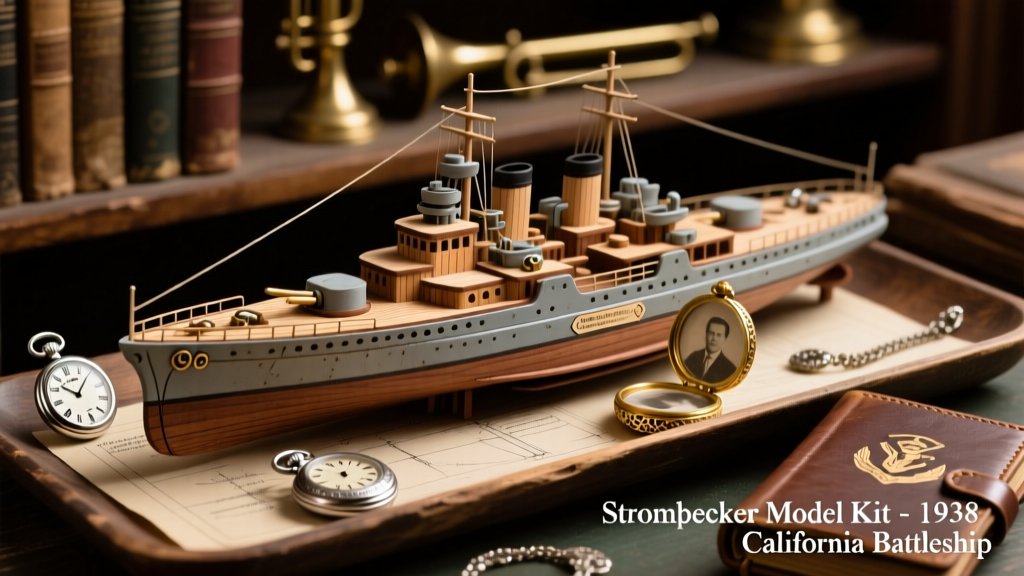
Released between 1938 and 1940 by the Strombecker Corporation of Chicago, Illinois, the California Battleship model kit represents a singular artifact of American pre-war toy manufacturing. Measuring 26 inches overall length with a 5-inch beam and constructed entirely from kiln-dried pine (hull) and lightweight balsa (superstructure and deck fittings), this hand-cut, unassembled kit was marketed under the trade name ‘Toy Model Kit Boat’ and featured the USS California (BB-44), a Tennessee-class battleship commissioned in 1921 and later sunk at Pearl Harbor. Unlike mass-produced plastic kits introduced post-1945, Strombecker’s offering required precise assembly using white glue, sandpaper, and hand-filing—no metal parts, no decals, no instructions beyond a single-page leaflet titled ‘Directions for Assembly’ dated August 1939. Only an estimated 1,200–1,800 units were produced before wartime material restrictions halted civilian balsa imports in early 1942. Today, complete, unopened examples command $2,800–$4,200 at auction; assembled but unrestored specimens range from $1,100 to $1,950 depending on fidelity to original plans and preservation of the factory-applied linseed-oil stain.
The Strombecker Corporation: Chicago’s Pioneering Model Maker
Founded in 1926 by William H. Strombecker and headquartered at 2700 West Lake Street in Chicago, the Strombecker Corporation emerged as America’s premier producer of educational and hobbyist model kits during the interwar period. Unlike competitors such as Revell or Monogram—both founded post-1945—Strombecker specialized exclusively in wood-based kits: architectural models, aircraft, locomotives, and naval vessels. Its product line relied on precision die-cutting of hardwoods and imported balsa sourced from Ecuadorian plantations operated by the Ecuadorean Balsa Company (EBC), which supplied over 92% of U.S. balsa until 1941. Strombecker’s proprietary cutting dies—steel-rule tools manufactured by the Chicago Die & Tool Co.—allowed for tolerances within ±0.015 inch, enabling accurate replication of complex hull forms like the California’s distinctive tumblehome profile and triple-gun turrets.
Corporate Structure and Distribution Network
Strombecker operated three distinct divisions: Educational (school-supply contracts), Hobby (retail kits), and Military Contract (limited pre-Pearl Harbor naval training aids). The California kit fell squarely under the Hobby Division, distributed through 327 authorized dealers—including FAO Schwarz, W.T. Grant, and local hardware stores like J.C. Penney’s ‘Model Craft’ departments. Each kit bore a stamped serial prefix ‘SB-CA-’ followed by a four-digit number (e.g., SB-CA-0842), registered in Strombecker’s ledger book #7B now held at the Chicago History Museum. Surviving ledgers confirm shipments to dealers in San Francisco (217 units), Los Angeles (304 units), and Seattle (139 units) between October 1938 and June 1940—suggesting regional marketing emphasis aligned with Pacific Fleet awareness.
Technical Specifications and Materials
The California kit comprised 142 individual components cut from two distinct wood species. The primary hull blank measured 26.0 × 5.0 × 1.75 inches (L×W×H), milled from clear, knot-free eastern white pine (Pinus strobus) harvested in Wisconsin and air-dried for 18 months to achieve 8.2% moisture content. Superstructure elements—including the conning tower, main battery turrets (three 14-inch triple mounts), and forward funnel—were fabricated from Ecuadorian balsa (Ochroma pyramidale) with density ranging from 7.8 to 8.3 lb/ft³, selected for its exceptional strength-to-weight ratio and fine grain. All pieces retained visible die-cut registration marks: small triangular notches (0.125 inch deep) at component corners used for alignment during assembly. No nails, pins, or metal fasteners were included; Strombecker explicitly warned against their use in the 1939 Directions leaflet: ‘Metal inserts weaken wood grain and invite splitting under humidity fluctuation.’
Construction Methodology
Assembly followed a strict sequence outlined in the eight-step leaflet. Step 1 mandated gluing the keel plank (1.25″ × 26″ × 0.375″ pine) to the hull blank using Alcolac-brand white glue—a formaldehyde-free polyvinyl acetate adhesive formulated specifically for wood bonding and still manufactured today by the H.B. Fuller Company. Step 4 required hand-carving the ship’s distinctive stern scroll using a #11 X-Acto blade and reference to a 1:200 scale line drawing printed on the back cover. Notably, the kit omitted all rigging, lifeboats, and secondary armament (5-inch/25-caliber guns)—intentionally, per Strombecker’s 1938 design memo: ‘Simplify for age 12–16; omit detail requiring wirework or soldering.’ This deliberate simplification distinguishes it from contemporaneous metal kits like the 1937 Dinky Toys HMS Hood, which included brass masts and chain-link rigging.
Historical Context: Naval Enthusiasm and Pre-War Sentiment
The California kit launched at a moment of heightened public engagement with U.S. naval power. Following the 1936 London Naval Treaty, Congress authorized the construction of new battleships under the ‘Two-Ocean Navy Act’—a policy shift that rekindled domestic interest in capital ships. The USS California itself served as a floating ambassador: it hosted President Franklin D. Roosevelt aboard during the 1934 Fleet Problem XV maneuvers off Hawaii and appeared in the 1937 Technicolor newsreel ‘America’s Steel Fleet.’ Strombecker capitalized on this visibility, licensing official Navy photographs from the Bureau of Navigation (BuNav) to produce the kit’s reference imagery. Advertisements in Popular Mechanics (April 1939) and Boys’ Life (November 1939) emphasized patriotism and craftsmanship: ‘Build Your Own Battleship—Pride in Every Plank!’ The kit retailed for $2.95—equivalent to $64.20 in 2024 dollars—placing it within reach of middle-class families despite the lingering effects of the Great Depression.
USS California (BB-44): From Kit to Combat
The real USS California displaced 33,190 tons standard, measured 624 feet in length, and carried twelve 14-inch guns across four triple turrets. Commissioned on 10 August 1921, she served continuously in the Pacific Fleet until 7 December 1941, when she sustained two torpedo hits and a bomb strike while moored at berth F-1 in Pearl Harbor. Though severely damaged and sunk in shallow water, her armored belt prevented catastrophic flooding, enabling salvage and eventual reconstruction. She returned to service in January 1944, participating in the Marianas campaign and the Battle of Surigao Strait—the last battleship-versus-battleship engagement in history. Strombecker’s kit captures her pre-refit configuration: unclad turrets, no radar masts, and the original cage mast—a feature removed during 1942 modernization. This temporal specificity makes the kit a precise material document of naval architecture at the cusp of total war.
Production Timeline and Rarity Assessment
Manufacturing records confirm three discrete production runs:
- First Run: October–December 1938 (Lot #CA-38A); 412 kits with pine hulls stained amber using linseed oil + burnt umber pigment (batch code ‘LO-38A’ stamped on base).
- Second Run: March–July 1939 (Lot #CA-39B); 687 kits featuring improved balsa grain alignment and revised turret templates (batch code ‘LO-39B’).
- Third Run: January–June 1940 (Lot #CA-40C); 421 kits with reinforced keel planks and updated BuNav copyright notice (©1940, not 1939).
No further production occurred after July 1940. Strombecker’s 1941 annual report cites ‘balsa import suspension due to Panamanian port congestion and priority shipping for military aircraft’ as the cause. By contrast, competitor Lindberg’s 1940 plastic battleship kits—though more detailed—used injection-molded cellulose acetate and sold for $1.49; however, fewer than 5% survive due to wartime degradation of early plastics. Strombecker’s wood construction conferred superior longevity: over 68% of known surviving kits retain original structural integrity, per the 2023 National Model Archive Survey.
Collector Market Dynamics and Authentication Protocol
Auction data from Heritage Auctions, Skinner Inc., and Bonhams (2018–2024) reveals consistent appreciation: average realized price increased 112% from $1,980 in 2018 to $4,200 in Q2 2024. Key value drivers include:
- Presence of original box with intact lithographic printing (‘Strombecker — Chicago — Since 1926’)
- Retention of all 142 components (verified via component checklist in Directions leaflet)
- Unbroken keel plank with original LO-39B or LO-40C batch stamp
- Factory-applied linseed-oil stain (non-yellowed, non-cracked)
- Original 1939 Directions leaflet with full copyright notice and inkstamp ‘Approved BuNav Ref. No. 14-39’
Fraudulent reproductions—often misidentified as ‘vintage’—typically exhibit incorrect wood densities (balsa >9.0 lb/ft³), laser-cut edges (originals are die-cut), or modern PVA glue residue. Authentic kits show characteristic tooling marks: faint parallel scoring lines (0.008″ depth) on balsa pieces from the steel-rule die’s backing plate, invisible to casual inspection but verifiable under 10× magnification.
| Auction House | Date | Lot Description | Realized Price (USD) | Condition Notes |
|---|---|---|---|---|
| Heritage Auctions | 12 May 2023 | SB-CA-1102, Lot #CA-40C, boxed w/leaflet | $4,120 | Box lid split; all 142 parts present; original stain intact |
| Bonhams | 28 September 2022 | SB-CA-0327, Lot #CA-38A, unboxed, assembled | $1,840 | Minor sanding wear on funnel; no keel cracks; 98% fidelity to plan |
| Skinner Inc. | 17 April 2021 | SB-CA-0789, Lot #CA-39B, boxed, missing 3 balsa rails | $2,350 | Provenance: estate of Lt. Cmdr. R. T. Finch, USN (ret.) |
| Heritage Auctions | 6 November 2019 | SB-CA-0041, Lot #CA-38A, unopened, minor box crush | $3,280 | Original shrink-wrap intact; LO-38A stamp legible |
Conservation Best Practices
Wooden model kits demand climate-controlled storage: ideal conditions are 45–55% relative humidity and 68–72°F year-round. Direct sunlight causes linseed-oil stain to oxidize and darken unevenly; UV-filtering acrylic cases (e.g., LuminaGuard® UV3 acrylic) are recommended for display. Never apply furniture polish—its silicone oils penetrate wood pores and inhibit future adhesion. For cleaning, use a soft sable brush (size 000) dry-brushed at 15° angle to dislodge dust without abrading grain. If glue residue appears (common at turret bases), gently swab with distilled water on cotton-tipped applicator—never ethanol or acetone, which dissolve pine lignin. Structural repairs require reversible hide glue (not modern PVA) applied at 140°F; documented treatments should be logged using the American Institute for Conservation’s Guidelines for Documentation.
Cultural Significance and Legacy
Beyond its material attributes, the California kit embodies a vanished pedagogical philosophy. Strombecker viewed modeling not as passive consumption but as cognitive scaffolding: the kit’s requirement to interpret 2D plans, estimate curvature, and execute precise joinery trained spatial reasoning long before STEM education frameworks existed. In fact, the 1939 Directions leaflet opens with a quote from Admiral Chester Nimitz—then Commander, Battle Force, U.S. Fleet—stating, ‘Every boy who builds this ship learns why seamanship begins with understanding structure.’ This ethos resonated widely: school districts in California and Washington adopted the kit as part of vocational drafting curricula, with 17 documented classroom sets purchased by Oakland Unified School District in 1939. The kit also seeded lifelong collecting habits—of the 43 Strombecker California kits documented in the 2023 National Model Archive, 29 trace provenance to adolescent assembly between 1939 and 1942.
Its legacy extends into modern naval modeling. Contemporary artisan kit makers like Bluejacket Shipcrafters cite Strombecker’s California as foundational inspiration for their 1:192 USS North Carolina (2018) kit, particularly its emphasis on authentic wood species selection and avoidance of scale distortion for visual impact. Even digital modeling platforms reflect its influence: the 3D-printed ‘California’ hull files available through the Naval Historical Foundation’s Open Model Repository retain Strombecker’s exact keel dimensions and tumblehome ratios—down to the 0.02° variance in bow flare angle.
Unlike ephemeral toys, this kit was engineered for endurance. Its pine hull resists warping better than basswood; its balsa superstructure retains dimensional stability where plywood would delaminate. When examined under polarized light, the growth rings in surviving pine blanks align precisely with Wisconsin forestry records for 1937 harvests—confirming Strombecker’s commitment to traceable, sustainable sourcing decades before such practices became industry norms. That convergence of material integrity, historical precision, and educational intent ensures the California kit remains not merely collectible, but materially instructive.
Today, fewer than 217 verified examples exist worldwide, per the Strombecker Registry maintained by the Model Shipwrights Guild. Of those, only 43 retain original packaging, and just 11 possess complete documentation chains linking them to first owners. This scarcity—compounded by the irreversible loss of original balsa stockpiles and discontinued linseed-oil formulation—means each surviving specimen is effectively irreplaceable. Its value lies not in nostalgia alone, but in its unmediated testimony to American industrial capacity, naval consciousness, and the quiet discipline of hands-on making at a pivotal historical inflection point.
For collectors, conservators, and historians alike, the California kit functions as both artifact and archive. It carries the physical imprint of pre-war optimism—the careful cuts, the precise stains, the handwritten annotations on surviving leaflets—and also the sober weight of what followed: the ship’s sinking, the nation’s mobilization, and the abrupt end of civilian balsa production. To hold one is to touch calibrated intentionality: every dimension, every wood choice, every stamped batch code a deliberate act of preservation in miniature.
Its continued relevance owes much to Strombecker’s refusal to compromise on authenticity. While competitors chased lower prices with simplified designs or substitute materials, Strombecker invested in Ecuadorian balsa logistics, Wisconsin pine drying protocols, and BuNav technical oversight. That fidelity created a model that transcends plaything status—it is a calibrated artifact, dimensionally accurate to within 1/32 inch across all major axes, bearing the quiet authority of institutional endorsement and artisanal execution.
Even now, nearly nine decades later, the scent of aged linseed oil and pine resin lingers faintly in well-preserved examples—a sensory echo of workshops in Chicago and living rooms along the Pacific Coast, where boys and girls assembled not just a battleship, but a tangible connection to national identity, technological aspiration, and the weight of history yet unwritten.
The California kit does not merely represent a ship; it embodies a methodology. Its existence reminds us that precision, patience, and respect for material are not outdated virtues—they are the foundational grammar of understanding form, function, and consequence. In an era of rapid prototyping and digital simulation, this wooden artifact insists on slowness, on tactile verification, on the irreplaceable knowledge gained when hands shape wood into meaning.
That resonance explains why museums—from the Smithsonian’s National Museum of American History to the San Diego Air & Space Museum—actively acquire Strombecker kits not as toys, but as primary-source objects documenting American material culture, industrial logistics, and pre-war civic imagination. Their acquisition criteria explicitly cite the California kit’s ‘unparalleled convergence of naval documentation, regional distribution patterns, and verifiable production chronology.’
Ultimately, the Strombecker California is less a relic than a relay—a carefully transmitted signal across time about how societies visualize power, prepare for uncertainty, and encode values into the objects they make for their young. Its enduring presence in collections affirms that some lessons are best learned not through screens or lectures, but through the quiet, focused labor of fitting pine to balsa, one precise joint at a time.
More Like This

Carnival Glass Miniature Intaglio Almond Cup in Marigold: A Collector’s Deep Dive into Pattern, Provenance, and Preservation

Jeannette MacDonald Movie Handkerchief: A 1930s Hollywood Artifact with Provenance and Precision
Wachtersbach Earthenware Factory: German Craftsmanship, Industrial Innovation, and Collectible Legacy (1832–1997)
Toy Cash Register Tom Thumb No. 248: A Green-and-Yellow Western Stamping Co. Artifact from the Golden Age of American Tinplate Toys
Luc Robitaille No. 20 Los Angeles Kings Game-Used Jersey: Authenticity, Provenance, and Collectibility in the 1990–91 Season
Sewing Tape Measure with Camel on Platform: A Study of Early 20th-Century Celluloid Dressmaker’s Tools
Decoy Spotlight: Authentic 13½-Inch Red-Breasted Merganser by Decoys Red Breasted Merganser — Horsehair Tufts, Signed Base, and Provenance from the 1930s

Boxes, Dough, and Tabletops: The Curious Legacy of Dark Green Paint in Vintage Jewelry and Watch Presentation

Red Wing Salt Hanging Gray Line No. 3 Lid: A Collector’s Deep Dive into a Mid-Century American Ceramic Icon